

More than one in five adults in California lives with a disability, yet many still face unfair treatment at work. Discrimination in the workplace goes beyond outright rejection and often shows up as missed promotions, denied schedule changes, or a refusal to provide even basic accommodations. Recognizing what counts as disability discrimination empowers both employees and employers to respond to these problems and create a truly fair environment.
Table of Contents
- Defining Disability Discrimination In California Workplaces
- Legal Standards For Modified Schedule Requests
- Interactive Process And Employer Responsibilities
- Employee Rights When Modifications Are Denied
- Challenges, Risks, And Legal Outcomes In Tustin
Key Takeaways
| Point | Details |
|---|---|
| Disability Discrimination Definition | Employers must not treat employees unfairly due to current, past, perceived disabilities, or association with someone disabled. |
| Responsibilities for Accommodations | Employers are legally required to engage in an interactive process to determine reasonable accommodations unless it poses undue hardship. |
| Employee Rights | Employees can document denials of accommodation requests and pursue formal complaints if their requests are unreasonably rejected. |
| Risks for Employers | Failure to comply can lead to significant financial consequences, reputational damage, and mandatory policy changes. |
Defining Disability Discrimination in California Workplaces
Disability discrimination represents a serious legal violation where employers treat qualified employees or job applicants unfairly based on their disability status. According to California Civil Rights Department, discrimination occurs when an employer negatively treats an individual because of a current disability, past disability history, perceived disability, or even their association with someone who has a disability.
Workplace disability discrimination can manifest in numerous ways, including denying reasonable work accommodations, refusing to hire, demoting, or terminating an employee due to their disability. Disability Rights California emphasizes that both federal and state laws require employers to provide appropriate accommodations unless doing so would cause significant operational hardship.
Key indicators of disability discrimination include:
- Refusing to modify work schedules or job responsibilities
- Excluding employees from training or advancement opportunities
- Making discriminatory comments about an employee’s disability
- Failing to provide necessary workplace adaptations
Under California law, reasonable accommodations are critical protections for employees with disabilities. These might include ergonomic workstations, flexible scheduling, modified job duties, or additional support tools that enable an employee to perform essential job functions effectively. When employers systematically deny these accommodations without demonstrating genuine undue hardship, they potentially violate state and federal disability discrimination statutes.
Employees experiencing workplace discrimination have legal recourse. By documenting incidents, communicating formally with HR, and understanding their rights, workers can challenge unfair treatment. Disability Discrimination resources can provide additional guidance on navigating these complex workplace challenges.
Legal Standards for Modified Schedule Requests
Modified work schedules represent a critical reasonable accommodation for employees with disabilities under California law. California Department of Justice clearly outlines that the Fair Employment and Housing Act (FEHA) requires employers to provide reasonable accommodations, including flexible scheduling, unless such modifications would impose undue hardship on business operations.
The legal framework for modified schedule requests involves a comprehensive interactive process between employers and employees. According to the Pocket Guide to Disability Discrimination, both FEHA and the Americans with Disabilities Act (ADA) mandate that employers must seriously consider and engage in good-faith discussions about potential workplace accommodations.
Key elements of legally compliant modified schedule requests include:
- Providing clear medical documentation supporting the accommodation need
- Demonstrating that the modified schedule allows essential job functions to be performed
- Showing that the requested modification does not create substantial operational difficulties
- Maintaining open communication with employer about specific disability-related requirements
Employers cannot arbitrarily reject reasonable accommodation requests.
 They must evaluate each request individually, considering factors such as job responsibilities, workplace structure, and the specific limitations presented by an employee’s disability. When employers fail to engage in this interactive process or summarily deny legitimate modification requests, they potentially violate state and federal disability discrimination protections.
Navigating these legal standards requires understanding your rights and documenting all interactions. Workplace Disability Discrimination resources can provide additional guidance for employees seeking fair workplace accommodations.
Interactive Process and Employer Responsibilities
The interactive process is a critical legal requirement in addressing workplace disability accommodations. California Civil Rights Department emphasizes that employers must engage in a timely, good faith dialogue with employees to identify reasonable workplace accommodations that enable individuals with disabilities to perform essential job functions.
Employer responsibilities during this process involve several key components. Disability Rights California highlights that employers must proactively communicate, document discussions, and genuinely explore potential accommodations without automatically dismissing an employee’s requests.
Critical steps in the interactive process include:
- Initiating confidential discussions about accommodation needs
- Requesting and reviewing relevant medical documentation
- Exploring multiple potential workplace modifications
- Evaluating the feasibility of proposed accommodations
- Documenting all communication and decision-making processes
Employers cannot simply go through the motions. They must demonstrate a sincere effort to understand the employee’s specific limitations and find practical solutions. This means considering modifications like flexible scheduling, equipment adjustments, job restructuring, or reassignment when the current role cannot be reasonably adapted.
When employers fail to engage meaningfully or systematically reject accommodation requests without substantive justification, they risk legal consequences.
VIDEO:video_content] Understanding these nuanced responsibilities helps protect both employee rights and organizational compliance. [Workplace Disability Discrimination resources can provide additional insights into navigating these complex interactions.
Employee Rights When Modifications Are Denied
When an employer unreasonably denies workplace accommodation requests, employees have several critical legal protections and recourse options. Disability Rights California advises that workers can take strategic steps to challenge discriminatory practices and protect their employment rights.
Formal complaint procedures represent the primary mechanism for addressing denied accommodations. California Civil Rights Department provides employees with comprehensive channels to formally document and challenge workplace discrimination, including specific processes for filing disability accommodation complaints.
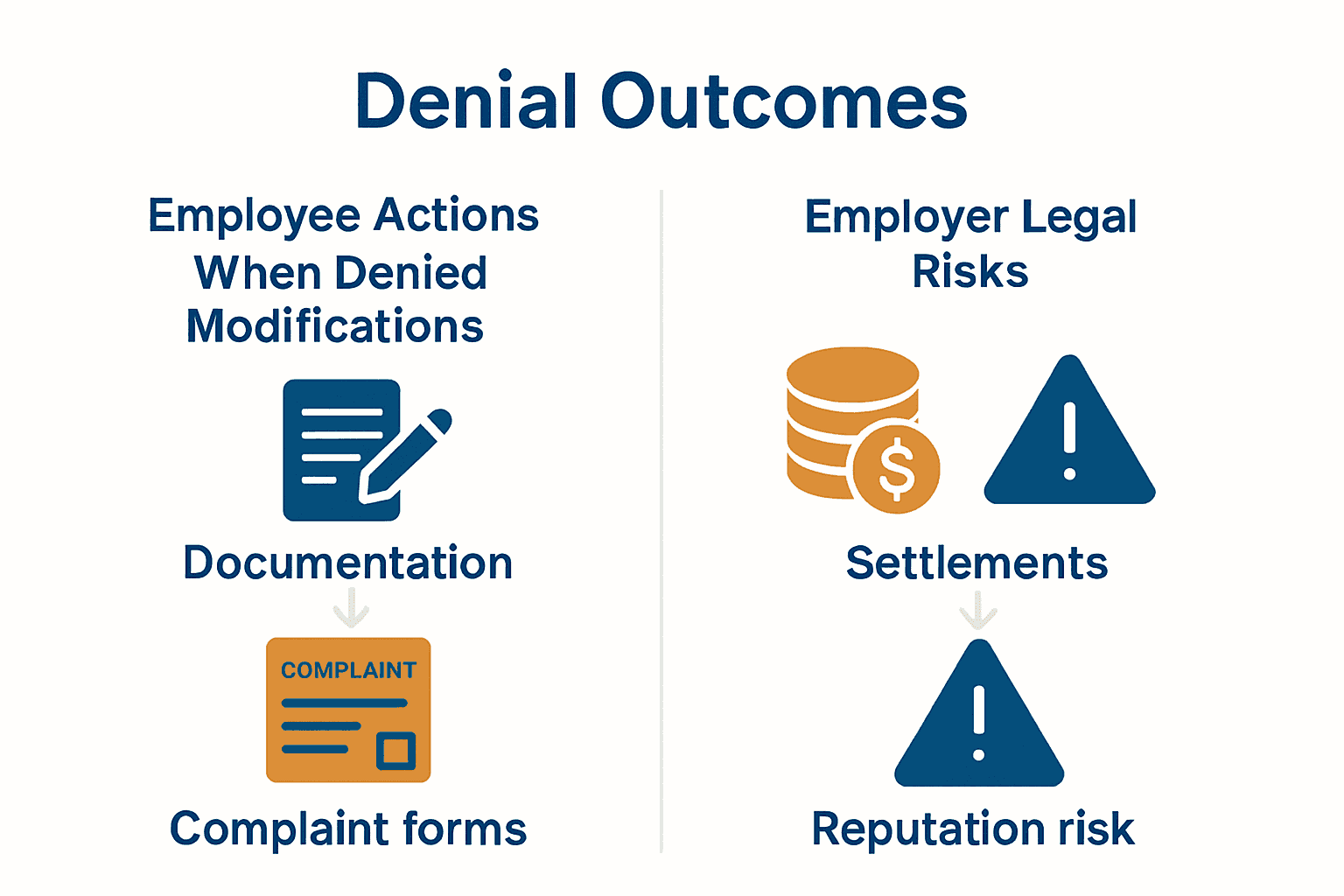
Key actions employees can take when modifications are denied include:
- Documenting all communication regarding accommodation requests
- Gathering supporting medical documentation
- Requesting written explanations for accommodation denials
- Consulting with employment law specialists
- Filing official complaints with state and federal agencies
The complaint process typically involves multiple potential avenues. Employees can file claims with the California Civil Rights Department, the Equal Employment Opportunity Commission (EEOC), or pursue legal action through employment discrimination attorneys. Each route offers different potential remedies, including monetary compensation, workplace policy changes, or reinstatement.
Navigating these complex legal challenges requires careful documentation and strategic planning. Experienced Orange Employment Law Attorneys can provide personalized guidance on protecting your workplace rights and pursuing appropriate legal remedies when accommodation requests are unjustly denied.
Challenges, Risks, and Legal Outcomes in Tustin
Disability discrimination cases in Tustin present complex legal landscapes with significant potential consequences for employers. Reuters recently highlighted the substantial financial risks, exemplified by a $14 million settlement involving a major tech company accused of penalizing employees who took medical leave.
Legal outcomes in disability discrimination cases can be financially and reputationally devastating for local businesses. Pocket Guide to Disability Discrimination emphasizes that employers face multiple potential consequences when failing to properly accommodate employees with disabilities.
Key risks and potential legal outcomes include:
- Monetary settlements ranging from thousands to millions of dollars
- Mandatory workplace policy revisions
- Mandatory employee training programs
- Potential punitive damages
- Significant damage to organizational reputation
- Potential loss of business licenses or contracts
The complexity of these cases underscores the importance of proactive compliance and genuine engagement with employee accommodation needs. Employers in Tustin must recognize that discrimination claims extend beyond immediate financial penalties, potentially causing long-term operational and reputational damage.
Experienced Tustin Workplace Discrimination Lawyers can provide critical guidance in navigating these intricate legal challenges, helping both employers and employees understand their rights and responsibilities in disability accommodation scenarios.
Fight Back Against Disability Discrimination in Your Workplace
If you have been denied a modified work schedule due to a disability in Tustin you are not alone and you do not have to face this challenge in silence. The pain of being unfairly refused reasonable accommodations can be overwhelming and threaten your ability to maintain your job and livelihood. Employers are legally obligated to engage in a genuine interactive process and to provide reasonable accommodations unless it causes undue hardship. Denying these requests without proper justification is a serious violation of your rights.
At Serendib Law Firm, we understand how confusing and stressful disability discrimination claims can be. Our dedicated team is ready to guide you through every step of asserting your rights and pursuing fair treatment. Learn more about how we protect workers facing discrimination in the Tustin community. Take control of your situation now by exploring our expertise in disability accommodation cases and reach out for a free consultation at https://serendiblaw.com. Do not wait until your opportunity to act has passed. Secure the advocacy you need today.
Frequently Asked Questions
What constitutes a denial of a modified schedule request?
A denial of a modified schedule request occurs when an employer refuses to accommodate an employee’s request for flexible work hours or a modified work arrangement without demonstrating genuine undue hardship on business operations.
What are my rights if my modified schedule request is denied?
If your modified schedule request is denied, you have the right to document all communications regarding your request, gather supporting medical documentation, and potentially file formal complaints with relevant state and federal agencies.
How can I prove that I need a modified schedule due to a disability?
To prove the need for a modified schedule, you should provide clear medical documentation that outlines your disability and how a flexible schedule would enable you to perform essential job functions effectively.
What legal protections are in place for employees facing discrimination based on modified schedule requests?
Employees facing discrimination regarding modified schedule requests are protected by laws such as the Fair Employment and Housing Act (FEHA) and the Americans with Disabilities Act (ADA), which require employers to engage in an interactive process to consider reasonable accommodations.