

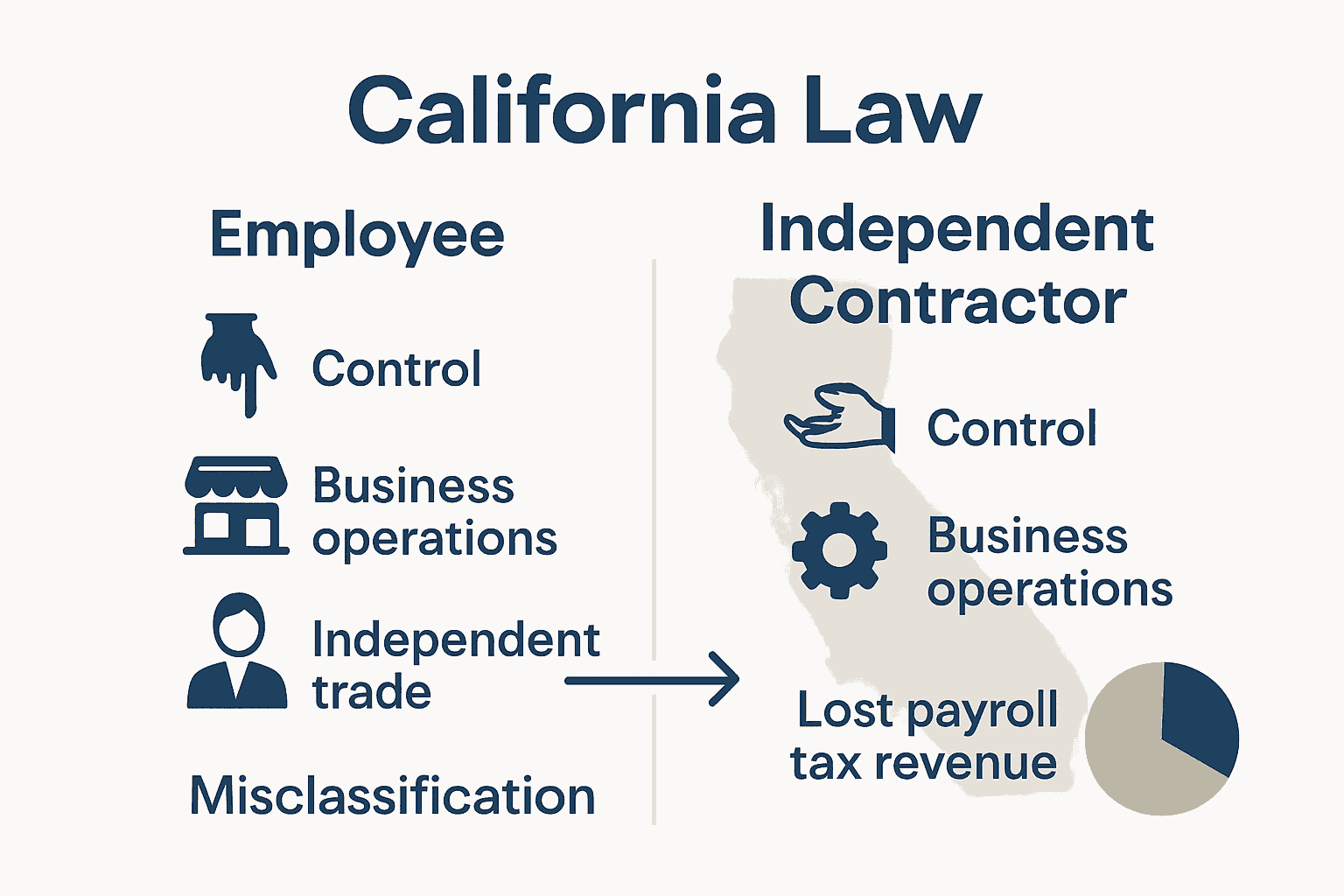
Over $7 billion in lost payroll tax revenue is linked each year to worker misclassification in California. This widespread problem not only leaves workers without key benefits like minimum wage and overtime but also exposes employers to heavy legal and financial penalties. Understanding how California defines and polices misclassification is crucial for anyone working or hiring in the state, especially as the line between independent contractor and employee can carry life-changing consequences.
Table of Contents
- Defining Worker Misclassification in California
- Key Signs Workers Are Misclassified
- Legal Standards: Irs and California Laws
- Employer Risks and Penalties
- Remote Worker Rights and Seeking Help
Key Takeaways
| Point | Details |
|---|---|
| Worker Misclassification | In California, misclassifying an employee as an independent contractor can result in significant legal and financial consequences for employers, stripping workers of essential labor protections. |
| ABC Test for Classification | The ABC test determines worker status, presuming workers are employees unless proven otherwise based on control, business operations, and independent trade. |
| Employer Risks | Misclassification can lead to serious penalties, including fines, back taxes, unpaid wages, and potential lawsuits, making correct classification critical for businesses. |
| Worker Rights | Remote workers suspecting misclassification should document their work, gather evidence, and seek help from legal or government resources to protect their rights. |
Defining Worker Misclassification in California
Worker misclassification occurs when an employer improperly labels an employee as an independent contractor, creating significant legal and financial consequences. According to the California Department of Industrial Relations, this practice allows employers to evade critical payroll taxes and wage laws while denying workers essential legal protections.
Under California law, worker misclassification is a serious issue that impacts thousands of workers’ rights and compensation. The Labor and Workforce Development Agency explains that employers who incorrectly designate employees as independent contractors effectively strip workers of fundamental labor law protections. These protections typically include minimum wage guarantees, overtime compensation, workers’ compensation benefits, and unemployment insurance.
To determine whether a worker is truly an independent contractor or an employee, California uses the stringent ABC test. This legal standard presumes workers are employees unless an employer can definitively prove three specific criteria:
- A: The worker is free from the company’s control and direction in performing work
- B: The worker performs tasks outside the company’s typical business operations
- C: The worker is engaged in an independently established trade, occupation, or business
Failing to meet any of these criteria means the worker should legally be classified as an employee, not an independent contractor.
 Gig Workers Misclassification under California Law Updates provides additional insights into how these complex legal determinations impact modern workplace relationships.
Key Signs Workers Are Misclassified
Identifying worker misclassification requires careful examination of the working relationship between employers and workers. According to the Law Offices of Steven E. Springer, a critical red flag is when employers exercise significant control over a worker’s daily activities, including setting schedules and directly managing tasks – actions that typically characterize an employee relationship, not an independent contractor arrangement.
The control indicators are complex and multifaceted. The Law Office of Parag L. Amin highlights several key signs of potential misclassification:
- The employer determines work hours and specific job performance methods
- Workers are required to use company equipment or resources
- Compensation is structured like a regular salary rather than project-based payments
- The worker is not permitted to work for multiple clients simultaneously
- No independent business infrastructure exists for the worker
Financial arrangements often reveal misclassification as well. Misclassified workers typically lack standard employee benefits like health insurance, retirement plans, and paid time off. They might also be subject to reimbursement policies that mirror employee expense management, despite being labeled as independent contractors. Understanding Misclassification of Gig Workers provides additional context for recognizing these nuanced employment relationship dynamics.
The consequences of misclassification can be severe. Employers may face significant legal penalties, including back taxes, retroactive benefit payments, and potential litigation. Workers, meanwhile, risk losing critical wage protections, unemployment benefits, and workers’ compensation coverage. Recognizing these signs early can help both employers and workers understand their true legal employment status and take appropriate action.

Legal Standards: IRS and California Laws
Navigating worker classification involves understanding complex legal standards set by both the Internal Revenue Service (IRS) and California state law. The Economic Policy Institute highlights California’s groundbreaking Assembly Bill 5 (AB5), which established the stringent ABC test to determine employee status, creating one of the most robust worker protection frameworks in the United States.
The IRS and California have distinct yet overlapping criteria for worker classification. The IRS typically evaluates three primary categories of control to determine worker status:
- Behavioral Control: The extent to which a company directs and controls work performance
- Financial Control: How the worker is paid, reimbursed, and can realize profit or loss
- Relationship Type: The permanence of the relationship and presence of employee benefits
California’s AB5 goes further by implementing the ABC test, which presumes workers are employees unless employers can prove three specific conditions:
- A: The worker is free from the company’s control and direction
- B: The work performed is outside the company’s typical business operations
- C: The worker is engaged in an independently established trade or business
The consequences of misclassification can be severe. Employers may face significant financial penalties, including back taxes, retroactive benefit payments, and potential legal action. Workers might lose critical protections like minimum wage guarantees, overtime compensation, and workers’ compensation.
Misclassification Archives provides additional insights into the complex legal landscape of worker classification.
Employer Risks and Penalties
Misclassifying workers is far more than a simple administrative error – it’s a serious legal liability that can devastate a business financially and legally. The California Department of Industrial Relations warns employers that worker misclassification penalties can be extraordinarily severe, with fines ranging from $5,000 to $25,000 per individual violation.
The financial risks extend far beyond initial penalties. Employers may face substantial additional consequences:
- Retroactive payment of unpaid wages and benefits
- Back taxes with significant interest and potential criminal charges
- Potential civil lawsuits from misclassified workers
- State and federal agency investigations
- Mandatory reimbursement of workers’ compensation and unemployment insurance
Legal repercussions can compound quickly, transforming what seems like a minor classification issue into a potential existential threat for a business. Employers might be required to:
- Pay back wages for overtime
- Provide retroactive employee benefits- Cover payroll taxes with substantial penalties
- Compensate workers for lost wages and potential damages
These complex legal challenges underscore the critical importance of proper worker classification. Wage and Hour Claims: General Rules and Violations offers deeper insights into how businesses can navigate these intricate legal waters and avoid costly misclassification mistakes.
Remote Worker Rights and Seeking Help
Remote workers experiencing misclassification have multiple avenues for seeking justice and protecting their rights. The Labor and Workforce Development Agency advises workers who suspect misclassification to take proactive steps, including submitting a Request for Preliminary Worker Classification or filing a formal wage claim to assert their legal protections.
The process of addressing worker misclassification involves several critical actions:
- Documenting all work-related communications and compensation details
- Gathering evidence of employer control and job responsibilities
- Collecting contracts, payment records, and communication histories
- Identifying potential witnesses or corroborating evidence
- Consulting with an employment law professional
The California Attorney General’s Office emphasizes that workers have multiple reporting mechanisms to protect their rights. Potential resources include:
- California Labor Commissioner’s Office
- State Employment Development Department
- Federal Department of Labor
- Local employment rights organizations
- Professional legal counsel specializing in employment law
Workers should understand that misclassification can impact critical benefits like unemployment insurance, workers’ compensation, and overtime pay. Understanding Disability Discrimination in Tech and Remote Work provides additional context for workers navigating complex employment classification challenges.
Protect Your Rights Against Remote Worker Misclassification
Misclassifying remote workers can leave you without the protections and benefits you deserve. This common challenge involves complex legal criteria like the ABC test and can lead to lost wages, denied unemployment benefits, and lack of workers’ compensation. If you feel trapped in a misclassified role or suspect your employer is not following California employment laws, you are not alone. Many employees face confusion and frustration over their true legal status and rights.
Do not wait for penalties or loss of benefits to impact you. Explore our Misclassification Archives | Serendib Law Firm to learn how we help workers just like you reclaim their rightful employment protections. Visit Serendib Law Firm today for personalized advice tailored to your situation. Take the first step by contacting us now to schedule a free consultation and secure the legal guidance you need before it is too late.
Frequently Asked Questions
What is worker misclassification?
Worker misclassification occurs when an employer incorrectly labels an employee as an independent contractor, which can lead to significant legal and financial consequences for both the employer and the worker.
How can I determine if I am misclassified as a remote worker?
To determine if you are misclassified, assess if you meet the criteria of the ABC test, which includes whether you are free from employer control, whether your work is outside their typical business operations, and whether you are engaged in an independently established trade.
What are the potential consequences of misclassification for employers?
Employers can face severe consequences such as fines ranging from $5,000 to $25,000 per violation, back taxes, unpaid wages, civil lawsuits, and mandatory reimbursement of employee benefits.
What steps can I take if I believe I have been misclassified?
If you suspect misclassification, document your work-related communications and responsibilities, gather evidence of employer control, and consult with an employment law professional. You may also file a formal wage claim to assert your rights.
2 Responses