

Over 50 million american workers face classification decisions that impact everything from pay to legal protections. Whether you run a small business or work as a freelancer, knowing if someone should be treated as an employee or contractor is more than paperwork. Making the right call avoids costly fines and helps both sides understand their rights and responsibilities in a shifting economy.
Table of Contents
- Worker Classification Fundamentals and Legal Definition
- Key Differences: Independent Contractor Vs. W-2 Employee
- California’s ABC Test and Legal Standards
- Real-World Examples in Fountain Valley Software Firms
- Risks and Penalties for Misclassification
- Protecting Rights: Steps for Misclassified Workers
Key Takeaways
| Point | Details |
|---|---|
| Understanding Worker Classification | Correct classification as employee or contractor is crucial to avoid legal and financial penalties. Employers must use criteria such as the ABC Test to evaluate status. |
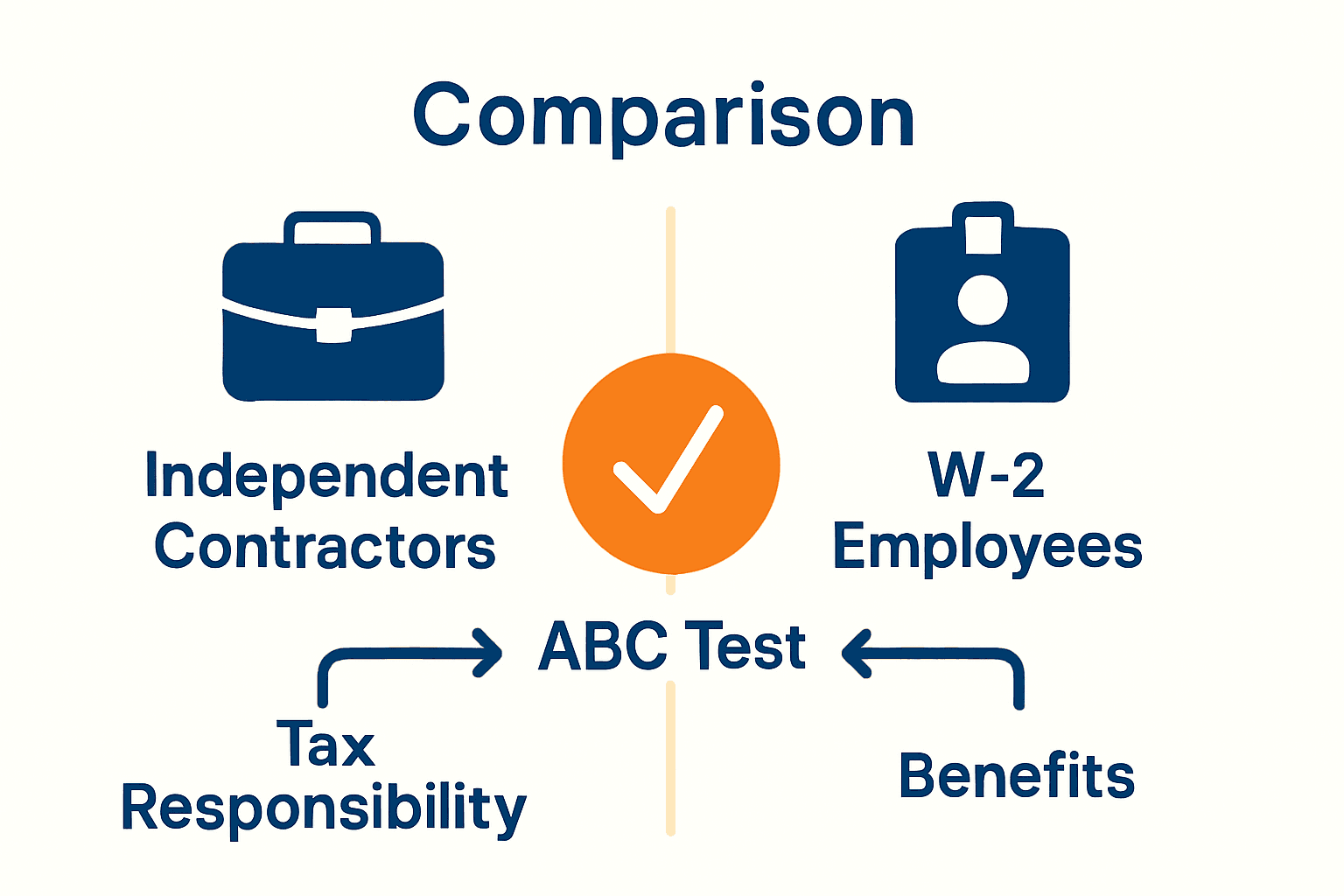
| Differences Between Contractors and Employees | Contractors manage their own taxes and benefits, while W-2 employees have these handled by employers and receive additional benefits. |
| California’s ABC Test | The ABC Test requires meeting three criteria for independent contractor status; failure to meet these results in classification as a W-2 employee. |
| Risks of Misclassification | Misclassification can lead to significant penalties, including back taxes and legal fees, as well as reputational damage for businesses. |
Worker Classification Fundamentals and Legal Definition
Understanding worker classification is critical for businesses and employees navigating modern employment landscapes. According to the Cornell Law, legal frameworks like the ABC test provide comprehensive guidelines for determining whether a worker qualifies as an employee or an independent contractor.
The ABC Test represents a rigorous legal standard designed to evaluate worker status through three fundamental criteria. As defined by Cornell Law, these criteria include: (1) the worker’s degree of freedom from employer control, (2) whether the work performed falls outside the typical course of the employer’s business, and (3) whether the worker is genuinely engaged in an independently established trade or occupation.
Worker classification carries significant legal and financial implications. Misclassification can result in substantial penalties, including back taxes, missed benefit contributions, and potential legal liability. Employers must carefully assess each working relationship, considering factors beyond simple job titles or contractual language. A comprehensive guide to misclassification risks can provide additional insights into navigating these complex legal distinctions.
Key considerations for accurate worker classification include examining the level of behavioral and financial control, the nature of the working relationship, and the specific services being performed. While legal standards can vary by jurisdiction, maintaining clear documentation and understanding the nuanced differences between contractors and employees remains crucial for businesses seeking compliance and risk mitigation.
Key Differences: Independent Contractor vs. W-2 Employee
Navigating the complex landscape of worker classification requires a deep understanding of the fundamental distinctions between independent contractors and W-2 employees. Cornell Law provides critical insights into these legal differentiations, emphasizing the importance of examining the nature of the working relationship beyond surface-level contractual agreements.
The primary distinctions emerge across several key dimensions. Taxation represents a significant differentiator, with independent contractors responsible for their own tax withholdings and self-employment taxes, while W-2 employees have taxes automatically withheld by their employers. Benefits also diverge dramatically – W-2 employees typically receive comprehensive benefits including health insurance, retirement plans, and paid time off, whereas contractors must independently secure and fund these protections. A comprehensive guide to misclassification risks highlights the potential financial and legal consequences of misunderstanding these classifications.
Control and autonomy form another critical distinguishing factor. Independent contractors generally maintain substantial independence in how they complete work, selecting their own tools, setting their own schedules, and often working for multiple clients simultaneously. W-2 employees, conversely, operate under more direct supervision, follow employer-defined processes, and typically work exclusively for one organization. According to the Cornell Law ABC test framework, this level of control represents one of the most crucial elements in determining worker classification.
Financial arrangements further underscore the differences. Contractors usually invoice for completed projects, negotiate their own rates, and bear the financial risks of their work. W-2 employees receive consistent wages, are protected by minimum wage laws, and benefit from the employer’s financial stability. Understanding these nuanced distinctions is essential for both employers and workers to ensure legal compliance, proper compensation, and a clear understanding of professional responsibilities.

California’s ABC Test and Legal Standards
California has established one of the most stringent worker classification frameworks in the United States, known as the ABC Test. California Labor provides a comprehensive approach to determining worker status, requiring employers to meet three specific criteria to classify a worker as an independent contractor.
The test’s three fundamental components are critically important. According to Law Cornell, a worker must simultaneously satisfy these conditions: (A) the worker must be free from the hiring entity’s control and direction, (B) the work performed must be outside the usual course of the company’s business, and © the worker must be independently established in the same type of work being performed. Gig Workers Misclassification under California Law offers additional insights into how these complex legal standards are applied in real-world scenarios.
Failure to meet even one of these criteria results in automatic classification as a W-2 employee, not an independent contractor. This approach provides significant worker protections by ensuring that businesses cannot easily circumvent labor laws through superficial contractual arrangements. The stringent nature of California’s ABC Test reflects a broader commitment to protecting worker rights and preventing potential exploitation through misclassification.
Practical implications of the ABC Test are profound. Businesses must carefully evaluate their working relationships, documenting how each worker meets all three criteria. The test essentially shifts the burden of proof to employers, requiring them to demonstrate that a worker genuinely operates as an independent business entity rather than as an integrated part of the company’s core operations. This comprehensive approach ensures that workers receive appropriate legal protections, benefits, and compensation consistent with their actual working relationship.
Real-World Examples in Fountain Valley Software Firms
Fountain Valley’s software industry provides a compelling microcosm of the complex worker classification challenges facing modern tech companies. Experienced Fountain Valley Employment Law Attorneys frequently encounter nuanced scenarios where the line between independent contractor and W-2 employee becomes critically blurred.
According to AP News, recent labor rule changes have heightened the stakes for misclassification. In one local software startup, developers initially engaged as independent contractors were found to be performing core product development work, directly contradicting the ABC Test’s requirement that contractor work fall outside the company’s primary business operations. This scenario illustrates how seemingly straightforward contractor arrangements can quickly unravel under careful legal scrutiny.
Typical misclassification patterns emerge across several dimensions. Small software firms often engage developers as contractors to reduce overhead costs, providing project-based work that appears independent. However, when these contractors work exclusively for one company, use company-provided equipment, follow strict development protocols, and receive ongoing assignments, they effectively function as employees. The financial implications are substantial – misclassification can result in back taxes, missed benefits, and potential legal penalties that far outweigh initial cost-saving strategies.
Practical challenges underscore the complexity of worker classification in tech environments. Remote work and project-based development have further complicated traditional employment distinctions, making it increasingly difficult for companies to definitively classify workers. Fountain Valley software firms must now carefully document worker relationships, demonstrating true independence through factors like multiple client engagements, self-provided tools, and genuine operational autonomy. Experienced Fountain Valley Workplace Discrimination Lawyers emphasize that proactive legal compliance is far less expensive than defending against potential misclassification claims.
Risks and Penalties for Misclassification
Worker misclassification represents a legal minefield with potentially catastrophic financial and operational consequences for businesses. Misclassification of Managers: Complete Legal Guide underscores the complex landscape of employment law that companies must carefully navigate.
The financial risks associated with misclassification are substantial and multifaceted. Businesses may face significant penalties including back taxes, retroactive benefit payments, and potential wage violations. These financial burdens can include:
- Unpaid overtime compensation
- Federal and state tax penalties
- Social Security and Medicare contribution arrears
- Potential damages for denied employee benefits
- Substantial legal fees and potential litigation costs
Employers face additional legal complications beyond immediate financial penalties.
 Misclassification can trigger comprehensive state and federal investigations, potentially resulting in comprehensive audits that examine multiple years of employment practices. Intentional misclassification can lead to even more severe consequences, including punitive damages and potential criminal charges for willful labor law violations.
The long-term reputational damage can be equally devastating. Companies found guilty of systematic worker misclassification risk losing credibility with potential employees, investors, and regulatory bodies. Understanding Misclassification of Gig Workers highlights how these legal missteps can permanently damage an organization’s standing in the business community, making future recruitment and business partnerships significantly more challenging.
Protecting Rights: Steps for Misclassified Workers
Employees who suspect worker misclassification have critical legal pathways to protect their rights and seek appropriate compensation. Gig Workers Misclassification under California Law Updates provides essential context for understanding these complex legal strategies.
According to California Labor, workers can proactively assess their employment status using the ABC Test criteria. The recommended steps for addressing potential misclassification include:
- Document your actual work responsibilities and relationship with the employer
- Compare your working conditions against the ABC Test requirements
- Collect evidence of your work arrangements, including:
- Communication records
- Assignment details
- Equipment and tool usage
- Payment structures
- Consult with an employment law professional
Legal recourse options are multifaceted and potentially powerful. Workers may pursue administrative complaints with state labor boards, file wage claims, or initiate civil litigation to recover unpaid wages, benefits, and potential damages. Complete Guide to Misclassification in Logistics Law emphasizes that timely action is crucial in protecting workers’ rights and challenging improper employment classifications.
Comprehensive documentation serves as the foundation of any successful misclassification claim. Workers should maintain meticulous records of their work history, communication with employers, compensation details, and any evidence demonstrating their actual working relationship. Seeking professional legal guidance can help workers understand their specific rights, evaluate the strength of their potential claims, and navigate the complex landscape of employment law with confidence.
Navigate Worker Classification Challenges with Trusted Legal Support
Understanding the fine line between independent contractors and W-2 employees is critical for Fountain Valley businesses and workers alike. Misclassification can lead to costly legal consequences, including back taxes, denied benefits, and potential penalties. If you face uncertainty about worker status or suspect misclassification under California’s strict ABC Test, you are not alone.
At Serendib Law Firm, we are dedicated to protecting your rights and helping businesses stay compliant with complex employment laws. Explore insights and real cases in our Fountain Valley Archives to understand how these issues impact the local workforce. If you are ready to take control of your situation, contact us now for a free consultation and ensure your working relationship is properly classified. Visit our California Archives to learn more about statewide legal standards and let our experienced team guide you through every step.
Frequently Asked Questions
What is the ABC Test for worker classification?
The ABC Test is a legal standard used to classify workers as either independent contractors or W-2 employees based on three criteria: freedom from employer control, whether the work falls outside the employer’s usual business, and if the worker is independently established in their trade.
What are the financial implications of misclassification for employers?
Misclassification can result in significant financial penalties, including back taxes, unpaid overtime, retroactive benefit payments, and potential litigation costs. Employers may also face audits and legal actions from state and federal agencies.
How can workers assess if they have been misclassified?
Workers can evaluate their classification by comparing their work responsibilities and conditions to the ABC Test criteria. Documenting communication, assignment details, and payment structures can be essential in proving misclassification.
What steps should misclassified workers take to protect their rights?
Workers should document their actual duties, compare their conditions against the ABC Test, collect supporting evidence, and consult with an employment law professional. They can also pursue administrative complaints or initiate civil litigation to seek compensation.