

More than 40 percent of American tech workers over age 35 report feeling overlooked or sidelined in their careers. The fast-paced world of Silicon Valley prizes youth, leaving experienced professionals facing subtle forms of exclusion that go far beyond stereotypes. Understanding how age discrimination unfolds in the technology sector can empower you to identify and respond to these hidden workplace challenges, protecting your rights in an industry that often undervalues experience.
Table of Contents
- Defining Age Discrimination In Tech Workplaces
- California And Federal Age Discrimination Laws
- Layoff Practices At Broadcom And Google
- Recognizing Signs Of Age Bias In Layoffs
- Employee Rights And Legal Remedies
Key Takeaways
| Point | Details |
|---|---|
| Age Discrimination Prevalence | Age discrimination in tech workplaces targets older workers, particularly those over 35, limiting their professional opportunities and career advancement. |
| Legal Protections | The Age Discrimination in Employment Act (ADEA) and California’s Fair Employment and Housing Act (FEHA) provide essential protections against age discrimination, with California offering broader coverage and remedies. |
| Layoff Practices Concerns | Tech companies, like Broadcom and Google, have been scrutinized for layoff practices that may disproportionately affect older employees, raising concerns about underlying age bias. |
| Documentation Importance | Employees should meticulously document instances of potential age discrimination to strengthen their legal claims and protect their rights. |
Defining Age Discrimination in Tech Workplaces
Age discrimination in technology workplaces represents a systemic challenge that undermines professional opportunities for experienced workers. Research analyzing software developer demographics reveals a troubling pattern of bias against professionals perceived as older, particularly those over 35 years old.
Tech companies frequently perpetuate harmful stereotypes that equate youth with innovation and technological prowess. Studies indicate programmers over 35 are often viewed as ‘outdated’, creating significant barriers to career advancement and professional development. These perceptions manifest through subtle yet pervasive workplace practices that marginalize seasoned professionals, including:
- Preferential hiring of younger candidates
- Limited training and upskilling opportunities for older workers
- Perception that older employees are less adaptable to technological changes
- Systematic exclusion from high-visibility projects
- Disproportionate representation in workforce reduction strategies
The legal framework surrounding age discrimination provides critical protections for workers, particularly in technology sectors where ageist practices can be especially pronounced. The Age Discrimination in Employment Act (ADEA) prohibits employment discrimination against individuals 40 years and older, offering a crucial safeguard against systemic workplace biases.
Pro Tip: Document every instance of potential age discrimination meticulously, including dates, specific interactions, and witnesses, which can provide crucial evidence if legal action becomes necessary.
California and Federal Age Discrimination Laws
Age discrimination in employment represents a critical legal challenge addressed by both state and federal legislation. The California Fair Employment and Housing Act (FEHA) provides robust protections that complement federal statutes, establishing comprehensive safeguards for workers over 40 years old.
The Age Discrimination in Employment Act (ADEA) serves as the primary federal mechanism protecting workers, prohibiting discriminatory practices in hiring, promotion, termination, and compensation. California’s FEHA goes further by offering more expansive protections, including:
- Broader coverage for protected age groups
- Lower threshold for proving discriminatory intent
- More stringent penalties for employers
- Enhanced remedies for victims of age discrimination
Technological advances continue to challenge legal frameworks protecting older workers, creating complex scenarios where subtle forms of discrimination can persist despite existing legal protections. In tech industries like those in Irvine, these challenges are particularly pronounced, with companies often prioritizing perceived youth and innovation over experienced talent.
The intersection of federal and California state laws creates a multilayered approach to combating age discrimination, enabling workers to pursue legal recourse through multiple channels. Employees facing potential age discrimination can file complaints with the Equal Employment Opportunity Commission (EEOC) or California’s Civil Rights Department, each offering distinct investigative and remedial processes.
Pro Tip: Collect comprehensive documentation of potential age discrimination, including performance reviews, communication records, and witness statements, to strengthen any future legal claims.
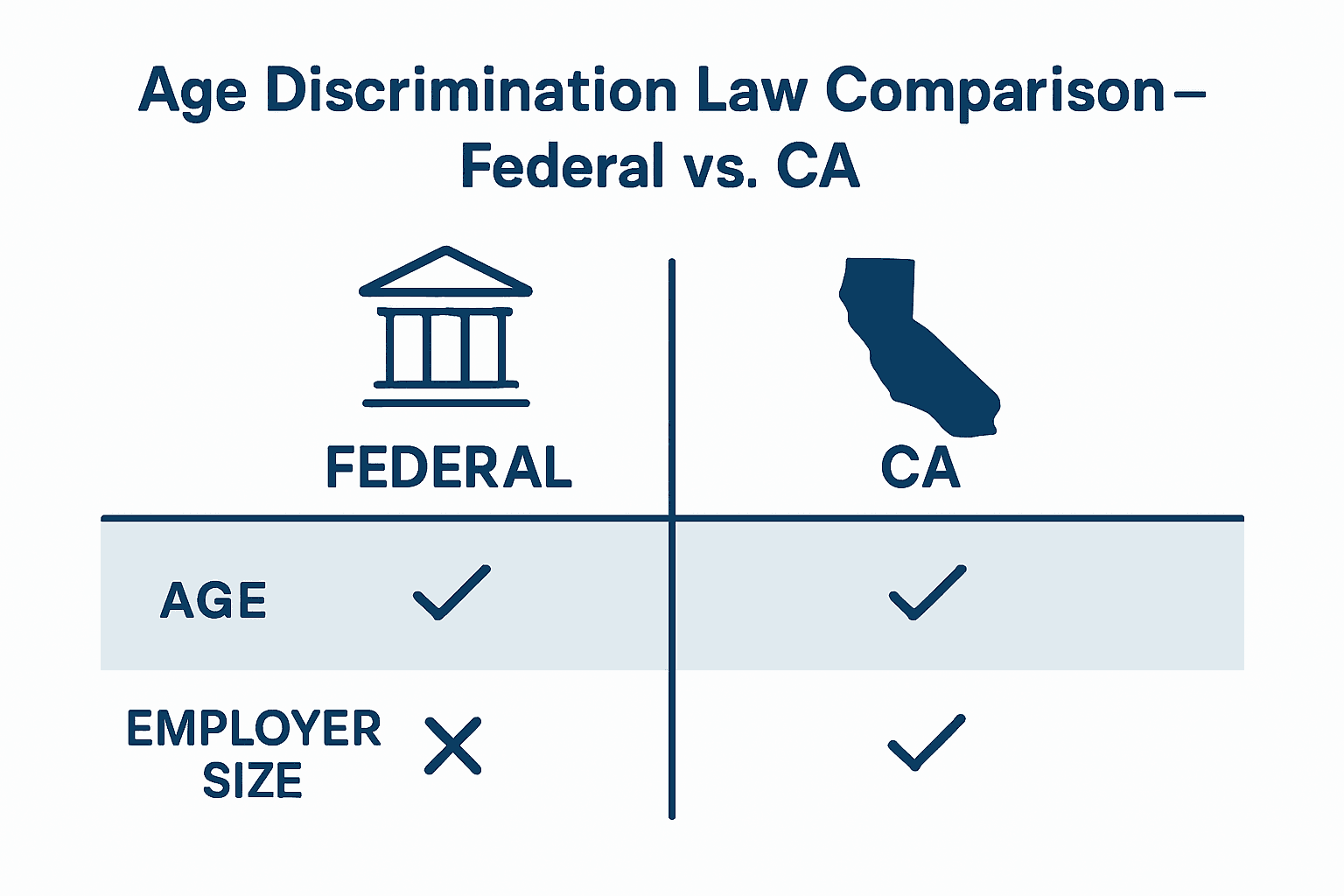
Here’s a concise comparison of key protections provided by federal and California age discrimination laws:
| Criterion | Federal (ADEA) | California (FEHA) |
|---|---|---|
| Age Coverage | Protects 40+ years | Protects 40+ years, sometimes broader |
| Law Scope | Applies nationwide | Added state-level rights in California |
| Employer Size | 20+ employees | 5+ employees |
| Proof Burden | Higher for employees | Lower standard for claimants |
| Remedies | Back pay, reinstatement | Fines, damages, injunctive relief |
Layoff Practices at Broadcom and Google
Tech layoffs in Silicon Valley have increasingly come under scrutiny for potential age discrimination, with Broadcom and Google representing notable examples of workforce reduction strategies that raise legal concerns. Recent shifts in corporate hiring directives suggest complex workforce management approaches that may disproportionately impact older workers.
Broadcom’s layoff practices have drawn particular attention, with reports indicating a pattern of reducing workforce through strategies that appear to target more experienced employees. These practices often manifest through:
- Restructuring departments
- Eliminating senior-level positions
- Implementing performance review criteria that disadvantage older workers
- Creating financial incentives for early retirement
- Prioritizing younger, lower-cost talent
Language patterns in job advertisements and workforce management strategies can reveal underlying age biases, with tech companies like Google and Broadcom potentially implementing subtle discriminatory practices. The tech industry’s rapid evolution creates an environment where older workers may be perceived as less adaptable, despite extensive experience and institutional knowledge.
Google’s recent workforce reductions have similarly raised questions about age discrimination, with significant layoffs affecting employees across various age groups and experience levels. The company’s approach to workforce management reflects broader industry trends of prioritizing technological agility and cost efficiency over long-term employee retention.

Pro Tip: Request a detailed, written explanation of layoff criteria from your employer, which can provide critical evidence if age discrimination is suspected.
Recognizing Signs of Age Bias in Layoffs
Age discrimination during workforce reductions often manifests through subtle and complex workplace practices that can be challenging to identify. Workplace discrimination research highlights patterns where older employees are disproportionately targeted without clear performance-based justifications.
Employers may demonstrate age bias through several strategic yet discriminatory layoff approaches:
- Consistently selecting employees over 40 for reduction
- Creating performance metrics that disadvantage experienced workers
- Replacing older employees with significantly younger staff
- Using euphemistic language about “workforce modernization”
- Implementing training or technology requirements that marginalize senior employees
- Offering early retirement packages specifically targeting older workers
Recognizing age discrimination requires careful documentation and understanding of systematic patterns. Key warning signs include scenarios where experienced employees with strong performance histories are suddenly deemed “less competitive” or “not aligned with company vision,” despite demonstrated expertise and institutional knowledge.
Tech companies like Broadcom and Google frequently utilize complex reorganization strategies that can mask underlying age discrimination. These approaches might include restructuring job descriptions, implementing new technological requirements, or creating evaluation frameworks that inherently disadvantage workers with longer professional histories.
To better recognize subtle age bias in tech layoffs, consider these typical indicators and their workplace impact:
| Indicator | Common Manifestation | Potential Employee Impact |
|---|---|---|
| Sudden Job Role Changes | Redefining senior roles requiring recent skills only | Forces experienced workers to retrain or exit |
| ‘Culture Fit’ Reasoning | Stating experienced employees don’t fit new direction | Justifies replacing older staff with younger hires |
| Skewed Performance Reviews | Downgrading strong histories without specific cause | Reduces eligibility for advancement or bonuses |
| Selective Project Assignments | Excluding older workers from key initiatives | Limits exposure, career progression, and retention |
Pro Tip: Document every performance review, communication, and professional interaction meticulously, creating a comprehensive record that can serve as potential evidence if age discrimination is suspected.
Employee Rights and Legal Remedies
Employee rights in age discrimination cases provide critical protections for workers facing unfair treatment during layoffs. Legal frameworks analyzing ageism in labor markets offer comprehensive mechanisms for challenging discriminatory workplace practices.
Employees experiencing potential age discrimination have several legal remedies available:
- Filing a complaint with the Equal Employment Opportunity Commission (EEOC)
- Pursuing claims under the Age Discrimination in Employment Act (ADEA)
- Seeking remedies through California’s Fair Employment and Housing Act (FEHA)
- Requesting administrative hearings
- Initiating civil lawsuits for back pay and reinstatement
- Demanding compensatory and punitive damages
Historical legal precedents like the Dickason case demonstrate the complexity of challenging age-based workplace discrimination. Successful legal strategies typically require comprehensive documentation of discriminatory practices, including evidence of disparate treatment, biased performance evaluations, and patterns of workforce reduction that disproportionately impact older workers.
Specific legal actions can include challenging layoff decisions through administrative complaints, negotiating settlements, or pursuing litigation that exposes systemic age discrimination in tech workplace environments. Experienced Orange Employment Law Attorneys can provide critical guidance in navigating these complex legal challenges.
Pro Tip: Preserve all employment documentation, including performance reviews, communication records, and layoff notices, as these can serve as crucial evidence in potential age discrimination legal proceedings.
Protect Your Rights Against Age Discrimination in Irvine Tech Jobs
Facing potential age discrimination during layoffs at companies like Broadcom or Google brings unique challenges that require knowledgeable legal support. If you feel sidelined because of your age or experience unfair treatment in Irvine’s competitive tech landscape it is crucial to understand your rights and act promptly. Common issues include biased performance reviews, exclusion from key projects, and vague layoff criteria that disproportionately affect seasoned professionals.
Do not let age bias undermine your career and livelihood. Our experienced team specializes in California Employment Law and can guide you through filing claims under federal and state protections with confidence. Visit CA Employment Law Archives to learn more about your legal options. Take control now by contacting the trusted advocates at Serendib Law Firm for a free consultation and personalized strategy to fight back and secure the justice you deserve.
Frequently Asked Questions
What constitutes age discrimination in tech layoffs?
Age discrimination in tech layoffs refers to practices that unfairly target older employees during workforce reductions, such as consistently selecting workers over 40, implementing biased performance metrics, or using euphemistic language that masks discriminatory intent.
How do I recognize signs of age bias in layoffs?
Signs of age bias may include patterns like sudden role changes for older employees, performance reviews that downgrade experienced workers without justification, and the selective assignment of key projects to younger staff.
What legal protections exist against age discrimination in the workplace?
Legal protections against age discrimination include the Age Discrimination in Employment Act (ADEA) and California’s Fair Employment and Housing Act (FEHA), which safeguard workers over 40 from discriminatory practices in hiring, promotion, and termination.
What steps can I take if I suspect age discrimination during layoffs?
If you suspect age discrimination, you should document all relevant interactions, gather performance reviews and communication records, and consider filing a complaint with the Equal Employment Opportunity Commission (EEOC) or seeking legal counsel to explore your options.