

Tech leaders in Irvine are facing a new wave of challenges as recent american mass layoff trends ripple through the industry. With more than 50 workers affected at a single site triggering strict legal obligations, companies risk severe penalties if WARN Act rules are missed. Understanding the differences between federal and California requirements helps HR managers and business owners protect their organizations while giving employees the transparency and support they deserve.
Table of Contents
- Defining Mass Layoffs And Warn Act Basics
- Key Differences: Federal Vs. California Warn
- When Irvine Tech Employers Must Comply
- Notification Process And Content Requirements
- Risks, Penalties, And Legal Challenges In Noncompliance
- Critical Best Practices For Layoff Planning
Key Takeaways
| Point | Details |
|---|---|
| Understanding Mass Layoffs | Mass layoffs involve significant workforce reductions and require compliance with the WARN Act, mandating 60 days’ notice for affected employees. |
| California vs. Federal WARN Requirements | California’s WARN Act imposes stricter requirements and additional worker protections compared to federal regulations, necessitating detailed notifications and support plans. |
| Compliance Risks for Tech Firms | Noncompliance with the WARN Act can lead to substantial financial penalties and legal challenges, emphasizing the need for proactive compliance strategies. |
| Best Practices in Layoff Planning | Employers should implement comprehensive planning strategies and transparent communication to mitigate risks and support displaced workers effectively. |
Defining Mass Layoffs and WARN Act Basics
Mass layoffs represent significant workforce reductions that can dramatically impact employees and local economies. The Worker Adjustment and Retraining Notification (WARN) Act provides critical protections for workers facing sudden unemployment by establishing specific guidelines for employer notification and worker transition support.
Under federal law, mass layoffs are defined by specific workforce reduction thresholds. Employers with 100 or more employees must provide advance notice if they plan to terminate 50 or more workers at a single site, or if the layoff affects at least 33% of the site’s workforce with a minimum of 50 employees. Federal regulations mandate that these notifications must occur at least 60 days before the planned workforce reduction.
The WARN Act covers various employment scenarios, including:
- Permanent plant closings
- Substantial workforce reductions
- Significant reductions in work hours (over 50% for six consecutive months)
- Involuntary terminations affecting multiple employees
Tech firms in Irvine must carefully navigate these regulations, understanding that non-compliance can result in significant financial penalties, including back pay and potential legal action from affected employees.
Pro tip: Consult with an employment law specialist before implementing mass layoffs to ensure full compliance with WARN Act requirements and minimize potential legal risks.
Key Differences: Federal vs. California WARN
While the federal and California WARN Acts share fundamental notification requirements, the state law introduces significant additional protections for workers in technology and other industries. California’s WARN Act goes beyond federal standards by mandating more comprehensive workforce transition support and detailed communication protocols.
The key distinctions between federal and California WARN regulations include:
- Employer size thresholds
- Notification content requirements
- Local workforce board engagement
- Support service coordination
Under the California version, employers must not only provide 60-day advance notice but also include detailed information about the layoff, such as specific contact points, permanent or temporary status of the reduction, and explicit descriptions of available state assistance programs like CalFresh. Federal WARN regulations are comparatively more general, focusing primarily on advance notification without the same level of mandated support service details.
Tech firms in Irvine must recognize that California’s enhanced WARN Act requirements demand a more proactive approach to workforce transitions. The state’s law requires employers to coordinate with local workforce development boards, provide more extensive documentation, and demonstrate a clear plan for supporting displaced workers through state-sponsored retraining and assistance programs.

Here’s a side-by-side summary of federal and California WARN Act requirements for technology employers:
| Requirement Area | Federal WARN Act | California WARN Act |
|---|---|---|
| Advance Notice Period | 60 days required | 60 days required |
| Employer Size Threshold | 100+ employees | 75+ employees |
| Notification Content | Basic layoff details | Detailed layoff info, state program resources |
| Stakeholder Notifications | Employees, local agencies | Employees, local agencies, workforce board |
| Support Services | Not mandated | Mandatory retraining and assistance plan |
Pro tip: Develop a comprehensive layoff communication strategy that not only meets legal requirements but also demonstrates genuine commitment to your employees’ future career transitions.
When Irvine Tech Employers Must Comply
Irvine technology companies must carefully evaluate their workforce size and planned reductions to determine WARN Act compliance. California’s layoff notification requirements apply to employers with specific workforce characteristics, creating complex compliance challenges for tech firms experiencing rapid organizational changes.
The key compliance triggers for Irvine tech employers include:
- Employing 100 or more workers
- Planning layoffs affecting 50 or more employees
- Reducing workforce by 33% or more at a single site
- Implementing substantial work hour reductions
Federal WARN regulations mandate that tech companies must provide 60 days’ advance notice before mass layoffs or plant closings. This requirement applies not just to permanent terminations, but also to situations involving significant work hour reductions or temporary shutdowns that meet specific threshold criteria. Irvine technology firms must be particularly vigilant, as California’s state laws often impose more stringent requirements than federal guidelines.
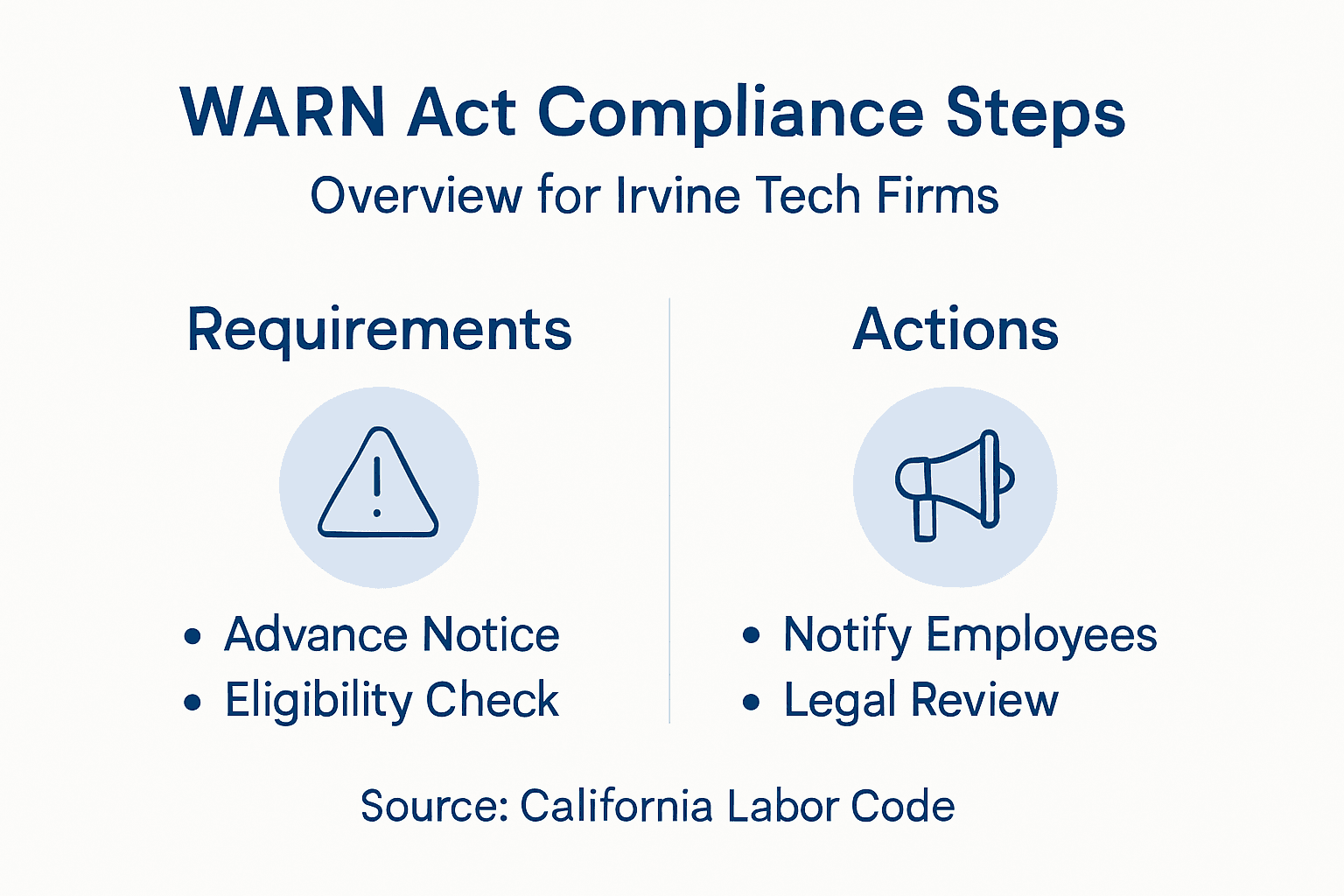
Technology companies must recognize that compliance extends beyond simple headcount calculations. The WARN Act requires detailed notifications to employees, local workforce development boards, and state agencies, with specific documentation outlining the scope, duration, and potential impact of workforce reductions.
Pro tip: Maintain a comprehensive workforce tracking system that helps you proactively identify potential WARN Act triggers before they become compliance risks.
Notification Process and Content Requirements
Irvine technology employers must meticulously craft their WARN Act notifications to meet stringent legal standards. Detailed notification protocols require comprehensive written communication that goes far beyond a simple termination announcement.
The notification must include several critical elements:
- Complete contact information for a company official
- Precise details about the employment site
- Specific dates and schedules of potential layoffs
- Exact number of affected employees by job title
- Clear indication of permanent or temporary status
- Potential coordination with local workforce boards
Federal WARN regulations mandate that these written notices must be delivered to multiple stakeholders, including:
- Directly affected employees
- Employee representatives
- Local government officials
- State dislocated worker units
Tech companies in Irvine must understand that the notification process is not merely a bureaucratic exercise. The goal is to provide transparent, actionable information that allows workers sufficient time to prepare for potential job transitions, seek retraining, or explore alternative employment opportunities. Incomplete or delayed notifications can result in significant legal penalties and potential litigation.
Pro tip: Develop a standardized notification template that can be quickly customized to meet WARN Act requirements, ensuring consistency and comprehensive information delivery.
Risks, Penalties, and Legal Challenges in Noncompliance
Irvine technology companies face substantial financial and legal risks when failing to comply with WARN Act notification requirements. Employer liability provisions create significant potential for costly legal challenges that can severely impact a company’s financial stability and reputation.
The key financial penalties for WARN Act noncompliance include:
- Back pay and benefits for affected employees
- Up to 60 days of compensation per worker
- Civil penalties of $500 per day for each violation
- Potential federal court litigation expenses
Federal court enforcement mechanisms enable employees, their representatives, and local governments to initiate civil actions against noncompliant employers. These legal challenges often extend beyond simple monetary penalties, potentially damaging a company’s professional reputation and creating long-term challenges in talent recruitment and retention.
Technology firms in Irvine must recognize that WARN Act violations are not merely technical legal issues. The consequences can include substantial financial liabilities, protracted legal battles, and significant disruptions to business operations. Employers must proactively develop comprehensive compliance strategies that anticipate potential workforce reduction scenarios and create robust notification protocols.
This table consolidates major risks faced by Irvine tech firms for WARN Act noncompliance:
| Risk Type | Description | Long-Term Impact |
|---|---|---|
| Financial Penalties | Back pay, civil fines | Loss of capital, reduced investment |
| Legal Challenges | Lawsuits, enforcement actions | Damage to reputation, costly settlements |
| Recruitment Issues | Negative employer brand | Difficulty attracting talent |
| Operational Disruption | Business process interruptions | Lower employee morale, productivity losses |
Pro tip: Establish an internal compliance team dedicated to monitoring workforce changes and maintaining up-to-date WARN Act notification templates to minimize legal exposure.
Critical Best Practices for Layoff Planning
Irvine technology companies must approach workforce reductions with strategic precision and comprehensive planning. Layoff planning strategies require careful consideration of legal, ethical, and operational implications beyond simple headcount reduction.
Key strategic considerations for effective layoff planning include:
- Conduct thorough workforce impact assessments
- Develop transparent communication protocols
- Identify legally protected employee categories
- Create comprehensive support resources
- Minimize potential discrimination risks
- Maintain documentation of selection criteria
Effective layoff management demands a holistic approach that balances legal compliance with organizational integrity. Tech firms must recognize that layoffs are not merely transactional events but complex processes with significant human and operational consequences. Strategic selection of affected employees, timing considerations, and comprehensive communication plans are critical to mitigating potential negative impacts.
Employers should prioritize compassionate and transparent approaches that provide clear information, support services, and potential transition assistance for affected workers. This approach not only reduces legal risks but also helps preserve the company’s reputation and potential future recruitment capabilities.
Pro tip: Create a cross-functional layoff planning team that includes human resources, legal counsel, and senior management to ensure comprehensive and compliant workforce reduction strategies.
Protect Your Firm from WARN Act Risks with Expert Legal Guidance
Mass layoffs and WARN Act compliance present complex challenges for Irvine technology companies. Understanding the nuances of both federal and California WARN laws, along with managing notification requirements and potential penalties, can overwhelm even the most experienced business leaders. Facing delays or errors in compliance may lead to costly back pay, legal action, and reputational damage. Staying ahead requires clear strategies and knowledgeable legal support.
If your Irvine tech firm needs assistance navigating these critical employment law issues, our team at Serendib Law is here to help. We offer dedicated counsel specializing in CA Employment Law Archives | Serendib Law Firm to ensure your workforce reductions are legally sound and transparent. Act now to minimize risks and protect your business with expert advice from a trusted Orange County law firm. Visit https://www.serendiblaw.com/ to schedule your free consultation and take the first step toward comprehensive WARN Act compliance.
Learn more about your rights and obligations to avoid legal pitfalls by exploring our detailed resources in the California Employment Law Archives | Serendib Law Firm. Secure your workforce transition with confidence and professional guidance today.
Frequently Asked Questions
What constitutes a mass layoff under the WARN Act?
A mass layoff under the WARN Act occurs when an employer terminates 50 or more employees at a single site, or if the layoff affects at least 33% of the site’s workforce with a minimum of 50 employees.
What are the notification requirements for employers under the WARN Act?
Employers must provide at least 60 days’ advance notice to affected employees, employee representatives, and local government officials before any mass layoffs or plant closings.
How does the California WARN Act differ from the federal WARN Act?
The California WARN Act has more stringent requirements, including a lower employer size threshold (75+ employees), detailed notification content, mandatory coordination with local workforce boards, and a requirement for state assistance information.
What are the potential penalties for not complying with the WARN Act?
Employers that fail to comply with the WARN Act may face penalties such as back pay for affected employees, civil fines of $500 per day for each violation, and potential litigation costs, which can significantly impact the company’s financial stability.
Recommended
- Age Discrimination in Irvine Tech Layoffs: Broadcom and Google | Serendib Law Firm
- Experienced Irvine Employment Law Attorneys
- Non-Compete and Trade Secret Disputes in Cypress Tech | Serendib Law Firm
- Pregnancy Accommodations in Santa Ana Tech Sector: Complete Guide | Serendib Law Firm
- Prepare for the Worst: Develop an Incident Response Plan – Cloudology