

Keeping up with California’s rapidly evolving employment laws is no small feat for HR managers and business owners in Irvine. New pay transparency mandates, artificial intelligence regulations, and stricter workplace rights notices are quickly transforming how local companies manage compliance and protect their teams. This article highlights the pivotal trends and actionable steps Irvine employers need to minimize legal risk and adapt confidently as 2026 unfolds.
Table of Contents
- Defining 2026 Employment Law Trends In Irvine
- Major Legislative Changes Affecting Employers
- Key Court Decisions Reshaping Compliance
- New Employer Obligations And Notice Requirements
- Top Legal Risks And Mitigation Strategies
- Preparing Irvine Workplaces For 2026 Changes
Key Takeaways
| Point | Details |
|---|---|
| Pay Transparency | Organizations must disclose comprehensive salary ranges, fostering equity and trust among employees. |
| AI Compliance | Employers need to conduct mandatory bias audits to ensure non-discriminatory algorithmic decision-making. |
| Employee Protections | New regulations require enhanced communication and documentation of employee rights, emphasizing transparency and compliance. |
| Legal Preparedness | Establishing a dedicated compliance team is essential for navigating the evolving regulatory landscape effectively. |
Defining 2026 Employment Law Trends in Irvine
Employment law in Irvine is experiencing significant transformations in 2026, driven by California’s progressive legislative landscape. Emerging workplace regulations are reshaping how businesses approach workforce management, with a particular focus on technological innovation, worker protections, and transparent employment practices.
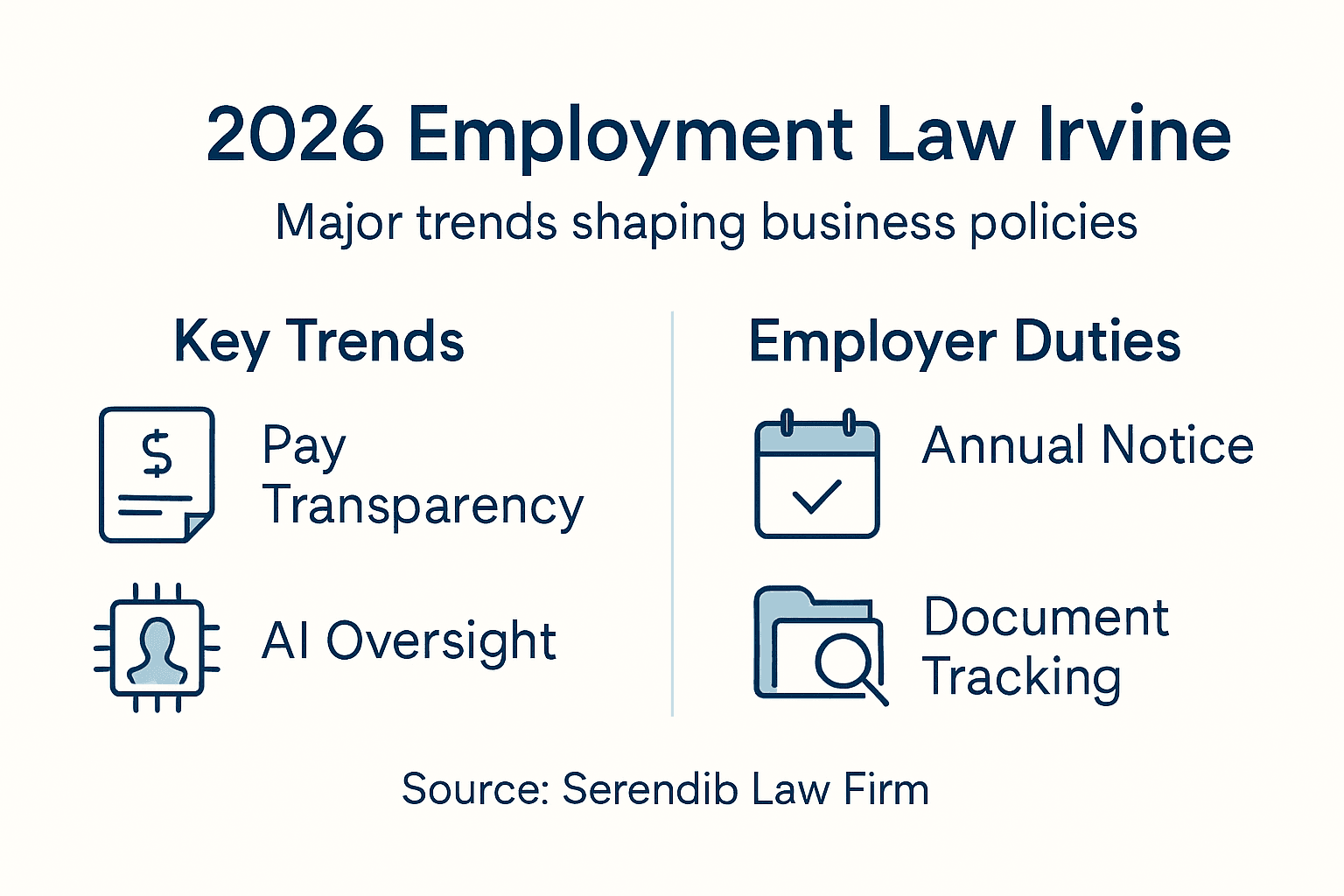
The key employment law trends for Irvine in 2026 center around several critical areas. First, pay transparency has become a non-negotiable requirement, compelling organizations to disclose comprehensive salary ranges and compensation structures. Second, artificial intelligence integration in employment decisions now demands rigorous regulatory compliance, with employers required to demonstrate non-discriminatory algorithmic decision-making processes. Third, workplace mobility and layoff regulations have been significantly enhanced, providing stronger protections for employees during organizational restructuring.
Moreover, Irvine’s tech-centric business ecosystem is experiencing nuanced changes in employment regulations. Companies must now navigate complex requirements around workforce training repayment restrictions, expanded pay-equity rules, and more stringent workplace rights notices. These developments reflect California’s commitment to creating equitable, transparent, and technologically adaptive employment environments.
Pro tip: Conduct a comprehensive audit of your current employment policies at least twice annually to ensure alignment with the rapidly evolving 2026 regulatory landscape.
Major Legislative Changes Affecting Employers
Employers in Irvine are confronting a transformative landscape of legislative changes in 2026, with unprecedented regulatory complexity challenging traditional workforce management strategies. The new legal framework introduces comprehensive shifts that demand immediate and strategic organizational adaptation across multiple dimensions of employment practices.

Several critical legislative modifications are reshaping employer obligations. Senate Bill 294 now mandates annual ‘Know Your Rights’ notices, requiring organizations to provide detailed employee communication protocols. Additionally, new artificial intelligence regulations demand rigorous transparency, compelling employers to conduct mandatory bias audits and demonstrate non-discriminatory automated decision-making processes. These legislative changes specifically target technological integration in employment, ensuring algorithmic fairness and preventing potential discriminatory practices.
Furthermore, immigration and labor reform efforts have introduced stricter visa scrutiny and modified work authorization processes. Employers must now navigate more complex personnel documentation requirements, including expanded definitions of pay scales and enhanced personnel record management under Senate Bills 642 and 513. These statutes significantly increase penalties for noncompliance, creating a high-stakes environment where meticulous adherence to regulatory standards is not just recommended, but essential.
Pro tip: Implement a dedicated compliance team or external consultancy to conduct quarterly legislative reviews and proactively update organizational policies.
Key Court Decisions Reshaping Compliance
The judicial landscape in 2026 is dramatically transforming employment law compliance, with courts delivering landmark rulings that fundamentally redefine employer responsibilities. Judicial interpretations of workplace regulations are creating unprecedented challenges for organizations seeking to navigate increasingly complex legal environments.
Recent court decisions have placed extraordinary emphasis on emerging technological challenges, particularly around artificial intelligence and discrimination claims. Judicial rulings are now scrutinizing algorithmic decision-making processes with unprecedented depth, requiring employers to demonstrate comprehensive transparency in hiring, promotion, and personnel management systems. Specific focus areas include rigorous examination of AI-generated employment screening tools, mandating that automated systems provide clear, non-discriminatory rationales for workforce decisions.
Moreover, the courts have significantly tightened standards surrounding employee classification, wage-payment timing, and enforcement of non-compete agreements. These decisions underscore a broader judicial trend toward enhanced worker protections and more stringent interpretations of existing employment statutes. Employers in Irvine must now implement more sophisticated compliance frameworks that can withstand intense judicial scrutiny, with particular attention to documentation, algorithmic fairness, and precise adherence to evolving legal standards.
Pro tip: Develop a comprehensive legal audit protocol that reviews all employment decision-making algorithms and documentation processes quarterly to ensure ongoing compliance.
New Employer Obligations and Notice Requirements
Employers in Irvine are confronting an unprecedented wave of administrative responsibilities in 2026, with expanded notice requirements transforming traditional workplace communication protocols. Senate Bill 294 introduces comprehensive mandates that fundamentally reshape how organizations interact with and inform their workforce about critical employment rights and protections.
The new legislative framework requires employers to develop and distribute an annual ‘Know Your Rights’ notice covering multiple dimensions of employee protections. This comprehensive document must explicitly address workers’ compensation rights, labor organizing privileges, immigration protections, and emergency contact protocols. Critically, employers must now collect and maintain updated emergency contact information, with explicit provisions for notifying designated contacts if an employee experiences workplace detention or significant regulatory interactions.
Moreover, these obligations extend beyond simple document distribution. Employers must now maintain rigorous documentation proving the delivery and receipt of these notices, with a mandatory three-year retention requirement. Enhanced CalWARN notice requirements demand unprecedented levels of transparency during organizational transitions, compelling businesses to provide detailed disclosures surrounding potential layoffs, structural changes, and workforce reductions. These expanded communication duties represent a significant shift toward increased workplace transparency and employee protection.
Here’s a summary of major 2026 employment law changes impacting Irvine employers:
| Regulatory Area | New Requirement | Employer Impact |
|---|---|---|
| Pay Transparency | Disclose salary ranges and structures | Reduces pay inequity, builds trust |
| Artificial Intelligence | Mandatory bias audits | Minimizes algorithmic discrimination |
| Employee Classification | Stricter standards for roles | Prevents misclassification penalties |
| Notice Documentation | 3-year retention of notice records | Ensures audit readiness, avoids fines |
| Immigration & Labor Reform | Expanded visa and record requirements | Increases admin workload for HR teams |
Pro tip: Develop a centralized digital tracking system that logs notice distributions, captures employee acknowledgments, and maintains a comprehensive audit trail for all required communications.
Top Legal Risks and Mitigation Strategies
Employers in Irvine face an increasingly complex legal landscape in 2026, with emerging risks requiring sophisticated and proactive management strategies. Legal risks surrounding workplace technologies have escalated dramatically, particularly in areas involving artificial intelligence, data privacy, and automated decision-making systems.
The most critical legal vulnerabilities center on technological implementation and algorithmic decision-making processes. Employers must establish comprehensive AI governance frameworks that include detailed bias assessments, transparent documentation, and robust audit trails. This requires creating an official AI register that tracks all automated systems, documents their decision-making logic, and demonstrates ongoing monitoring for potential discriminatory patterns. Organizations must develop granular policies that explicitly outline acceptable technological uses, ensuring each algorithmic tool undergoes rigorous scrutiny before workplace deployment.
Beyond technological risks, employers must navigate complex wage-hour compliance challenges and evolving federal enforcement priorities. Mitigation strategies demand a multifaceted approach, including regular internal audits, comprehensive staff training, and continuous policy refinement. Companies should prioritize creating clear, documented processes that demonstrate proactive compliance efforts, maintaining detailed records of decision-making rationales, employee communications, and systemic checks that prevent potential legal vulnerabilities.
Pro tip: Implement a quarterly technology and compliance review board that systematically evaluates all automated systems, employment algorithms, and potential legal risks before they become problematic.
Preparing Irvine Workplaces for 2026 Changes
Irvine employers must develop comprehensive strategies to navigate the complex legal landscape of 2026, with systematic compliance approaches becoming critical for organizational resilience. The rapidly evolving regulatory environment demands proactive and strategic workplace transformations that address technological, legal, and human resource challenges.
Critical preparation steps include comprehensive policy updates targeting multiple dimensions of employment law. Employers must revise offer letters, employee handbooks, and training repayment policies to align with new regulatory mandates. This requires a holistic approach that encompasses artificial intelligence governance, wage equity considerations, immigration policy shifts, and enhanced employee rights documentation. Organizations should prioritize developing granular policies that explicitly outline technological usage, decision-making protocols, and comprehensive employee protection mechanisms.
Moreover, workplace preparation extends beyond policy documentation. HR departments must invest in extensive staff training programs that educate employees about new rights, obligations, and workplace protections. This includes upgrading information systems to capture required notices, maintaining meticulous emergency contact records, and implementing robust audit trails that demonstrate proactive compliance. Engaging legal counsel becomes essential for navigating the nuanced and dynamic regulatory landscape, ensuring organizations can effectively interpret and implement complex legislative updates.
Pro tip: Create a dedicated compliance task force with cross-departmental representation to continuously monitor and implement regulatory changes in real-time.
Comparison of key compliance strategies for Irvine businesses in 2026:
| Compliance Strategy | Focus Area | Business Benefit | Typical Challenge |
|---|---|---|---|
| Quarterly Legal Reviews | Legislative change monitoring | Early detection of new risks | Time-intensive process |
| Centralized Notice System | Employee communication tracking | Improved transparency, less errors | Requires tech upgrades |
| AI Governance Framework | Tech bias and fairness audits | Reduces legal exposure from AI use | Needs expert oversight |
Stay Ahead of Employment Law Changes in Irvine with Expert Legal Support
Navigating the complex and rapidly evolving employment law trends in Irvine for 2026 is a daunting challenge for many employers. From mandatory pay transparency and rigorous AI bias audits to expanded notice requirements and tightened employee classification rules, the risk of noncompliance can lead to costly penalties and workplace disputes. Understanding these legal demands is crucial to protect your business and your workforce effectively.
At Serendib Law Firm, we specialize in guiding Orange County employers through the latest California employment laws with personalized and proactive strategies. Explore our CA Employment Law Archives | Serendib Law Firm to learn more about key regulations that impact your business. Let us help you create clear policies, maintain proper documentation, and implement compliant procedures to avoid legal risks and build a fair workplace.
Take the next step to secure your company’s future today. Contact us via https://www.serendiblaw.com/ for a free consultation. Our bilingual legal team is ready to help you interpret complex legislation and implement effective solutions tailored to your needs. For broader insights on California law affecting your business landscape, visit our California Employment Law Archives | Serendib Law Firm. Don’t wait until compliance issues arise. Act now to protect your company and employees with trusted legal advocacy.
Frequently Asked Questions
What are the key employment law trends for Irvine in 2026?
The key trends in Irvine include pay transparency mandates, regulatory compliance for artificial intelligence in employment decisions, enhanced employee protections during layoffs, and expanded notice requirements for workplace rights.
How do the new pay transparency laws impact employers?
Employers are now required to disclose comprehensive salary ranges and compensation structures, promoting equity and trust within the workplace while also minimizing potential discrimination claims.
What compliance strategies should businesses implement for AI-related regulations?
Businesses should establish comprehensive AI governance frameworks that include bias assessments, transparent documentation of algorithmic processes, and ongoing monitoring to ensure compliance with anti-discrimination laws.
What are the requirements for the ‘Know Your Rights’ notice for employees?
Employers must develop an annual ‘Know Your Rights’ notice that outlines various employee protections, including workers’ compensation rights and immigration protections, and maintain documentation proving distribution and receipt for three years.
Recommended
- Experienced Irvine Employment Law Attorneys
- Mass Layoffs and WARN Act: What Irvine Tech Firms Face
- Age Discrimination in Irvine Tech Layoffs: Broadcom and Google | Serendib Law Firm
- Non-Compete and Trade Secret Disputes in Cypress Tech | Serendib Law Firm
- remote work interview questions – ParakeetAI
- Understanding Layoff: What It Means for You | siift