

Facing sudden termination after a Performance Improvement Plan can leave tech professionals in Irvine questioning their workplace rights and future prospects. This challenge is made more complex by the unique pressures and expectations within technology roles, where innovation and reputation go hand in hand. Understanding the difference between lawful at-will terminations and wrongful termination protections empowers tech employees to assess their situation, recognize potential legal violations, and make informed decisions about seeking compensation.
Table of Contents
- Defining Wrongful Termination In Tech Roles
- How Performance Improvement Plans Work
- Legal Standards For Termination After A PIP
- Recognizing Retaliation And Discrimination Signs
- Employee Options And Legal Remedies In Irvine
Key Takeaways
| Point | Details |
|---|---|
| Understanding Wrongful Termination | Wrongful termination involves firing that violates employment laws or contracts, with protections for employees against unjust dismissal, especially in tech roles. |
| Performance Improvement Plans (PIPs) | PIPs can be used to document performance issues but may also serve as a tool for termination if goals are unrealistically set. |
| Legal Protections | Employees can challenge wrongful termination through various legal avenues, including filing complaints or pursuing lawsuits, depending on the circumstances. |
| Recognizing Retaliation and Discrimination | Employees should document signs of retaliation and discrimination to protect themselves legally and substantiate their claims. |
Defining Wrongful Termination in Tech Roles
Wrongful termination in tech roles represents a complex legal scenario where an employee is fired under circumstances that violate established employment laws or contractual agreements. While most tech employment remains at-will, meaning companies can terminate staff without specific cause, there are critical exceptions that protect workers from unjust dismissal. Wrongful discharge laws provide significant safeguards for employees, particularly in innovative technology sectors where professional reputation and career trajectory are paramount.
In the context of Irvine’s technology landscape, wrongful termination typically emerges through several distinct scenarios. These include discriminatory firing based on protected characteristics, retaliatory termination after reporting workplace misconduct, dismissal that breaches explicit employment contracts, or firing that violates public policy principles. Performance Improvement Plans (PIPs) can sometimes serve as a potential mechanism for constructive termination, where employers create intentionally unachievable performance standards to push an employee out while maintaining a veneer of procedural legitimacy.
The legal framework surrounding wrongful termination recognizes multiple protected scenarios for tech workers. Wrongful termination occurs when an employee is fired for refusing to commit illegal acts, exercising statutory rights, fulfilling public obligations, or engaging in whistleblowing activities. In the technology sector, this might include scenarios like reporting unethical data practices, refusing to manipulate financial records, or challenging discriminatory workplace policies. Employers cannot legally retaliate against employees who act in good faith to protect professional and ethical standards.
Pro tip: Document every interaction, performance review, and communication during a Performance Improvement Plan to create a comprehensive record that could become critical evidence in potential legal proceedings.
Here’s a comparison of common wrongful termination scenarios in the tech sector:
| Scenario Type | Description | Typical Employee Protection |
|---|---|---|
| Discriminatory Firing | Dismissal based on protected characteristics | Anti-discrimination laws |
| Retaliatory Termination | Firing after reporting misconduct | Whistleblower statutes |
| Breach of Contract | Dismissal violating employment agreements | Contract enforcement mechanisms |
| Violation of Public Policy | Termination for refusing illegal acts | Labor code and public policy |
| Constructive Termination (via PIP) | Forced out with unachievable standards | Evidence and documentation |
How Performance Improvement Plans Work
Performance Improvement Plans (PIPs) are structured management tools designed to address employee performance challenges systematically and transparently. Performance improvement strategies typically follow a comprehensive framework that establishes clear expectations, measurable goals, and specific timelines for professional development. In tech environments like Irvine, these plans serve as critical mechanisms for aligning employee performance with organizational standards while providing a documented pathway for potential remediation or transition.

The typical PIP structure involves several key components that create a comprehensive performance intervention strategy. First, managers document specific performance gaps through detailed evidence and concrete examples of underperformance. Second, they develop SMART performance goals that are Specific, Measurable, Attainable, Realistic, and Time-bound. These goals outline precise expectations, skill improvements needed, and quantifiable metrics that demonstrate successful performance. The plan usually includes regular check-in meetings, typically weekly or biweekly, where supervisors and employees discuss progress, challenges, and potential support mechanisms.
Tech companies often implement PIPs with nuanced approaches that recognize the complex nature of professional performance. While ostensibly designed as improvement tools, PIPs can simultaneously function as formal documentation for potential termination. The plans create a structured environment where employees are given explicit opportunities to meet performance standards, but they also generate a paper trail that can justify employment separation if improvements are not achieved. This dual nature makes PIPs particularly sensitive instruments in tech workplace management, where skill requirements and performance expectations can shift rapidly.
Pro tip: Request a written copy of your Performance Improvement Plan and meticulously document all interactions, completed tasks, and communication during the PIP period to protect your professional interests.
Legal Standards for Termination After a PIP
Legal standards for termination following a Performance Improvement Plan (PIP) in technology sectors demand rigorous procedural fairness and comprehensive documentation. Performance improvement processes require employers to establish clear, measurable performance expectations and provide genuine opportunities for employees to demonstrate improvement. In Irvine’s competitive tech landscape, these standards protect both employer interests and employee rights by ensuring termination decisions are based on objective, well-documented performance metrics rather than arbitrary or discriminatory criteria.
The legal framework surrounding post-PIP termination involves several critical components that safeguard against unlawful dismissal. Employers must demonstrate that the PIP was implemented in good faith, with specific, achievable goals and sufficient support mechanisms. Termination legal standards mandate that performance expectations be realistic, nondiscriminatory, and directly related to job requirements. This means that PIPs cannot be constructed as intentional traps designed to eliminate employees, but must represent genuine attempts to address performance deficiencies and provide meaningful improvement opportunities.
Technology companies must navigate complex legal terrain when considering termination after a PIP. Key legal considerations include ensuring nondiscrimination, protecting against retaliation, and maintaining consistent performance standards across the organization. Employers are required to apply PIP protocols uniformly, document all performance interactions meticulously, and provide clear feedback that allows employees a reasonable chance to meet established performance benchmarks. The burden of proof remains on the employer to demonstrate that termination was justified based on objective performance failures, rather than subjective or prejudicial factors.
Pro tip: Request comprehensive documentation of your PIP, including all performance metrics, feedback sessions, and supporting materials to protect your legal interests and create a transparent record of your performance evaluation process.
Recognizing Retaliation and Discrimination Signs
In the complex landscape of technology workplace dynamics, identifying retaliation and discrimination requires keen awareness and understanding of subtle professional signals. Clear signs of workplace retaliation encompass a range of behaviors that extend beyond overtly hostile actions, often manifesting through nuanced professional interactions. Tech employees in Irvine must remain vigilant about workplace patterns that might indicate systematic attempts to marginalize, punish, or disadvantage employees who have raised concerns or exercised protected legal rights.
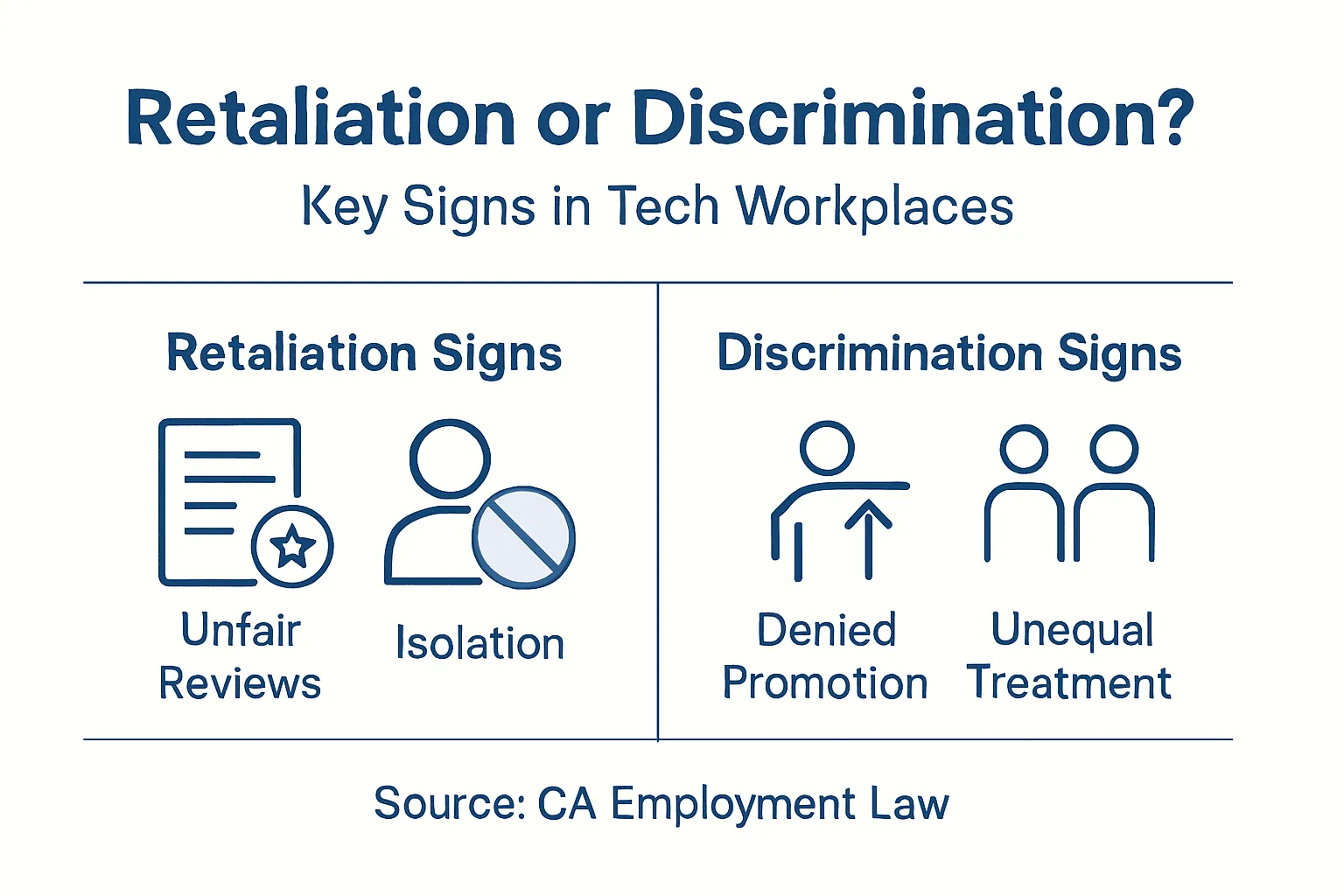
Retaliation typically emerges through strategic workplace maneuvers designed to undermine an employee’s professional standing. These tactics can include sudden exclusion from critical meetings, unexpected negative performance evaluations, unexplained changes in job responsibilities, or micromanagement that creates a hostile work environment. Retaliation in workplace contexts frequently involves calculated actions that appear professional on the surface but are fundamentally designed to create professional obstacles or diminish an employee’s credibility and opportunities for advancement.
Discrimination signs in tech environments often intertwine with retaliatory behaviors, creating complex scenarios that require careful documentation and strategic response. Potential indicators include consistent patterns of unequal treatment, disparate performance expectations, selective enforcement of workplace policies, and subtle but persistent professional marginalization. These behaviors can target employees based on protected characteristics such as gender, race, age, disability status, or previous whistleblowing activities. Recognizing these signs requires a comprehensive understanding of both overt and covert workplace dynamics, with a focus on systematic patterns rather than isolated incidents.
Pro tip: Maintain a confidential, contemporaneous record of all potentially discriminatory or retaliatory interactions, including dates, specific behaviors, witnesses, and potential motivating factors.
Employee Options and Legal Remedies in Irvine
Technology employees in Irvine facing wrongful termination have multiple legal pathways to challenge unjust dismissal and seek appropriate remedies. Wrongful termination claims provide critical protections for workers who have been fired in violation of anti-discrimination laws, retaliation statutes, employment contracts, or public policy principles. These legal options extend beyond simple monetary compensation, offering comprehensive strategies to address workplace injustices and protect professional integrity.
California’s robust employment laws provide employees with several administrative and judicial channels for pursuing legal action. Potential remedies include filing complaints with state agencies like the California Civil Rights Department, initiating administrative proceedings, or pursuing civil litigation. Legal remedies for workers typically encompass a range of outcomes, including monetary damages, potential reinstatement, compensatory awards, and punitive damages designed to penalize employers for egregious misconduct. Tech professionals must carefully document all interactions, performance evaluations, and communications to build a compelling legal case.
Navigating the legal landscape requires strategic consideration of various factors, including statutes of limitations, available evidence, and the specific circumstances of the termination. Tech employees should prioritize gathering comprehensive documentation, including performance records, communication logs, witness statements, and any evidence suggesting discriminatory or retaliatory motivations. Experienced Irvine employment law attorneys can provide crucial guidance in evaluating the strength of a potential claim, understanding procedural requirements, and determining the most appropriate legal strategy for addressing workplace injustices.
Pro tip: Consult with an employment law specialist within 30 days of termination to preserve your legal rights and develop a comprehensive strategy for challenging potentially unlawful dismissal.
Below is a summary of legal remedies available to wrongfully terminated tech employees in Irvine:
| Remedy Type | Process Involved | Potential Outcome |
|---|---|---|
| State Agency Complaint | File with Civil Rights Department | Investigation, possible reinstatement |
| Administrative Hearing | Attend hearing or mediation session | Monetary or injunctive relief |
| Civil Lawsuit | Initiate litigation in court | Damages, penalties, attorney’s fees |
| Attorney Consultation | Seek legal advice and representation | Strategy development and case review |
Protect Your Rights After a PIP in Irvine Tech Jobs
Facing a Performance Improvement Plan that feels more like a setup for wrongful termination is a challenging and stressful experience. If you suspect your dismissal was unfair, retaliatory, or discriminatory, it is critical to understand your rights and act quickly. The article highlighted key terms like wrongful termination, retaliation, and constructive dismissal—issues that demand careful legal attention to ensure your professional future is protected.
At Serendib Law Firm, our experienced team specializes in employment law cases involving retaliation and wrongful termination within the Orange County tech community. We provide personalized guidance to help you document your situation, assess the strength of your claim, and pursue the best possible outcome. Do not wait until it is too late. Learn more about your options in our Retaliation Archives | Serendib Law Firm and explore how we support clients across Irvine and Newport Beach in fighting wrongful dismissal through trusted advocacy (Newport Beach Archives | Serendib Law Firm).
Take the first step toward regaining control of your career by contacting us today. Visit Serendib Law Firm to schedule your free consultation and protect your future with skilled legal support.
Frequently Asked Questions
What constitutes wrongful termination after a Performance Improvement Plan (PIP)?
Wrongful termination after a PIP occurs when an employee is dismissed for illegal reasons, such as discrimination or retaliation for reporting misconduct, or if the PIP was structured unfairly with unachievable goals.
How can I prove that my termination was wrongful after a PIP?
To prove wrongful termination, you should gather documentation including your PIP details, performance evaluations, communication logs, and any evidence indicating discriminatory or retaliatory motives for your termination.
What are my legal rights if I believe I’ve been wrongfully terminated after a PIP?
You have the right to file a complaint with state agencies, pursue administrative hearings, or initiate civil lawsuits for wrongful termination, especially if your dismissal violated employment contracts, anti-discrimination laws, or public policy.
What steps should I take immediately after being terminated following a PIP?
You should document all details about your termination, consult with an employment law attorney to understand your options, and consider filing a legal claim swiftly, as there are specific time limits for taking action.