
Long shifts at Anaheim hotels and convention centers often mean working well past your scheduled hours, yet overtime pay can disappear without clear explanation. This happens when employers ignore or exploit laws designed to protect hospitality workers like you. California overtime laws require at least one and one-half times your regular pay for any hours beyond 8 in a day or 40 in a week, making it crucial to know if you are missing wages. Understanding your rights is the first step to reclaiming what you have earned.
Table of Contents
- Defining Unpaid Overtime for Anaheim Hospitality Workers
- Overtime Laws Impacting Anaheim Hotel Employees
- How Employers Misclassify or Deny Overtime Pay
- Employee Rights and Steps to File Overtime Claims
- Risks, Deadlines, and Common Employer Defenses
Key Takeaways
| Point | Details |
|---|---|
| Unpaid Overtime Definition | Unpaid overtime refers to hours worked beyond 8 in a day or 40 in a week without proper compensation, requiring employers to pay one and one-half times the regular rate for such hours. |
| Employee Rights | California law offers strong protections for workers; retaliation against those who file claims or report violations is illegal, and employers cannot waive these rights. |
| Misclassification Risks | Many hospitality employers misclassify workers as exempt to avoid paying overtime, which can lead to significant wage losses for affected employees. |
| Claim Filing Process | Workers can file claims for unpaid wages with California’s labor enforcement agency, with timelines typically requiring action within three years of the violation. |
Defining Unpaid Overtime for Anaheim Hospitality Workers
You’ve probably heard the term “unpaid overtime” thrown around, but what does it actually mean in the hospitality context? In California, unpaid overtime refers to work hours that employers fail to compensate at the legally required rate. Specifically, hours worked beyond 8 in a single day or 40 in a workweek for nonexempt employees trigger overtime pay obligations. As a hotel or convention center worker in Anaheim, this distinction matters enormously because it determines whether you’re owed back wages. The law treats these excess hours differently from regular work. You must receive compensation at one and one-half times your regular rate for overtime hours. This isn’t optional for employers. It’s a legal requirement that applies across the hospitality industry unless you fall into a specific exemption category, which most front-line hospitality workers do not.
Understanding what constitutes your “regular rate” is crucial for calculating what you’re actually owed. Your regular rate includes your base hourly wage, salary components, and any commissions. The critical part: this regular rate can never be lower than California’s minimum wage. The Fair Labor Standards Act establishes federal overtime standards requiring one and one-half times regular pay for work beyond 40 hours weekly, which serves as a baseline. California often provides stronger protections than federal law, so you benefit from whichever standard is more favorable. If you work as a housekeeper, server, bartender, front desk clerk, or in any other nonexempt position at Anaheim’s hotels and convention centers, these rules apply to you. Some employers misclassify positions as exempt to avoid paying overtime, which is illegal. The hospitality industry is notorious for this practice, with management sometimes claiming that particular roles don’t qualify for overtime protection. That’s rarely accurate for typical hospitality positions.
Unpaid overtime accumulates in multiple ways throughout your employment. Maybe your manager scheduled you for 12-hour shifts on certain days but never calculated the extra 4 hours daily at the overtime rate. Perhaps you worked through meal breaks or stayed late completing side work without compensation adjustments. Your employer might have simply failed to pay the proper overtime rate even when hours exceeded the threshold. Wage and hour violations in hospitality are remarkably common, sometimes due to poor payroll systems but often from deliberate practices to reduce labor costs. When you identify unpaid overtime, you’re looking at weeks, months, or even years of underpayment depending on when the violation began. Each unpaid hour represents real money owed to you. Documentation matters significantly here. Keep records of the actual hours you worked, not what your time sheet shows if it differs. Text messages to coworkers, personal calendars, or manager communications all help establish what you actually worked. Understanding wage and hour violations requires knowing specific rules around compensation that many employers ignore deliberately.
Pro tip: Start documenting your actual work hours immediately in a personal record separate from your employer’s system, noting the date, time in, time out, and any tasks completed after your scheduled shift ends, as this creates independent evidence if you need to file an unpaid overtime claim.
Overtime Laws Impacting Anaheim Hotel Employees
Anaheim’s hotel workers operate under some of the strongest labor protections in the nation, yet many employees don’t fully understand what these laws guarantee them. California Labor Code Section 510 forms the backbone of your overtime rights, and it’s considerably more protective than federal law. Under this statute, California’s overtime laws require compensation for hours exceeding 8 daily or 40 weekly. What makes this different from federal standards is the daily threshold. Federal law only requires overtime after 40 hours per week, but California recognizes that a 12-hour shift on Monday creates immediate overtime liability, regardless of how many hours you work the rest of the week. As a hotel employee in Anaheim, this distinction directly impacts your paycheck. If you work the front desk, housekeeping, food service, or any other nonexempt position, these protections apply automatically to your employment. Your employer cannot waive these rights, and no agreement you sign can eliminate them.
The law also includes what’s called double-time compensation, which kicks in after 12 hours in a single day or when you work your seventh consecutive day without a break. This provision addresses the grueling schedules common in hospitality where managers might pressure employees into working extended shifts. If you work Monday through Sunday without a day off, the seventh day work automatically qualifies for double-time pay regardless of daily hours. Similarly, once you hit 12 hours in a day, every minute beyond that point pays at two times your regular rate, not merely time and a half. Convention centers and large hotels in Anaheim frequently schedule workers without adequate breaks or days off, making this provision critical to understand. The double-time pay protection after 12 hours in a workday exists specifically because employers would otherwise exhaust their workforce with minimal compensation increases. This structure incentivizes employers to hire additional staff rather than forcing overwork on existing employees.
Your employer cannot classify you as exempt just to avoid these obligations. Many Anaheim hotels attempt this illegal practice, claiming that certain positions don’t qualify for overtime protection. They might argue that your role involves supervisory duties or specialized knowledge, therefore exempting you from overtime requirements. These exemptions exist, but they’re narrow and specific. You’re likely not exempt unless you make significantly more money than typical hotel workers in your position, spend your day performing actual management functions, or hold a genuine professional license. Front-line hospitality workers, regardless of job title, typically qualify for full overtime protections. The law also mandates that your regular rate used for overtime calculations includes all compensation you receive, not just base hourly wages. Bonuses, commissions, and shift differentials all factor into your overtime rate calculation. This prevents employers from artificially suppressing their overtime liability by paying bonuses instead of raising base wages.
The Division of Labor Standards Enforcement actively enforces these protections and maintains detailed guidance on employer duties. If your hotel fails to comply with these requirements, you have multiple avenues to address the violation. Understanding scheduling practices that create unlawful overtime patterns helps you recognize when your employer violates these standards. Many Anaheim hospitality employers have faced significant lawsuits over systematic overtime violations, with employees recovering thousands or even tens of thousands of dollars in back wages and penalties. These cases succeed because the violations are typically deliberate and documented in payroll records. Your employer knows these laws exist, yet chooses not to comply because the penalties have sometimes been less painful than properly staffing their operations.
Pro tip: Obtain copies of your pay stubs and timesheets from the past two or three years and compare the hours shown to what you actually worked, noting any days over 8 hours that didn’t result in overtime pay, as this creates a clear pattern of violation when presented to legal counsel.
Here’s a quick comparison between California and Federal overtime laws as they impact Anaheim hospitality workers:
| Criteria | California Law | Federal Law |
|---|---|---|
| Overtime threshold | Over 8 hours/day or 40/week | Over 40 hours/week only |
| Double-time pay | After 12 hours/day or 7th day | Not required by federal law |
| Coverage | Most nonexempt workers | Most nonexempt workers |
| Protection strength | Strong labor protections | Serves as a minimum standard |
How Employers Misclassify or Deny Overtime Pay
Misclassification is the most common weapon Anaheim hospitality employers use to strip workers of overtime pay. Your boss might call you an “independent contractor” when you should be classified as an employee, or label you “exempt” when you clearly qualify for overtime protection. The distinction matters enormously because misclassification denies workers rights to overtime pay and other benefits. If you’re a true employee, you’re economically dependent on your employer for income and entitled to labor law protections. Independent contractors, by contrast, are self-employed and work with multiple clients. Yet many Anaheim hotels deliberately blur this line, treating employees like contractors to avoid payroll taxes, workers compensation insurance, and overtime obligations. A housekeeper who works exclusively for one hotel, follows the hotel’s schedules, uses the hotel’s cleaning supplies, and reports to a manager is an employee, not a contractor. No written agreement changes that reality. Courts look at actual working conditions, not what your pay stub says.
The exempt employee misclassification happens constantly in hospitality settings. Employers promote someone to “supervisor” or “assistant manager” status, give them a marginal raise, and suddenly claim they don’t qualify for overtime. The problem is that California law has strict requirements for exemption. You’re only exempt if you earn significantly more than the minimum salary threshold, spend the majority of your time performing actual management functions like hiring or discipline decisions, and exercise independent judgment. A front desk worker who occasionally opens or closes the shift, answers some employee questions, and gets a small title bump doesn’t meet these criteria. Neither does a server promoted to “lead server” or a housekeeper promoted to “housekeeping coordinator.” These titles exist primarily to deny overtime compensation to workers who still perform the same tasks as their peers. The employer knows this is illegal, but counts on workers not understanding their rights or lacking resources to challenge the classification.
Another tactic involves denying overtime through deliberate record falsification. Your manager might tell you to clock out before completing assigned side work, or pressure you into working off the clock. Perhaps your timesheet mysteriously shows 8 hours when you worked 10. Some hotels implement scheduling systems designed to keep workers under 8 hours daily and 40 hours weekly on paper, while actual work expectations exceed those thresholds. You work the extra time but receive no overtime compensation because the records don’t reflect reality. This scheme works especially well with workers who are undocumented, speak limited English, or fear retaliation. The employer counts on silence. Employer misclassification strategies often target vulnerable populations in hospitality who lack knowledge about their rights or fear job loss.
Understanding the true test for exemption helps you recognize when your employer violates the law. Ask yourself these questions about your daily responsibilities. Do you regularly make hiring or firing decisions? Do you perform discipline interviews? Do you set schedules or approve time off? Do you have authority to override established procedures? Do you spend more than 50 percent of your time on nonmanual, non-supervisory work? If you answered “no” to most of these, you’re not exempt regardless of your job title. Misclassification as a manager when you lack genuine supervisory authority is rampant in hospitality and grounds for successful litigation. Document what you actually do daily. Write down the specific tasks, the time spent on each, and who has ultimate decision-making authority. This documentation proves what your job actually entails, destroying the employer’s claimed exemption. When combined with payroll records showing unpaid overtime hours, this evidence creates an ironclad case for wage violations and misclassification damages.
Pro tip: Request and save emails or messages where managers discuss scheduling you for extra hours, tell you to “stay late,” or mention staffing problems, as these communications prove the employer knew you worked beyond 8 hours daily but failed to compensate you accordingly.
To help you recognize and address misclassification, here are key differences between exempt and nonexempt roles in hospitality:
| Aspect | Exempt Position | Nonexempt Position |
|---|---|---|
| Overtime eligibility | Not entitled to overtime | Entitled to overtime pay |
| Primary duties | Managerial, supervisory | Routine front-line tasks |
| Salary threshold | Must meet higher earnings | Can be hourly or lower wage |
| Decision authority | Independent judgment | Follows established procedures |
Employee Rights and Steps to File Overtime Claims
You have concrete rights when your Anaheim hospitality employer refuses to pay overtime wages, and the law provides multiple pathways to recover what you’re owed. First, understand that retaliation is illegal. Your employer cannot fire you, reduce your hours, cut your pay, demote you, or treat you poorly because you filed an overtime claim or complained about wage violations. This protection exists because employers would otherwise silence workers through intimidation. If your boss retaliates after you file a claim, that retaliation itself becomes a separate violation with additional damages. You also have the right to file complaints with California’s labor enforcement agency without needing to hire an attorney first. The California Division of Labor Standards Enforcement investigates wage violations and can compel employers to pay back wages plus penalties. This process is free and available to all workers regardless of immigration status.
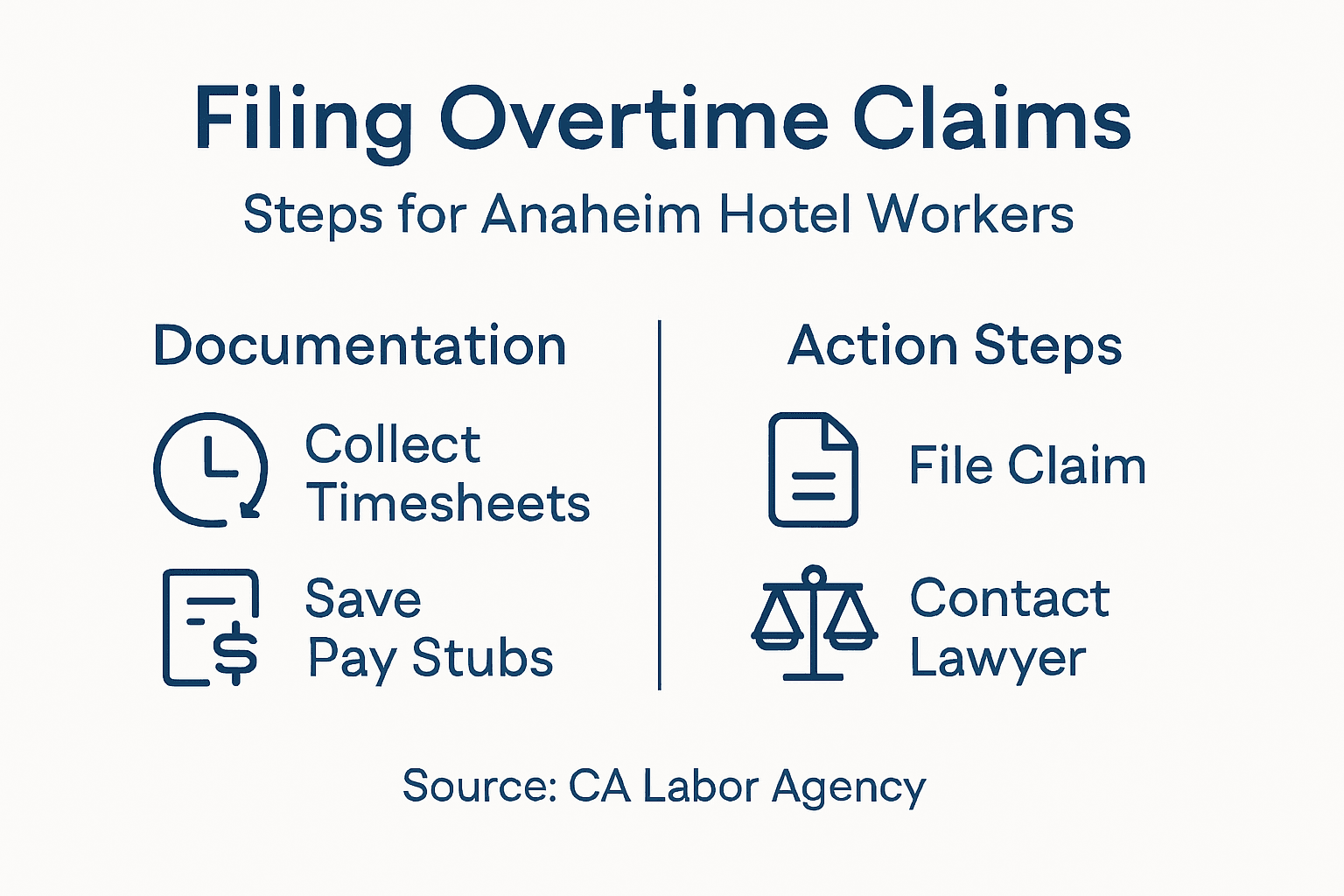
The practical steps to file a claim begin with documentation. Gather everything that proves unpaid overtime. Collect your pay stubs from the past several years, noting the hours shown versus what you actually worked. Retrieve any timesheets, scheduling records, or emails from managers mentioning when you worked. Text messages with coworkers discussing shifts, personal calendar entries showing when you worked, or photos timestamped from your workplace all create evidence. Write a detailed timeline of when unpaid overtime occurred, listing specific dates, hours worked, and hourly rate. Calculate what you believe you’re owed by multiplying unpaid overtime hours by one and one-half times your regular rate. Include double-time hours if applicable. This self-calculation gives you a baseline for your claim, though the agency will recalculate officially. Next, contact the Division of Labor Standards Enforcement directly. You can file a wage claim through their website, by mail, or in person. They provide forms and guidance in multiple languages including Spanish. Be specific about what happened. Describe which employer (include the hotel name and location), what positions you held, when the violation occurred, and how many hours went unpaid. The DLSE will then investigate, which may include interviewing your employer and demanding payroll records.
Alternatively, you can pursue unpaid overtime claims through private legal action with an employment attorney who specializes in wage and hour cases. Many hospitality workers prefer this route because attorneys can pursue larger damages, including penalties and attorney fees paid by the employer. Most employment attorneys handling wage claims work on a contingency basis, meaning you pay nothing unless you win or settle. This removes the financial barrier to getting legal representation. Your attorney will demand the same documentation you would provide to the DLSE, but they can also file lawsuits, negotiate settlements, and pressure employers more effectively. Some cases settle for thousands of dollars because employers know they will lose. Be aware that there are applicable statute of limitations on when you can file claims, which should be evaluated on a case by case basis with an attorney.
Throughout this process, protect yourself strategically. Do not discuss your overtime claim with coworkers where management might overhear. Do not post about it on social media. Keep all communications about the claim in writing (emails are better than verbal conversations). If your manager pressures you about the claim or your employment situation changes negatively after filing, document that immediately. Take screenshots of emails, write down dates and times of conversations, and record what was said. These communications prove retaliation. Consider requesting reasonable accommodations if filing the claim creates stress, and use any employee assistance programs your employer offers. Some workers consult with an attorney before filing a complaint to understand their options and protections. This costs little and provides clarity about which path makes sense for your situation.
Pro tip: Before filing any claim, create a backup copy of all documentation on a personal cloud storage account or external drive separate from your work computer or work email, ensuring the evidence cannot be deleted or altered by your employer even if they terminate your access to company systems.
Risks, Deadlines, and Common Employer Defenses
Time is your enemy in unpaid overtime claims. You cannot wait indefinitely to assert your rights because strict legal deadlines apply. Under both California and federal law, statute of limitations deadlines typically allow three years to file regular overtime claims, though willful violations extend to four years. This means if your employer denied overtime pay starting in 2021, you must file by 2024 to recover those wages. Every month you delay reduces the total amount you can recover. If you wait five years, you’ve lost one full year of potential damages that your employer should have paid. The clock starts from the last date you worked unpaid overtime, not from when you first realized the violation. Many workers lose thousands of dollars simply because they waited too long to act. Once the deadline passes, that money is gone forever, no matter how egregious the violation. Consult with an attorney immediately if you believe you’re owed unpaid overtime. They can evaluate your specific situation and determine the exact deadline that applies to your case.
Employers deploy predictable defenses when facing overtime claims, and understanding these tactics helps you prepare. The most common defense is claiming you were exempt from overtime requirements. Your employer will argue that your job duties qualified you for the administrative or executive exemption, therefore overtime rules didn’t apply to you. They’ll point to your job title, your responsibilities during certain periods, or your compensation to support this claim. However, exemptions require specific criteria. You must earn at least the minimum salary threshold California establishes, spend the majority of your worktime on genuine managerial or administrative duties, and exercise independent judgment in important matters. A front desk supervisor who still works shifts alongside regular employees, follows established scripts and procedures, and reports all decisions to general management doesn’t qualify for exemption. Employers often mischaracterize job responsibilities or exaggerate the independence workers actually exercised. Another common defense involves disputing your hours. Your employer will claim you didn’t actually work the hours you’re claiming, or that timesheets accurately recorded your time even though you know they don’t. They might argue that you clocked out before finishing assigned work, suggesting you voluntarily stayed past your shift without request from management. This defense collapses when you have documentation like text messages from managers assigning tasks, photos timestamped from the workplace showing you there, or coworker testimony about schedules. They may also challenge your regular rate calculation, arguing certain bonuses or compensation shouldn’t be included. California law is clear that virtually all compensation counts toward your regular rate.
Retaliation represents a separate legal risk you face after filing a claim. Retaliation against employees for asserting their wage and hour rights is strictly prohibited, yet employers do it anyway because many workers don’t recognize retaliation or don’t know how to document it. After you file an overtime claim, your employer might reduce your hours, assign you worse shifts, give you additional work without compensation, exclude you from meetings or opportunities, or create a hostile work environment. They might even fire you, though termination immediately following a claim filing creates obvious evidence of retaliation. More subtle retaliation includes negative performance reviews on issues never previously mentioned, sudden discipline for minor infractions others commit without consequence, or being passed over for promotions given to less qualified colleagues. The key to proving retaliation is timing and documentation. If your employer treats you worse after the claim becomes known, that timing suggests retaliation. Save every email, text, and performance document. Write down conversations with dates and what was said. Notify your employer in writing if you believe you’re experiencing retaliation, creating a paper trail. Some workers face immigration-related threats or suggestions that filing claims will result in immigration reporting. This is illegal retaliation and amplifies your damages claim significantly.
The risks of filing extend beyond the employer’s defenses. Your wages might be temporarily withheld during disputes, creating financial pressure to accept low settlement offers. Your emotional stress increases, particularly if you fear retaliation or job loss. Your professional relationships at the workplace change, sometimes creating isolation from coworkers who fear association with you. These consequences are real and serious, which is why having legal representation makes a substantial difference. An attorney shields you from direct interaction with your employer’s legal team, handles communications, and protects you from self-incriminating statements. They also ensure you don’t accept inadequate settlement offers under pressure. Most importantly, they preserve all your legal options and maximize your recovery. Some workers pursue administrative claims through the Division of Labor Standards Enforcement first, which is free but slower. Others file directly with an employment attorney using contingency representation, which costs nothing upfront but may resolve faster. Understanding your specific situation, the strength of your evidence, and the applicable deadlines requires professional evaluation. Every case differs based on when violations occurred, how many hours were involved, your documentation quality, and your employer’s willingness to negotiate.
Pro tip: Calculate your potential recovery by counting every day you worked beyond 8 hours in the past three years, multiplying those hours by one and one-half times your regular hourly rate, then add any double-time hours after 12 daily or seventh consecutive workday hours, as this number represents what you’re legally owed and helps you evaluate settlement offers.
Protect Your Right to Fair Overtime Pay in Anaheim Hospitality
If you have faced unpaid overtime or suspect your employer is misclassifying your role to deny rightful wages, you are not alone. Many Anaheim hospitality workers experience wage violations such as missed overtime pay or unlawful exemptions. Understanding your rights under California’s strong labor laws is the first step to securing the compensation you deserve. Key issues like daily overtime beyond 8 hours, double-time after 12 hours, and employer misclassification require careful attention to detail and expert guidance.
At Serendib Law Firm, we are committed to advocating fiercely for Anaheim employees facing unpaid overtime and wage disputes. Explore insights on wage violations or learn how these issues impact workers specifically in Anaheim through our Anaheim Archives. Do not delay addressing your claim since strict deadlines limit your ability to recover lost wages. Visit Serendib Law Firm to schedule your free consultation today. Empower yourself with trusted legal representation now and ensure your employer upholds their duties to pay you what you are owed.
Frequently Asked Questions
What is unpaid overtime in the context of hospitality workers?
Unpaid overtime refers to hours worked beyond 8 in a single day or 40 in a workweek that employers fail to compensate at the legally required overtime rate. In the hospitality industry, it is crucial for employees to understand their rights to compensation for these extra hours.
How can I prove that I have worked unpaid overtime?
To prove unpaid overtime, it is important to keep detailed records of your actual hours worked, including dates, times in and out, and tasks completed after your shift ends. Documentation such as text messages to coworkers, personal calendars, and manager communications can significantly support your claim.
What are the steps to file an unpaid overtime claim?
To file an unpaid overtime claim, you should first gather documentation of unpaid hours, such as pay stubs and timesheets. Then, you can file a complaint with the California Division of Labor Standards Enforcement or consult with an employment attorney to evaluate your case and potentially pursue legal action.
What protections do I have if my employer retaliates against me for filing an overtime claim?
If your employer retaliates against you for filing an overtime claim, they are violating the law. You have the right to report this retaliation, and it can become a separate legal violation that may result in additional damages. Keep records of any negative changes in your employment status that occur after filing a claim.