

Facing unexpected job loss in Irvine can leave corporate employees with more questions than answers, especially when advance notice seems lacking. Understanding the WARN Act matters because it sets clear rules for how employers must handle mass layoffs, aiming to give workers and their families time to prepare for change. This guide explains what qualifies as a WARN Act violation, the differences between federal and California protections, and what steps you can take to assert your rights if your employer falls short.
Table of Contents
- Defining WARN Act Violations And Mass Layoffs
- Federal Vs. California WARN Act Differences
- Notice Requirements For Irvine Employers
- Risks, Penalties, And Employee Remedies
- Legal Action Steps For Affected Workers
Key Takeaways
| Point | Details |
|---|---|
| WARN Act Overview | The WARN Act requires employers with 100 or more employees to provide a 60-day notice before mass layoffs, defined as affecting 50-499 employees or 33% of the workforce. |
| California WARN Act Nuances | California’s WARN Act has stricter requirements than the federal law, covering employers with 75+ employees and including additional protections for workers. |
| Notification Process | Employers must deliver a detailed 60-day written notice to affected employees, local workforce boards, and government officials, ensuring compliance to avoid penalties. |
| Consequences of Non-Compliance | Violating WARN Act provisions can lead to significant financial penalties, including back pay for affected workers and legal action against employers. |
Defining WARN Act Violations and Mass Layoffs
The Worker Adjustment and Retraining Notification (WARN) Act provides critical legal protections for employees facing significant workplace disruptions. Advance notice requirements mandate that employers with 100 or more workers provide 60 days warning before mass layoffs or plant closures, ensuring workers have time to prepare for potential job loss.
Under the WARN Act, a mass layoff is specifically defined as a workforce reduction that meets precise legal criteria:
- Impacts 50-499 employees at a single employment site
- Represents at least 33% of the total workforce at that location
- Involves an involuntary termination or significant reduction in work hours
The legal definition of employment loss under this act is comprehensive and includes several scenarios:
- Permanent termination
- Layoffs exceeding six months
- Reduction of work hours by more than 50% within a six-month period
Corporate layoffs in Irvine’s tech sector must carefully navigate these complex regulatory requirements. Failure to provide proper notification can result in significant financial penalties and potential legal action against the employer.

Pro tip: If you suspect your employer is violating WARN Act requirements, document all communication and consult with an employment law specialist immediately to understand your potential rights and remedies.
Federal vs. California WARN Act Differences
The California WARN Act introduces more stringent requirements compared to its federal counterpart, creating unique challenges for employers in the state. State-specific notification rules demonstrate significant variations that can dramatically impact corporate layoff procedures in Irvine’s tech sector.
Key differences between federal and California WARN Act regulations include:
- Employer Coverage Threshold: Federal law applies to companies with 100+ employees, while California covers employers with 75+ employees
- Notification Requirements: Both mandate 60-day advance notice, but California imposes more comprehensive reporting
- Geographic Considerations: California requires notices for relocations over 100 miles, regardless of employee count
The California version provides additional worker protections not found in the federal statute:
- Expanded definition of employment termination
- Mandatory wage and benefit continuation
- More detailed reporting to state agencies
Enforcement mechanisms also differ substantially. While federal WARN Act violations are handled through federal courts, California empowers the Labor Commissioner to directly oversee and enforce compliance, creating a more robust regulatory environment.
This table highlights core differences between the Federal and California WARN Acts for quick reference:
| Criteria | Federal WARN Act | California WARN Act |
|---|---|---|
| Employer Size | 100+ employees | 75+ employees |
| Types of Notice | Plant closures, mass layoffs | Closures, layoffs, relocations |
| Geographic Rule | No relocation clause | Notice for relocations over 100 miles |
| Enforcement | Federal court | Labor Commissioner oversight |
California’s WARN Act essentially provides a safety net that extends beyond federal protections, offering more comprehensive safeguards for employees facing potential job loss.
Pro tip: Consult with an employment law specialist who understands both federal and California WARN Act nuances to ensure full compliance and protect your workplace rights.
Notice Requirements for Irvine Employers
Irvine employers must navigate complex WARN Act notification requirements with precision and care. Detailed layoff notice protocols mandate comprehensive communication strategies that protect both employers and employees during workforce transitions.
The notification process involves multiple critical steps:
- Providing 60-day advance written notice to all affected employees
- Submitting formal notifications to the Employment Development Department (EDD)
- Informing local workforce development boards
- Notifying chief elected officials in affected jurisdictions
Specific content requirements for WARN Act notices include:
- Total number of employees being terminated
- Job titles and departments affected
- Whether layoffs are permanent or temporary
- Expected separation schedule
- Contact information for additional information
Notification details must be extraordinarily precise. Employers must describe the exact nature of the layoff, including potential recall possibilities, precise job classifications, and the specific business circumstances driving the workforce reduction.
California’s stringent notification requirements underscore the importance of transparent and comprehensive workforce communication during organizational changes.
Pro tip: Maintain meticulous documentation of all WARN Act notification communications to protect your organization from potential legal challenges.
Risks, Penalties, and Employee Remedies
Employers who violate the WARN Act face significant financial and legal consequences. Employer liability for mass layoffs can result in substantial penalties that extend far beyond simple monetary damages.
Key penalties for WARN Act violations include:
- Back pay for affected employees up to 60 days
- Civil penalties of $500 per day of violation
- Potential legal action by employees or their representatives
- Mandatory notification penalties to local government units
Specific financial risks for non-compliance encompass:
- Mandatory compensation for lost wages
- Continuation of health benefits
- Potential additional compensatory damages
- Legal fees and court costs
Employee remedies are designed to provide meaningful protection and compensation. Workers may pursue multiple avenues of recourse, including filing administrative complaints with state labor departments or initiating private lawsuits seeking back pay and benefits.
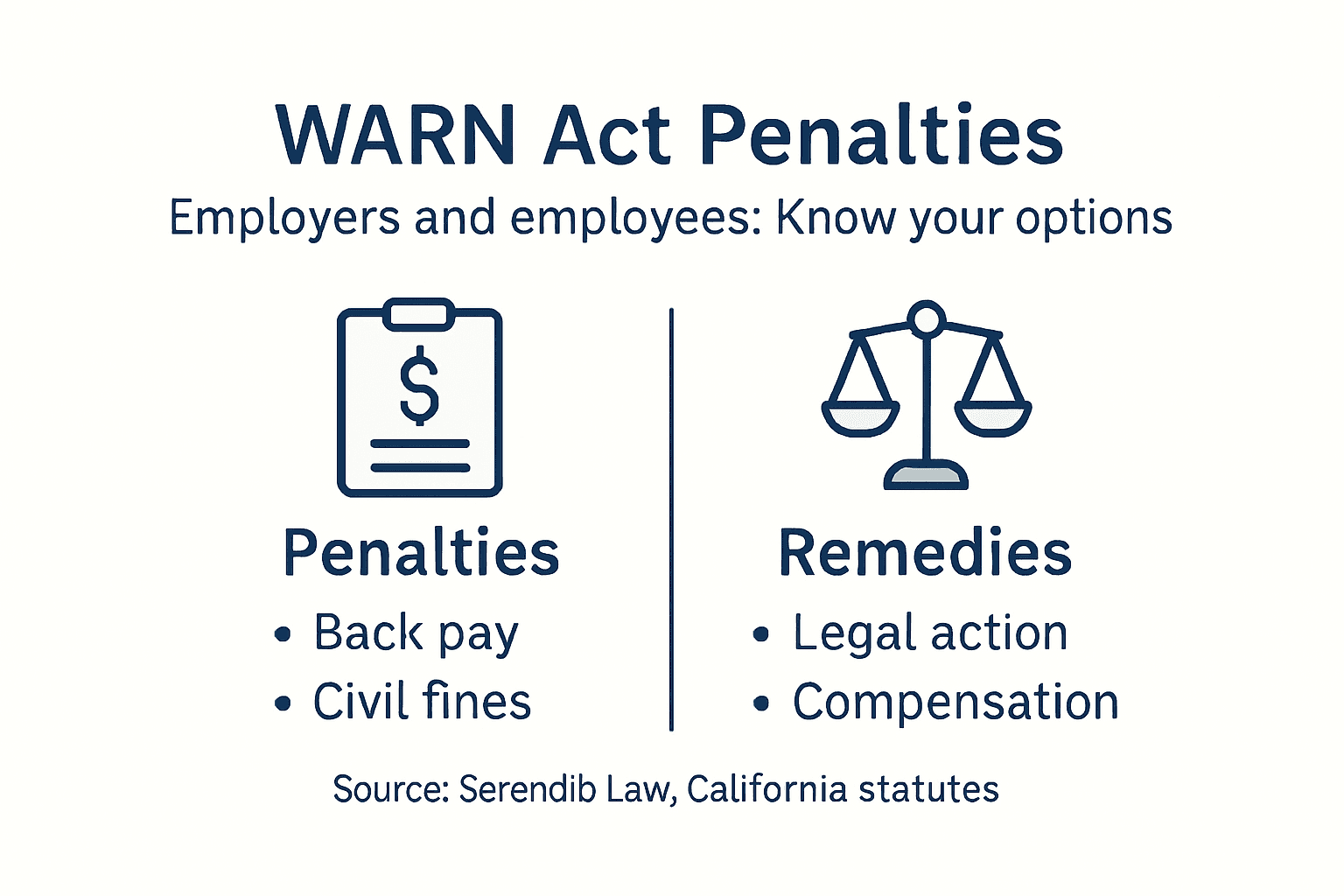
Here is a summary of potential penalties and remedies for WARN Act violations:
| Consequence | Applies To | Impact |
|---|---|---|
| Back pay | Affected employees | Up to 60 days lost wages |
| Civil penalties | Employer | $500 per day of non-compliance |
| Health benefits extension | Workers | Protection for lost coverage |
| Legal action | Both sides | Lawsuits or administrative complaints |
WARN Act violations can create substantial financial exposure for employers, making proactive compliance critical for avoiding expensive legal challenges.
Pro tip: Document every step of your workforce reduction process and consult with employment law specialists before implementing any mass layoff strategy.
Legal Action Steps for Affected Workers
Workers confronting WARN Act violations have several critical legal pathways to seek justice and compensation. Federal court remedies provide multiple strategies for addressing employer non-compliance and protecting employee rights.
Initial legal action steps include:
- Documenting all communication related to the layoff
- Preserving employment records and notices
- Gathering evidence of insufficient WARN Act notification
- Consulting with an employment law specialist
Employees can pursue legal remedies through multiple channels:
- Filing civil lawsuits in federal court
- Seeking back pay for up to 60 days
- Requesting continuation of health benefits
- Recovering potential attorney fees
- Demanding civil penalties against the employer
Legal proceedings require strategic preparation and timely action. Workers must typically file claims within specific timeframes, making prompt consultation with legal professionals essential for protecting their rights and potential compensation.
Proactive documentation and swift legal response can significantly enhance an employee’s ability to recover damages and hold non-compliant employers accountable.
Pro tip: Collect and preserve all employment-related documents immediately after receiving notice of layoff, as these will be crucial evidence in potential legal proceedings.
Protect Your Rights During Irvine Corporate Layoffs
Facing a mass layoff or plant closure subject to the WARN Act can be overwhelming and uncertain. This article highlights the complex legal requirements employers in Irvine must follow, including strict notice provisions under both federal and California WARN Acts. If you worry your employer may not have provided the proper 60-day advance warning or if you face potential wage and benefit losses, you are not alone.
At Serendib Law Firm, we understand the stress and financial risks that come with WARN Act violations. Our experienced attorneys provide trusted guidance on employment law matters including wage violations, ensuring you know your rights and remedies. Whether you need help navigating layoff notice issues or pursuing compensation, our Orange County legal team is ready to support you. Visit our Wage Violations Archives | Serendib Law Firm and Orange County Archives | Serendib Law Firm to learn more about how we protect workers across the region.
Do not wait until it is too late. Take control of your situation by contacting us today at Serendib Law Firm to schedule a free consultation with an employment law expert who can help you act promptly and secure the compensation and protection you deserve.
Frequently Asked Questions
What constitutes a WARN Act violation?
A WARN Act violation occurs when an employer fails to provide the required 60 days advance notice to employees before a mass layoff or plant closure, as specified by the law.
How do I know if my employer has violated the WARN Act?
You can suspect a violation if your employer does not provide written notice 60 days in advance of a mass layoff or if they do not meet the minimum employee impact criteria defined by the WARN Act.
What are the penalties for employers who violate the WARN Act?
Employers who violate the WARN Act may face penalties including back pay for affected employees for up to 60 days, civil penalties of $500 per day of non-compliance, and potential legal actions from employees.
What steps can employees take if they believe their WARN Act rights have been violated?
Employees should document all communications related to the layoff, gather evidence of any insufficient notifications, and consult with an employment law specialist to explore options for legal recourse.