

Facing job loss after standing up for your health can feel overwhelming, especially in Huntington Beach where recovering from a work injury should not cost you your livelihood. California law, including Labor Code section 132a, clearly prohibits employers from firing or discriminating against employees for filing workers’ compensation claims. This article helps you understand what defines wrongful termination, highlights legal protections, and guides you through proven steps if your job was put at risk for exercising your rights.
Table of Contents
- Defining Wrongful Termination After Workers’ Comp
- California Legal Protections Against Retaliation
- Recognizing Employer Retaliation And Discrimination Tactics
- Employee Rights After Filing Workers’ Comp Claims
- Filing Complaints And Pursuing Legal Remedies
Key Takeaways
| Point | Details |
|---|---|
| Wrongful Termination Defined | Employers cannot fire employees for filing workers’ compensation claims, as this violates California law. |
| Robust Legal Protections | California law offers strong protections against retaliation, including reinstatement and monetary compensation for affected employees. |
| Recognizing Retaliation Tactics | Workers should be aware of both subtle and overt retaliation strategies that may undermine their professional standing. |
| Pursuing Legal Remedies | Employees have multiple avenues to file complaints and seek justice if they experience wrongful termination after workers’ compensation claims. |
Defining wrongful termination after workers’ comp
In Huntington Beach and throughout California, wrongful termination after a workers’ compensation claim represents a serious legal violation. Labor Code section 132a prohibits employers from firing or discriminating against employees who file legitimate workers’ compensation claims, creating crucial protections for injured workers.
Wrongful termination in this context occurs when an employer takes adverse employment action specifically because an employee pursued workers’ compensation benefits. The key elements that define such termination include:
- Direct retaliation immediately following a workers’ comp claim
- Discriminatory treatment based on work-related injury status
- Intentional efforts to punish an employee for seeking legally mandated medical coverage and disability benefits
- Violation of state and federal employment protection statutes
California law recognizes that workers should not face professional consequences for exercising their legal right to seek medical treatment and compensation after a workplace injury. Employers who terminate employees under these circumstances can face significant legal penalties, including potential reinstatement, back wages, and additional compensatory damages.
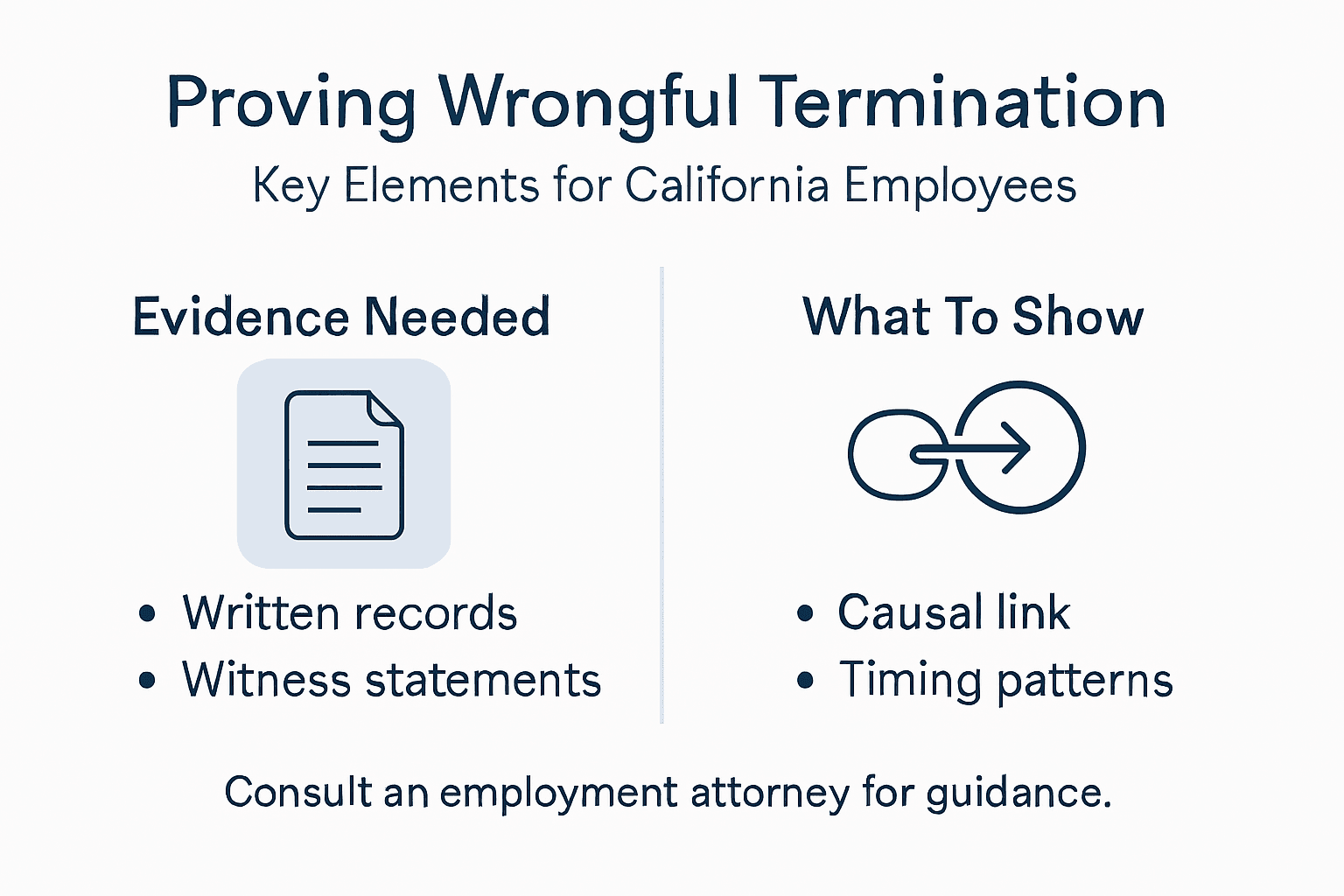
Proving wrongful termination requires demonstrating a clear causal connection between the workers’ compensation claim and subsequent job loss. This typically involves establishing a timeline showing discriminatory actions, documenting communication records, and gathering evidence of the employer’s motivations.
Pro tip: Document every interaction and communication with your employer after filing a workers’ compensation claim to create a robust paper trail that could support potential legal action.
California legal protections against retaliation
California provides robust legal protections for employees against workplace retaliation, particularly for workers who exercise their fundamental rights. California labor laws prohibit multiple forms of retaliation that could harm an employee’s professional standing or economic opportunities.
The state’s comprehensive legal framework offers protection across various scenarios, including workers’ compensation claims and other legally protected activities. Key protections include defending employees from adverse employment actions such as:
- Termination after filing a workplace injury claim
- Demotion following disability reporting
- Salary reduction after requesting medical accommodations
- Harassment or discriminatory treatment related to injury status
- Reduction in work hours or responsibilities
Employer retaliation can take many subtle and overt forms, making it critical for workers to understand their rights. The California Labor Commissioner’s Office actively investigates and enforces these protections, ensuring that employees can pursue legitimate claims without fear of professional repercussions.
Under state law, employees who experience retaliation have multiple legal remedies. These may include filing complaints with state agencies, seeking reinstatement, recovering lost wages, and potentially pursuing additional compensatory damages for emotional distress and professional harm.
Here’s a summary comparing key protections and remedies available to California employees facing retaliation:
| Legal Protection or Remedy | Description | Example Outcome |
|---|---|---|
| Reinstatement | Return to previous job or position | Employee resumes former role |
| Back Pay | Compensation for lost wages due to retaliation | Recovered salary for missed work |
| Compensatory Damages | Monetary award for emotional/professional harm | Payment for stress/distress |
| Agency Complaint Procedures | Filing with state labor agencies | Investigation into employer |
| Additional Legal Action | Suing for further damages if needed | Civil lawsuit in court |
Pro tip: Maintain detailed documentation of all workplace interactions, communications, and incidents that might demonstrate retaliatory behavior, as these records can be crucial evidence in potential legal proceedings.
Recognizing employer retaliation and discrimination tactics
Employers often employ subtle and complex strategies to discriminate against workers who file workers’ compensation claims. Retaliation can manifest through multiple sophisticated tactics designed to undermine an employee’s professional standing and economic stability.
Understanding these discriminatory tactics is crucial for workers in Huntington Beach and throughout California. Common employer retaliation strategies include:
- Unexplained performance evaluations with suddenly negative feedback
- Systematic exclusion from team meetings or professional opportunities
- Creating hostile work environments through increased scrutiny or criticism
- Subtle job restructuring that diminishes responsibilities
- Implementing unreasonable work conditions or impossible performance standards
Some employers use more overt forms of discrimination, such as direct termination, demotion, or significant reduction in work hours. These actions are particularly prevalent when an employee has filed a legitimate workers’ compensation claim and the employer seeks to discourage future claims or punish the employee.

Employees should remain vigilant and recognize that retaliation can be both psychological and professional. Tactics may include passive-aggressive management techniques, social isolation within the workplace, or strategic attempts to make continuing employment uncomfortable or untenable.
This table distinguishes between subtle and overt retaliation tactics workers may face:
| Retaliation Type | Common Examples | Potential Impact |
|---|---|---|
| Subtle | Unjustified negative evaluations | Damage to reputation |
| Exclusion from meetings | Isolation from opportunities | |
| Overt | Direct termination or demotion | Loss of employment/income |
| Major reduction in work hours | Economic instability |
Pro tip: Keep a contemporaneous, detailed log of all workplace interactions, communications, and incidents that might indicate discriminatory behavior, as these records can serve as critical evidence in potential legal proceedings.
Employee rights after filing workers’ comp claims
Workers in Huntington Beach and across California have robust legal protections when filing workers’ compensation claims. Employees are entitled to specific rights and benefits designed to protect their health, economic stability, and professional standing after a workplace injury.
The comprehensive workers’ compensation rights include:
- Immediate medical treatment for work-related injuries
- Temporary disability payments during recovery
- Permanent disability compensation if applicable
- Protection from employer retaliation
- Access to rehabilitation services
- Right to choose medical providers within network guidelines
- Ability to appeal decisions about claims
Under California law, employers cannot legally obstruct or penalize employees for exercising their workers’ compensation rights. This means workers are protected from termination, demotion, reduction in hours, or any form of discriminatory treatment resulting from filing a legitimate claim.
The legal framework ensures that injured workers can focus on recovery without fear of professional repercussions. Workers have the right to file claims promptly, receive appropriate medical care, and seek compensation for work-related injuries without compromising their employment status.
Pro tip: Always document every interaction, medical record, and communication related to your workplace injury and workers’ compensation claim to strengthen your legal protections and potential future legal actions.
Filing complaints and pursuing legal remedies
Employees who have experienced wrongful termination after workers’ compensation claims in Huntington Beach have multiple avenues for seeking justice. Filing complaints with the Labor Commissioner’s Office represents a critical first step in addressing workplace retaliation and protecting employee rights.
The legal complaint process typically involves several key stages:
- Documenting all evidence of discriminatory treatment
- Submitting a detailed complaint form to the appropriate state agency
- Requesting an official investigation into the employer’s actions
- Participating in potential mediation or hearing proceedings
- Seeking potential remedies such as reinstatement or compensation
Workers have the right to file complaints through various state agencies, including the California Labor Commissioner’s Office and the Division of Workers’ Compensation. These agencies can investigate claims, potentially requiring employers to cease retaliatory actions, reinstate employees, and provide back wages or additional compensation.
Navigating the legal complaint process requires careful documentation and strategic approach. Employees should preserve all communication records, medical documentation, and evidence of discriminatory treatment to support their claims and strengthen their legal position.
Pro tip: Consult with an employment law attorney specializing in workers’ compensation cases before filing a formal complaint to understand the full scope of your legal options and potential strategies.
Protect Your Rights After Wrongful Termination in Huntington Beach
Facing wrongful termination after filing a workers’ compensation claim can leave you feeling vulnerable and uncertain about your future. This article highlights the critical challenges workers face including retaliation, discrimination, and employer tactics aiming to punish you for exercising your legal rights under California law. If you recognize any of these warning signs or have experienced unjust professional consequences following a workplace injury, you need trusted legal help immediately.
At Serendib Law Firm, we understand the emotional and financial toll such retaliation can take. Our dedicated team specializes in employment law and retaliation cases and fights tirelessly to help you reclaim your job, recover lost wages, and secure compensation for any damages suffered. Explore our expertise further by visiting the Huntington Beach Archives and Retaliation Archives to see how we protect workers just like you. Do not wait until your rights are further compromised. Reach out now through https://www.serendiblaw.com/ for a free consultation and take the first step toward justice and peace of mind.
Frequently Asked Questions
What constitutes wrongful termination after a workers’ comp claim?
Wrongful termination occurs when an employer fires or discriminates against an employee specifically for filing a legitimate workers’ compensation claim. This includes direct retaliation, discriminatory treatment based on injury status, and violations of employment protection laws.
What legal protections do employees have against retaliation in California?
California laws prohibit various forms of retaliation, including termination after filing a workplace injury claim, harassment due to injury status, and demotion after reporting a disability. Employees are protected from adverse actions due to exercising their rights under workers’ comp laws.
How can I prove wrongful termination after my workers’ comp claim?
To prove wrongful termination, you need to demonstrate a causal link between your workers’ compensation claim and your job loss. This often involves documenting evidence such as communication records, performance evaluations, and any discriminatory actions by your employer.
What should I do if I believe I’ve been wrongfully terminated?
If you suspect wrongful termination, document all relevant interactions and communications, then file a complaint with the appropriate state agency, such as the California Labor Commissioner’s Office. Consulting with an employment law attorney can also help you understand your legal options.