

Facing sudden demotions or negative reviews after raising concerns at the Orange County Superior Court leaves many employees questioning what comes next. Retaliation is more than just a job setback—it directly threatens your right to report issues, participate in investigations, or request fair treatment without fear. This guide clarifies how to spot punishment for protected activities and explains your legal protections, giving you tools to defend your rights and support fair workplace practices.
Table of Contents
- Defining Retaliation In The Court Workplace
- Common Retaliatory Actions And Examples
- Legal Protections For Court Employees
- Reporting Procedures And Evidence Requirements
- Risks, Remedies, And Avoiding Mistakes
Key Takeaways
| Point | Details |
|---|---|
| Understanding Retaliation | Retaliation occurs when an employer punishes an employee for engaging in legally protected activities, such as reporting discrimination. |
| Forms of Retaliation | Adverse actions can include demotion, reduced hours, negative evaluations, and exclusion from opportunities, rather than just termination. |
| Legal Protections | Federal and state laws protect employees from retaliation for participating in protected activities, even if the complaints are later unsubstantiated. |
| Documentation is Key | Employees should meticulously document all protected activities and any retaliatory actions to support their claims effectively. |
Defining Retaliation in the Court Workplace
Retaliation in the workplace occurs when an employer punishes an employee for engaging in legally protected activities. As a court employee in Orange County, you need to understand what actions qualify as protected and what responses from management constitute illegal retaliation.
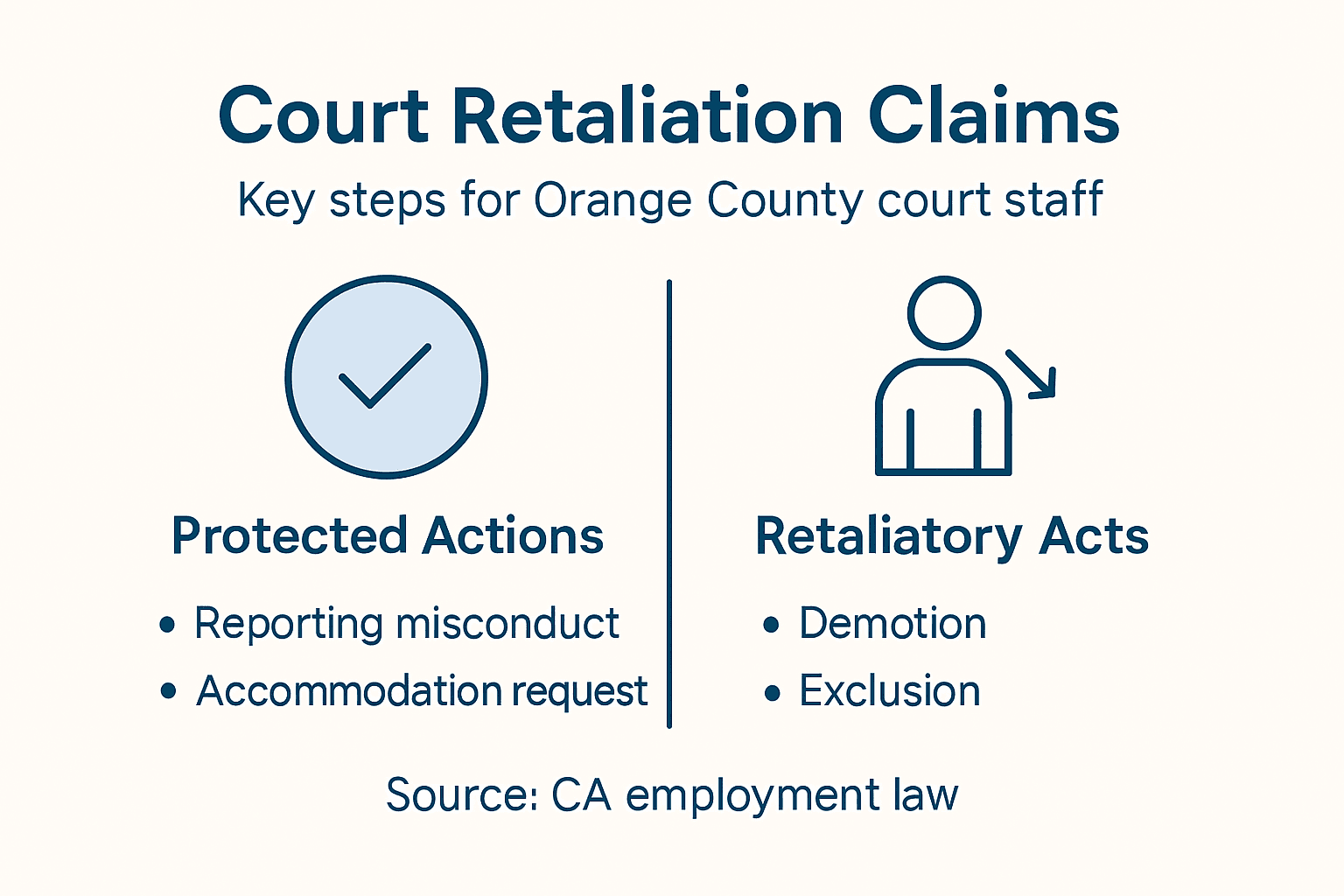
Retaliation means punishment for protected activities such as reporting unlawful conduct, refusing illegal orders, or participating in investigations. The key is that you engaged in an activity the law explicitly protects.
In the court environment, protected activities include:
- Reporting harassment or discrimination to management or HR
- Participating in internal complaints or investigations
- Refusing to engage in illegal practices
- Supporting a coworker’s complaint
- Reporting violations of court procedures or ethics
- Speaking up about safety concerns
Retaliation takes many forms beyond termination. Employers punish protected activity through demotion, reduced hours, negative performance evaluations, exclusion from assignments, or hostile treatment. Even subtle changes in your work environment can constitute retaliation.
The critical element is causation—your employer must have known about your protected activity and taken adverse action because of it. If you filed a complaint about harassment on Monday and received a negative review on Friday, the timing alone suggests a connection.
Federal and state laws prohibit retaliation against employees for engaging in protected activities, even if the underlying complaint later proves unsubstantiated.
You don’t need to prove the original complaint was valid to win a retaliation claim. Courts focus on whether you reasonably believed you were reporting unlawful conduct and whether your employer knew about it.
When examining retaliation claims, courts consider whether you engaged in a protected activity, suffered an adverse employment action, and whether a causal connection exists between the two. Understanding employer retaliation for workers’ compensation claims provides helpful context about how courts evaluate retaliation across different contexts.
As a court employee, your workplace carries additional complexity. Court administration may claim judicial immunity or separate legal standing, but individual supervisors and the organization remain liable for illegal retaliation.
Pro tip: Document every protected activity you engage in—the date, what you reported, who you reported it to, and any response. Keep copies of emails, messages, and written complaints in a secure location outside work systems.
Common Retaliatory Actions and Examples
Retaliation against court employees takes many forms. Understanding what actions qualify as illegal retaliation helps you recognize when your employer has crossed the line from managing performance to punishing protected activity.

Retaliatory actions are not limited to termination. Employers often use subtler tactics that damage your career while maintaining plausible deniability. Adverse actions like firing, reducing hours, denying promotions or sending employees home without pay all constitute retaliation when tied to protected activity.
Common retaliatory actions in the court workplace include:
- Termination or forced resignation
- Demotion or reassignment to less desirable positions
- Reduction in hours, pay, or benefits
- Negative performance evaluations without legitimate basis
- Exclusion from meetings, projects, or advancement opportunities
- Increased scrutiny or excessive monitoring of your work
- Hostile or dismissive treatment from supervisors
- Denial of training, professional development, or certifications
- Transfer to a different department or shift as punishment
Timing reveals intent. If you report harassment on Tuesday and your supervisor suddenly finds fault with your work by Thursday, courts examine whether the timing suggests causation. The closer the adverse action follows protected activity, the stronger your retaliation claim.
Whistleblowing at a court creates particular vulnerabilities. You might report unethical case handling, improper document destruction, or violations of judicial procedures. Your supervisor then assigns you to less desirable work or excludes you from important cases, claiming “operational needs.”
Retaliation often appears as unfair treatment masked by neutral-sounding business justifications, making documentation critical to proving your case.
Another common scenario involves discrimination complaints. You file a complaint about gender or racial bias in hiring decisions. Suddenly you receive critical feedback you never received before, or your applications for promotions are rejected with vague explanations.
Accommodation requests trigger retaliation too. You request flexible hours for a medical condition, and your employer denies the request, reduces your responsibilities, or removes you from preferred assignments. Retaliation for accommodation requests demonstrates how employers punish employees for asserting legal rights.
Do not dismiss subtle retaliation as normal workplace frustration. Exclusion from decision-making meetings, loss of mentorship, or being passed over for projects you previously handled all constitute adverse employment actions when connected to protected activity.
Here’s a side-by-side look at protected activities and corresponding common employer retaliatory actions in the court workplace:
| Protected Activity | Possible Retaliatory Action | Employer’s Stated Reason |
|---|---|---|
| Reporting discrimination | Demotion or negative review | “Performance issues” |
| Requesting accommodations | Loss of responsibilities | “Operational needs” |
| Participating in investigations | Denial of promotion | “Lack of qualifications” |
| Whistleblowing on procedures | Exclusion from meetings | “Project restructuring” |
| Refusing illegal orders | Reduced hours or pay | “Budget cuts” |
This table highlights how specific protected activities often draw subtle or overt forms of retaliation, sometimes justified by neutral-sounding explanations.
Pro tip: Create a detailed timeline with dates, times, and witnesses for each adverse action you experience, noting the proximity to any protected activity—this timeline becomes your strongest evidence in a retaliation claim.
Legal Protections for Court Employees
Court employees in Orange County have specific legal protections against retaliation. Multiple federal and state statutes create a safety net when you exercise your legal rights at work.
The foundation of retaliation protection comes from federal civil rights laws. The EEOC enforces federal laws prohibiting retaliation against employees who oppose discrimination or participate in proceedings related to discrimination claims. This protection applies regardless of whether your underlying complaint ultimately succeeds.
Your protections include:
- Title VII of the Civil Rights Act (race, color, religion, sex, national origin discrimination)
- The Age Discrimination in Employment Act (age-based discrimination)
- The Americans with Disabilities Act (disability discrimination and accommodation requests)
- The Equal Pay Act (gender-based pay discrimination)
- California Fair Employment and Housing Act (broader state protections)
- Whistleblower statutes protecting reporting of illegal conduct
- Labor Code protections for workers compensation claims and safety complaints
These laws protect you when you report discrimination, participate in investigations, request accommodations, or refuse illegal orders. Courts apply broad definitions of “protected activity” to ensure employees feel safe asserting their rights.
California courts recognize a strong public policy against retaliation. You cannot be punished for refusing to commit unlawful acts, even if your employer claims it is part of your job. This protection extends to reporting violations of law to management or external authorities.
Retaliation protection covers adverse actions and applies even when complaints are ultimately found without merit, ensuring you are safe to assert your rights.
The burden shifts once you establish a causal connection between protected activity and adverse action. Your employer must then prove they would have taken the same action regardless of your protected activity. This makes timing and documentation extraordinarily important.
Court employees benefit from additional protections under whistleblower protection laws that guard employees reporting judicial misconduct or violations of court procedures. Reporting unethical case handling or improper document destruction receives specific statutory protection.
State law provides protections various federal laws including the Fair Labor Standards Act and Family and Medical Leave Act prohibit employers from retaliatory actions against employees who assert their rights or cooperate with investigations. These cover wage disputes, medical leave usage, and safety reporting.
Your protection is not absolute. Your employer can still take adverse actions for legitimate, non-retaliatory reasons. The key is proving the timing and circumstances show retaliation, not legitimate performance management.
Pro tip: Before filing any complaint, save copies of your job description, performance reviews, and compensation records to your personal email account—this creates baseline evidence of your employment status before retaliation occurs.
Reporting Procedures and Evidence Requirements
Proving retaliation requires more than simply stating your supervisor was unfair. You need evidence showing a clear connection between your protected activity and the adverse action taken against you.
The first step is understanding what you must demonstrate. To prove retaliation, an employee must show they engaged in protected activity, suffered an adverse action, and there is a causal link between the two. This three-part test applies to virtually all retaliation claims in Orange County courts.
Building your evidence starts with documentation:
- Written records of the protected activity (complaint emails, formal reports, dates)
- Witness names and contact information for those who observed the protected activity
- Performance evaluations and communications before and after the protected activity
- Adverse action details (termination letter, demotion notice, written warnings)
- Timing evidence showing how quickly retaliation followed your complaint
- Communications from your supervisor referencing your protected activity
- Comparator evidence showing similarly situated employees received better treatment
- Any statements suggesting retaliatory motive or animus
Timing matters enormously. If your supervisor took adverse action within days or weeks of your complaint, courts view this as strong circumstantial evidence of causation. A gap of several months weakens your claim unless other evidence shows ongoing animus.
Document everything moving forward. Write down conversations with supervisors, noting dates, times, and what was discussed. Save emails to your personal account. Take screenshots of communications. This creates a contemporaneous record that courts find credible.
Strong evidence of retaliation includes witness testimony confirming you engaged in protected activity and supervisors acknowledging knowledge of your complaint before taking adverse action.
Internal reporting procedures matter. Most employers have formal complaint mechanisms through HR or employee hotlines. Using these creates an official record showing you engaged in protected activity. However, informal complaints to supervisors also qualify as protected activity if the employer could reasonably understand you were reporting unlawful conduct.
When reporting at the court, consider both internal channels and external agencies. The EEOC accepts charges and investigates discrimination claims. California’s Department of Fair Employment and Housing handles state discrimination and retaliation claims. Labor Commissioner offices address wage and safety violations.
The table below summarizes key differences between internal and external retaliation reporting channels:
| Reporting Channel | How to Use | Advantages | Risks or Limitations |
|---|---|---|---|
| Internal (HR/Hotline) | Submit formal complaint | Quick initial response | Management may not act |
| External (EEOC/DFEH) | File with agency | Independent investigation | May trigger employer defense |
| Legal Counsel | Consult attorney | Legal advice, representation | Possible fees, takes time |
Selecting the appropriate channel depends on your goals, the urgency of your situation, and the evidence available.
Participation in investigations provides protection too. Once your employer initiates an investigation into discrimination or misconduct, you cannot be retaliated against for cooperating or providing truthful testimony. This extends to external agency investigations as well.
Present your evidence chronologically. Establish when the protected activity occurred, when your employer knew about it, and when adverse actions followed. Connect these events with clear explanations of why the timing suggests retaliation.
Pro tip: Create a written timeline immediately after experiencing retaliation while details are fresh—include exact dates, names, locations, what was said, who witnessed it, and how it differs from your normal treatment—this document becomes invaluable evidence.
Risks, Remedies, and Avoiding Mistakes
Retaliation claims carry real consequences for both you and your employer. Understanding the potential outcomes helps you make informed decisions about moving forward with your claim.
For you as an employee, the risks of inaction are substantial. Retaliation typically escalates if left unchecked. Your supervisor may intensify hostile treatment, expand the adverse actions, or manufacture performance problems to justify termination. Staying silent often makes your situation worse, not better.
The remedies available to you include:
- Back pay and lost wages from the date of retaliation
- Reinstatement to your original position or comparable role
- Front pay if reinstatement is not feasible
- Compensation for emotional distress and damage to reputation
- Attorney fees and court costs
- Corrective actions by your employer (policy changes, training)
- Punitive damages in cases of gross misconduct by management
California courts can award substantial damages. Back pay covers all lost income, benefits, and opportunities from the retaliation date forward. Emotional distress damages compensate for anxiety, humiliation, and career harm. Courts also shift legal costs to your employer.
Remedies for retaliation include reinstatement, back pay, and corrective actions that address both individual harm and systemic problems at your workplace.
Common mistakes court employees make include waiting too long to report retaliation. Delays weaken your case by making causation harder to establish. The sooner you document and report adverse actions, the clearer the connection to protected activity appears.
Another mistake is failing to use internal complaint procedures before going to external agencies. Most employers have formal processes for raising concerns. Using these creates official records courts find credible and often triggers investigations that protect you from further retaliation.
Do not resign in response to retaliation. Quitting allows your employer to claim you voluntarily left, complicating claims for back pay and damages. Continued employment despite adverse conditions strengthens your case by showing you did not accept the retaliation as justified.
Avoid discussing your retaliation claim widely at work. Loose talk can create witness problems and give your employer advance warning of your legal strategy. Keep complaints professional and documented rather than emotional or gossipy.
Many employees make the critical error of ignoring clear documentation of retaliation or waiting months before consulting an attorney. Early legal counsel prevents procedural mistakes that can derail otherwise strong claims.
Delays in pursuing your claim create statute of limitations problems. Different laws have different deadlines, and missing them forfeits your right to recover. Consult an attorney promptly to understand applicable deadlines for your specific situation.
Pro tip: If you decide to pursue a retaliation claim, contact an employment law attorney before resigning, requesting accommodations, or taking any further employment action—early intervention prevents costly mistakes and preserves your strongest claims.
Protect Your Rights Against Retaliation in the Orange County Court Workplace
Facing retaliation after reporting misconduct or discrimination as a court employee in Orange County can feel overwhelming and isolating. This article highlights how subtle or overt retaliatory actions threaten your career and peace of mind. You deserve a workplace where your protected activities such as whistleblowing or requesting accommodations do not lead to unfair punishment or hostility. Understanding your legal rights is the first step toward regaining control and securing justice.
At Serendib Law Firm, we provide dedicated support for employees confronting retaliation through experienced legal advocacy tailored to your unique situation. Explore our Retaliation Archives | Serendib Law Firm to learn how we have helped others protect their rights. For those exposing unethical behavior, our expertise in Whistleblower Retaliation Archives | Serendib Law Firm ensures you have strong representation. Do not wait for retaliation to escalate. Visit Serendib Law Firm today to schedule your free consultation and take the first step toward stopping retaliation from ruining your career and livelihood.
Frequently Asked Questions
What constitutes retaliation in the workplace for court employees?
Retaliation occurs when an employer punishes an employee for engaging in legally protected activities, such as reporting unlawful conduct, participating in investigations, or refusing illegal orders.
What actions are considered protected activities in a court workplace?
Protected activities include reporting harassment or discrimination, participating in investigations or complaints, refusing illegal orders, supporting coworkers’ complaints, and raising safety concerns.
How can I prove retaliation if it occurs?
To prove retaliation, you must demonstrate that you engaged in a protected activity, suffered an adverse action, and that there is a causal link between the two, typically evidenced through documentation, timing, and witness statements.
What protections do court employees have against retaliation?
Court employees are protected under federal and state laws prohibiting retaliation for engaging in activities like reporting discrimination or unsafe practices. This includes laws such as Title VII of the Civil Rights Act and the Americans with Disabilities Act.