

Many Blizzard Entertainment employees in Irvine mistakenly believe California’s at-will employment means layoffs strip away all job protections. That assumption is dangerously wrong. California’s at-will employment generally allows termination without cause but includes key exceptions protecting against retaliation and wrongful termination, especially when employees report misconduct, file complaints, or engage in protected activities. This article reveals how Blizzard workers can identify illegal retaliation during layoffs and take decisive legal action.
Table of Contents
- Legal Context And At-Will Employment Exceptions
- Understanding Retaliation In The Workplace
- Proving Retaliation And Legal Evidence
- Key California Legal Protections
- Wrongful Termination And Retaliation Overlap
- Procedural Steps After Retaliation Or Termination
- Practical Guidance For Employees
- Get Legal Help With Employment Disputes In Irvine
- Frequently Asked Questions
Key takeaways
| Point | Details |
|---|---|
| At-will exceptions exist | California law protects employees from retaliation even under at-will employment through FEHA and Labor Code provisions. |
| Document everything | Employees must record protected activities, adverse actions, timing, and communications to prove retaliation claims. |
| Timing matters critically | Close timing between protected conduct and termination helps establish illegal causation in retaliation cases. |
| File claims promptly | Missing statutory deadlines destroys legal rights, so consult attorneys immediately after suspected retaliation. |
| Layoffs can mask retaliation | Employers sometimes disguise wrongful termination as legitimate layoffs to hide illegal motives. |
Legal context and at-will employment exceptions
California operates under at-will employment, meaning employers can terminate workers without providing cause or advance notice. However, this doctrine contains crucial exceptions protecting Blizzard employees from wrongful termination and retaliation. Understanding these protections separates lawful layoffs from illegal firings.
FEHA anti-retaliation provisions prohibit employers from firing workers who complain about discrimination, harassment, or participate in investigations. Labor Code 1102.5 shields whistleblowers who report illegal activities to authorities or internally. Public policy exceptions, established in precedent like Tameny v. Atlantic Richfield Co., prevent terminations violating fundamental public interests.
The WARN Act becomes particularly relevant for big tech debt crisis situations affecting Irvine tech companies. When Blizzard conducts mass layoffs, federal law requires 60 days’ notice for plant closures or large-scale terminations. Violations of WARN Act notice requirements give employees legal grounds to challenge WARN Act violations in Irvine layoffs.
Key protections include:
- FEHA safeguards against retaliation for discrimination or harassment complaints
- Labor Code 1102.5 protects whistleblowers reporting violations
- Public policy exceptions prevent firings violating California’s fundamental interests
- WARN Act mandates proper notice for mass layoffs
- Contract and implied covenant exceptions protect certain terminations
Employees terminated shortly after filing HR reports may have strong wrongful termination after HR reports in Orange County claims. Similarly, workers fired following performance improvement plans sometimes face wrongful termination after PIPs in Irvine tech scenarios where employers fabricate documentation to justify illegal terminations.
Understanding retaliation in the workplace
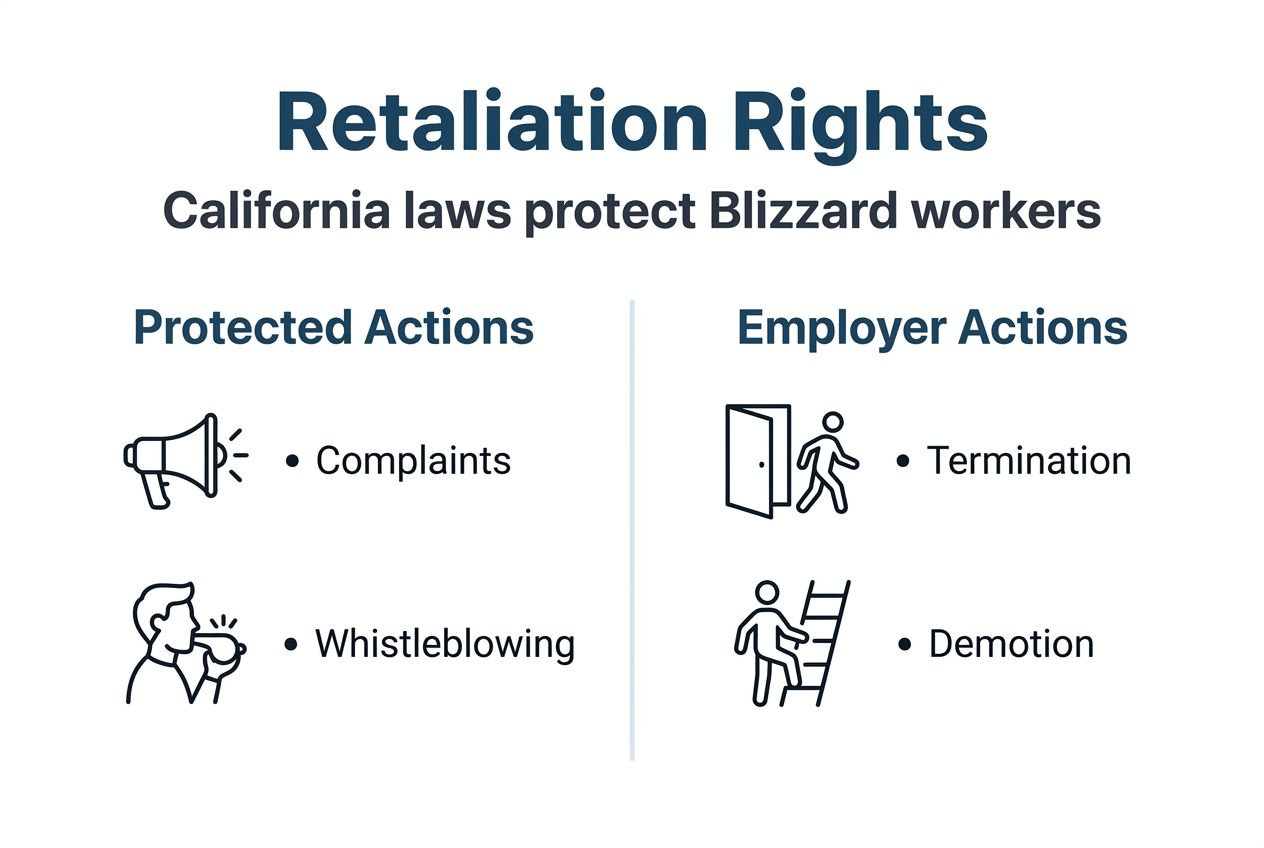
Retaliation includes both direct and indirect adverse actions such as firing, demoting, or reducing hours after protected activities. California law defines retaliation as an employer’s negative response to an employee engaging in legally protected conduct. Recognizing retaliation forms helps Blizzard workers identify when layoffs cross into illegal territory.
Protected activities triggering retaliation claims include:
- Reporting discrimination, harassment, or hostile work environments
- Filing wage and hour complaints or overtime disputes
- Whistleblowing about illegal business practices
- Requesting reasonable accommodations for disabilities
- Taking protected leave under FMLA or CFRA
- Participating in workplace investigations
Employers retaliate through various adverse actions. Termination remains the most obvious form, but retaliation includes demotions, pay cuts, shift changes, negative performance reviews, increased scrutiny, isolation from colleagues, or hostile treatment. Even subtle actions like excluding employees from meetings or withholding information can constitute retaliation if causally connected to protected conduct.

| Protected Activity | Example of Retaliation |
|---|---|
| Reporting sexual harassment | Termination during next layoff round |
| Filing wage claim | Demotion with reduced responsibilities |
| Requesting medical accommodation | Negative performance review |
| Whistleblowing safety violations | Hours reduced to force resignation |
| Participating in discrimination investigation | Transferred to undesirable location |
Blizzard employees who reported misconduct before layoffs should scrutinize whether their selection for termination connects to protected activities. Workers experiencing retaliation after whistleblowing cases often face calculated targeting disguised as legitimate business decisions.
Proving retaliation and legal evidence
Proving retaliation requires showing protected activity, an adverse action, and a causal connection supported by evidence like timing and employer knowledge. California courts apply a three-part framework examining whether the employee engaged in protected conduct, suffered adverse employment action, and can demonstrate causation between the two events.
Timing plays a critical role in establishing causation. Terminations occurring days or weeks after protected activities create strong circumstantial evidence of retaliation. Courts recognize that close temporal proximity between protected conduct and adverse action supports inference of illegal motive, though timing alone does not guarantee success.
Employer knowledge represents another essential element. Workers must show their employer knew about the protected activity before taking adverse action. Documentation proving management awareness of complaints, reports, or protected conduct strengthens retaliation claims significantly.
Steps to document retaliation evidence:
- Record dates, times, and details of all protected activities immediately
- Save emails, text messages, and written communications related to complaints
- Document all adverse actions with specific dates and decision makers
- Identify witnesses who observed protected conduct or retaliation
- Maintain copies of performance reviews, especially those showing pattern changes
- Note any statements by supervisors linking termination to protected activities
- Preserve evidence of comparators treated differently without engaging in protected conduct
Pro Tip: Create contemporaneous written records describing events as they occur. Courts give greater weight to notes made at the time rather than reconstructed memories months later. Store documentation outside company systems where employers cannot access or delete evidence.
Blizzard employees should understand they need not prove retaliation was the sole motive for termination. California law requires only showing protected activity was a substantial motivating factor in the adverse decision. Employers cannot escape liability by claiming mixed motives if retaliation played a significant role. Learning how to document workplace harassment legally provides crucial foundations for building strong cases.
Key California legal protections
Multiple California statutes protect Blizzard employees from retaliation and wrongful termination. FEHA, California’s primary anti-discrimination law, prohibits retaliation against employees who oppose unlawful practices, file discrimination complaints, or participate in investigations. FEHA covers employers with five or more employees and provides robust remedies including reinstatement and damages.
Labor Code 1102.5 offers powerful whistleblower protections. This statute prevents employers from retaliating against workers who disclose information to government agencies or internally report violations of state or federal law. Critically, Labor Code 1102.5 protections extend beyond current employment, prohibiting retaliation even after employees resign or are terminated.
Wage claim protections under Labor Code 98.6 specifically prevent retaliation against employees who file wage claims, testify in Labor Commissioner proceedings, or assert wage and hour rights. Given California’s strict wage and hour laws, these protections frequently apply when Blizzard workers challenge unpaid overtime or misclassification issues.
Key statutes protecting workers:
- FEHA (Government Code 12940) covers discrimination, harassment, and retaliation claims
- Labor Code 1102.5 protects whistleblowers reporting illegal activity
- Labor Code 98.6 prevents retaliation for wage claims
- Labor Code 6310 prohibits retaliation for workplace safety complaints
- Health and Safety Code 1278.5 protects healthcare workers reporting patient care concerns
California enforcement agencies actively pursue retaliation claims. The Civil Rights Department (formerly DFEH) investigates discrimination and retaliation complaints, while the Labor Commissioner handles wage claim retaliation. Statistical data shows retaliation claims comprise a significant portion of employment disputes filed in California, with employers facing substantial liability when violations are proven.
Wrongful termination and retaliation overlap
Wrongful termination claims frequently overlap with retaliation allegations, especially in layoff contexts. Wrongful termination occurs when employers fire workers in violation of statutes, contracts, or public policy. Retaliation represents a common basis for wrongful termination claims when terminations punish protected activities.
Common scenarios blending wrongful termination and retaliation include terminations shortly after employees return from protected medical leave, dismissals following discrimination complaints, or layoffs targeting whistleblowers. Employers sometimes disguise retaliatory terminations as performance-based decisions or include retaliatory targets in broader layoffs to obscure illegal motives.
Retaliation claims strengthen wrongful termination cases by establishing illegal intent. When employees can show their protected activities motivated termination decisions, they transform seemingly legitimate layoffs into unlawful retaliation. This overlap creates multiple legal theories supporting the same factual circumstances.
Legal remedies available to wrongfully terminated employees:
- Reinstatement to former position with full benefits
- Back pay covering lost wages from termination through trial
- Front pay compensating future lost earnings
- Compensatory damages for emotional distress
- Punitive damages punishing egregious employer conduct
- Attorney fees and litigation costs
Blizzard employees terminated after taking medical leave should investigate whether their dismissals constitute wrongful termination after medical leave violations. Similarly, workers fired following workplace injuries may have claims for wrongful termination combined with workers’ compensation retaliation.
Procedural steps after retaliation or termination
Blizzard employees suspecting retaliation or wrongful termination must take prompt procedural action to preserve legal rights. California’s Civil Rights Department handles FEHA retaliation claims, requiring employees to file complaints within three years of the adverse action under recent statutory changes. However, employees may also file directly in court after obtaining a right-to-sue notice.
Statutes of limitations vary by claim type. FEHA claims allow three years, while some Labor Code violations permit one year and others allow longer periods. Wrongful termination claims based on public policy violations typically follow a two-year statute of limitations. Missing these deadlines permanently bars legal action regardless of case merit.
Procedural steps after suspected retaliation:
- Document all circumstances surrounding termination immediately
- Consult an experienced employment attorney within days of termination
- File administrative complaints with appropriate agencies before deadlines expire
- Preserve all evidence including emails, texts, and performance documents
- Avoid signing severance agreements without legal review
- Request personnel files and investigatory materials through proper channels
- Attend mandatory hearings and respond to agency inquiries promptly
Pro Tip: Consult employment lawyers specializing in retaliation cases within one week of termination. Early legal consultation prevents critical mistakes like signing releases waiving claims or missing evidence preservation opportunities. Attorneys can issue litigation hold letters preventing employers from destroying relevant documents.
Workers terminated after filing workers’ compensation claims face specific protections against wrongful termination after workers’ compensation claims or wrongful termination workers comp Huntington Beach scenarios. Local resources include Anaheim workplace retaliation lawyers and Fountain Valley retaliation lawyers experienced in Orange County employment disputes.
Practical guidance for employees
Blizzard employees facing potential layoffs or experiencing workplace disputes should take proactive steps protecting their legal rights. Thorough documentation creates the foundation for successful retaliation claims, while careful communication avoids providing employers ammunition for legitimate termination defenses.
Maintain detailed records of all workplace interactions relating to protected activities. Save copies of emails, performance reviews, pay stubs, and any documents showing work quality or achievements. When verbal conversations occur, immediately write detailed notes including dates, times, participants, and specific statements made.
Practical protection strategies:
- Create backup copies of work emails and documents on personal devices before termination
- Keep witness contact information for colleagues who observed protected activities or retaliation
- Avoid emotional confrontations or threatening language that undermines credibility
- Request written explanations for any adverse actions taken
- Review employee handbooks noting applicable policies
- Track all time worked and wages owed meticulously
- Photograph workplace conditions relevant to safety complaints
Pro Tip: Use neutral, professional language in all workplace communications, especially when documenting complaints or concerns. Avoid accusations or emotional language that employers can characterize as insubordination or unprofessional conduct. Frame issues as concerns requiring resolution rather than attacks on individuals.
Seek experienced employment law attorneys early when disputes arise. Lawyers specializing in California employment law understand how to evaluate case strength, navigate procedural requirements, and negotiate favorable settlements. Many employment attorneys offer free consultations and work on contingency fees, making legal representation accessible regardless of financial circumstances.
Blizzard employees should know their rights and refuse to accept retaliatory layoffs silently. California law provides substantial protections, but only when workers assert their rights promptly and strategically. Documentation, legal consultation, and timely action transform theoretical protections into practical remedies.
Get legal help with employment disputes in Irvine
Blizzard employees facing layoffs or retaliation need experienced employment law attorneys who understand California’s complex protections and local workplace dynamics. Lake Forest employment law attorneys, Huntington Beach employment law attorneys, and Newport Beach employment law attorneys provide personalized representation for wrongful termination and retaliation claims throughout Orange County.
Early legal consultation protects rights that disappear when statutory deadlines expire. Skilled lawyers evaluate case strength, identify applicable legal theories, and develop strategies maximizing recovery. They handle negotiations with employers, file administrative complaints, and litigate cases through trial when necessary.
Orange County employment attorneys familiar with tech industry practices understand how companies like Blizzard structure layoffs and performance management systems. This knowledge helps identify pretextual justifications masking retaliation. Attorneys also access expert witnesses, investigators, and resources individual employees cannot obtain alone.
Don’t accept wrongful termination without fighting back. Contact experienced employment law attorneys immediately to discuss your situation and explore legal options. Prompt action preserves evidence, meets deadlines, and positions you for the strongest possible outcome.
Frequently asked questions
What is considered retaliation under California law?
Retaliation occurs when employers take adverse employment actions like termination, demotion, or discipline because employees engaged in protected activities such as filing complaints, reporting violations, or participating in investigations. California law prohibits retaliation even if the underlying complaint lacks merit, as long as the employee held a reasonable good faith belief.
Can Blizzard fire me during a layoff for reporting harassment?
No, employers cannot legally terminate employees in retaliation for reporting harassment, even during legitimate layoffs. If timing and circumstances suggest your layoff selection connected to protected complaints, you may have wrongful termination and retaliation claims. Close temporal proximity between reports and termination creates strong evidence of illegal motive.
How long do I have to file a retaliation claim in California?
FEHA retaliation claims must be filed within three years of the adverse action. Labor Code retaliation claims have varying deadlines, typically one to three years depending on the specific statute. Wrongful termination claims generally allow two years. Consult an attorney immediately because missing deadlines permanently destroys legal rights.
What evidence do I need to prove workplace retaliation?
You need evidence showing you engaged in protected activity, suffered adverse employment action, and a causal connection between the two. Strong evidence includes documentation of complaints, emails showing employer knowledge, close timing between protected conduct and termination, and comparators treated differently. Witness testimony and patterns of escalating adverse actions also support claims.
Can I be fired for whistleblowing about illegal activity at Blizzard?
No, Labor Code 1102.5 prohibits retaliation against employees who report violations of state or federal law to government agencies or internally to supervisors. Whistleblower protections apply even if investigations find no violations, as long as you reasonably believed illegal activity occurred. Terminations following whistleblowing create presumptions of retaliation requiring employers to prove legitimate reasons.
What damages can I recover in a retaliation lawsuit?
Successful retaliation claims can recover back pay, front pay, reinstatement, compensatory damages for emotional distress, punitive damages in cases of malice or oppression, and attorney fees. Some claims also allow recovery of benefits lost due to termination. Damage awards vary significantly based on lost earnings, emotional harm severity, and employer conduct egregiousness.
Recommended
- WARN Act Violations Impact Irvine Corporate Layoffs | Serendib Law Firm
- Experienced Orange Workplace Retaliation Lawyers
- Mass Layoffs and WARN Act: What Irvine Tech Firms Face
- La Crisi Silenziosa del Debito Big Tech – Avtonoma – La piattaforma di consulenza finanziaria indipendente
- The Greene & Greene Firm Dissolution: The Partnership Ends