

Many Santa Ana government employees who expose corruption believe they’re automatically shielded from retaliation, but the reality is far more complex. Understanding California’s Whistleblower Protection Act requires navigating employer defenses, employee status requirements, and strict reporting procedures. This guide clarifies the legal landscape for government workers facing the difficult decision to report wrongdoing while protecting their careers and livelihoods.
Table of Contents
- Understanding California’s Whistleblower Protection Laws
- Navigating The ‘Same-Decision’ Defense And Employee Status Nuances
- Practical Steps To Take If You Face Retaliation After Whistleblowing
- Comparing Whistleblower Protections: Santa Ana Government Employees Vs Other Sectors
- Get Expert Legal Help With Whistleblower Rights In Santa Ana
Key takeaways
| Point | Details |
|---|---|
| Strong legal protections exist | California’s Whistleblower Protection Act shields government employees from retaliation when reporting improper activities. |
| Employer defenses complicate claims | The ‘same-decision’ defense allows employers to avoid liability if they prove the adverse action would have occurred regardless of whistleblowing. |
| Employee status matters critically | Only employees receive full protections, contractors and volunteers are excluded from coverage under California law. |
| Documentation is essential | Detailed records of retaliation incidents strengthen legal claims and improve chances of successful remedies. |
| Expert legal counsel is vital | Navigating complex defenses and procedural requirements demands specialized employment law expertise for best outcomes. |
Understanding California’s whistleblower protection laws
The foundation of protection for government employees who expose wrongdoing rests on California’s Whistleblower Protection Act, which provides robust legal safeguards for workers reporting improper governmental activities. This law creates a powerful framework that specifically targets retaliation against employees who speak up about corruption, waste, fraud, or violations of law within Santa Ana government offices.
The act covers a broad range of protected activities. When you report information to a government or law enforcement agency about violations of state or federal statutes, regulations, or violations of fiduciary responsibility by a corporation or limited liability company to its shareholders, investors, or employees, you’re engaging in protected whistleblowing. Internal complaints to supervisors about illegal conduct also qualify for protection, creating multiple safe channels for raising concerns.
Eligibility for whistleblower protections in Santa Ana depends on your employment status and the nature of your disclosure. Full-time and part-time government employees receive comprehensive coverage, but the protections don’t extend to independent contractors or volunteers. The wrongdoing you report must involve significant issues like misuse of public funds, health and safety violations, gross misconduct by officials, or abuse of authority that harms the public interest.
Protected whistleblowing activities include:
- Reporting violations to government agencies or law enforcement
- Disclosing information during official investigations or hearings
- Refusing to participate in activities that violate state or federal law
- Providing truthful testimony about workplace violations
- Making internal complaints to supervisors about illegal practices
Retaliation can take many forms beyond termination. Employers may demote you, reduce your hours, transfer you to less desirable positions, deny promotions, create hostile work environments, or subject you to increased scrutiny. Each of these actions violates the law when taken in response to protected whistleblowing activity. Recognizing these subtle forms of retaliation helps you identify violations early and take appropriate action to defend your rights.

Navigating the ‘same-decision’ defense and employee status nuances
Even with strong statutory protections, employers have developed legal strategies to defend against retaliation claims. The ‘same-decision’ defense represents one of the most challenging obstacles whistleblowers face when seeking remedies. Under this doctrine, employers can avoid fee awards if they prove they would have taken the same adverse action regardless of your whistleblowing activity.
This defense creates a high bar for proving retaliation. Suppose your employer documents performance issues before you report corruption. They may argue those documented problems, not your whistleblowing, justified your termination or demotion. Courts examine the timing, severity, and documentation of performance concerns versus the timing of your protected disclosure. Strong cases require clear evidence that the adverse action followed your whistleblowing and lacked legitimate justification.
The California Supreme Court recently clarified that whistleblower protections apply only to employees, not independent contractors, in a ruling that significantly impacts coverage. This distinction matters enormously for government workers whose employment status may be ambiguous. If your agency classifies you as a contractor despite exercising significant control over your work, you may lack statutory protection even when reporting serious violations.
Employee status determination considers multiple factors. Courts examine who controls the manner and means of work performance, who provides tools and workspace, the duration of the relationship, whether the work is part of the employer’s regular business, and how the parties perceive the relationship. Misclassification as a contractor when you function as an employee can support both retaliation claims in Yorba Linda and wage violations.
Pro Tip: If you suspect your employer may invoke the ‘same-decision’ defense, immediately request copies of all performance evaluations, disciplinary records, and communications about your work quality. This documentation helps establish whether documented concerns existed before your whistleblowing or appeared suspiciously after you reported wrongdoing.
Watch for warning signs that your employer is building a ‘same-decision’ defense. Sudden documentation of minor performance issues after years of satisfactory reviews, newly implemented performance improvement plans following your disclosure, or shifting explanations for adverse actions all suggest retaliatory intent masked as legitimate business decisions. Consulting experienced legal counsel early helps you recognize and counter these strategies before they solidify into a comprehensive defense narrative.
Practical steps to take if you face retaliation after whistleblowing
When retaliation occurs, your immediate actions determine the strength of your legal claims and available remedies. Swift, strategic responses protect your rights and create the evidence needed to prove violations. Following a structured approach maximizes your chances of successful recovery while minimizing additional harm to your career and wellbeing.
- Document everything immediately. Create detailed written records of every retaliatory incident including dates, times, locations, witnesses, and exact words spoken. Save all emails, text messages, performance reviews, and written communications related to your whistleblowing or subsequent treatment. Screenshot digital communications before they can be deleted or modified.
- Report retaliation through proper channels. File internal complaints with your human resources department or designated ethics officer, keeping copies of all submissions. External reporting to the California Labor Commissioner, Equal Employment Opportunity Commission, or relevant oversight agencies creates official records that support later legal action.
- Consult employment law attorneys promptly. Contact specialized whistleblower retaliation lawyers within days of experiencing adverse action. Early legal guidance helps you avoid procedural mistakes that could weaken your claims or miss critical filing deadlines.
- Preserve evidence systematically. Store documentation in multiple secure locations outside your employer’s control. Cloud storage, home computers, and physical copies at trusted locations ensure evidence remains available even if you lose access to workplace systems.
- Maintain professional conduct. Continue performing your job duties competently despite the hostile environment. Poor performance or policy violations after whistleblowing strengthen your employer’s ‘same-decision’ defense and undermine your credibility.
- Seek mental health support. Retaliation creates enormous stress that affects your health, relationships, and decision-making. Professional counseling helps you process the emotional impact while maintaining the resilience needed for potential legal proceedings.
Available remedies under California’s Whistleblower Protection Act include reinstatement to your former position, back pay for lost wages, compensation for emotional distress, punitive damages in cases of malicious conduct, and attorney’s fees. Injunctive relief can stop ongoing retaliation while your case proceeds. Understanding these potential outcomes helps you evaluate settlement offers and litigation strategies with your legal team.
Pro Tip: Create a secure email account outside your employer’s system immediately after experiencing retaliation. Use this account to communicate with attorneys, document incidents, and store evidence. Employer-controlled email can be monitored, deleted, or used against you in legal proceedings.
Timely action matters because statutes of limitations restrict how long you can wait before filing claims. Most whistleblower retaliation complaints must be filed within specific timeframes, often one to three years depending on the violation type and legal theory. Consulting Santa Ana workplace harassment lawyers early ensures you don’t forfeit valuable legal rights through procedural delays.
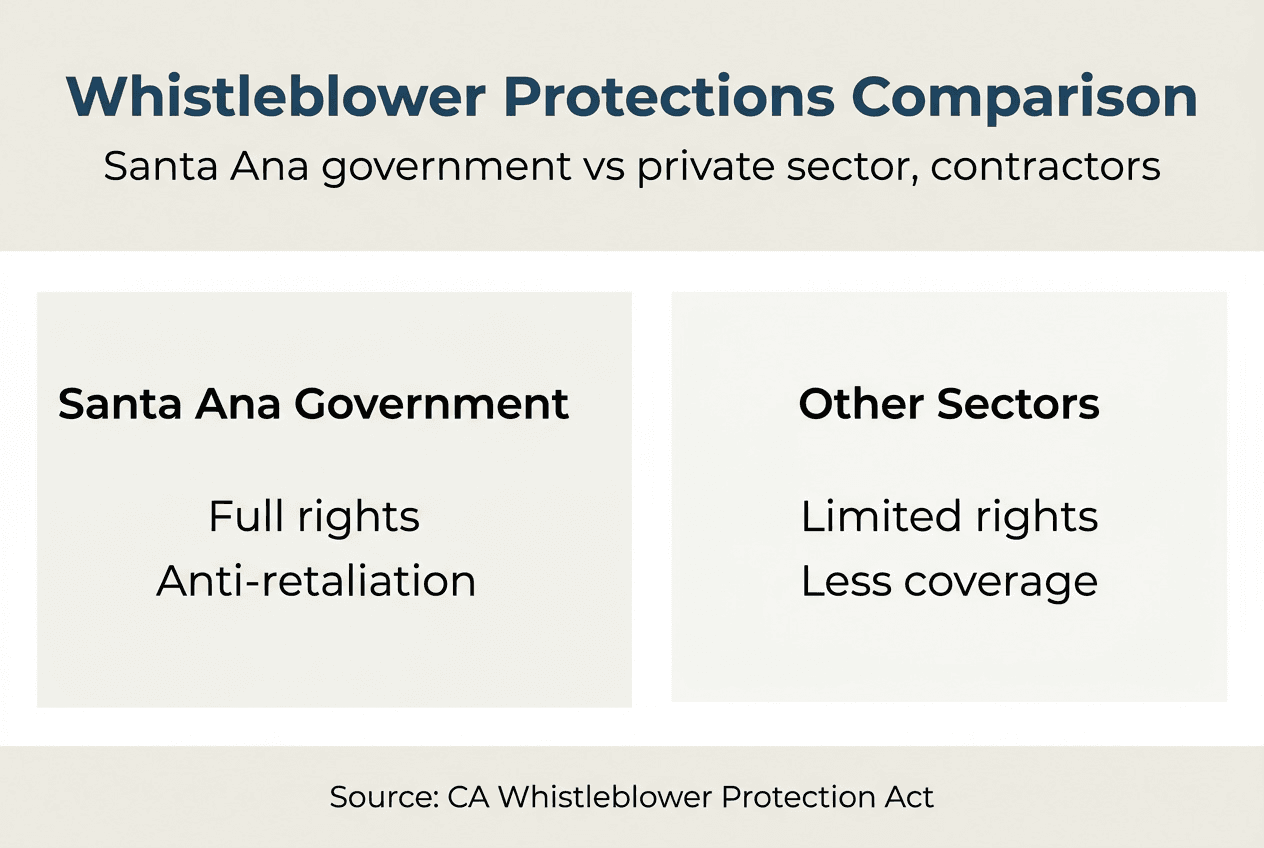
Comparing whistleblower protections: Santa Ana government employees vs other sectors
Whistleblower protections vary significantly across employment sectors, creating important distinctions that affect your legal rights and available remedies. Understanding how Santa Ana government employee protections compare to other workers helps you recognize the unique advantages and limitations of your coverage.
| Protection aspect | Santa Ana government employees | Private sector employees | Independent contractors |
|---|---|---|---|
| Statutory coverage | California Whistleblower Protection Act | Labor Code Section 1102.5, federal SOX | No statutory protection |
| Retaliation remedies | Reinstatement, back pay, damages | Similar remedies, varies by law | Contract claims only |
| Reporting channels | Internal, oversight agencies, law enforcement | OSHA, SEC, internal compliance | Limited options |
| Burden of proof | Employer must prove ‘same-decision’ | Employee proves retaliation causation | Must prove contract breach |
| Time limits | Varies by claim type | 1-3 years typical | Contract terms govern |
Government employees in Santa Ana benefit from specialized statutory protections designed specifically for public sector workers. These laws recognize that government whistleblowing serves critical public interests by exposing corruption, waste, and abuse of taxpayer resources. The heightened scrutiny on government operations creates stronger incentives for comprehensive whistleblower protections compared to some private sector contexts.
However, California courts clarify that protections apply only to employees, not contractors, creating a critical gap in coverage. This limitation particularly affects workers in hybrid arrangements common in modern government operations. If you perform essential government functions but are classified as a contractor, you may discover you lack the protections you assumed existed when you reported wrongdoing.
Key distinctions affecting government employees include:
- Government employers face additional oversight from ethics commissions and oversight agencies
- Public sector whistleblowing often receives media attention, increasing pressure for accountability
- Civil service protections may provide additional layers of job security beyond whistleblower laws
- Government retaliation may involve reassignment to different departments or locations
- Public records laws can aid discovery of evidence in retaliation cases
Whistleblower protections for Anaheim contractors demonstrate the coverage gap between employees and contractors. While employees enjoy statutory shields against retaliation, contractors must rely on contract law and wrongful termination claims that require proving specific contractual violations. This weaker protection discourages contractors from reporting wrongdoing despite their frequent access to sensitive information about government operations.
Healthcare workers in nearby jurisdictions face unique considerations. Whistleblower protections for Anaheim healthcare workers include federal protections under the False Claims Act for reporting Medicare and Medicaid fraud, creating potential financial rewards for successful qui tam actions. Government healthcare employees may qualify for both public sector protections and healthcare-specific statutes, providing multiple legal pathways for addressing retaliation.
Understanding these sectoral differences helps you identify which laws apply to your situation and which legal strategies offer the strongest protection. The complexity of overlapping federal, state, and local protections demands careful legal analysis to maximize your coverage and available remedies when facing retaliation for exposing government corruption.
Get expert legal help with whistleblower rights in Santa Ana
Protecting your whistleblower rights requires specialized legal expertise that understands both the statutory framework and practical realities of retaliation cases. Serendib Law Firm offers comprehensive employment law services for Santa Ana government employees and workers throughout Orange County who face retaliation for reporting corruption. Our experienced attorneys provide personalized case assessments, strategic litigation planning, and zealous advocacy to secure the remedies you deserve.
We offer free consultations to evaluate your situation and explain your legal options without financial risk. Our team handles cases on a contingency basis when appropriate, meaning you pay no attorney fees unless we recover compensation for you. This approach makes high-quality legal representation accessible regardless of your financial situation. Contact our Lake Forest employment law attorneys, Huntington Beach employment law attorneys, or experienced La Habra employment law attorneys to discuss your whistleblower case today.
Frequently asked questions
What legal protections do California government employees have when whistleblowing?
California’s Whistleblower Protection Act shields employees from retaliation for reporting improper governmental activities to authorities or during official proceedings. Protections include prevention of firing, demotion, harassment, or any adverse employment action taken in response to protected disclosures.
Can employers legally retaliate using the ‘same-decision’ defense after whistleblowing?
Employers can avoid penalties if they prove they would have taken the same adverse action regardless of your whistleblowing activity. This defense requires substantial evidence of legitimate, non-retaliatory reasons documented before your protected disclosure. Contesting this defense demands experienced legal representation.
What steps should I take if I experience retaliation after reporting corruption?
Document all retaliation incidents immediately with detailed written records including dates, witnesses, and communications. Seek legal counsel promptly to protect your rights and avoid missing critical filing deadlines. Report retaliation through internal channels and appropriate government agencies to create official records supporting your claims.
Do independent contractors receive whistleblower protections in California government agencies?
No, California courts have ruled that statutory whistleblower protections apply only to employees, not independent contractors or volunteers. Contractors must rely on contract law and limited common law protections that are generally weaker than employee statutory rights.
How long do I have to file a whistleblower retaliation claim in California?
Statutes of limitations vary depending on the specific legal theory and type of claim, typically ranging from one to three years from the retaliatory action. Consulting an attorney immediately after experiencing retaliation ensures you preserve all available legal remedies and meet critical deadlines.