
TL;DR:
- Many Irvine employees mistakenly believe that signing an arbitration agreement permanently waives their workplace rights, which is not true under California law.
- Courts enforce arbitration agreements only if they meet strict fairness standards, allowing employees to challenge unfair clauses and retain court access.
Many Irvine employees believe that signing an arbitration agreement at the start of a job means they have permanently given up the right to fight back if their employer harasses, discriminates against, or wrongfully terminates them. That belief is simply wrong. California courts apply some of the strictest standards in the country when deciding whether an arbitration agreement is actually enforceable, and a signed document does not always mean a closed door. This guide breaks down how these agreements work, what legal protections California gives you, and exactly what steps to take if you are facing a workplace dispute in Irvine right now.
Table of Contents
- How arbitration agreements work in the Irvine workplace
- Your rights under California’s fair arbitration rules
- How mixed or ambiguous paperwork can affect your rights
- What to do if you’re facing arbitration after workplace mistreatment
- Why enforceability is rarely black-and-white: A lawyer’s take
- Get professional help with Irvine workplace arbitration disputes
- Frequently asked questions
Key Takeaways
| Point | Details |
|---|---|
| Arbitration isn’t absolute | Not every signed arbitration agreement blocks you from legal remedies in Irvine. |
| California protects employees | State law requires arbitration clauses to be fair, neutral, and not one-sided. |
| Mixed documents create options | When work paperwork is ambiguous, courts may let disputes proceed in court despite arbitration. |
| Action is time sensitive | Act fast if you suspect your agreement may be flawed or unfair, and consult legal support early. |
How arbitration agreements work in the Irvine workplace
Arbitration is a private dispute resolution process that takes place outside of a courtroom. Instead of a judge and jury, a neutral third party called an arbitrator hears both sides and makes a decision. Employers use these agreements because arbitration tends to be faster, cheaper for them, and less public than a court trial.
In most Irvine workplaces, you probably encountered an arbitration agreement without realizing how significant it was. Employers slip these clauses into offer letters, employee handbooks, onboarding packets, and annual policy acknowledgment forms. Many employees sign them quickly during busy first days on the job, without reading a word.
Here is what most employees get wrong about these agreements:
- They assume the agreement covers every possible dispute, without exception.
- They believe signing the paperwork permanently waives all court rights.
- They do not realize the agreement itself must meet specific legal standards to be valid.
- They think arbitration automatically favors employers, so fighting it is pointless.
- They never ask whether the arbitration clause conflicts with other documents they signed.
California treats employment law arbitration basics very differently than most other states. The landmark Armendariz decision established a checklist of requirements that any arbitration agreement must satisfy before a California court will enforce it. Without meeting those requirements, the agreement may be thrown out entirely.
“In California employment cases, arbitration agreements enforceability depends on specific fairness requirements set by case law, meaning not every signed agreement will hold up in court.”
This matters enormously. If your employer’s arbitration clause fails even one of these fairness tests, you could retain the right to file a lawsuit in civil court, where juries can award far greater remedies, including punitive damages.
Your rights under California’s fair arbitration rules
California law does not leave employees at the mercy of whatever language an employer stuffs into an arbitration clause. The Armendariz framework creates a concrete checklist, and courts take it seriously.

According to established California case law, arbitration agreements must meet criteria including a neutral arbitrator, access to adequate discovery (the process of gathering evidence), a written arbitration award, and equal access to the same types of relief a court could grant. If any of these elements are missing or watered down, enforceability is in question.
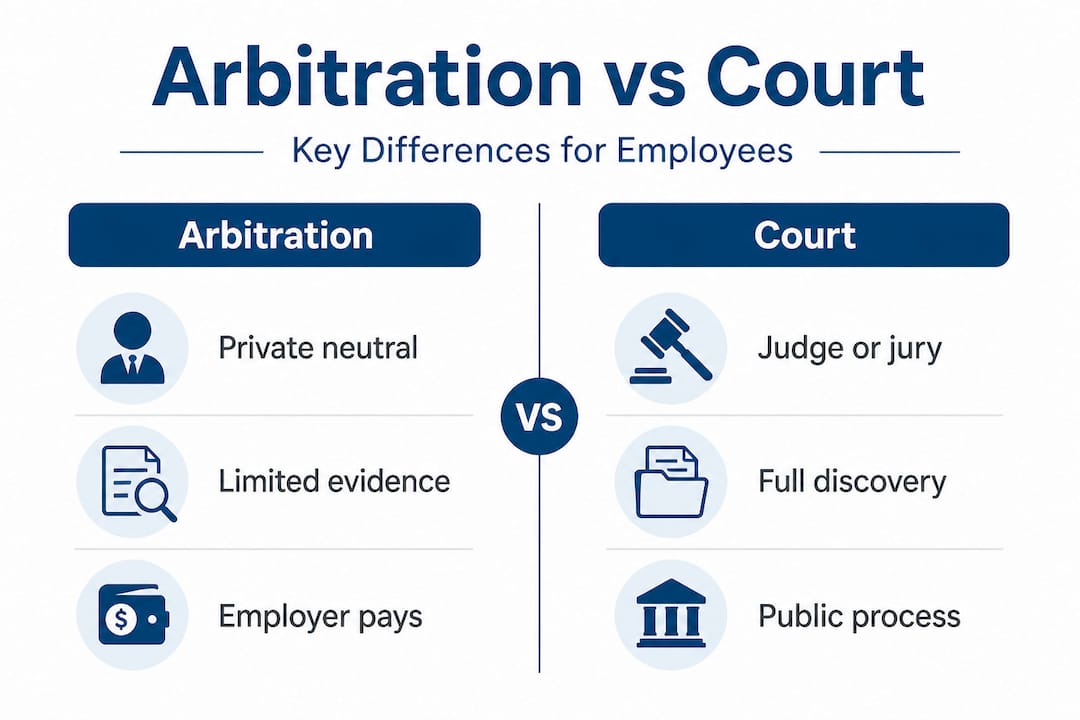
Here is a quick comparison of what employees can expect in arbitration versus in court:
| Feature | Arbitration | Court (Civil Litigation) |
|---|---|---|
| Decision maker | Private arbitrator | Judge or jury |
| Discovery rights | Often limited | Full discovery available |
| Public record | Typically private | Publicly accessible |
| Appeal options | Very restricted | Standard appellate rights |
| Potential for punitive damages | Depends on agreement terms | Generally available |
| Cost allocation | Employer often must pay | Standard court filing fees |
One area where California really protects employees is cost. Employers generally cannot force workers to pay arbitration fees that would make it financially impossible to pursue a claim. If your arbitration agreement requires you to split the cost of the arbitrator’s fees equally, that provision alone could render the entire agreement unenforceable.
Pro Tip: Before signing any arbitration agreement, look specifically for three things: who pays the arbitrator’s fees, how much discovery you are allowed, and whether you can still seek the same remedies a court would offer. A clause that limits any of these puts your legal rights at risk.
When an arbitration agreement can be enforced:
- It is written clearly and signed knowingly.
- It provides a neutral arbitrator without conflicts of interest.
- It allows enough evidence gathering to present a fair case.
- It requires the employer to pay most arbitration costs.
- It does not limit the types of damages you could receive.
When an arbitration agreement cannot be enforced:
- It is buried in lengthy paperwork with no opportunity to review.
- It restricts your right to gather evidence.
- It caps your remedies below what a court would allow.
- It uses an arbitration company with ties to the employer.
- It is so one-sided that a court finds it unconscionable.
Understanding employment mediations as an alternative is also worth exploring, since mediation offers a more collaborative path that can sometimes resolve disputes without arbitration or litigation. When reviewing your options, labor compliance basics can also provide useful context on employer obligations in regulated workplaces.
How mixed or ambiguous paperwork can affect your rights
Here is where things get genuinely interesting for Irvine employees. Many workers sign not just one document at hire but a stack of them: an offer letter, a confidentiality agreement, a non-disclosure agreement, an employee handbook acknowledgment, and perhaps a separate arbitration clause. These documents can interact with each other in ways that seriously affect whether arbitration can be enforced.
Recent California Supreme Court guidance on paperwork ambiguity cases makes this especially important. The Court warned that when an employer includes a confidentiality or non-disclosure agreement that allows them to litigate in court to protect trade secrets, but forces employees into arbitration for everything else, that one-sided carveout can undermine the entire arbitration agreement.
In plain terms: if your employer can run to court whenever it suits them, but you are blocked from doing the same, California courts may find that fundamentally unfair.
Here is how different employment documents interact:
| Document type | Potential effect on arbitration |
|---|---|
| Offer letter with arbitration clause | Creates baseline agreement, but may lack required fairness elements |
| Standalone arbitration agreement | Strongest form, but still subject to Armendariz review |
| Employee handbook with arbitration mention | Often found unenforceable if handbook is not signed as a contract |
| Confidentiality agreement with court carveout | Can undermine broader arbitration agreement per recent case guidance |
| NDA silent on dispute resolution | Creates ambiguity that could favor the employee |
Steps to take if you see conflicting documents:
- Gather every employment document you have ever signed, including digital acknowledgments.
- Look for any language that mentions dispute resolution, courts, or arbitration.
- Check whether any document gives the employer the right to seek court relief while you are limited to arbitration.
- Note any documents that are silent on where disputes must be resolved.
- Bring all of them to an attorney before assuming arbitration applies to your claim.
Pro Tip: Silence in a secondary agreement can actually be your ally. When a confidentiality agreement or handbook says nothing about where disputes must be resolved, that gap often creates a strong argument that arbitration does not govern claims arising from that document.
Understanding the harassment arbitration problems that arise specifically in harassment cases is critical, and digging deeper into arbitration’s impact on harassment claims can reveal additional protections Congress created through the Ending Forced Arbitration of Sexual Assault and Sexual Harassment Act, which prevents employers from forcing sexual harassment and sexual assault claims into arbitration at all.
California Supreme Court guidance on layered employment documents signals a clear trend: courts are increasingly skeptical of arbitration arrangements that benefit only the employer. Irvine employees who are dealing with HR documentation conflicts should treat this as an opportunity, not an obstacle.
What to do if you’re facing arbitration after workplace mistreatment
Once you realize your rights may be stronger than your employer wants you to believe, the next step is moving quickly and strategically. Here is a practical roadmap.
Step 1: Secure all your paperwork immediately. Print or save digital copies of every document your employer has ever given you. This includes offer letters, performance reviews, emails about your dispute, and any severance or settlement offers.
Step 2: Review your arbitration clause line by line. Look for: who pays fees, which disputes are covered, what remedies are available, and whether there is a carveout for the employer to go to court.
Step 3: Identify any unfair provisions. The enforceability challenges you can raise include unconscionability (extreme one-sidedness), lack of mutuality, and ambiguity in the agreement’s scope.
Step 4: Document your workplace mistreatment thoroughly. Write down dates, times, names, and descriptions of every incident of harassment, discrimination, or retaliation. Preserve text messages, emails, and voicemails. Do not delete anything.
Step 5: Understand the statute of limitations. There are applicable deadlines for filing workplace claims in California, and they vary by type of claim. These timelines must be evaluated carefully on a case-by-case basis, so do not delay in consulting with an attorney.
Step 6: Consult an employment attorney before responding to any arbitration demand. This is the single most important step. Responding to an arbitration demand without legal advice can waive arguments you might otherwise have.
Evidence to preserve includes:
- Performance reviews and any sudden negative evaluations after you complained.
- Emails or messages from managers or HR discussing your dispute.
- Witness contact information for coworkers who saw the mistreatment.
- Pay stubs if you are claiming wage loss or demotion damages.
- Medical records if emotional distress or physical harm is part of your claim.
Legal representation for workplace disputes gives you the strongest possible footing when facing an employer who wants to push you into arbitration on their own terms. If harassment is at the center of your situation, connecting with workplace harassment lawyers who handle Orange County cases can make a concrete difference in your outcome. Resources like fair hiring basics can also help you understand broader employee protections that run alongside your arbitration rights.
Why enforceability is rarely black-and-white: A lawyer’s take
Here is the uncomfortable truth that many employees never hear: the conventional wisdom that a signed arbitration agreement is ironclad is simply not accurate in California. Courts do not look at these agreements as a simple binary, either binding or not binding. Instead, they run through a detailed structural and fairness analysis every single time.
The benchmark for enforceability challenges in California requires courts to examine specific structural elements and fairness factors alongside standard contract law defenses like unconscionability. That process creates real opportunities for employees who know how to raise the right arguments.
What we see in practice is that arbitration agreements drafted by employers almost always tilt in the employer’s favor in at least one measurable way. Sometimes it is the arbitrator selection process. Sometimes it is a restrictive discovery clause. Sometimes it is buried cost-shifting language that would bankrupt an employee before the case is even heard. Any one of these defects can be the lever that changes everything.
The employees who lose in arbitration situations are typically the ones who assumed they had no options and never pushed back. Irvine workers who take a close look at what they actually signed, and who get a second opinion from a qualified employment attorney, frequently discover that they have far more power than their employer wanted them to know about.
A detailed guide to arbitration cases can walk you through how these arguments play out in real Orange County workplace disputes. The bottom line is this: do not let an employer’s confidence that the arbitration agreement will hold up become your assumption. Make them prove it first.
Get professional help with Irvine workplace arbitration disputes
Facing a workplace dispute while also trying to figure out whether your arbitration agreement is even enforceable is an overwhelming position to be in. You should not have to navigate it alone. Serendib Law Firm represents employees across Orange County, including Irvine, in cases involving harassment, discrimination, wrongful termination, and retaliation, including disputes where arbitration clauses are at the center of the fight. Our team offers one-on-one consultations to review your specific paperwork and explain your realistic options. Whether you are just beginning to raise a complaint or already facing an arbitration demand, our Lake Forest employment law attorneys are ready to help. Learn more about how we handle employment arbitration help for Orange County employees and take the first step toward protecting your rights today.
Frequently asked questions
Are all arbitration agreements in Irvine automatically enforceable?
No. In California, an arbitration agreement is only enforceable if it meets strict fairness and procedural standards, and specific criteria determine whether the agreement will hold up, including a neutral arbitrator, adequate discovery, and available relief.
Can I still sue my employer if I signed an arbitration agreement?
You may still have options to litigate if your agreement is ambiguous, one-sided, or conflicts with other employment documents, since layered documents or ambiguity can allow employees to pursue claims in court despite an existing arbitration clause.
What factors will make an arbitration agreement unfair in California?
Lack of a neutral arbitrator, severely limited evidence gathering, forced high fees, or restricted remedies all make arbitration agreements unenforceable because specific criteria determine fairness under California law.
Can I challenge an arbitration agreement after I’ve signed it?
Yes. California law allows employees to challenge enforceability even after signing, particularly when the agreement lacks fairness or contains confusing or ambiguous paperwork that benefits only the employer.
Recommended
- Know Your Rights: Blizzard Layoffs And Irvine Tech Protections | Serendib Law Firm
- Layoffs and retaliation rights for Blizzard Irvine 2026 | Serendib Law Firm
- Sexual Harassment Claims and Arbitration in Orange CA | Serendib Law Firm
- Experienced Irvine Employment Law Attorneys
- How Labor Laws Shape Fair Hiring: What Job Seekers Must Know