
If you’re an employee in Southern California dealing with a workplace conflict, understanding business litigation explained in plain terms could change how you respond to your situation. Most people assume business litigation is something that only happens between large corporations fighting over contracts. The reality is that employees get pulled into these processes regularly, whether they are fighting wrongful termination, standing up against workplace discrimination, or pushing back against retaliation for reporting misconduct. Knowing what this process looks like before you’re deep inside it is one of the most useful things you can do.
Table of Contents
- Key Takeaways
- Business litigation explained from an employee’s perspective
- What to expect from the business litigation process
- Your legal rights and protections as an employee in California
- Common mistakes employees make in business legal disputes
- My take on what employees in Southern California actually need to know
- How Serendib law can help you fight back
- FAQ
Key Takeaways
| Point | Details |
|---|---|
| Business litigation affects employees directly | Workplace disputes over discrimination, wrongful termination, and retaliation all fall under business litigation. |
| The process has multiple stages | From pre-filing negotiations to discovery and potential trial, each phase has strategic importance for employees. |
| California offers strong employee protections | State law provides rights against retaliation, discrimination, and wage theft that go beyond federal minimums. |
| Evidence preservation matters early | Saving texts, emails, and documentation from the start of a dispute can determine the outcome of a case. |
| Legal representation changes outcomes | Employees without counsel face serious disadvantages when employers have legal teams working against them. |
Business litigation explained from an employee’s perspective
Most people hear the phrase “business litigation” and picture two corporations locked in a boardroom dispute. But employment disputes are one of the most common forms of business litigation, covering wrongful termination, workplace discrimination, harassment, wage and hour violations, and retaliation claims. If you work in Irvine, Huntington Beach, or Santa Ana and believe your employer has treated you unlawfully, what is a business litigation case for you? It is the formal legal process you can use to enforce your rights and seek a remedy.
Understanding business litigation starts with recognizing that it is civil litigation, not criminal. You are not trying to put anyone in jail. You are asking a court to remedy a wrong done to you. Civil litigation remedies go far beyond simple money damages. Courts can issue injunctions to stop harmful conduct, order reinstatement to a former position, or compel compliance with employment agreements.
Here is a quick breakdown of the types of workplace disputes that most commonly lead to business litigation for employees in Southern California:
- Wrongful termination: Being fired for an illegal reason, such as whistleblowing, taking protected leave, or reporting harassment.
- Workplace discrimination: Adverse employment actions based on race, gender, age, disability, religion, or national origin under both federal and California law.
- Retaliation: Punishment by an employer after you exercise a legal right, file a complaint, or report illegal activity.
- Wage and hour violations: Unpaid overtime, missed meal breaks, or misclassification as an independent contractor.
- Harassment: Hostile work environment or quid pro quo harassment by supervisors or coworkers.
Pro Tip: If your employer has an HR department, any complaint you make there creates a paper trail. Save copies of those communications. They become evidence if litigation follows.
Business litigation cases also frequently involve breach of contract claims, particularly when employers violate written employment agreements, severance terms, or commission structures. Contracts matter even when you did not sign a formal employment agreement, because implied contracts can exist based on company handbooks or verbal assurances.
What to expect from the business litigation process
Commercial litigation explained at a high level often skips the practical steps employees need to understand. Here is what the business litigation process actually looks like from start to finish.
-
Case evaluation. Your attorney reviews the facts, gathers initial documentation, and assesses whether your claims are viable. This is also when applicable statutes of limitations get evaluated, which vary by claim type and should be reviewed with a lawyer without delay.
-
Pre-litigation negotiation. Many workplace disputes never become lawsuits. A demand letter, combined with a clear evidence strategy, often pushes employers toward settlement. Pre-litigation resolution is faster, cheaper, and less stressful for employees.
-
Filing the complaint. If negotiation fails, your attorney files a formal complaint in the appropriate court or administrative agency. This document spells out your claims, the legal basis for each claim, and the relief you are seeking.
-
Service and the answer. The employer receives formal notice and has a set period to respond. Their answer will either admit, deny, or contest your allegations.
-
Discovery phase. This is often the most time-consuming stage. Discovery involves written interrogatories, document requests, subpoenas, depositions of key witnesses, and sometimes expert testimony. Your employer’s internal communications, performance reviews, and HR records all become fair game.
-
Motions and hearings. Either side can file motions asking the court to rule on legal questions before trial. A summary judgment motion, for example, asks the judge to dismiss claims that lack sufficient evidence. These hearings shape what actually goes to trial.
-
Mediation and settlement. Most cases settle before trial. Mediation in employment cases brings both sides together with a neutral mediator to negotiate a resolution. Settlements can include monetary compensation, reinstatement, policy changes, or confidentiality agreements.
-
Trial. If settlement talks fail, the case goes before a judge or jury. Both sides present evidence, examine witnesses, and make legal arguments. The court then renders a verdict.
Your legal rights and protections as an employee in California
California offers some of the strongest employee protections in the country. This matters enormously if you are working in Fullerton, Costa Mesa, or Newport Beach and facing a legal dispute with your employer.

Employees have federal and California law protections against discrimination, wrongful termination, and retaliation. California’s Fair Employment and Housing Act extends protections beyond federal law, covering employers with five or more employees for certain claims, and adding protections for categories like sexual orientation and gender identity.
Beyond monetary damages, courts can order a range of remedies in your favor. Courts may issue injunctions to stop ongoing harmful conduct, or compliance orders that require an employer to implement policy changes. If you were wrongfully terminated, reinstatement to your former role is a possible outcome, not just a financial payout.
Key protections and remedies employees should know about:
- Back pay and front pay: Compensation for lost wages, both before and after a judgment.
- Emotional distress damages: California courts recognize the psychological harm caused by workplace misconduct.
- Punitive damages: Available in cases involving particularly egregious employer conduct.
- Attorney’s fees: In many employment cases, a prevailing employee can recover legal fees from the employer.
- Reinstatement: Courts can order your job back if wrongful termination is proven.
Pro Tip: Start a personal log of every incident, including dates, times, who was present, and exactly what was said. This contemporaneous record is far more credible to a court than recollections made months later.
Understanding your rights also means recognizing that evidence must be preserved early. Digital records, texts, emails, and even accounting documents can disappear quickly once a dispute becomes formal. Save everything you can access through your personal accounts before you lose access to employer systems.
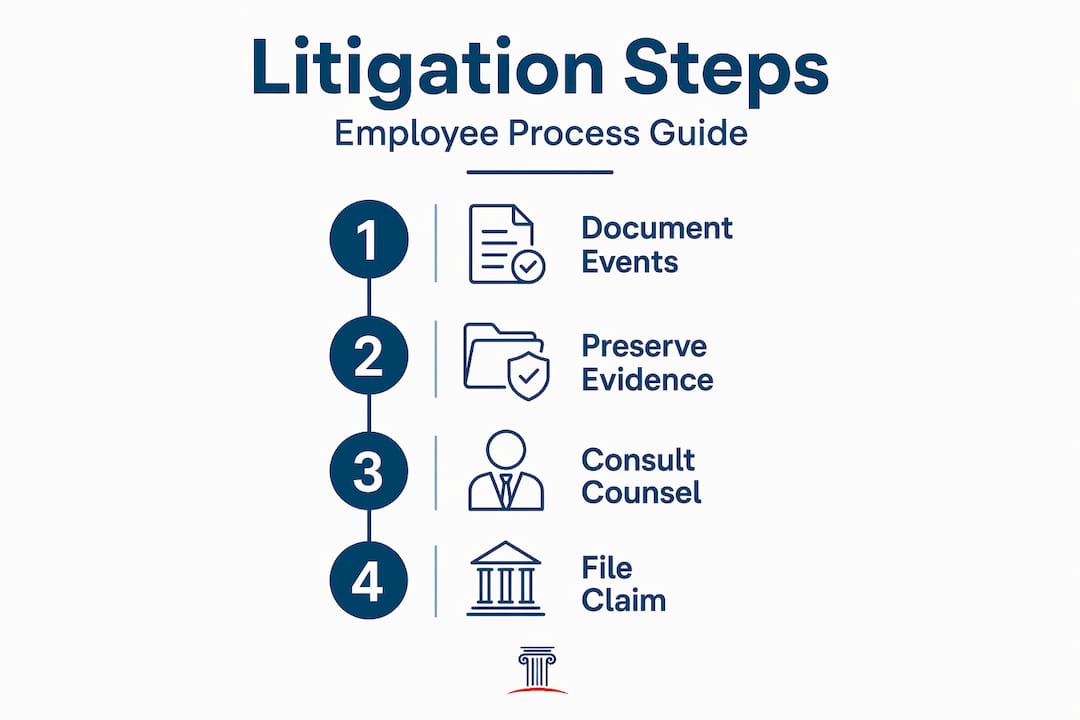
For employees in cities like Santa Ana or Fullerton who need guidance on choosing employment counsel, the decision you make there will affect every subsequent stage of the process.
Common mistakes employees make in business legal disputes
Even employees with strong cases can undermine their own positions. Business legal disputes are rarely won or lost on merit alone. How you handle the early days often matters as much as the facts themselves.
-
Waiting too long to seek legal advice. Every claim has a statute of limitations, and those clocks start ticking from specific triggering events. The moment you suspect something illegal has happened, consult an attorney. Do not wait to see how things develop.
-
Deleting or ignoring communications. Employees sometimes delete texts or emails from supervisors because the content feels uncomfortable. That content may be your most important evidence. Preserve it, do not edit it, and do not discuss it on work devices.
-
Talking too much on social media. Public posts about your workplace dispute can be used against you. Employers and their lawyers monitor social media during litigation. Say nothing publicly about your case while it is active.
-
Assuming mediation or arbitration is a loss. Many employees view settlement as giving up. In reality, arbitration in employment cases and mediated settlements often result in faster, more private, and equally favorable outcomes compared to a full trial. Business dispute resolution outside of court is a legitimate strategic choice, not a concession.
-
Underestimating the employer’s legal resources. When the other side has legal counsel and you do not, the imbalance is real and consequential. An unrepresented employee negotiating against a corporate legal team is at a serious structural disadvantage at every stage of the process.
-
Missing administrative filing requirements. Some California employment claims require you to file a complaint with the California Civil Rights Department or the EEOC before you can sue. Missing those steps can close the door on your lawsuit entirely.
My take on what employees in Southern California actually need to know
I’ve watched employees arrive with strong cases and lose ground because they misunderstood what the process actually demands of them. The legal system rewards preparation far more than righteous anger. That is the uncomfortable truth.
What I’ve seen repeatedly is that employees underestimate how early the case is really decided. By the time you are in depositions or pre-trial motions, the foundation has already been set by what you did or did not do in the first weeks after the dispute began. The employees who fare best are those who treated their situation seriously from the moment things felt wrong, not the moment things became official.
I’ve also noticed that employees in cities like Orange and Tustin often carry a sense that litigation is too big and expensive to be worth pursuing. That hesitation costs them real money and real justice. Many employment attorneys in Southern California, including those at firms like Serendib law, work on contingency for qualifying claims, meaning you do not pay unless you win. The financial barrier is lower than most employees realize.
My honest advice is to reframe how you see this process. You are not being dramatic. You are not overreacting. If your employer violated the law, you have every right to hold them accountable. The process exists for exactly that purpose.
How Serendib law can help you fight back
If you are an employee in Southern California dealing with a workplace dispute, Serendib law brings deep experience in employment law across Orange County and beyond. The firm handles cases involving wrongful termination, harassment, retaliation, discrimination, and wage violations for employees in communities including Irvine, Newport Beach, Huntington Beach, Lake Forest, and Westminster.
Serendib law’s attorneys understand the local legal environment and tailor their approach to each client’s specific situation rather than applying a generic playbook. The firm offers free consultations and works on contingency in qualifying cases, so your access to legal help should not depend on your financial position right now.
If you are in Huntington Beach, connect with the Huntington Beach employment attorneys at Serendib law for a case evaluation. Employees in Lake Forest can reach the firm’s Lake Forest employment law team directly. For workers in Newport Beach, dedicated Newport Beach employment attorneys are ready to assess your options. Do not navigate this alone.
FAQ
What is business litigation in the context of employment?
Business litigation in an employment context refers to formal legal proceedings where an employee seeks to enforce their rights against an employer, covering claims like wrongful termination, discrimination, retaliation, and wage violations.
What is a business litigation case for an employee?
A business litigation case for an employee is any formal dispute brought through the court system or an administrative process to address unlawful employer conduct, with remedies that can include monetary damages, reinstatement, or court orders to stop ongoing harm.
How long does the business litigation process take?
The timeline varies significantly based on case complexity, whether the matter settles pre-trial, and court scheduling. Simple cases may resolve in months while contested matters can take one to three years or longer through trial.
Do I need a lawyer to handle a business legal dispute?
You are not legally required to have one, but going unrepresented against an employer with legal counsel puts you at a measurable disadvantage in negotiations, discovery, and court proceedings.
Can business disputes settle without going to trial?
Yes. Most employment-related business disputes resolve through pre-litigation negotiation, mediation, or settlement agreements before reaching a courtroom, often producing outcomes that serve employees well without the cost or stress of a full trial.