
If you work in Tustin, California and have experienced harassment, discrimination, or wrongful termination, you are not alone and you are not without options. Many employees assume that fighting back against a toxic employer is too complicated, too expensive, or simply not worth the effort. That assumption costs people real money and real justice. California has some of the strongest employee protection laws in the country, and understanding how those laws apply to your specific situation in Tustin is the first step toward doing something about it.
Table of Contents
- Key takeaways
- Legal protections for employees in Tustin, California
- How to report workplace harassment or discrimination
- What a Right-to-Sue notice means for you
- Local resources and protections for Tustin workers
- Practical steps if you are facing a workplace issue right now
- My perspective on employment law in Tustin
- How Serendib law can help Tustin employees
- FAQ
Key takeaways
| Point | Details |
|---|---|
| California law protects you broadly | FEHA covers race, gender, disability, and many other categories for employees in Tustin. |
| Written complaints matter | Submitting internal complaints in writing creates the evidence record your case may depend on. |
| Two filing pathways exist | You can request an immediate Right-to-Sue notice or let the CRD investigate your claim. |
| Deadlines are strict | Missing filing deadlines can permanently end your legal claim, regardless of its merits. |
| Local resources are available | Tustin Unified School District and Orange County agencies offer complaint channels for specific workers. |
Legal protections for employees in Tustin, California
California’s Fair Employment and Housing Act, known as FEHA, is the primary law shielding workers from discrimination and harassment in the workplace. If you work in Tustin, FEHA applies to you, and it covers a wide range of protected categories including race, national origin, gender, sexual orientation, religion, age, disability, pregnancy, and marital status. Employers with five or more employees must comply, which covers the vast majority of businesses operating in the area.
What FEHA prohibits goes beyond obvious acts of discrimination. It covers hostile work environments, failure to accommodate disabilities, unequal pay based on protected characteristics, and retaliation against employees who report violations. Tustin workplace discrimination lawyers regularly see cases involving subtle but persistent conduct that, when documented properly, meets the legal threshold for a claim.
Tustin’s workforce reflects the broader diversity of Orange County. With a population of approximately 79,035 and a median household income of $108,435, the city includes workers across retail, healthcare, education, tech, and service industries. That diversity also means discrimination claims span a broad range of protected categories, and no type of workplace is immune.

For employees working in public schools, additional protections apply. The Tustin Unified School District explicitly prohibits harassment and discrimination under district policy, with named equity and Title IX coordinators available to receive complaints. Staff at district schools have both internal and external complaint options, which gives them multiple layers of protection.
Pro Tip: If you are a Tustin Unified School District employee, document any discriminatory or harassing conduct and report it to both the district’s equity coordinator and the California Civil Rights Department. Using both channels strengthens your position.
How to report workplace harassment or discrimination
Knowing your rights is one thing. Knowing how to act on them is another. The process for addressing workplace misconduct follows a clear sequence, and where you start matters.
Submit a written internal complaint first. Before filing with any government agency, put your complaint in writing to your HR department or direct supervisor. Written internal complaints create contemporaneous evidence that your employer had notice of the problem. Courts and agencies look at this record when evaluating employer liability. An email with a clear description of what happened, when it happened, and who was involved is far more useful than a verbal conversation that no one documented.
File a complaint with the California Civil Rights Department (CRD). The CRD is the state agency that enforces FEHA. You can file online, by mail, or in person. Under FEHA, employees generally have three years from the date of the discriminatory act to file with the CRD, though applicable statutes of limitations should be evaluated on a case-by-case basis with an attorney.
Choose between an immediate Right-to-Sue notice or a CRD investigation. When you file with the CRD, you have two options. You can request an immediate Right-to-Sue notice, which allows you to go directly to court without waiting for the agency to finish investigating. Or you can allow the CRD to investigate your claim, which may take months or even years. Most employees working with legal counsel choose the immediate notice route.
Consider filing with the federal EEOC as well. If your claim involves federal law, such as Title VII of the Civil Rights Act, you may also need to file with the Equal Employment Opportunity Commission. Federal EEOC claims carry a 300-day deadline in California, which is significantly shorter than the FEHA period. Missing the EEOC deadline can forfeit your federal rights even if your state claim remains valid.
Track both deadlines carefully. Dual filing with CRD and EEOC allows streamlined processing, but it requires monitoring two separate timelines. This is one of the most common places employees lose claims without ever realizing it.
Pro Tip: Do not wait to see if your employer “fixes” the problem before filing. The clock on your claim starts running from the date of the discriminatory act, not the date you decide the situation is not improving.
What a Right-to-Sue notice means for you
Once you receive a Right-to-Sue notice from the CRD, you have the legal authorization to file a lawsuit in California Superior Court. This is a significant moment in your case. It means the administrative phase is complete and the civil litigation phase can begin.
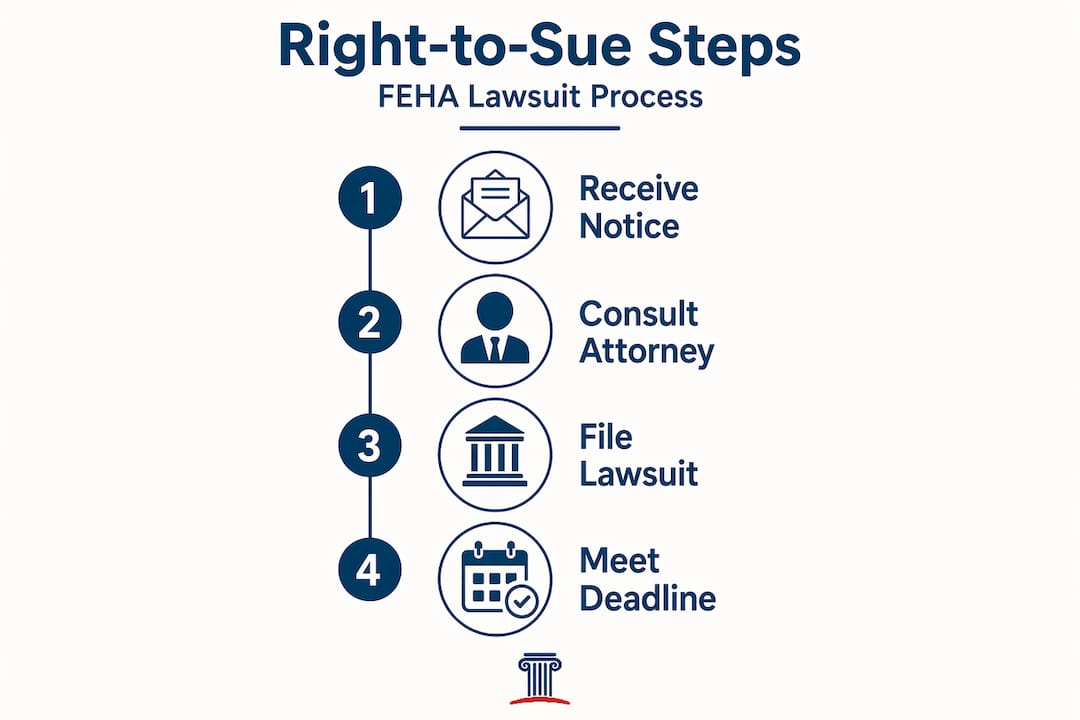
After receiving the notice, employees have one year to file their FEHA lawsuit. That deadline is strict. Courts do not extend it based on how strong your case is or how sympathetic your circumstances are. Missing this deadline results in permanent dismissal of the claim. The merits become irrelevant at that point.
Most employees represented by experienced attorneys request immediate Right-to-Sue notices rather than waiting for a CRD investigation. The reason is straightforward: immediate notices typically issue within days, giving you faster access to court and the full range of civil remedies, including compensatory damages, punitive damages, and attorney’s fees.
The table below compares the two pathways so you can understand what each involves.
| Factor | Immediate Right-to-Sue | CRD Investigation |
|---|---|---|
| Time to receive notice | Days | Months to years |
| Access to court | Immediate after notice | After investigation closes |
| Agency involvement | Minimal | Full CRD review |
| Best for | Cases with strong evidence | Cases needing agency leverage |
| Attorney recommendation | Strongly preferred by most counsel | Situational |
Consulting with a Tustin employment law attorney before making this choice is worth the time. The right pathway depends on the specific facts of your case, the type of claim, and what remedies you are seeking.
Local resources and protections for Tustin workers
Tustin employees have access to several specific resources beyond the general state and federal complaint systems.
- Tustin Unified School District equity contacts. District employees can reach Stephanie Yang, the Equity Compliance Officer and Title IX Coordinator, or Michelle Everitt, the Section 504 Coordinator, for complaints involving discrimination or harassment in school settings. These contacts provide a structured internal channel before escalating to state agencies.
- California Civil Rights Department regional offices. The CRD serves Orange County employees and accepts complaints online at the CRD website. You do not need to be in a major city to access state-level enforcement.
- Orange County legal aid organizations. Several nonprofit organizations in Orange County provide free or low-cost legal guidance for workers who cannot afford private representation. These organizations can help you understand whether your situation warrants a formal complaint.
- Document everything. Keep a personal log of every incident, including dates, times, locations, what was said or done, and who witnessed it. Save any relevant emails, texts, or written communications. This documentation becomes the foundation of any legal claim you pursue.
The workplace culture in any city can create informal pressures that discourage employees from speaking up. Tustin is no exception. Fear of retaliation is one of the most common reasons employees delay filing complaints, but California law specifically prohibits retaliation against employees who report discrimination or harassment in good faith.
Practical steps if you are facing a workplace issue right now
If you are currently dealing with harassment, discrimination, or wrongful termination in Tustin, the following steps will protect your rights and prepare you for possible legal action.
- Write down everything immediately. Memory fades and details matter. Record each incident as soon as it happens, including the date, time, location, what was said or done, and the names of anyone present.
- Use your employer’s complaint process in writing. Do not rely on verbal conversations. Send an email to HR or your supervisor describing the problem. Keep a copy. This creates the paper trail that establishes employer liability in harassment and discrimination cases.
- Do not resign without legal advice. Quitting before consulting an attorney can complicate your claim. In some situations, a resignation can be treated as voluntary, which affects certain types of relief. If conditions are intolerable, an attorney can advise whether a “constructive dismissal” argument applies to your situation.
- Avoid posting about your situation on social media. Anything you post publicly can be used against you. Keep details of your complaint private until you have spoken with an attorney.
- Contact an employment attorney early. The sooner you consult with counsel, the more options you have. Attorneys who handle workplace harassment claims in Tustin can assess your situation quickly and advise on the best path forward.
Pro Tip: If your employer offers a severance agreement after termination, do not sign it without having an attorney review it first. These agreements almost always include a release of legal claims, and you may be giving up significant rights without realizing it.
My perspective on employment law in Tustin
I’ve seen the same pattern repeat itself more times than I can count. An employee experiences months of harassment or discrimination, tells a coworker about it, maybe mentions it verbally to a manager, and then waits to see if things improve. By the time they come to an attorney, the strongest evidence is gone, the deadlines are closing in, and the employer has had time to build a paper trail of their own.
The single biggest mistake I see Tustin employees make is underestimating how much a written internal complaint changes the legal equation. It is not just a formality. It puts the employer on notice, creates a timestamp, and shifts the burden in ways that matter enormously in court. Employees who skip this step often find themselves in a much harder position later.
I also think most employees do not realize how quickly an immediate Right-to-Sue notice can move things forward. Waiting for a CRD investigation can feel like the “official” path, but in my experience, it often delays justice without adding meaningful benefit. Working with counsel to request an immediate notice and move toward litigation is almost always the more effective strategy for employees with solid facts.
The overlap between FEHA deadlines and EEOC deadlines is where I see claims quietly disappear. Both clocks run simultaneously, and missing either one can cost you rights you did not even know you had. This is not the area to navigate without guidance.
How Serendib law can help Tustin employees
If you are dealing with a workplace issue in Tustin, Serendib law offers experienced legal representation for employees across Orange County. The firm handles employment law claims in California including harassment, discrimination, wrongful termination, and retaliation, and serves workers in Tustin, Lake Forest, and throughout the region. Serendib law also supports employees in Lake Forest employment matters with the same level of commitment. Free consultations are available, and representation in select cases is handled on a contingency basis, meaning you pay nothing unless your case succeeds. The team is bilingual in English and Spanish, making legal help accessible to more of the Tustin community. Reach out today to discuss your situation and understand your options before time runs out.
FAQ
What does FEHA protect employees from in Tustin?
FEHA protects Tustin employees from discrimination, harassment, and retaliation based on protected categories including race, gender, disability, age, religion, and sexual orientation. It applies to employers with five or more employees.
What is a Right-to-Sue notice and why does it matter?
A Right-to-Sue notice from the California Civil Rights Department gives you legal authorization to file a FEHA lawsuit in Superior Court. After receiving it, you have one year to file, and missing that deadline permanently ends your claim.
Should I file with the CRD or the EEOC?
You may need to file with both, depending on whether your claim involves state law, federal law, or both. Federal EEOC claims carry a 300-day deadline in California, which is shorter than the FEHA period, so tracking both timelines is critical.
Can my employer retaliate against me for filing a complaint?
California law prohibits retaliation against employees who report discrimination or harassment in good faith. If your employer takes adverse action after you file a complaint, that retaliation may itself be a separate legal claim.
When should I contact an employment attorney?
Contact an attorney as early as possible, ideally before filing any formal complaint. Early legal guidance helps you choose the right filing pathway, preserve evidence, and avoid mistakes that can weaken or end your claim.