
Workplace retaliation in Lake Forest CA is defined as any adverse action an employer takes against an employee for exercising a legally protected right. California law gives employees in Lake Forest some of the strongest protections in the country, covering everything from reporting unpaid wages to filing discrimination claims. If your employer fired you, demoted you, or made your job miserable after you spoke up, that is not just unfair. It is illegal. Understanding what counts as retaliation, which laws apply, and what you can do about it is the first step toward protecting yourself.
What are common forms of workplace retaliation in lake forest?
Retaliation includes adverse actions such as firing, demotion, harassment, and exclusion from workplace activities triggered by protected employee actions. These actions can be obvious or subtle, and both forms are equally illegal under California law.

Overt retaliation is the easier kind to spot. Your employer terminates you the week after you file a wage complaint. You get passed over for a promotion you were clearly in line for after reporting workplace harassment. Your hours get slashed right after you request medical leave. These are textbook examples of retaliation that employment attorneys in Lake Forest see regularly.
Subtle retaliation is harder to identify but just as damaging. It can look like:
- Being left out of team meetings or key projects after reporting a coworker for discrimination
- Receiving sudden negative performance reviews with no prior warning after filing a complaint
- Getting reassigned to a less desirable shift or location after raising concerns about safety violations
- Being excluded from training opportunities that would lead to advancement
- Facing increased scrutiny or micromanagement that did not exist before you spoke up
Employers cannot legally punish employees who complain about unpaid wages, overtime violations, or labor law infractions in California. This protection applies to every worker in Lake Forest, whether you work for a small business or a large corporation.
Pro Tip: Keep a private log of every incident that feels like retaliation. Write down the date, who was involved, what was said or done, and any witnesses present. This record can become critical evidence if you pursue a claim.
Retaliation can also follow complaints about workplace harassment. If you reported sexual harassment by a supervisor and then found yourself suddenly on a performance improvement plan, the timing matters. Courts and investigators look closely at the gap between a protected action and an adverse employment decision.
Which laws protect lake forest employees from retaliation?
California employees in Lake Forest benefit from two major layers of legal protection: state law and federal law. State law is generally stronger, which is why most employment attorneys in Orange County recommend pursuing claims under California statutes first.
| Protection Layer | Law | Employer Size Threshold | Key Benefit |
|---|---|---|---|
| California State | FEHA (Fair Employment and Housing Act) | 5 or more employees | Broader coverage, longer filing window |
| Federal | Title VII of the Civil Rights Act | 15 or more employees | Federal court access, EEOC process |
| California State | California Labor Code | All employers | Covers wage, safety, and labor complaints |
FEHA applies to employers with 5 or more employees, which means far more Lake Forest workers are covered than under federal law. Title VII requires a minimum of 15 employees before federal protections kick in. That gap matters enormously if you work for a smaller company.
The California Civil Rights Department, formerly known as the Department of Fair Employment and Housing (DFEH), enforces FEHA. The CRD investigates retaliation complaints, attempts to mediate disputes, and can authorize employees to sue their employers in civil court. At the federal level, the Equal Employment Opportunity Commission (EEOC) handles Title VII claims.
California’s Labor Code adds another layer of protection specifically for wage and hour complaints. If you reported that your employer was not paying overtime or was misclassifying you as an independent contractor, the Labor Code shields you from retaliation for making that report.
Pro Tip: You can file a retaliation complaint with both the CRD and the EEOC at the same time. This is called cross-filing, and it preserves your rights under both state and federal law without requiring extra paperwork.
Your California employment law rights extend beyond just discrimination and harassment. They cover whistleblower activity, workers’ compensation claims, jury duty, and even political activity in some circumstances.
How can lake forest employees document and respond to retaliation?
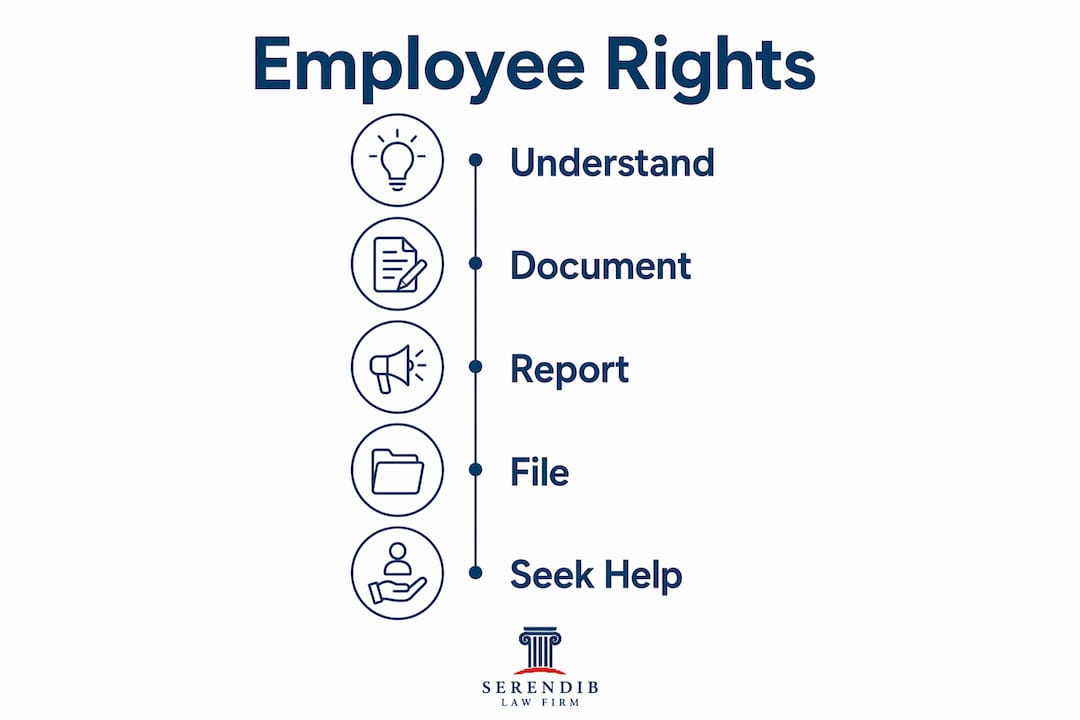
Documentation is the foundation of every successful retaliation claim. Employees should document every incident carefully, including dates, witnesses, and communications, to strengthen retaliation claims. Without a clear record, it becomes your word against your employer’s.
Here is a practical step-by-step approach for Lake Forest employees who believe they are facing retaliation:
Start a written log immediately. Record every incident as soon as it happens. Include the date, time, location, what was said or done, who was present, and how it affected your work. Use a personal email or a notebook you keep at home, not a company device.
Save all relevant communications. Forward work emails to a personal account before your access is cut off. Screenshot text messages. Print or save any written warnings, performance reviews, or schedule changes that followed your protected activity.
Identify the timeline. Write down when you made your complaint or engaged in the protected activity, then list every adverse action that came after. A clear timeline showing that negative treatment began right after you spoke up is powerful evidence.
Report internally if it is safe to do so. Many companies have HR departments or ethics hotlines. Reporting internally creates a paper trail and puts your employer on notice. If your HR department is part of the problem, you can skip this step and go directly to the CRD.
Identify witnesses. Think about coworkers who saw the retaliation happen or who can confirm that your work performance was strong before you made your complaint. Witnesses do not need to be willing to testify right away. Just note their names and what they observed.
Consult an employment attorney in Lake Forest. An attorney experienced in employment law in Lake Forest can review your documentation, assess the strength of your claim, and advise you on next steps before you file anything official.
Acting quickly matters. California law sets applicable statutes of limitations on retaliation claims, and those deadlines should be evaluated on a case-by-case basis with an attorney. Do not wait to see if things improve on their own.
What legal recourse options are available in lake forest?
Lake Forest employees who experience retaliation have several concrete paths to seek justice. The most common starting point is filing a complaint with the California Civil Rights Department.
| Legal Option | Process | Possible Outcome |
|---|---|---|
| CRD Complaint | File intake form; CRD investigates | Settlement, mediation, or Right to Sue notice |
| Right to Sue Notice | Request from CRD to bypass investigation | File civil lawsuit directly in court |
| EEOC Complaint | Federal agency investigation | Federal lawsuit or settlement |
| Civil Lawsuit | Attorney files in California court | Reinstatement, back pay, damages, attorney fees |
Filing complaints with the California Civil Rights Department initiates an investigation that may lead to settlement or litigation. Employees may bypass lengthy administrative processes by requesting a Right to Sue notice. That notice gives you the authority to take your employer to civil court without waiting for the CRD to finish its investigation.
The CRD typically takes up to one year to complete an initial investigation after a complaint is filed. That timeline can feel long when you are dealing with ongoing retaliation at work. Requesting a Right to Sue notice early in the process is a legitimate strategy that many employment attorneys in Lake Forest recommend.
If your case goes to court, the potential outcomes include reinstatement to your former position, back pay for lost wages, compensation for emotional distress, punitive damages in serious cases, and attorney fees paid by the employer. California courts have awarded significant damages in retaliation cases, which is why employers with experienced legal teams take these claims seriously.
California law allows up to three years to submit a discrimination or retaliation complaint intake form to the CRD, which is longer than the federal EEOC deadline of 300 days. That extended window gives Lake Forest employees more time to build a case, but waiting too long can still hurt your claim.
How do california protections benefit lake forest employees vs. federal law?
California’s retaliation protections give Lake Forest employees a clear advantage over the federal baseline. Here is what sets state law apart:
- Lower employer threshold. FEHA covers employers with as few as 5 employees, compared to Title VII’s minimum of 15. If you work for a small business in Lake Forest, California law likely still protects you even when federal law does not.
- Longer filing window. California gives employees up to three years to file a retaliation complaint with the CRD. The federal EEOC deadline is 300 days. That difference can determine whether your claim is viable.
- Broader definitions. California defines protected activity more broadly than federal law. Complaining about wage theft, requesting a disability accommodation, or reporting a safety violation all qualify as protected activity under state law.
- Cross-filing maximizes protection. Cross-filing retaliation and discrimination claims with both state and federal agencies preserves employee rights and broadens protection coverage. You do not have to choose one or the other.
The practical takeaway is straightforward. If you work in Lake Forest and face retaliation, California law is almost always the stronger tool. Federal law serves as a backup and provides access to federal courts, but state protections cover more employees and offer more time to act.
Key takeaways
California law gives Lake Forest employees stronger retaliation protections than federal law, covering smaller employers, broader protected activities, and longer filing windows.
| Point | Details |
|---|---|
| Retaliation is broadly defined | Firing, demotion, harassment, and exclusion all qualify as illegal retaliation under California law. |
| FEHA covers small employers | Employers with 5 or more employees must comply with FEHA, far below the federal threshold of 15. |
| Documentation wins cases | Recording dates, witnesses, and communications from the start is the single most important step you can take. |
| CRD is your primary agency | Filing with the California Civil Rights Department starts the official process and preserves your right to sue. |
| Cross-filing protects more rights | Filing with both the CRD and EEOC simultaneously preserves state and federal claims without extra effort. |
What i have learned about retaliation cases in lake forest
The employees who come to me most frustrated are not the ones who were fired outright. They are the ones who stayed at their jobs while the retaliation slowly wore them down. Subtle retaliation is the most insidious form because it makes you question yourself. You start wondering if the bad reviews are deserved, if the schedule changes are coincidental, if you are being too sensitive. You are not.
The biggest mistake I see employees make is waiting. They hope the situation will resolve itself, or they worry that filing a complaint will make things worse. By the time they reach out for legal advice, critical evidence has been deleted, witnesses have moved on, and the applicable deadlines are closing in. Early action is not aggressive. It is smart.
Another thing I have noticed is that Lake Forest employees often do not realize how many of their daily work complaints qualify as protected activity. Telling your manager that your overtime is not being paid correctly is a protected act. Asking HR about a disability accommodation is a protected act. Reporting a coworker for racial harassment is a protected act. The law covers far more than most people expect.
My honest advice: treat your employment situation the way you would treat any other serious legal matter. You would not wait months to see a doctor after a serious injury. Do not wait months to get legal advice on workplace retaliation either. The sooner you understand your rights, the more options you have.
How Serendib law supports lake forest employees facing retaliation
Serendib law represents employees in Lake Forest who are facing workplace retaliation, wrongful termination, and discrimination. The firm’s Lake Forest employment law attorneys provide personalized counsel focused entirely on employee rights, not employer interests. From your first consultation through the complaint process or litigation, Serendib law guides you through every step with clear communication and direct advocacy. The team is bilingual in English and Spanish, making legal support accessible to more workers in the Lake Forest community. If you believe your employer has retaliated against you for asserting your rights, contact Serendib law for a free consultation and find out exactly where you stand. You can also explore the firm’s overview of California employment law claims to understand the full range of options available to you.
FAQ
What counts as workplace retaliation in california?
Workplace retaliation is any adverse employment action taken because an employee engaged in a legally protected activity. This includes termination, demotion, pay cuts, harassment, and exclusion from workplace opportunities.
Does california law protect me if i work for a small company in lake forest?
Yes. FEHA protects employees at companies with 5 or more employees, which covers most small businesses in Lake Forest. Federal law only applies to employers with 15 or more employees.
How long do i have to file a retaliation complaint in california?
California law allows up to three years to file a complaint intake form with the California Civil Rights Department, which is significantly longer than the federal EEOC deadline. Applicable statutes of limitations vary by claim type and should be reviewed with an attorney.
Can i be retaliated against for reporting wage theft in lake forest?
No. California law explicitly prohibits employers from punishing employees who report unpaid wages, overtime violations, or other labor law infractions. Retaliation for wage complaints is illegal and actionable.
What is a right to sue notice and when should i request one?
A Right to Sue notice is issued by the California Civil Rights Department and authorizes you to file a civil lawsuit against your employer without waiting for the CRD to complete its investigation. Requesting one early can speed up your path to court if the CRD investigation is taking too long.