
Retaliation in Lake Forest CA reporting workplace misconduct is defined as any adverse employer action taken against an employee because they reported illegal activity, safety hazards, harassment, or other workplace misconduct. California law treats this as a serious violation of employee rights, and two state agencies enforce these protections: the California Civil Rights Department (CRD) and the Division of Labor Standards Enforcement (DLSE). Employees in Lake Forest who speak up about discrimination, wage theft, or hazardous workplace conditions are legally protected from punishment. Understanding what counts as retaliation, which laws apply, and how to respond is the first step toward protecting yourself.
What actions count as retaliation after reporting misconduct?
Retaliation covers far more than getting fired. California law defines retaliation as any materially adverse employment action that would discourage a reasonable employee from reporting misconduct. That definition is intentionally broad.
Common retaliatory actions include:
- Demotion or reduction in job title
- Pay cuts or elimination of bonuses
- Negative or false performance reviews
- Undesirable transfers or shift changes
- Denial of training or promotion opportunities
- Isolation from coworkers or exclusion from meetings
- Creation of a hostile work environment
- Increased scrutiny or micromanagement
Adverse actions include less obvious forms like denying training, unfavorable schedule changes, and deliberately isolating an employee from team activities. These subtle tactics are just as unlawful as a termination letter.
Lake Forest workplaces span industries from tech firms and healthcare providers to retail and construction. Retaliation looks different across each setting. A warehouse worker might face sudden schedule changes after reporting a safety violation. An office employee might receive a suspicious negative review days after filing a harassment complaint.

Pro Tip: Keep a private log of every change in your treatment at work, noting the date, what happened, and who was involved. Patterns of subtle mistreatment often become the strongest evidence in a retaliation case.
Which activities are legally protected when reporting workplace misconduct in Lake Forest?
Protected activity is the legal term for any action an employee takes that triggers anti-retaliation protections under California law. You do not need to file a formal lawsuit or contact a government agency to be protected. Internal complaints count too.
Protected activities in Lake Forest workplaces include:
- Reporting discrimination or harassment to HR or a supervisor
- Filing a complaint with the CRD, DLSE, or Cal/OSHA
- Reporting wage theft, unpaid overtime, or meal break violations
- Reporting hazardous workplace conditions or safety violations
- Participating as a witness in a coworker’s complaint or investigation
- Refusing to participate in illegal employer conduct
- Requesting a reasonable accommodation for a disability
California Labor Code Section 1102.5 is the primary whistleblower protection statute. It covers employees who report violations of state or federal law to a supervisor, government agency, or law enforcement. The Fair Employment and Housing Act (FEHA) adds parallel protections for employees who report discrimination or harassment.
A reasonable good-faith belief that misconduct occurred is enough to trigger protection under Labor Code 1102.5. You do not need to prove your report was factually correct. If you genuinely believed a violation was happening and reported it honestly, California law protects you. That standard removes a major barrier for employees who hesitate to speak up because they fear being wrong.
How to file a retaliation complaint in Lake Forest CA
Choosing the right agency is the most critical procedural decision you will make. Filing with the wrong agency can cause significant delays or result in outright dismissal of your claim. California routes retaliation complaints through three primary agencies depending on the underlying misconduct.
| Agency | Claim Type | Notes on Deadlines |
|---|---|---|
| California Civil Rights Department (CRD) | Discrimination, harassment, FEHA retaliation | Statute of limitations applies; evaluate case by case |
| Division of Labor Standards Enforcement (DLSE) | Wage violations, Labor Code 1102.5 whistleblower claims | Statute of limitations applies; evaluate case by case |
| Cal/OSHA | Safety-related retaliation complaints | Shorter filing window; consult an attorney promptly |
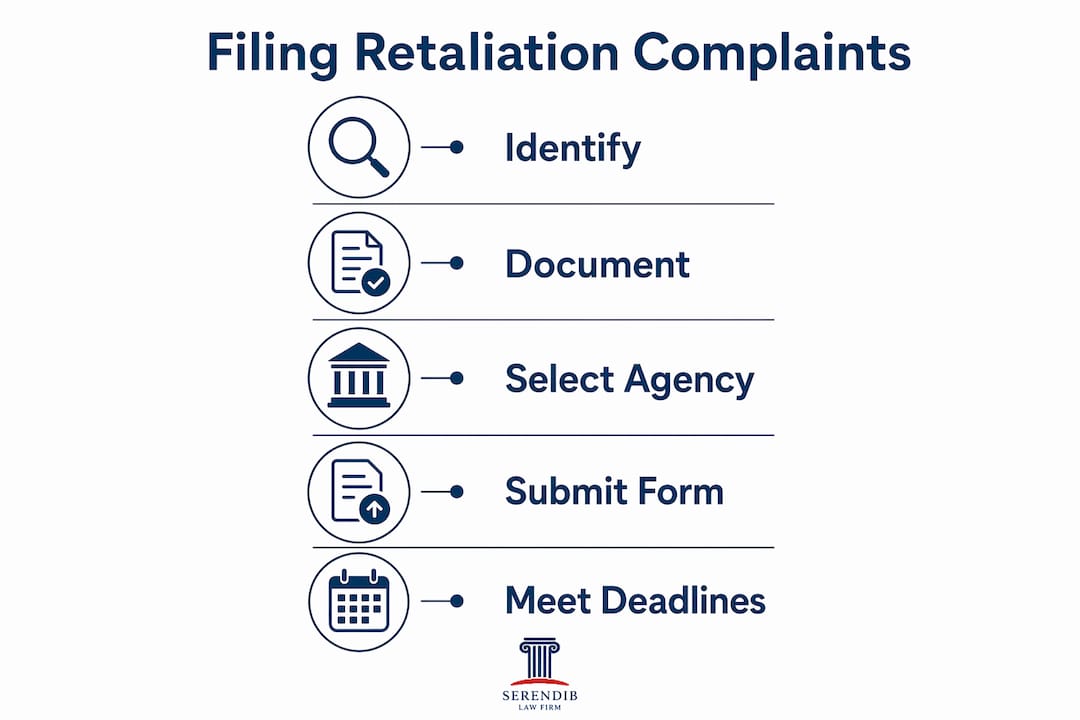
The general steps for filing a retaliation complaint follow a consistent pattern across agencies. You submit an intake form or initial complaint, the agency conducts an intake interview, an investigator reviews your documentation, and the agency either mediates, investigates further, or issues a right-to-sue notice.
Filing promptly matters because statutory deadlines vary by claim type and agency. Missing a deadline can permanently bar your claim regardless of how strong your evidence is. Applicable statutes of limitations should be evaluated on a case-by-case basis with an attorney, since the rules differ depending on the type of retaliation and the agency involved.
For employees in Lake Forest, experienced employment law attorneys can identify the correct agency before you file, preventing costly procedural errors.
Pro Tip: Start documenting everything the moment you suspect retaliation, not after you decide to file. Early records carry more credibility because they were created before any legal dispute began.
How to document retaliation and build a strong case in Lake Forest workplaces
Strong documentation is what separates a compelling retaliation claim from one that stalls during investigation. Chronological documentation of each protected activity and subsequent adverse action, with specific dates and detailed evidence, greatly improves claim validity.
Build your case with these steps:
- Create a written timeline. Record every protected activity you engaged in, with exact dates, and then list every adverse action that followed. The sequence matters enormously.
- Save all relevant communications. Emails, text messages, performance reviews, and written warnings are primary evidence. Print or export digital copies and store them somewhere your employer cannot access.
- Collect performance records from before and after your report. A glowing review followed by a sudden negative evaluation after you filed a complaint is a classic indicator of retaliation.
- Document witness information. Note the names and contact details of coworkers who observed the retaliation or the original misconduct. Witness accounts corroborate your timeline.
- Keep copies of every complaint you filed. Retain confirmation emails, case numbers, and any employer responses to your internal complaints.
- Track changes in your daily treatment. Note shifts in how supervisors communicate with you, whether you are excluded from meetings, or whether your workload changed after your report.
Documentation of the causal connection between your protected activity and the adverse action is the core of any retaliation claim. Without it, even a legitimate case becomes difficult to prove. The closer in time the adverse action follows your report, the stronger the implied connection.
What legal protections and evidentiary advantages apply to retaliation claims in California?
California provides employees with some of the strongest anti-retaliation protections in the country. Several laws and legal presumptions work together to level the playing field between employees and employers.
Under SB 497, if an employer takes adverse action against an employee within 90 days of a protected activity, California law presumes that action was retaliatory. The burden then shifts to the employer to prove the action was taken for a legitimate, independent reason using clear and convincing evidence. That is a high standard, and it gives employees a significant tactical advantage early in a case.
Key protections employees in Lake Forest can rely on include:
- Labor Code 1102.5 contributing factor standard. Employees only need to show that their protected activity was a contributing factor in the adverse action, not the sole cause.
- SB 497’s 90-day presumption. Adverse action within 90 days of protected activity triggers a legal presumption of retaliation, shifting the burden to the employer.
- Good faith protection. Employees are protected even if the underlying report turns out to be unsubstantiated, as long as the belief was reasonable and the report was made honestly.
- Employer burden shifting. Once the presumption applies, the employer must produce clear and convincing evidence of a legitimate reason for the adverse action.
- Available remedies. Employees who prevail can seek reinstatement, back pay, compensatory damages, and in some cases civil penalties.
Employees reporting retaliation after safety reports face the same legal framework, with Cal/OSHA adding an additional layer of protection for safety-specific complaints.
The 90-day retaliation presumption created by SB 497 is one of the most employee-friendly provisions in California labor law. It means that suspicious timing alone can shift the legal burden onto your employer. That is a powerful tool, especially in cases where direct evidence of retaliatory intent is hard to find.
Key Takeaways
Employees in Lake Forest who report workplace misconduct are protected by California’s anti-retaliation laws, and acting quickly with proper documentation and agency selection determines whether a claim succeeds.
| Point | Details |
|---|---|
| Retaliation is broadly defined | Adverse actions include demotion, pay cuts, hostile environments, and denied training, not just termination. |
| Good faith reporting is protected | You do not need to prove your report was correct, only that you had a reasonable belief misconduct occurred. |
| Agency selection is critical | Filing with the wrong agency (CRD, DLSE, or Cal/OSHA) can delay or dismiss your claim entirely. |
| SB 497 creates a 90-day presumption | Adverse action within 90 days of protected activity shifts the burden of proof to the employer. |
| Documentation wins cases | A detailed chronological record linking protected activity to adverse actions is the foundation of a strong claim. |
What I have learned about retaliation cases in Lake Forest workplaces
The single biggest mistake I see employees make is waiting too long to document and consult an attorney. By the time someone calls for help, weeks of critical evidence have already disappeared. Emails get deleted. Witnesses move on. The memory of exact dates fades. Retaliation cases are won or lost on specifics, and specifics require contemporaneous records.
Another pattern I notice consistently: employees file with the wrong agency because they assume all retaliation complaints go to the same place. A wage-related retaliation claim filed with the CRD instead of the DLSE can cost months of delay and sometimes the claim itself. That is an avoidable error with early legal guidance.
What surprises many employees is that suspicious timing is often their strongest asset. When a negative review appears three weeks after an internal harassment complaint, that sequence speaks for itself. California’s SB 497 presumption was designed precisely to capture that pattern. Good faith reporting is protected even if the employer’s investigation ultimately clears the company of wrongdoing. The protection attaches to the act of reporting, not the outcome.
My honest advice: treat the period immediately after you report misconduct as a legal evidence-gathering window. Document everything. Save everything. And consult an attorney before you file anywhere, because the procedural choices you make in the first weeks shape the entire trajectory of your case.
— Maya Serkova
Serendib Law Firm is ready to help Lake Forest employees
Serendib Law Firm represents employees in Lake Forest and throughout Southern California who face retaliation after reporting workplace misconduct. The firm handles retaliation claims under Labor Code 1102.5, FEHA, and SB 497, providing personalized case assessments and full support through the complaint filing process. Serendib Law Firm offers free consultations and takes select cases on a contingency basis, meaning you pay nothing unless you recover. The team is bilingual in English and Spanish, making legal guidance accessible to a wider community. To discuss your situation with an attorney, contact Serendib Law Firm today and get clarity on your rights before deadlines pass.
FAQ
What is workplace retaliation under California law?
Workplace retaliation is any adverse employer action taken against an employee because they engaged in a legally protected activity, such as reporting misconduct, harassment, or safety violations. California Labor Code 1102.5 and FEHA both prohibit this conduct.
Do I need proof my report was accurate to be protected?
No. California law protects employees who report misconduct in good faith based on a reasonable belief that a violation occurred, even if the report is ultimately unsubstantiated.
Which agency handles retaliation complaints in Lake Forest CA?
The correct agency depends on the type of claim. The CRD handles discrimination and harassment retaliation, the DLSE handles wage and whistleblower claims, and Cal/OSHA handles safety-related retaliation. Filing with the wrong agency can result in dismissal.
What is the SB 497 90-day presumption?
SB 497 creates a legal presumption that retaliation occurred if an employer takes adverse action within 90 days of a protected activity. The employer must then prove the action was legitimate using clear and convincing evidence.
How do I strengthen a retaliation claim in Lake Forest?
Build a detailed timeline linking your protected activity to each adverse action, save all communications and performance records, and document witness information. Early documentation and prompt legal consultation are the most effective steps you can take.