
Wage and hour claims are legal actions that allow employees to recover unpaid wages, overtime, and other compensation their employer failed to pay under California labor law. Garden Grove workers face these violations across retail, hospitality, construction, and healthcare jobs every day. The California Labor Commissioner’s Office, through its Division of Labor Standards Enforcement (DLSE), handles these claims at no cost to the employee. California’s labor code is among the strongest in the country, covering unpaid regular wages, overtime premiums, missed meal and rest break pay, and more. If your employer has shorted your paycheck, you have a legal path to recover every dollar owed.
What types of unpaid wages qualify for wage and hour claims in Garden Grove?
California law defines wages broadly, and that definition works in your favor. Wages include commissions, bonuses, and accrued vacation pay, not just your hourly rate. Many Garden Grove employees leave money on the table by focusing only on base pay when filing a claim.
The most common violations that qualify for unpaid wage recovery in Garden Grove include:
- Unpaid overtime. California requires 1.5 times your regular rate for hours beyond 8 in a day or 40 in a week, and double time for hours beyond 12 in a day or after 8 hours on the seventh consecutive workday.
- Minimum wage shortfalls. Any pay below California’s current minimum wage is a recoverable violation.
- Missed meal and rest break premiums. If your employer skipped or cut short your legally required breaks, you are owed one additional hour of pay per missed break.
- Unreimbursed business expenses. Mileage, tools, uniforms, and phone costs your employer required but never repaid count as unpaid wages.
- Waiting time penalties. If your employer willfully fails to pay all final wages at termination, penalties begin to accrue immediately.
- Unpaid commissions and bonuses. Earned commissions and discretionary bonuses that were promised but never paid qualify as wage theft under California law.
Pro Tip: If you received a commission or bonus in writing, even in a text message, that document is evidence of a wage obligation. Save it before you file.
Overtime claims in Garden Grove are especially common in industries that use shift scheduling, because daily overtime thresholds catch employers who spread hours across long single shifts rather than full weeks.
How do Garden Grove employees calculate unpaid wages and damages?
Calculating your claim accurately is the difference between recovering what you are owed and leaving penalties behind. The process is straightforward when you break it into parts.
- Calculate unpaid regular wages. Multiply the hours your employer failed to pay by your agreed hourly rate. If your rate changed over time, apply the correct rate to each pay period separately.
- Add overtime premiums. For each hour beyond 8 in a day, add 0.5 times your regular rate. For hours beyond 12 in a day, add a full extra regular rate on top of your base pay. Apply the same logic to your seventh consecutive workday.
- Include missed break pay. Count each missed or interrupted meal or rest break and add one hour of pay at your regular rate for each one.
- Add waiting time penalties. If your employer failed to pay your final wages on time, penalties under Labor Code § 203 can reach up to 30 days of additional wages. That figure alone can significantly increase your total recovery.
- Apply interest. Unpaid wages accrue interest at 10% annually. The longer your employer delays payment, the more you are owed.
The table below shows how these components stack up for a sample claim:
| Wage Component | How It Is Calculated |
|---|---|
| Unpaid regular wages | Hours not paid × agreed hourly rate |
| Daily overtime (hours 9–12) | Unpaid overtime hours × 1.5x regular rate |
| Daily double time (12+ hours) | Unpaid double time hours × 2x regular rate |
| Missed break premium | Number of missed breaks × 1 hour of regular pay |
| Waiting time penalty | Up to 30 days of daily wages under Labor Code § 203 |
| Interest on unpaid wages | 10% per year on total unpaid amount |
Pro Tip: Run your calculation for every pay period separately, not just as a lump sum. Errors in individual paychecks are easier to prove and harder for employers to dispute.
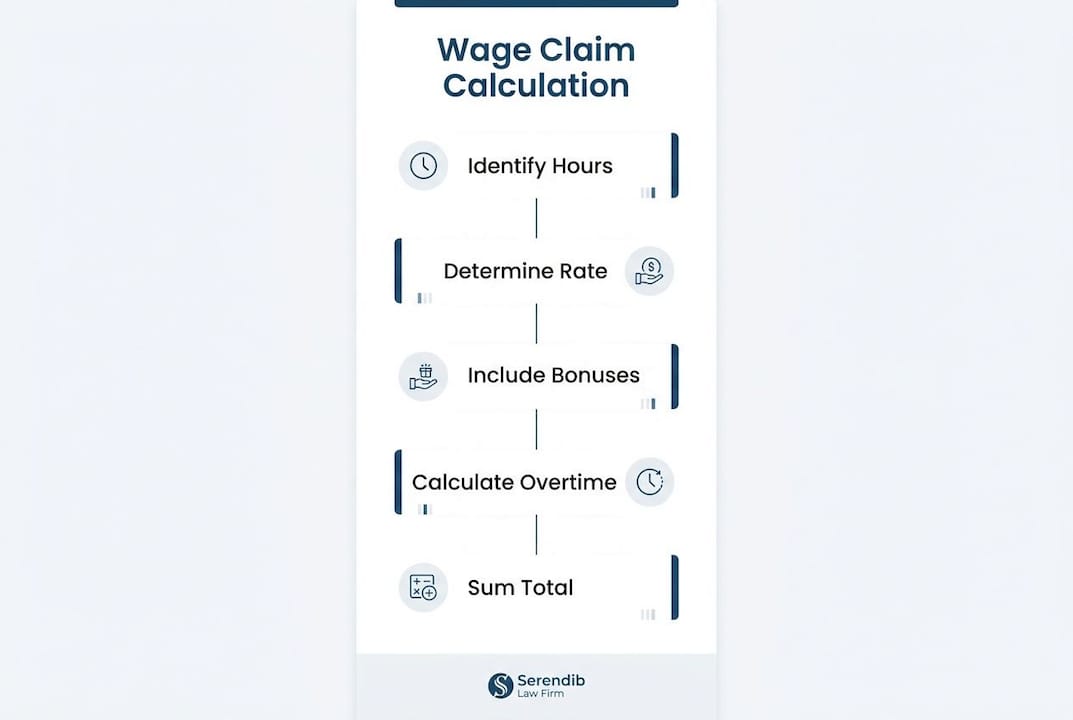
Do not forget to include commissions and bonuses in your base calculation. Overtime rates in California are calculated from your “regular rate of pay,” which includes non-discretionary bonuses. Omitting those figures understates both your overtime owed and your total claim.
How do you file a wage and hour claim in Garden Grove with the DLSE?
The DLSE wage claim process is free and designed so employees can represent themselves without an attorney. That said, understanding each step before you start saves time and avoids mistakes.
Here is how the process works:
- File your claim. Submit a wage claim form online through the California Labor Commissioner’s website, by mail, or in person at a local district office. Provide your employer’s legal name, your job title, the dates of employment, and the specific wages you believe are owed.
- Employer response window. After you file, your employer has 10 calendar days to respond. They can pay the claim, dispute it, or fail to respond, which strengthens your position.
- Settlement conference. A Deputy Labor Commissioner schedules a settlement conference. Both sides present their positions informally. Many claims resolve here without a full hearing.
- Berman hearing. If no settlement is reached, the case moves to a Berman hearing. This is an informal but legally binding proceeding where a hearing officer reviews evidence, asks specific questions about hours and payroll, and issues an order. The hearing officer asks focused questions about hours and payroll entries, so arriving with organized records is critical.
- Post-hearing enforcement. If the hearing officer rules in your favor and your employer still refuses to pay, the DLSE can take enforcement action, including placing a lien on the employer’s business assets.
Pro Tip: Bring physical copies of all your documents to the settlement conference. Employees who arrive prepared with organized records settle faster and more favorably than those who rely on memory.
Statute of limitations rules apply to wage claims, and they operate on a rolling basis. Each paycheck with unpaid wages triggers its own deadline, which means you can recover wages from the past three years even if you are still employed. Applicable deadlines vary by claim type and should be evaluated on a case-by-case basis with legal guidance.
What evidence should Garden Grove employees prepare for their claims?
Strong evidence is the foundation of a successful overtime claim or unpaid wage recovery. Well-organized documentation often results in quicker settlements and reduces the chance of a prolonged hearing.
Gather the following before you file:
- Pay stubs. These confirm your stated pay rate and show what your employer actually paid versus what you worked.
- Personal time logs. Write down your actual start and end times for every shift you can recall. Your memory, recorded consistently, is admissible evidence.
- Work schedules. Printed or digital schedules show the hours your employer assigned, which can contradict payroll records that undercount your time.
- Offer letters and employment contracts. These documents confirm your agreed pay rate, commission structure, or bonus terms.
- Emails and text messages. Any written communication about hours, pay, or scheduling is relevant. Screenshot and save these immediately.
- Expense receipts. If you paid out of pocket for work-related costs, receipts prove the amount and the business purpose.
Bringing a physical, organized folder of personal records to your hearing greatly improves your chances. The hearing officer will interrupt to ask for specific records. Employees who can produce them on the spot project credibility and control the narrative.
Pro Tip: Organize your evidence chronologically by pay period, not by document type. Hearing officers move through timelines quickly, and matching your records to their questions in real time makes a strong impression.
Legal experts recommend early and thorough evidence collection to avoid pitfalls that delay or weaken wage claims. The sooner you start gathering records, the less risk that payroll data disappears or memories fade.
Key Takeaways
California wage and hour law gives Garden Grove employees strong tools to recover unpaid overtime, missed break pay, waiting time penalties, and interest, but acting quickly and filing with complete evidence is what determines how much you actually recover.
| Point | Details |
|---|---|
| Wages include more than hourly pay | Commissions, bonuses, and vacation pay all qualify as recoverable wages under California law. |
| Overtime thresholds are daily and weekly | California triggers overtime after 8 hours in a day, not just 40 hours in a week. |
| Penalties multiply your recovery | Waiting time penalties can add up to 30 days of wages, and interest accrues at 10% annually. |
| The DLSE process is free | Employees can file and represent themselves at no cost through the Labor Commissioner’s Office. |
| Evidence wins claims | Organized pay stubs, time logs, and written communications are the difference between settling fast and prolonged hearings. |
What I have learned about wage claims that most guides skip
By Maya Serkova
Most articles about wage and hour claims focus on the law. What they skip is the psychology of the process. Garden Grove employees often underestimate their claims because they feel uncertain about the dollar amount or embarrassed to confront their employer formally. That hesitation costs them real money.
The Berman hearing is informal, but it is not casual. I have seen employees walk in without a single printed document and watch their credible verbal account get dismissed because they could not back it up on paper. The hearing officer is not there to investigate for you. They are there to weigh what you bring. Preparation is not optional.
California’s penalty structure is genuinely punishing for employers who drag their feet. Waiting time penalties and interest accumulate fast. That reality gives employees real leverage at the settlement conference, which is where most claims actually resolve. Employers who understand the math often prefer to settle rather than risk a hearing order that includes every penalty.
The rolling statute of limitations is one of the most misunderstood protections in California wage law. Employees assume that because they are still working for the same employer, they cannot file. That is wrong. Each underpaid paycheck is its own claim. You can file today for wages your employer shorted you three years ago, and you can keep filing as new violations occur.
My strongest advice: do not wait for your employment to end before you act. File while the records are fresh, while witnesses remember, and while you still have access to your work schedule and communications. The employment law claims process in California is built for workers, but only workers who show up prepared benefit from it.
— Maya Serkova
Serendib Law Firm helps Garden Grove employees recover what they are owed
Serendib Law Firm represents employees in Garden Grove and across Southern California in wage and hour claims, including unpaid overtime, missed break pay, and waiting time penalties. The firm offers free initial consultations and guides clients through every stage of the DLSE process, from filing to the Berman hearing and post-hearing enforcement. Complex claims involving commissions, bonuses, or multiple violations benefit most from experienced legal support. The wage claim process is designed for self-representation, but having an attorney often increases the final recovery. Contact Serendib Law Firm through the firm’s contact page to schedule your free consultation and get a clear picture of what your claim is worth.
FAQ
What is a wage and hour claim in California?
A wage and hour claim is a formal legal action filed with the California Labor Commissioner’s Office to recover unpaid wages, overtime, or other compensation an employer failed to pay. The process is free and available to all employees regardless of immigration status.
How far back can Garden Grove employees recover unpaid wages?
The statute of limitations for most wage claims runs three years, with a four-year window for written contract violations. Deadlines apply on a per-paycheck basis, so applicable timeframes should be evaluated individually with legal guidance.
What happens if my employer disputes my wage claim?
If your employer contests the claim, the DLSE schedules a settlement conference followed by a Berman hearing if no agreement is reached. A hearing officer reviews the evidence and issues a legally binding order.
Do I need a lawyer to file a wage claim in Garden Grove?
The DLSE process allows self-representation at no cost, but legal counsel improves outcomes in complex cases involving multiple violations, commissions, or employer retaliation.
Can I file a wage claim while still employed?
Yes. California law allows employees to file wage claims for ongoing violations while still working for the same employer. Each underpaid paycheck carries its own deadline, so filing promptly protects your right to recover older wages.