

If you work in Irvine and meet the eligibility requirements, California law entitles you to job-protected leave for an extended period of unpaid, job-protected leave under the California Family Rights Act (CFRA). You qualify if you have worked for your employer for more than 12 months, logged at least 1,250 hours in the prior 12 months, and your employer meets the minimum employee threshold. That last threshold is critical: CFRA covers far more Irvine workers than the federal Family and Medical Leave Act (FMLA), which only applies to employers with 50 or more employees.
If you meet those three tests, here is what to do right now:
- Notify your supervisor or HR in writing that you need medical or family leave, and state the approximate start date and expected duration.
- Gather your documents: recent pay stubs, your original hire date, any medical paperwork, and a copy of any written communication with your employer about the leave.
- Contact the California Civil Rights Department (CRD) at calcivilrights.ca.gov if your employer refuses your request or retaliates against you.
- Contact the Employment Development Department (EDD) at edd.ca.gov to apply for Disability Insurance (DI) or Paid Family Leave (PFL) wage-replacement benefits separately from your CFRA job-protection claim.
- Consult an Irvine employment attorney if your employer denies leave, demotes you, or threatens your job in connection with your request.
Table of Contents
- What is CFRA and how does it differ from FMLA?
- Are you eligible? The CFRA checklist for Irvine employees
- What qualifies as CFRA leave and which family members are covered?
- How much leave do you get, and how does it interact with FMLA, DI, and PFL?
- How to request CFRA leave in Irvine: a step-by-step guide
- What your Irvine employer must do under CFRA
- Pay, benefits, and your finances during CFRA leave
- What to do if your employer denies CFRA leave or retaliates
- CFRA vs. FMLA: the differences that matter most for Irvine employees
- Irvine resources and when to contact an employment lawyer
- How CFRA and California Pregnancy Disability Leave work together
- Your confidentiality rights regarding medical information
- How CFRA leave affects your seniority and benefits beyond health insurance
- How quickly must your employer respond to a leave request?
- What if your employer has fewer than five employees?
- Key Takeaways
- What Irvine employees often get wrong about CFRA
- Serendib Law Firm is ready to help Irvine employees assert their CFRA rights
- Authoritative sources and next steps
What is CFRA and how does it differ from FMLA?
The California Family Rights Act (CFRA) is a state law that gives eligible employees the right to take job-protected family and medical leave without losing their position. It is enforced by the California Civil Rights Department (CRD), the state agency that also handles workplace discrimination and harassment complaints.
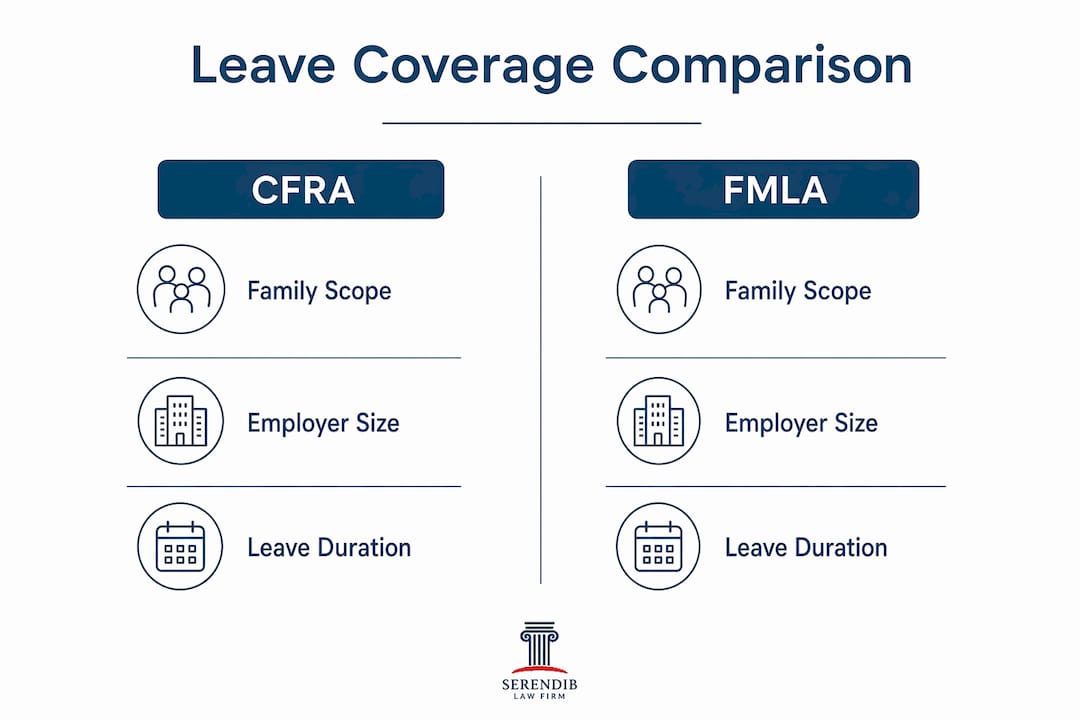
CFRA provides up to 12 workweeks of unpaid, job-protected leave in a 12-month period and applies to any employer with five or more employees, a much lower bar than the federal FMLA’s 50-employee threshold. That difference matters enormously for Irvine employees who work for small businesses, startups, or boutique firms that would not be covered under federal law at all.
The two laws also diverge on which family members qualify. CFRA covers a broader list, including grandparents, grandchildren, siblings, parents-in-law, and a “designated person” of the employee’s choosing. FMLA does not include those categories. When both laws apply to your employer, they can run concurrently, but the expanded CFRA protections still apply independently. For local legal guidance, Serendib Law Firm represents employees in Irvine and throughout Orange County on exactly these questions.
Are you eligible? The CFRA checklist for Irvine employees
CFRA eligibility turns on three statutory requirements, and you must meet all three:
- At least a full year of service with your current employer. This does not need to be continuous, but gaps in employment can affect the calculation.
- At least 1,250 hours worked in the 12-month period immediately before the leave begins. That averages roughly 24 hours per week, so many part-time workers qualify if their hours are consistent.
- Your employer has five or more employees (full-time or part-time). The employer’s size is measured at the time you establish eligibility and give notice, not later in the leave period.
A few edge cases worth knowing: a seasonal employee who has worked more than 12 months cumulatively and hit the 1,250-hour mark qualifies, even if the work is not year-round. If you are currently on another approved leave and have not yet crossed the 12-month service mark, you may become eligible while still on payroll. Under California regulations, your employer is required to designate the remaining leave as CFRA once you reach that threshold, so track your hire date and payroll status carefully.
To verify your eligibility, pull your most recent pay stubs, confirm your hire date in writing with HR, and calculate your hours from the prior 12 months. If your employer disputes your hours, your pay stubs and timesheets are your primary evidence.
What qualifies as CFRA leave and which family members are covered?
CFRA leave covers four main categories of qualifying reasons:
- Your own serious health condition that makes you unable to perform the essential functions of your job.
- Caring for a covered family member with a serious health condition.
- Bonding with a new child born, adopted, or placed in foster care, within one year of the child’s arrival.
- Military exigency related to a covered family member’s active duty or call to active duty in the U.S. Armed Forces.
California expanded CFRA’s family member categories significantly in recent years, removing the old 50-employee within-75-miles worksite rule and adding the “designated person” category. That means you can now take CFRA leave to care for someone who is not a blood relative but has a family-like relationship with you, which is a protection FMLA does not provide.
| Family Member | Covered Under CFRA | Covered Under FMLA |
|---|---|---|
| Spouse | Yes | Yes |
| Domestic partner | Yes | No |
| Child (biological, adopted, foster) | Yes | Yes |
| Parent | Yes | Yes |
| Parent-in-law | Yes | No |
| Grandparent | Yes | No |
| Grandchild | Yes | No |
| Sibling | Yes | No |
| Designated person | Yes | No |
For Irvine employees, this table has real practical weight. If you need leave to care for a grandparent or a sibling with a serious illness, CFRA protects you. FMLA does not.
How much leave do you get, and how does it interact with FMLA, DI, and PFL?
The standard entitlement under CFRA is job-protected leave for an extended period in any 12-month period, calculated proportionally to your normal work schedule. If you work four days a week, your 12 weeks are based on that schedule, not a full-time one.

When both CFRA and FMLA apply to your employer, the two laws generally run at the same time for qualifying reasons they share. That means you typically do not get 12 weeks under each law back-to-back for the same condition. However, because CFRA covers more qualifying reasons and more family members than FMLA, there are situations where CFRA leave runs separately, giving you additional protected time beyond what FMLA alone would provide.
The distinction between wage replacement and job protection trips up many employees. DI and PFL are wage-replacement programs administered by EDD. They can pay a portion of your wages while you are out, but they do not protect your job. CFRA is what protects your job. You need both: file for DI or PFL with EDD for income, and assert your CFRA rights with your employer for reinstatement.
| Rule | Detail |
|---|---|
| Maximum leave | Up to 12 workweeks of unpaid, job-protected leave per 12-month period |
| Eligibility: service | More than 12 months with employer |
| Eligibility: hours | At least 1,250 hours in prior 12 months |
| Employer size threshold | 5 or more employees (CFRA); 50+ (FMLA) |
For questions about overlapping leave requests and how concurrency is designated, Serendib Law Firm has published practical guidance specific to California employees.
How to request CFRA leave in Irvine: a step-by-step guide
- Notify your supervisor or HR department. You do not need to use the words “CFRA” or “FMLA,” but you must communicate that you need leave for a qualifying medical or family reason. Written notice is strongly preferred.
- Give 30 days’ advance notice for foreseeable leave. If you know about a planned surgery or an expected birth, provide notice at least 30 days ahead. For unforeseeable events, notify your employer as soon as practicable.
- Submit a written leave request. A short email works. Example: “I am writing to request CFRA leave beginning [date] for approximately [duration] due to a qualifying medical/family reason. Please let me know what certification or forms are required.”
- Respond to your employer’s certification request. Your employer may ask for written certification from a healthcare provider confirming the need for leave and its probable duration. The provider is not required to disclose your underlying diagnosis without your consent.
- Confirm receipt. After submitting your request or certification, follow up in writing (email or HR portal message) to confirm the employer received it. Save that confirmation.
- Track the employer’s response deadline. Your employer must respond to your leave request no later than five business days. If they do not, that delay is itself a potential violation.
Pro Tip: Keep a running timeline document, updated after every conversation with HR or your supervisor. Include the date, time, who you spoke with, and what was said. This contemporaneous record is often the most persuasive evidence in a CFRA complaint.
What your Irvine employer must do under CFRA
Your employer has specific, non-negotiable obligations once you request CFRA leave. They must respond to your request within five business days, provide you with written notice of your rights, and maintain your group health benefits on the same terms as if you had continued working. When you return, they must reinstate you to the same position or a comparable position with equivalent pay, benefits, and working conditions.

Employers are permitted to request medical certification and, in certain circumstances, to require you to use accrued paid leave concurrently with your CFRA leave. What they cannot do is interfere with your right to take leave, deny a request when you clearly meet eligibility, demote you, cut your hours, or retaliate against you in any way for exercising your rights.
A few examples of unlawful employer conduct: reassigning you to a less desirable shift upon your return, issuing a negative performance review that references your leave, or threatening termination if you take time off for a covered medical reason. These are not gray areas. CRD enforces CFRA, and retaliation is explicitly prohibited. If your employer fails to respond within five business days or takes adverse action connected to your leave request, document it immediately and consider contacting CRD or an employment attorney.
Pay, benefits, and your finances during CFRA leave
CFRA itself is unpaid. Your employer is not required to pay your regular wages during leave, though some do. What you can access depends on your situation and your employer’s policies.
Accrued paid time off (vacation, sick time, or other accumulated leave) may be used during CFRA leave, either at your election or because your employer requires it under their policy. If you are taking leave for a family member’s serious health condition or to bond with a new child, your employer may require you to use accrued vacation or other paid leave (excluding sick time in some circumstances) unless you are already receiving PFL benefits from EDD.
For wage replacement, file separately with EDD. Disability Insurance covers your own serious health condition; Paid Family Leave covers bonding and caregiving. Both programs replace a portion of your wages for a limited period. To apply, visit edd.ca.gov and have your employer information, medical documentation, and recent earnings records ready.
Your employer must continue your group health insurance coverage during CFRA leave under the same terms. Seniority and benefit accrual are addressed in more detail below, but the short answer is that CFRA leave does not automatically count as time worked for accrual purposes unless your employer’s policy says otherwise.
What to do if your employer denies CFRA leave or retaliates
If your employer denies your leave request or takes adverse action against you, act quickly and methodically.
- Preserve all evidence immediately. Save emails, text messages, HR portal records, and any written communications about your leave request and your employer’s response. Screenshot anything that could be deleted.
- Confirm the denial in writing. Send an email to HR stating that you understand your leave request has been denied and asking for the specific reason. Their written response (or silence) is evidence.
- File an internal HR complaint if your company has a formal complaint process. This creates a paper trail and may trigger an internal investigation.
- Collect witness information. If coworkers witnessed adverse treatment or heard relevant statements from management, note their names and what they observed.
- Contact the California Civil Rights Department (CRD). CRD is the primary enforcement agency for CFRA. You can file a complaint at calcivilrights.ca.gov. Filing deadlines are case-specific and governed by applicable statutes of limitations, so consult with an attorney to evaluate your timeline.
- Contact EDD if your wage-replacement benefits are also at issue.
- Consult an Irvine employment attorney. If your job status has been materially affected, denial of reinstatement, demotion, or termination tied to your leave request are situations where legal representation makes a concrete difference.
Pro Tip: After every conversation with HR or management about your leave, send yourself a brief email summarizing what was said. Courts and CRD investigators treat contemporaneous records as far more credible than recollections written months later. This one habit can be the difference between a strong complaint and a weak one.
For detailed guidance on CFRA leave denials and retaliation, Serendib Law Firm has published a dedicated resource for California employees.
CFRA vs. FMLA: the differences that matter most for Irvine employees
The most practically significant difference is coverage. CFRA applies to employers with five or more employees; FMLA applies only to employers with 50 or more employees. For many Irvine workers at smaller companies, CFRA is the only leave law that applies to them at all.
When both laws cover your employer, they generally run concurrently for qualifying reasons they share. But CFRA’s expanded family member list and the designated person category mean there are situations where CFRA leave runs independently, giving you additional protected time. For example, if you take FMLA leave to care for a parent and then need CFRA leave to care for a sibling, those are separate entitlements because FMLA does not cover siblings.
To check whether both statutes apply to your employer, confirm your employer’s total employee count and your own eligibility dates. If your employer has 50 or more employees and you have worked there for at least 12 months and 1,250 hours, both laws likely apply. For official guidance, the CRD at calcivilrights.ca.gov and the federal Department of Labor at dol.gov are the authoritative sources. For a practical comparison of FMLA leave rights in the context of California law, Serendib Law Firm’s Orange County resources are a useful starting point.
Irvine resources and when to contact an employment lawyer
The primary contacts for Irvine employees asserting CFRA rights are:
- California Civil Rights Department (CRD): calcivilrights.ca.gov. File complaints, access fact sheets, and get enforcement guidance.
- Employment Development Department (EDD): edd.ca.gov. Apply for Disability Insurance or Paid Family Leave and get wage-replacement information.
- Serendib Law Firm: Employee-side employment law representation for Irvine and Orange County residents, including CFRA, retaliation, and wrongful termination matters.
If you are consulting an employment attorney, bring these documents to your initial meeting:
- Your hire date and any written employment agreement
- Pay stubs covering the prior 12 months
- Your written leave request and any employer response
- Medical certifications submitted or requested
- Any written communications about your job status before, during, or after the leave
- Names, dates, and brief notes on any witnesses to relevant events
You should call a lawyer when your employer denies reinstatement, demotes or terminates you in connection with your leave, repeatedly refuses to process a certified leave request, or engages in any pattern of adverse treatment after you assert your rights. An initial consultation with Serendib Law Firm will cover whether your situation meets the legal threshold for a CFRA claim, what remedies may be available, and what the next steps look like. The firm represents employees only and offers bilingual service in English and Spanish.
How CFRA and California Pregnancy Disability Leave work together
California Pregnancy Disability Leave (PDL) and CFRA are separate protections that can stack, giving a pregnant employee significantly more total protected leave than either law provides alone.
PDL applies to employers with five or more employees and entitles an employee who is disabled by pregnancy, childbirth, or a related medical condition to up to four months of job-protected leave, depending on the actual period of disability. PDL runs concurrently with FMLA (if applicable) but does not run concurrently with CFRA. That distinction is significant: a pregnant employee can take up to four months of PDL for the disability period, and then take an additional 12 weeks of CFRA leave for baby bonding after the birth. The two leaves do not overlap, so the total protected time can be substantially longer than 12 weeks.
Reinstatement rights apply to both. After PDL, you are entitled to return to the same position. After CFRA bonding leave, you are entitled to the same or a comparable position. If your employer attempts to deny reinstatement after either leave, that is a violation of California law and grounds for a CRD complaint or legal action.
Your confidentiality rights regarding medical information
One of the most misunderstood aspects of CFRA is what your employer is actually entitled to know about your health. The answer is: less than most employees assume.
When you request CFRA leave for a serious health condition, your employer may require certification from your healthcare provider confirming that a serious health condition exists and stating the probable duration of the leave. However, the healthcare provider is not permitted to disclose your underlying diagnosis without your consent. You do not have to tell your employer what illness or condition you have. The certification confirms the need for leave; it does not open your full medical history to your employer.
Your employer is also required to keep any medical information it does receive in a separate, confidential file, apart from your general personnel records. Sharing that information with supervisors, coworkers, or other employees (beyond what is operationally necessary) is a violation of your privacy rights. If you believe your employer has disclosed your medical information improperly, document what was shared, with whom, and when, and raise it with CRD or an employment attorney.
How CFRA leave affects your seniority and benefits beyond health insurance
CFRA leave is generally treated as a break in service for purposes of benefit accrual, unless your employer’s policy provides otherwise. That means vacation time, sick leave, and similar benefits typically do not continue to accrue during unpaid CFRA leave, though your employer’s policy may be more generous than the legal minimum.
Seniority is a related but distinct question. Taking CFRA leave cannot be used against you in any seniority calculation or promotion decision. Your employer cannot treat the leave period as a negative factor when evaluating your tenure, performance, or eligibility for advancement. If your employer’s seniority system counts only hours actually worked, CFRA leave may not add to your seniority clock, but the leave itself cannot be used as a reason to reduce your standing.
For benefits beyond health insurance, such as pension contributions or stock vesting, the answer depends on the specific plan terms and whether the plan treats unpaid leave as a break in service. Review your plan documents and, if the terms are unclear, ask your HR department for a written explanation. If your employer changes your benefit status in a way that appears connected to your CFRA leave, that is worth discussing with an employment attorney.
How quickly must your employer respond to a leave request?
Your employer must respond to your CFRA leave request or certification as soon as possible and no later than five business days after receiving it. This is not a suggestion. CRD guidance treats delays beyond five business days as a potential violation, particularly when the delay causes the employee to miss the start of needed leave.
When your employer approves your request, they should provide written confirmation of the leave dates, the applicable leave law(s), and any conditions (such as required use of accrued PTO). If your employer denies your request, they should state the reason in writing. A denial without explanation, or no response at all, is itself a red flag worth documenting.
If five business days pass with no response, send a follow-up email to HR referencing your original request date and asking for a written response. That email creates a timestamped record of the delay. Persistent non-response or deliberate stalling can be escalated to CRD.
What if your employer has fewer than five employees?
If your employer has fewer than five employees, CFRA does not apply to your situation. That is a hard statutory threshold, and there is no partial coverage below it.
However, California law still provides other protections that may apply. Employers with fewer than five employees may still be subject to California’s Pregnancy Disability Leave law if they have at least five employees, and some smaller employers are covered by local ordinances or their own written leave policies that go beyond state minimums. Additionally, if your employer grows to five or more employees while you are on another type of leave and you remain on payroll, you may become eligible for CFRA at that point.
If you work for a very small employer in Irvine and are facing a medical or family leave situation, the absence of CFRA coverage does not mean you have no options. Review your employment contract, your employee handbook, and any written leave policies your employer has communicated. If your employer has a written policy promising leave and then refuses to honor it, that may give rise to a separate legal claim. An employment attorney can help you assess what protections, if any, apply to your specific situation.
Key Takeaways
Irvine employees who meet CFRA’s three eligibility requirements are entitled to job-protected leave for an extended period under California law, with wage-replacement benefits available separately through EDD.
| Point | Details |
|---|---|
| Eligibility checklist | You need 12+ months of service, 1,250+ hours in the prior 12 months, and an employer with 5+ employees. |
| 12-week job protection | CFRA provides up to 12 workweeks of unpaid, job-protected leave per 12-month period. |
| Wage replacement vs. job protection | DI and PFL from EDD replace wages but do not protect your job; CFRA provides the job protection. |
| Notice and records | Give 30 days’ notice for foreseeable leave; confirm all requests in writing and preserve dated records. |
| Serendib Law Firm | Represents Irvine employees on CFRA denials, retaliation, and reinstatement claims in Orange County. |
What Irvine employees often get wrong about CFRA
Most employees who contact us after a CFRA dispute share one thing in common: they assumed their employer was acting in good faith and waited too long to document what was happening. By the time they realized the leave had been mishandled, key communications had been deleted, timelines had blurred, and the employer had constructed a paper trail of its own.
The conventional advice to “try to work it out internally first” is not wrong, but it is incomplete. You can pursue an internal resolution and document everything simultaneously. Those two things are not in conflict. What is genuinely risky is waiting to start your written record until after the situation has escalated. The employees who come to us with the strongest cases are the ones who sent themselves a brief email after every HR conversation, kept copies of every leave-related document, and confirmed every verbal exchange in writing.
There is also a persistent misconception that CFRA only matters for serious, long-term illnesses. In practice, the law covers a wide range of conditions and family situations, including intermittent leave for chronic conditions that require periodic treatment. If your employer has discouraged you from taking intermittent leave or suggested it is “too complicated” to administer, that is worth examining. Intermittent CFRA leave is a legal right, not a favor your employer grants at its discretion.
Serendib Law Firm’s bilingual team serves Irvine and Orange County employees in English and Spanish, and we represent employees only.
Serendib Law Firm is ready to help Irvine employees assert their CFRA rights
When your employer denies your leave, fails to reinstate you, or retaliates against you for exercising your rights, you need an attorney who represents employees, not employers. Serendib Law Firm is an Orange County employment law firm that works exclusively on the employee side, handling CFRA denials, retaliation claims, wrongful termination, and related workplace disputes for Irvine residents and workers throughout the region.
We offer free initial consultations and contingency-based representation in qualifying cases, which means you can get a clear assessment of your situation without upfront cost. To prepare for your consultation, bring your hire date, recent pay stubs, your written leave request, any employer response, and notes on any adverse actions taken against you.
To schedule a consultation or reach our intake team, contact us here. We serve clients in English and Spanish and are committed to giving every Irvine employee a direct, honest assessment of their rights and options.
Authoritative sources and next steps
The following resources are the most reliable starting points for Irvine employees navigating CFRA rights:
- California Civil Rights Department (CRD): calcivilrights.ca.gov. The primary enforcement agency for CFRA. Access fact sheets, file complaints, and find the official CFRA poster your employer is required to display. CRD’s Family Care and Medical Leave guide is the most authoritative plain-language resource available.
- Employment Development Department (EDD): edd.ca.gov. Apply for Disability Insurance or Paid Family Leave, get wage-replacement information, and access the FMLA and CFRA FAQs that clarify the relationship between state and federal leave programs.
- Serendib Law Firm: Employee-side legal representation for Irvine and Orange County workers. Contact us for a free consultation if your CFRA rights have been violated.
Filing deadlines and statutes of limitations for CFRA complaints are case-specific and must be evaluated with qualified legal counsel based on the facts of your situation. Do not assume you have missed a deadline without first speaking to an attorney.
This article is general legal information, not legal advice. For guidance specific to your situation, consult a qualified California employment attorney or contact the CRD directly.