
If you were injured in a car accident in Westminster, CA, you can likely pursue compensation, but the clock starts running the moment the crash happens. Two things matter most right away: preserve every piece of evidence you can (photos, witness names, medical records) and confirm your filing deadlines before they slip past you. Legal representation is available to help injured Westminster residents protect both.
TL;DR:
- Filing deadlines are strict, with a two-year statute of limitations for personal injury claims and only 10 days to file the SR-1 accident report with the DMV.
- Evidence collection within the first 72 hours, including photos and medical reports, is crucial to prevent insurers from disputing injury or fault.
- Most crashes occur along key Westminster corridors like Beach Boulevard and Bolsa Avenue, where fault often depends on traffic signals and witness testimony.
- Insurance adjusters may contact injured drivers quickly, so speaking to a lawyer early can help protect your claim from undervaluation or fault disputes.
- California’s liability laws reduce compensation based on shared fault, emphasizing the importance of early, thorough evidence gathering and legal guidance.
Table of Contents
- Where Crashes Happen in Westminster and Common Causes
- 72-Hour Evidence and Claims Checklist After a Westminster Car Accident
- Statutes, DMV Reporting, and Special Deadlines That Can Bar Your Claim
- Damages You Can Seek in a Westminster Car Accident Claim
- What a Westminster Personal Injury Lawyer Does and Why That Helps Your Claim Value
- Selection Checklist and Exact Questions to Ask During a Free Consultation
- Realistic Timeline and Milestones for Settling or Litigating Your Case
- Serendib Law Firm’s Local Experience and Bilingual Support
- What Injured Drivers Get Wrong About Timing
- Talk to Serendib Law Firm Before You Talk to the Insurance Company
- Official Forms and Resources Worth Bookmarking
- Sources
Where Crashes Happen in Westminster and Common Causes
Westminster’s crash patterns follow its traffic, and its traffic follows a handful of predictable corridors. Beach Boulevard, Bolsa Avenue, Westminster Boulevard, and the intersections feeding onto Interstate 405 near Springdale Street carry heavy commuter and commercial volume throughout the day. Left-turn collisions cluster at signalized intersections along these corridors, often because a driver misjudges oncoming speed during a permissive green arrow. Rear-end crashes pile up near shopping centers and the Little Saigon retail district, where sudden braking for pedestrians or parking maneuvers catches following drivers off guard.
The type of collision usually points toward who is likely at fault, though California never assumes that automatically:
- Left-turn crashes typically place fault on the turning driver, unless the oncoming vehicle was speeding or ran a red light.
- Rear-end collisions generally favor the lead driver, but sudden lane changes or brake-light failure can shift blame.
- Angle collisions at intersections often hinge entirely on signal timing and witness accounts of who had the right of way.
- Speed-related crashes on wider corridors like Bolsa Avenue frequently involve disputed speed estimates that require reconstruction evidence.
Local evidence sources can make or break these disputes. Traffic cameras at major Westminster intersections, surveillance footage from nearby businesses, and statewide crash ranking data from the Office of Traffic Safety all help establish patterns and corroborate what happened. Insurance adjusters take these sources seriously, which is exactly why you should too.
72-Hour Evidence and Claims Checklist After a Westminster Car Accident
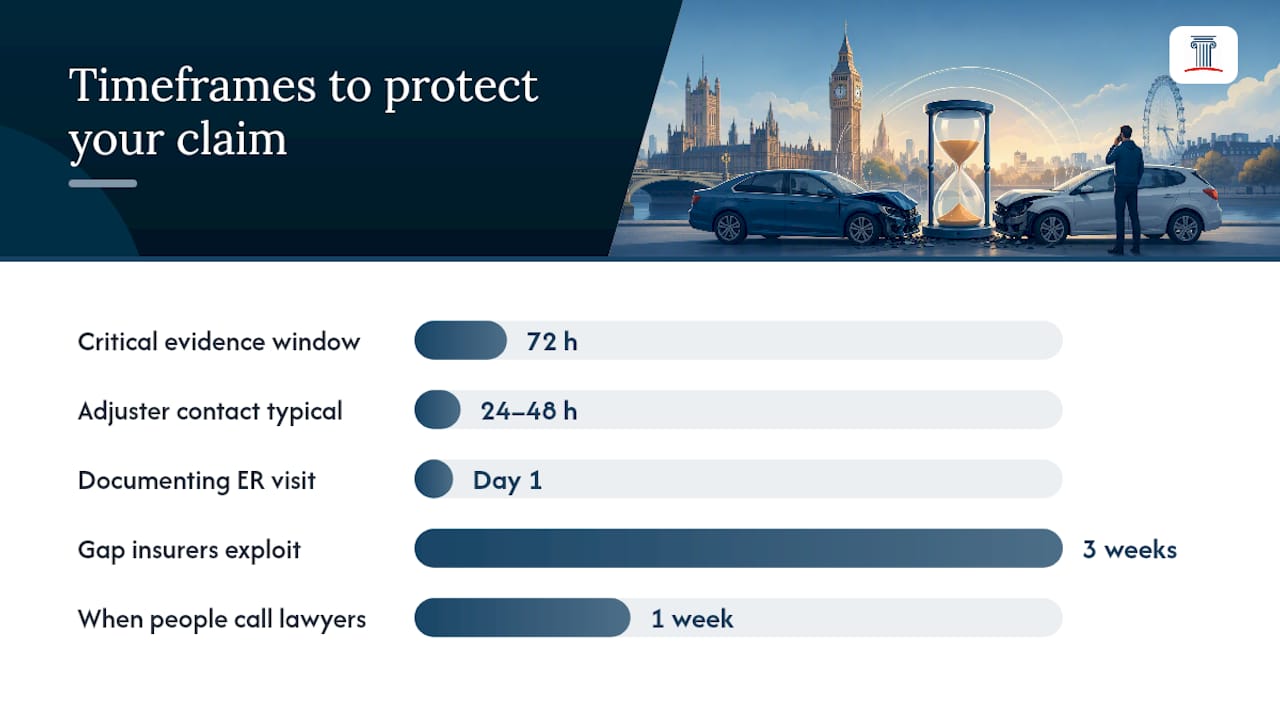
The first three days after a crash decide how strong your claim looks six months later. Insurers know this, which is why their adjusters often call within 24 to 48 hours, before you’ve seen a doctor or organized your evidence. Here’s the order that protects you.
- Get medical attention immediately, even if you feel fine. Adrenaline masks pain from whiplash, concussions, and soft-tissue injuries for hours or days. A documented ER visit or urgent care record on day one anchors your entire claim; a three-week gap between the crash and your first doctor visit gives insurers an opening to argue your injury came from something else.
- Photograph everything at the scene. Capture all vehicles from multiple angles, license plates, visible damage, skid marks, traffic signals, road signage, and your own visible injuries. Wide shots establish context; close-ups establish detail. Both matter.
- Collect information from every party involved. Get names, phone numbers, insurance policy numbers, and driver’s license numbers from other drivers. Ask witnesses for their contact information before they leave. A witness who saw the light change is often more persuasive than anything else in your file.
- Write down what happened while it’s fresh. Note the time, weather, speed estimates, and what each driver said immediately after the crash. Admissions made in the heat of the moment (“I didn’t see you”) tend to disappear from memory fast, but they carry real weight if written down that day.
- Call the police and get a report filed. A police report creates an official record of the scene, statements, and any citations issued. Request the report number before officers leave.
- File the SR-1 with the DMV within 10 days. California requires drivers to report accidents to the DMV whenever a crash causes bodily injury or more than $1,000 in property damage. This isn’t optional, and it isn’t automatic.
- Notify your own insurer, but keep your statement factual and brief. Report the accident occurred; avoid speculating about fault, minimizing your injuries, or giving a recorded statement to the other driver’s insurer without guidance.
Pro Tip: Many people assume the responding police officer files the SR-1 for them. According to the DMV’s own driver handbook, that’s not how it works: the driver or their legal representative has to file it, and missing that window can complicate your claim even when the police report is thorough. This is a common contributor to accident and injury claim confusion.
If any of this feels like too much to manage while you’re in pain, that’s a completely normal reaction, and it’s part of why so many injured drivers in Westminster reach out to a lawyer within the first week rather than waiting.
Statutes, DMV Reporting, and Special Deadlines That Can Bar Your Claim
California gives you two years from the date of injury to file a personal injury lawsuit, under Code of Civil Procedure Section 335.1. Miss it, and courts will almost always dismiss your case regardless of how strong your evidence is. That deadline sounds generous until you consider how long negotiations, medical treatment, and insurance back-and-forth actually take.
A few exceptions and parallel deadlines change the calculation:
- The discovery rule can extend your filing window if an injury wasn’t reasonably discoverable right away, such as a soft-tissue injury or traumatic brain injury that worsens over weeks. Courts apply this narrowly, so don’t count on it as a backup plan.
- Property damage claims carry a three-year statute of limitations, separate from your injury claim.
- Wrongful death claims generally follow the two-year rule too, but the clock starts from the date of death, not the accident, which matters when someone survives an injury for a period before passing.
- Government tort claims require formal notice within six months if a public entity or government employee, like a city bus or a poorly maintained road, contributed to your crash. This deadline is far shorter and cannot be extended by late notice.
- The SR-1 filing is due to the DMV within 10 days of any crash involving injury or property damage over $1,000, separate from your lawsuit deadline entirely.
Minors injured in car accidents generally get more time, since the statute of limitations typically doesn’t start running until they turn 18. That said, don’t treat this as a reason to delay: evidence disappears, witnesses move, and insurance companies count on memories fading long before any legal deadline arrives. Contacting a lawyer early costs you nothing during a free consultation and protects your right to sue while your options are still open.
Damages You Can Seek in a Westminster Car Accident Claim
California law allows injured drivers to recover both economic and noneconomic damages, and the gap between what people expect and what they’re actually owed often surprises them.
Economic damages cover the costs you can put a number on:
- Past and future medical expenses, including physical therapy and long-term care
- Lost wages and diminished future earning capacity
- Vehicle repair or replacement costs
- Out-of-pocket expenses like medication, transportation to appointments, and home modifications
Noneconomic damages compensate for harm that doesn’t come with a receipt: pain and suffering, loss of enjoyment of life, and emotional distress. Juries and insurance adjusters calculate these using different methods, often multiplying economic damages by a factor tied to injury severity, though there’s no fixed formula in California law.
If a crash results in death, survivors may pursue wrongful death damages covering loss of financial support and companionship, while the estate can separately pursue a survival action for the deceased’s own pain and suffering before death.
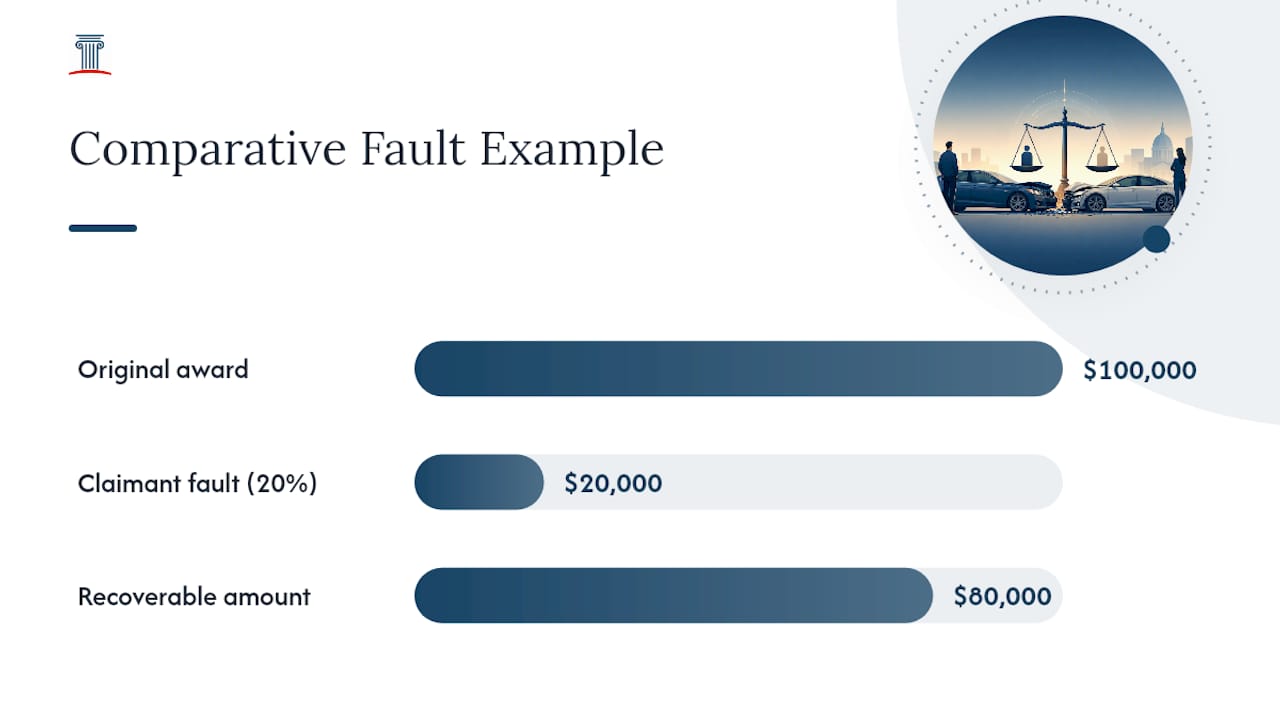
Here’s where comparative negligence changes everything: California jury instructions allow juries to apportion a percentage of fault to each party involved, and your final award gets reduced by your own percentage of fault. A driver found 20% responsible for a crash that resulted in $100,000 in damages recovers $80,000, not the full amount. Insurance companies routinely try to inflate a claimant’s fault percentage specifically because it directly lowers what they have to pay, which are one of the more common and least discussed obstacles in a Westminster auto accident lawsuit.
What a Westminster Personal Injury Lawyer Does and Why That Helps Your Claim Value
Insurance companies employ trained adjusters whose job is minimizing payouts. You’re negotiating against a professional while recovering from an injury, which is not a fair fight without representation.
A Westminster personal injury lawyer earns their fee through specific, concrete work:
- Investigation: pulling police reports, securing traffic camera and business surveillance footage before it’s deleted, gathering complete medical records, and consulting accident reconstruction experts when fault is disputed.
- Negotiation: building a demand package that documents every damage category, then pushing back against lowball offers with evidence rather than hope.
- Lien handling: resolving medical liens from hospitals or health insurers so a settlement doesn’t get eaten alive by unpaid bills.
- Litigation readiness: filing suit before the statute of limitations expires and handling government tort claims within the tight six-month window when a public entity is involved.
Pro Tip: Ask any attorney you’re considering how they handle liens and medical bill negotiation before settlement. This step gets overlooked constantly, and it can be the difference between a settlement that actually helps you and one that mostly pays your medical providers.
Most personal injury attorneys, including firms handling Westminster car accident claims, work on contingency: no upfront fee, and payment comes as a percentage of your settlement or verdict, typically in the range most California injury firms use. Case expenses like expert witness fees or filing costs are usually advanced by the firm and recovered from the final settlement.
Selection Checklist and Exact Questions to Ask During a Free Consultation
Choosing the right attorney matters as much as choosing to hire one at all. Look for local experience specific to Orange County courts and insurers, a track record that includes actual trial verdicts (not just settlements), bilingual staff if English isn’t your first language, and clear contingency terms in writing.
Bring these nine questions into your first free consultation:
- How many car accident cases have you handled in Westminster or nearby Orange County courts?
- What percentage is your contingency fee, and does it change if the case goes to trial?
- Who will actually handle my case day to day, an attorney or a paralegal?
- What’s your realistic estimate for how long my case will take?
- Have you handled cases involving my specific type of injury before?
- Do you offer services in Spanish for me or a family member?
- How do you communicate with clients, and how often should I expect updates?
- What expenses might I owe if we don’t win?
- Can you walk me through how you’d value my specific claim?
Red flags include vague fee explanations, reluctance to put terms in writing, or pressure to sign immediately. A solid engagement letter spells out the contingency percentage, expense handling, and communication expectations in plain language before you sign anything.
Realistic Timeline and Milestones for Settling or Litigating Your Case
Most Westminster car accident injury claims move through four rough phases, though severity and disputed liability can stretch any of them significantly.
- Days 0 to 30: You focus on medical treatment and evidence preservation. Your attorney, if you’ve hired one, requests the police report, sends preservation letters for surveillance footage, and opens communication with insurers.
- Months 1 to 6: Your legal team collects complete medical records, calculates lost wages, and typically waits until you reach maximum medical improvement before sending a demand letter, since settling too early often undervalues future treatment needs.
- Months 6 to 18: Negotiations happen here, sometimes resolving quickly, sometimes requiring a lawsuit filing to keep the statute of limitations alive while talks continue. Discovery, depositions, and expert reports happen if the case proceeds toward litigation.
- 18 months and beyond: Cases that don’t settle move toward a trial date, and Orange County court calendars can push that further out depending on caseload.
Severity of injury, disputed fault, and government entity involvement are the three biggest factors that stretch a timeline. A straightforward rear-end collision with clear fault often resolves faster than a disputed intersection crash requiring reconstruction experts.
Serendib Law Firm’s Local Experience and Bilingual Support
This article was prepared with editorial guidance from Maya Serkova, drawing on California statutory rules and DMV reporting requirements that govern how injury claims actually move through the system.
Legal representation is available across Orange County, including Westminster, in personal injury, employment law, business litigation, immigration, and workers’ compensation matters. Free consultations and contingency-based representation in select personal injury cases may be offered, meaning you may pay nothing upfront to find out where you stand. Bilingual services in English and Spanish help ensure language isn’t a barrier to understanding rights or claim progress. For a broader look at how the firm approaches injury representation across the region, the Newport Beach personal injury practice page outlines the same approach applied elsewhere in Orange County.
What Injured Drivers Get Wrong About Timing
The biggest misconception in Westminster car accident injury claims isn’t about how much a case is worth. It’s about when to act. People treat the two-year statute of limitations as a planning horizon, something to keep in the back of their mind while they focus on recovery. That’s backwards. The deadline that actually determines your outcome is the 10-day SR-1 window, the medical documentation gap in the first 72 hours, and the moment an insurance adjuster gets a recorded statement before you’ve spoken with anyone who represents your interests.
Conventional advice tells people to “wait and see how they feel” before pursuing a claim. That guidance ignores how comparative negligence works in California: every week you wait, evidence degrades and insurers build a narrative without your input. What actually protects a claim’s value is unglamorous, front loaded work: photos taken the same day, a doctor visit before pain peaks, and a phone call to a lawyer before the insurance company calls you first. Prioritize that sequence, not the settlement number you’re imagining.
— Maya Serkova
Talk to Serendib Law Firm Before You Talk to the Insurance Company
Serendib Law Firm gives Westminster residents a direct path to experienced representation without the upfront cost that keeps injured people from calling a lawyer in the first place. Bring what you have to your free consultation: the accident date, any photos from the scene, your police report number, medical bills or treatment records so far, and the other driver’s insurance information. You don’t need everything organized perfectly. During that first conversation, the firm reviews what happened, explains how contingency-fee representation works so you understand exactly what you’d owe (and when), and outlines what evidence still needs to be secured before it disappears. If you’re weighing whether to handle an insurance adjuster’s call alone or want a clear read on what your Westminster claim might be worth, schedule a consultation before you sign anything or give a recorded statement.
Official Forms and Resources Worth Bookmarking
The DMV accident reporting page explains SR-1 requirements and deadlines directly from the source. The DMV forms page hosts the SR-1, SR-1A SP, and SR-19C forms you’ll need to file or to request another driver’s report. For deadline questions beyond SR-1 filing, the California Courts self-help guide lays out statute of limitations rules in plain language. If a hit-and-run is involved, understanding the criminal implications of leaving the scene clarifies what additional legal exposure the other driver may face.
This article is general information, not a substitute for advice from a qualified lawyer. Consult a qualified legal professional about your own circumstances before acting on anything here.
Sources
- Deadlines to sue someone | California Courts | Self Help Guide
- Accident reporting | California DMV
- CACI No. 406. Apportionment of Responsibility :: California Civil Jury Instructions (CACI)