
If you were hurt on someone else’s property in Garden Grove because of an unreasonably dangerous condition, you likely have a premises liability claim once you can show the owner or occupier failed to exercise ordinary care and that failure caused your injury. Document the scene with photos, get witness names, seek medical care immediately, and file an incident report. Then contact a Garden Grove personal injury lawyer promptly, since a free consultation and contingency fee arrangement can help you preserve evidence and protect your deadlines before either disappears.
TL;DR:
- Most premises liability claims must be filed within two years, but injuries on public property require a claim within six months.
- Evidence preservation within the first 72 hours, especially surveillance footage and photos, is critical to strengthening your case.
- Property owners, tenants, managers, and contractors can all be held liable depending on who controlled the scene at the time of injury.
- Proving negligence requires showing the defendant’s control, breach of care, causation, and harm, with violations of safety codes potentially simplifying proof.
- Early legal action, such as sending preservation letters, significantly increases the chances of maintaining crucial evidence before it is overwritten or deleted.
Table of Contents
- What Counts as Premises Liability in Garden Grove
- The Legal Elements You Must Prove in a California Premises Case
- Evidence That Makes or Breaks Your Claim
- Deadlines You Cannot Afford to Miss
- What You Can Recover and How Fault Gets Divided
- How Serendib Law Firm Supports Garden Grove Premises Liability Clients
- Why Speed Matters More Than People Realize
- Talk to Serendib Law Firm About Your Garden Grove Claim
- Primary Sources and Legal References
- Sources
What Counts as Premises Liability in Garden Grove
Premises liability claims cover a wider range of incidents than most people expect. The most common categories in Garden Grove involve slip-and-fall accidents on wet floors, trip hazards from cracked sidewalks or uneven parking lots, unsafe stairways without proper railings, pool accidents at apartment complexes, dog bites on residential or commercial property, and assaults linked to inadequate security at retail centers or parking structures.
Liability does not always rest with the person who holds the deed. Courts look at who controlled the property at the time of the injury, and control can create a duty of care even without ownership. That means owners, tenants who lease and operate a space, property management companies, homeowners associations, and even contractors performing maintenance work can all end up named as defendants.
Picture a fall at a shopping center along Garden Grove Boulevard where a spill went unmopped for an hour, or an injury in an apartment complex’s shared courtyard where lighting had been broken for weeks. Both scenarios raise the same question: who knew, or should have known, about the hazard?
- Slip-and-fall accidents on wet, icy, or debris covered floors
- Trip hazards from broken pavement, loose carpeting, or poor lighting
- Unsafe stairways, balconies, or railings
- Swimming pool accidents at apartment or condo complexes
- Dog bites on private or commercial property
- Inadequate security leading to assault or robbery
The Legal Elements You Must Prove in a California Premises Case
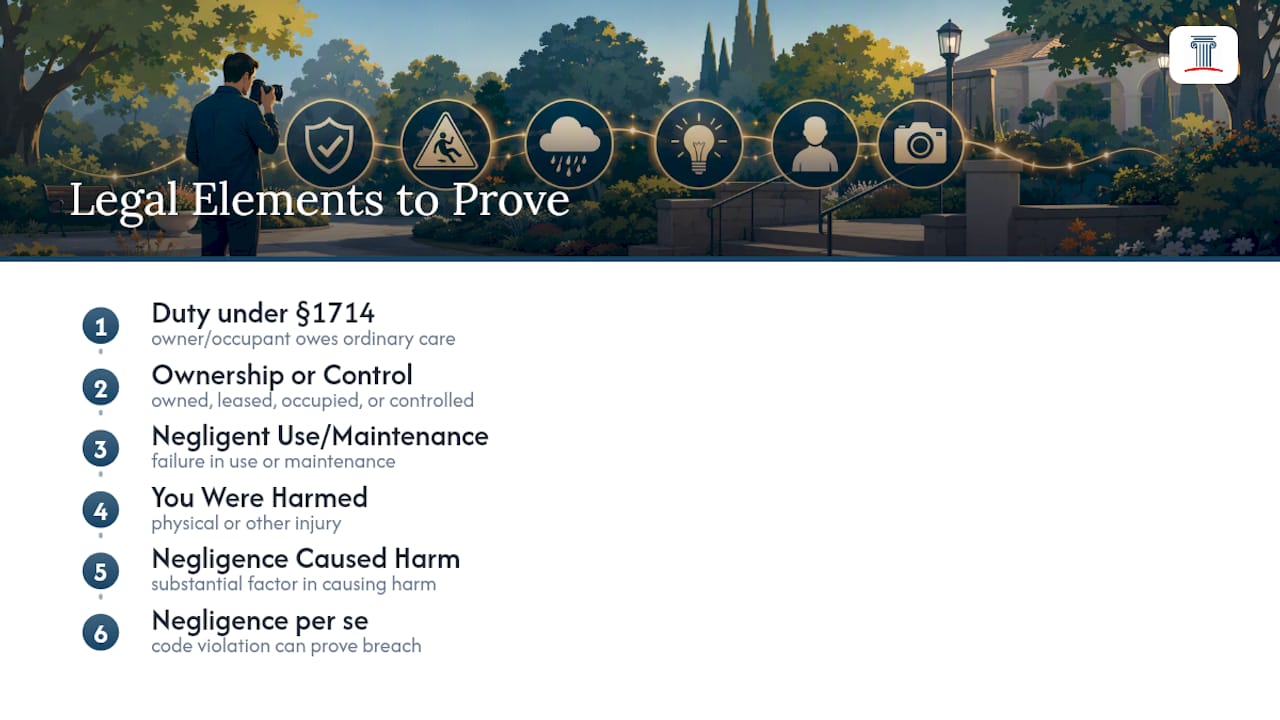
California law does not make a property owner automatically responsible just because someone got hurt on their land. You have to prove four specific things, and CACI No. 1000 lays them out clearly: the defendant owned, leased, occupied, or controlled the property; the defendant was negligent in how they used or maintained it; you were harmed; and the defendant’s negligence was a substantial factor in causing that harm.
The foundation for all four elements is Civil Code § 1714, which establishes that everyone who owns, occupies, or controls property owes a duty of ordinary care to avoid exposing others to unreasonable risk. “Reasonable care” is not a fixed standard. A grocery store has a different obligation to inspect for spills than a private homeowner does to check a backyard walkway, and juries weigh what a careful property manager would have done under the same circumstances.
There’s a shortcut that sometimes works in a plaintiff’s favor: negligence per se. If the property owner violated a building code, fire code, or municipal safety regulation, and that violation caused your injury, you may not need to prove reasonable care failed. The violation itself can establish the breach, which shifts real weight onto the defense to justify what happened.
Evidence That Makes or Breaks Your Claim
The strength of a Garden Grove premises liability claim usually comes down to what you preserved in the first 72 hours. Surveillance footage at many retail and apartment properties overwrites itself on a loop within days, so waiting even a week to request it can mean it’s gone permanently.
- Photos and video of the hazard from multiple angles, taken before anyone cleans it up or repairs it.
- Surveillance footage from the property, requested in writing as soon as possible.
- Witness names and contact information from anyone who saw the fall or the hazardous condition.
- The incident report filed with the property manager, store, or landlord at the time.
- Medical records documenting your treatment, starting with your very first visit.
- Maintenance logs or inspection records, if you can obtain them through your attorney.
Pro Tip: A preservation or spoliation letter is a formal demand an attorney sends to a property owner or manager, ordering them to retain surveillance footage, maintenance logs, and other evidence before it’s routinely deleted. Sending one early, often within days of the incident, is one of the most important tools that can stop a defendant from erasing the footage that would otherwise prove your case.
Avoid posting about the incident on social media. Defense attorneys routinely search for photos or comments that contradict your claimed injuries, and even an innocent post can be used to argue you weren’t hurt as badly as you say.
Deadlines You Cannot Afford to Miss
Most personal injury claims in California, including premises liability claims against private property owners, must be filed within two years of the date of injury under CCP § 335.1. Miss that date, and the court will almost certainly dismiss your case regardless of how strong the evidence is.
Government-owned property changes everything about the timeline. If your injury happened on property owned by a city, county, or other public entity, you generally must file a formal administrative claim within six months of the incident, not two years. Miss that six-month window, and you may lose your right to sue entirely, even though the general two-year rule would have otherwise applied. After the agency responds (or fails to respond within the statutory period), a separate and shorter deadline opens for filing a lawsuit.
A handful of tolling exceptions exist for minors or claimants under specific disabilities, but they’re narrow and easy to misjudge. Given how unforgiving these deadlines are, especially the six-month government rule, talking to an attorney early costs you nothing and protects options you can’t get back later.
What You Can Recover and How Fault Gets Divided
Premises liability damages fall into two buckets. Economic damages cover the costs you can put a number on: medical bills, future care and rehabilitation, lost wages, and property damage. Non-economic damages cover harder-to-quantify losses like pain and suffering, emotional distress, and loss of enjoyment of life. California does not cap non-economic damages in ordinary premises liability cases, which matters if your injury caused lasting physical or psychological harm.
Fault rarely lands on one party alone, though. California follows a comparative negligence rule, meaning the compensation you recover gets reduced by whatever percentage of fault a jury or insurer assigns to you. If you were texting while walking through a store and partly missed an obvious hazard, and a jury finds you 20% at fault, your total award drops by that same 20%. This is exactly why the evidence you preserve early, showing the hazard was genuinely dangerous and not something you should have avoided, carries so much weight later in negotiations.
How Serendib Law Firm Supports Garden Grove Premises Liability Clients
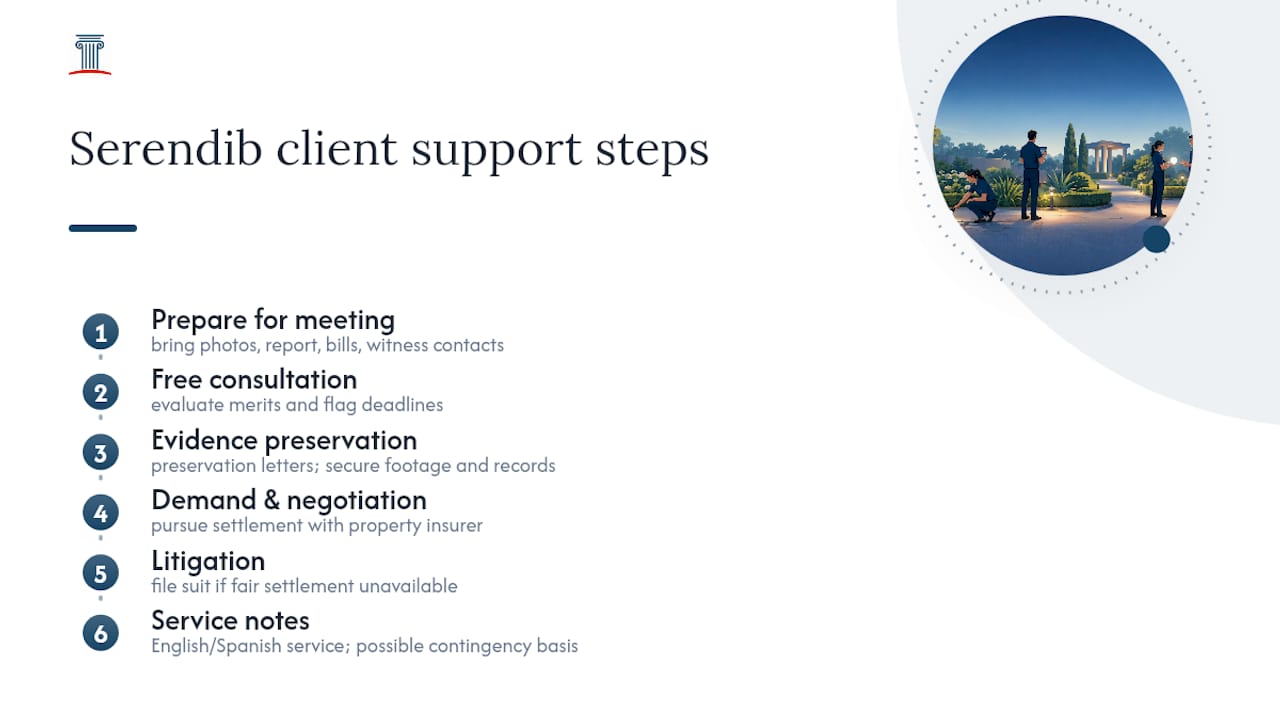
Serendib Law Firm handles premises liability claims for Garden Grove residents through a process built around speed and preservation. It starts with a free consultation to evaluate the merits of your case and flag any looming deadlines, followed by evidence preservation work, including preservation letters when surveillance or maintenance records are at risk. From there, the firm pursues a demand and negotiation with the property owner’s insurer, and moves into litigation when a fair settlement isn’t on the table.
Operating out of Orange County, the firm serves clients in both English and Spanish, which matters in a city as linguistically diverse as Garden Grove. The firm may offer representation on a contingency basis in qualifying premises liability cases.
If you’re preparing for a first meeting, bring whatever you already have: photos, the incident report, medical bills, and contact information for any witnesses. The more the firm can review upfront, the faster it can move on preservation requests before footage or records disappear. You can review the firm’s background on premises liability claims for additional detail on how these cases typically unfold.
Why Speed Matters More Than People Realize
Most advice about premises liability claims focuses heavily on the legal elements: proving control, proving breach, proving causation. That’s necessary, but it undersells the real bottleneck in these cases, which is almost always evidence, not law. I’ve seen the pattern repeat across similar claims in Anaheim and Westminster: a legally sound case falls apart not because the facts were weak, but because the surveillance footage got overwritten before anyone asked for it.
The conventional wisdom tells injured people to “consult a lawyer when you’re ready.” That advice is backwards for premises cases specifically. Readiness isn’t the constraint, timing is. A property’s camera system doesn’t wait for you to feel emotionally prepared to make a call, and neither does a six-month government claim deadline.
If you take one thing from this article, prioritize the preservation letter and the photos over polishing your account of what happened. Juries and insurers respond to what you can show them, not just what you can describe.
— Maya Serkova
Talk to Serendib Law Firm About Your Garden Grove Claim
Serendib Law Firm provides assistance for premises liability claims in Garden Grove. Instead of navigating deadlines and evidence requests on your own, a free consultation walks through the merits of your case, flags whether a government-claim deadline applies, and outlines what happens next. Representation may be provided on a contingency-fee basis in qualifying claims.
Contacting the firm early also means preservation letters go out before surveillance footage loops and disappears, which is often the single biggest factor in whether a claim succeeds. If you were hurt on someone else’s property in Garden Grove, reach out to Serendib Law Firm to schedule your free consultation and find out where your case stands.
Primary Sources and Legal References
These are the statutes and jury instructions cited throughout this article, useful if you want to verify a deadline or legal standard directly:
- California Code of Civil Procedure § 335.1 — the two-year statute of limitations for personal injury claims
- California Civil Code § 1714 — the duty of ordinary care owed by property owners and occupiers
- CACI No. 1000 — the jury instruction outlining the four elements of a premises liability claim
- California Courts Self-Help Center — guidance on statutes of limitations and administrative claims against government entities
This article is general information, not a substitute for advice from a qualified lawyer. Consult a qualified legal professional about your own circumstances before acting on anything here.
Sources
- California Code of Civil Procedure § 335.1 (Justia)
- California Civil Code § 1714 (California Legislative Information)
- California Premises Liability Law: Elements and Defenses – LegalClarity