
If you work in Placentia and need time off for a serious health condition, a new child, or to care for a family member, you likely qualify for up to 12 workweeks of job-protected leave under the California Family Rights Act (CFRA), the federal Family and Medical Leave Act (FMLA), or both. When both laws apply, you get whichever one protects you more. Wage-replacement programs like Paid Family Leave and State Disability Insurance pay you during that time, but they do not by themselves protect your job.
TL;DR:
- CFRA covers employers with five or more employees, offering broader eligibility than FMLA, which applies only to larger companies with 50 or more workers within 75 miles.
- Employees qualify for up to 12 weeks of leave if they’ve worked at least 1,250 hours over the past year and the employer has the required number of employees.
- Proper leave requests require giving at least 30 days’ notice for foreseeable needs and confirming all communication in writing to protect job rights.
- While Paid Family Leave and State Disability Insurance provide wage replacement, they do not guarantee job protection, which is only covered by CFRA or FMLA.
- Returning workers can be asked for a fitness-for-duty certification, but only if the employer follows legal notification procedures and the certification relates specifically to the leave’s original reason.
Table of Contents
- Which Laws Apply in Placentia: FMLA, CFRA, and PDL
- Eligibility Checklist for Placentia Employees
- How to Request Leave: Notice, Documentation, and Timelines
- Pay and Benefits While on Leave: PFL, SDI, and PTO
- Returning to Work: Job Restoration and Fitness-for-Duty
- If Your Leave Is Denied or You Face Retaliation
- How Serendib Law Helps Placentia Employees With Leave Issues
- A Placentia Employee’s Most Important Next Step
- Get Employment-Law Help From Serendib Law
- FAQ
- Sources
Which Laws Apply in Placentia: FMLA, CFRA, and PDL
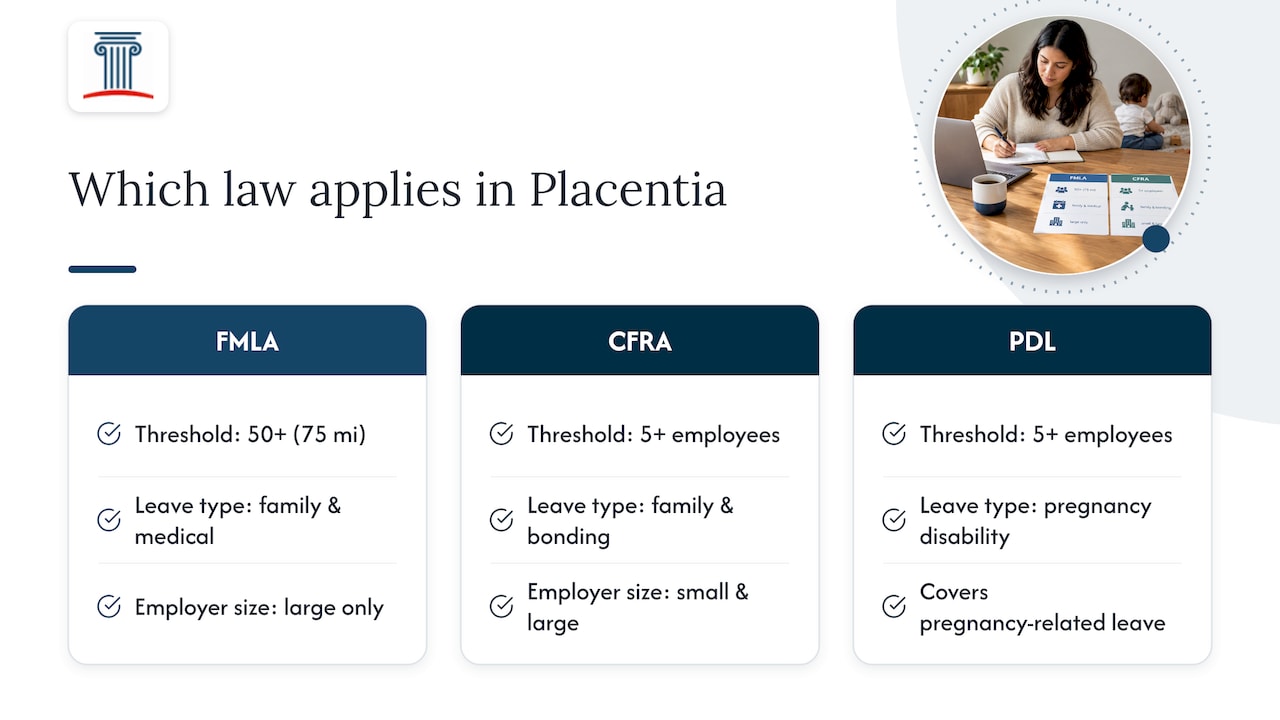
Three overlapping laws shape leave rights for employees in Placentia. The federal FMLA covers employers with 50 or more employees within 75 miles of the worksite. California’s CFRA, by contrast, applies to any private employer with just 5 or more employees, which means many smaller Placentia businesses that fall outside FMLA’s reach still must grant CFRA leave. Pregnancy Disability Leave (PDL) sits alongside both, covering pregnancy-related disability separately from bonding leave, and applies to employers with 5 or more employees as well.
Because CFRA’s threshold is so much lower, it covers a far larger share of the Placentia workforce than FMLA alone. A worker at a 20-person retail shop or a small medical office in Placentia who would not qualify under the federal law can still have a real claim to job-protected leave under CFRA. When an employee is eligible under both laws at once, the rule is simple: the employee gets whichever protection is stronger on that particular issue, whether that means a longer notice period, a broader definition of family, or stricter limits on what an employer can require before reinstatement. For CFRA leave specifics tied to a neighboring city, our CFRA leave in Fullerton, CA guide walks through the same framework in more local detail.
Eligibility Checklist for Placentia Employees
Before you request leave, it helps to know exactly where you stand. Both CFRA and FMLA share the same core eligibility test, but CFRA reaches further because of its lower employer-size threshold and its broader family definitions.
- You have worked for your employer for at least 12 months (not necessarily consecutive) and logged at least 1,250 hours in the past year.
- Your employer has 5 or more employees for CFRA coverage, or 50 or more employees within 75 miles for FMLA coverage.
- You need to leave for your own serious health condition, to bond with a new child, or to care for a covered family member, which under CFRA now includes a “designated person,” a category added in 2023 that goes beyond the traditional spouse, parent, or child relationship.
- You work for a covered employer type, since certain public agencies and some school district employees follow separate but comparable rules under CFRA.
If your employer has fewer than 50 workers but more than 5, CFRA may still be your path forward even though FMLA is not. Our CFRA leave in Irvine, CA article covers how small-employer mediation programs work for disputes that arise under this threshold.
How to Request Leave: Notice, Documentation, and Timelines
Requesting leave correctly protects you if your employer later disputes your eligibility or the timing of your request. The process differs slightly depending on whether your need for leave is foreseeable.
- Give 30 days’ advance notice whenever your need for leave is foreseeable, such as a scheduled surgery or an expected birth; when it is not foreseeable, notify your employer as soon as practicable.
- Make your request in writing whenever possible, stating the reason for leave, the expected start date, and the expected duration.
- If you first give notice verbally, send a follow-up email or letter the same day or the next business day confirming what you said, since a written paper trail matters if a dispute arises later.
- Watch for your employer’s response: covered employers must provide an eligibility notice and a rights and responsibilities notice within five business days of your request.
- Expect a designation notice telling you whether your leave qualifies as FMLA, CFRA, or both, and respond promptly to any request for medical certification, which your employer can require and, if needed, seek clarification or authentication on without delaying your leave.
Pro Tip: Keep a dated copy of every leave-related email, letter, and text message in one folder, since the five-business-day notice clock often becomes the central fact in a later dispute.
Pay and Benefits While on Leave: PFL, SDI, and PTO
Job protection and income replacement are two separate systems, and confusing them is one of the most common mistakes Placentia employees make. CFRA and FMLA protect your job. California Paid Family Leave (PFL) and State Disability Insurance (SDI) replace part of your income, but neither one guarantees you a job to return to.
Up to 8 weeks of partial wage replacement is available through PFL in a 12-month period for bonding or caregiving, funded through the CASDI contributions you can find listed on your pay stub. Eligibility depends on having sufficient contributions during the base period, and a $300 minimum base-period earnings threshold applies.
Many employers allow or require you to substitute accrued paid time off, such as vacation or sick leave, during unpaid portions of CFRA or FMLA leave, so check your employer’s written leave policy for how PTO integrates with your claim. Using PTO alongside a PFL claim is common and does not, by itself, affect your job-protected leave status.
Returning to Work: Job Restoration and Fitness-for-Duty
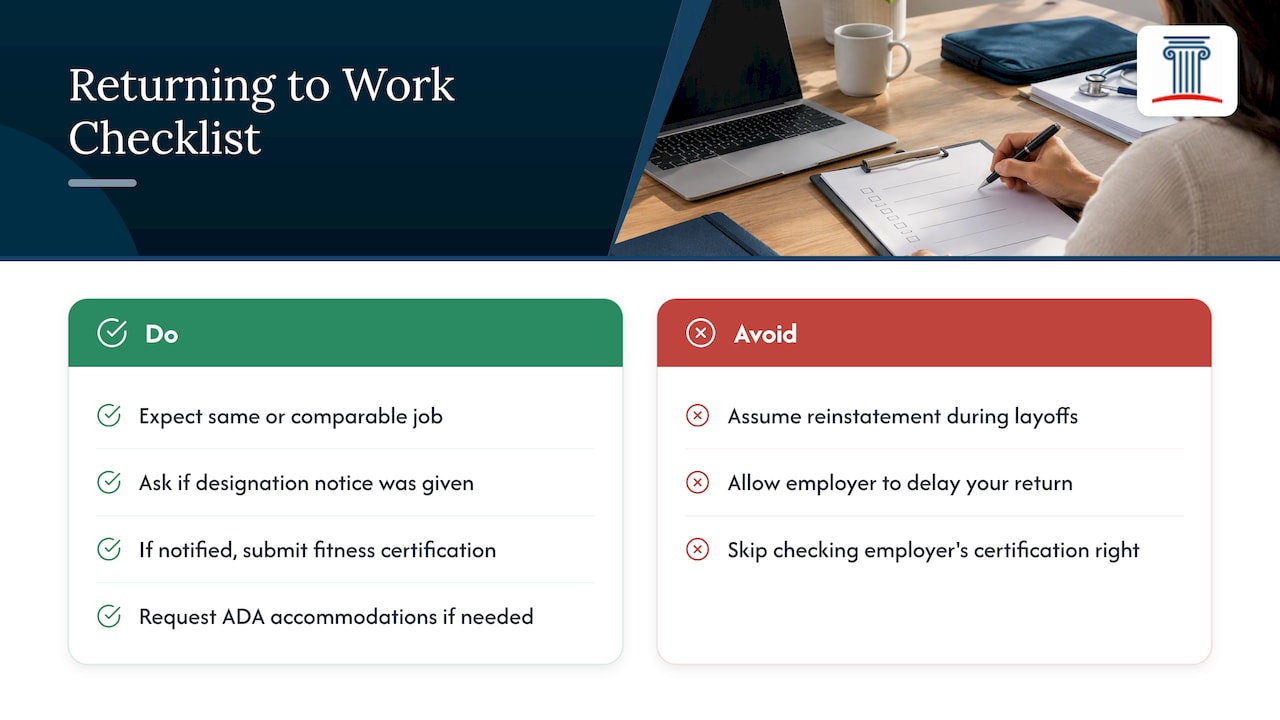
When your leave ends, you generally have the right to return to the same position or a comparable one with equivalent pay, benefits, and responsibilities. That right has a limit: if a layoff would have happened regardless of your leave, such as a company-wide reduction in force, reinstatement is not guaranteed.
Employers can require a fitness-for-duty certification before you return, but only under specific conditions. The employer must notify you of this requirement at the time your leave is designated, and the certification can only address the condition that caused your leave, not an unrelated health issue. An employer may contact your health care provider to clarify or authenticate the certification but cannot delay your return while that clarification is pending. If your employer failed to give the required designation notice earlier in the process, they may lose the right to demand this certification at all.
Separately, the Americans with Disabilities Act may require additional accommodations beyond CFRA or FMLA leave, particularly when a condition continues after your protected leave period ends.
If Your Leave Is Denied or You Face Retaliation
Acting early and keeping a clear record gives you the strongest position if your employer denies leave, delays reinstatement, or retaliates against you for requesting time off.
- Save copies of every leave request, employer response, medical certification, and relevant pay stub showing CASDI deductions.
- File a retaliation complaint with the California Civil Rights Department, which allows three years from the retaliatory act for CFRA and FEHA claims.
- Consider a Labor Commissioner claim for certain wage or leave-related Labor Code violations, which often carry a shorter one-year deadline.
- Contact the U.S. Department of Labor for FMLA-specific violations if your employer meets the federal threshold.
Deadlines run from the date of the violation, not from when you discover a lawyer could help, so waiting even a few months can close off options. If your employer denied reinstatement or you suspect retaliation tied to a leave request, our workplace retaliation page outlines what that process typically involves.
How Serendib Law Helps Placentia Employees With Leave Issues
We represent employees in disputes over denied leave, botched reinstatement, and retaliation tied to CFRA or FMLA requests. We offer free consultations and bilingual support, and we focus on calculating what denied leave or lost wages actually cost you. Before meeting with us, gather your leave request, your employer’s written responses, pay stubs showing CASDI contributions, and any medical certification paperwork.
A Placentia Employee’s Most Important Next Step
The single most protective thing you can do is document your leave request in writing and confirm your employer responded within the five business days CFRA and FMLA require. If reinstatement is denied or retaliation follows, get legal advice early, since the clock on your rights starts running the moment the problem occurs, not when you decide to act on it.
— Maya Serkova
Get Employment-Law Help From Serendib Law
We provide employment-law representation for employees dealing with denied leave, retaliation, or wrongful termination, with bilingual support and a free consultation to start. If your leave request was denied or you returned to a job that no longer looks like the one you left, reach out through our California Employment Lawyer page or learn more about our Employment Law practice to schedule a consultation.
This article is general information, not a substitute for advice from a qualified lawyer. Consult a qualified legal professional about your own circumstances before acting on anything here.
FAQ
What is the 3 day rule for FMLA?
The “3 day rule” commonly refers to the requirement that employees notify their employer of an unforeseeable need for leave as soon as practicable, often interpreted as within one to two business days, though FMLA itself does not set a strict three-day deadline. Employers may have their own internal notice policies that specify shorter windows, so check your employee handbook.
What are the employee rights under California CFRA laws?
Under CFRA, eligible employees get up to 12 workweeks of job-protected leave for a serious health condition, bonding with a new child, or caring for a family member, including an expanded “designated person” category. Employers with 5 or more employees must comply, and continued group health benefits apply during the leave.
What are my rights on returning from FMLA leave?
You generally have the right to return to your same job or an equivalent one with the same pay, benefits, and responsibilities, unless a layoff would have occurred regardless of your leave. Your employer can require a fitness-for-duty certification limited to the condition that caused your leave, as explained in the DOL’s employer guide.
Can you use PTO while on FMLA in California?
Yes, many employers allow or require employees to use accrued paid time off during otherwise unpaid FMLA or CFRA leave, which can help offset lost income. Using PTO does not reduce your 12 weeks of job-protected leave and can be combined with Paid Family Leave wage-replacement benefits.
Does California Paid Family Leave protect my job?
No, Paid Family Leave and State Disability Insurance only replace part of your wages. Job protection comes separately from CFRA or FMLA, so you need to confirm your eligibility under one of those laws if keeping your position matters.
Sources
- Family Care and Medical Leave: Quick Reference Guide (California Civil Rights Department)
- Family and Medical Leave Act (U.S. Department of Labor)
- Paid Family Leave (EDD)