
Audio summary
Rear-end crashes are a daily reality on Santa Ana streets and nearby freeways like the I-5 and SR-55. If you were hit from behind at a busy intersection or in stop-and-go traffic, understanding how fault is proven and what to do next can make a big difference in your recovery and any injury claim you may bring. For background on Santa Ana, see the Wikipedia article about Santa Ana.
Why Rear-End Crashes Are So Common in Santa Ana
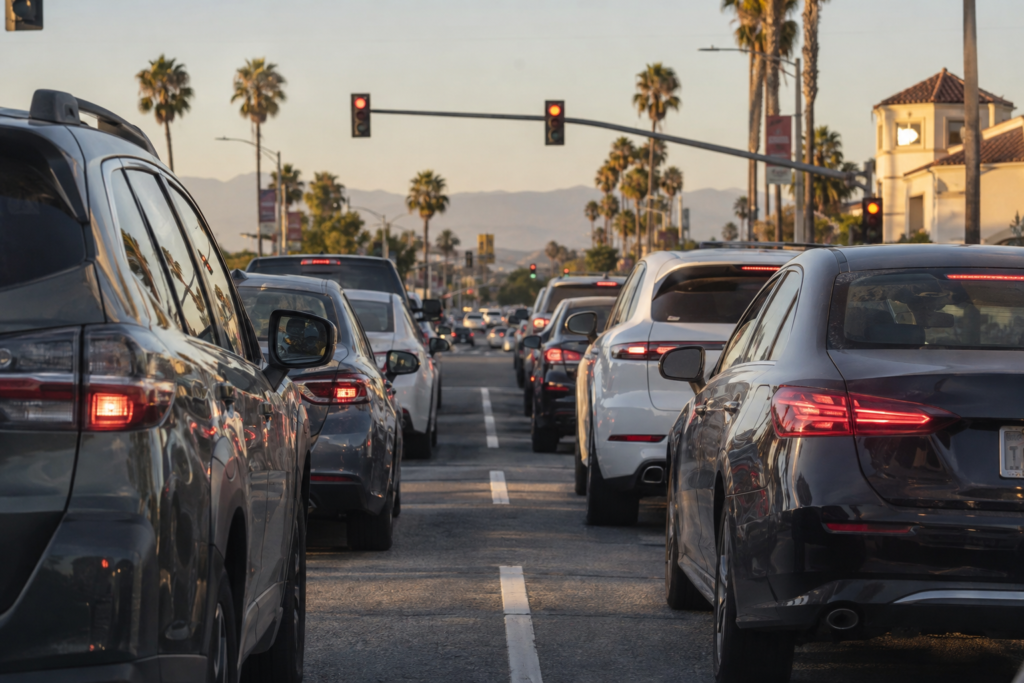
Santa Ana’s dense traffic, frequent signals, and heavy commuter flow create conditions where rear-end collisions are especially common. Recent crash data for the city show more than 23,000 reported traffic crashes between 2021 and 2025, with roughly one-third classified as rear-end collisions. That makes rear-end impacts the single most common collision type locally.
Local safety planning documents identify several high-collision corridors where rear-end and other crashes tend to cluster, including:
- Main Street and Grand Avenue through central Santa Ana
- Bristol Street and First Street near intersections like 1st & Bristol
- Harbor Boulevard and 17th Street, including Harbor & 1st and 17th & Grand
These areas, along with freeway segments on the I-5 and SR-55 around the city, see constant congestion and sudden stops. In Downtown Santa Ana, around the civic center and the Santa Ana Regional Transportation Center near the Lacy neighborhood, high pedestrian activity and buses add even more braking and merging, which can quickly lead to rear-end impacts when drivers follow too closely or aren’t paying attention.
How California Law Looks at Rear-End Car Accidents
In California, rear-end crashes are analyzed under basic negligence rules: did a driver fail to use reasonable care and cause someone else’s injuries? For rear-end collisions, a few legal principles are especially important.
Safe Following Distance and California Vehicle Code §21703
California law requires drivers to leave enough distance to stop safely. California Vehicle Code §21703 says a driver must not follow another vehicle more closely than is “reasonable and prudent,” taking into account speed, traffic, and roadway conditions. State driver-handbook guidance adds that drivers should use at least the three-second rule and increase following distance in heavy traffic, at higher speeds, or in bad weather.
When a rear driver is tailgating, looks away, or simply cannot brake in time, that can be strong evidence that they violated this duty. In many Santa Ana rear-end cases, particularly where one car is stopped at a light on Harbor Boulevard or Grand Avenue and is hit from behind, insurers and courts often find the rear driver negligent because they failed to maintain a safe following distance or control their speed.
No Automatic Fault for the Rear Driver
Even though the rear driver is often found at fault, California does not have a rigid rule that the trailing driver is always to blame. Liability depends on all the circumstances and the available evidence, not just the position of the cars after impact.
In some situations, fault can be shared or even shift toward the front driver. Examples might include:
- A front driver suddenly reversing instead of moving forward at a green light
- A vehicle stopping unexpectedly in a live lane with no reason and no brake lights
- A car cutting sharply into a lane on the I-5 just before slamming on the brakes
Insurers look at the bigger picture: speed, signaling, lane changes, traffic controls, and whether each driver followed the rules of the road. That is why evidence from the scene is critical.
Key Evidence Used to Prove Fault in Rear-End Crashes
To sort out fault in a rear-end collision, insurance adjusters, investigators, and sometimes juries rely on a mix of physical and testimonial evidence. Guidance from the California Highway Patrol (CHP) and crash-reconstruction practice shows that the following types of proof are commonly important:
Police Collision Reports
When officers respond to a crash in Santa Ana—whether at 17th & Grand or along Bristol Street—they typically document:
- Vehicle positions and direction of travel
- Apparent damage to each car
- Noted skid marks or debris patterns
- Driver and witness statements
- Citations issued (for example, following too closely or unsafe speed)
While a police report is not the final word on fault, it can carry significant weight with insurers and can help support your version of events.
Physical Evidence From the Scene
Physical details can tell a story about what happened:
- Skid marks and stopping distance that suggest whether the rear driver braked late or not at all
- Bumper, trunk, and frame damage patterns that show angle and force of impact
- Airbag deployment or lack of it, depending on the severity of the crash
- Debris location and fluids on the road indicating point of impact
Engineers and reconstruction experts can sometimes use these details, along with roadway conditions, to estimate speeds and braking behavior.
Witness Statements
Independent witnesses are especially valuable at busy Santa Ana intersections or freeway ramps where multiple vehicles may be involved. Witnesses may confirm that:
- The rear driver was tailgating or weaving through traffic
- The front driver was stopped at a red light for some time before being hit
- A sudden lane change or unsafe merge preceded the crash
Because memories fade quickly, collecting names and contact information at the scene (or as soon as possible afterward) is crucial.
Video Footage and Electronic Data
Video and electronic records are becoming more important in Santa Ana rear-end accident claims:
- Dashcam video from your vehicle or others
- Traffic or security cameras overlooking intersections, driveways, or business parking lots
- Vehicle event data recorders showing speed, braking, and throttle before impact
Capturing and preserving this data early can help resolve disputes about how fast each car was traveling or whether someone braked suddenly.
Medical Records and Injury Documentation
For many Santa Ana rear-end crashes, the main injury complaints involve the neck and back, often described as soft-tissue injuries. Insurers tend to evaluate whether the reported symptoms fit the mechanics of the crash and the documented medical findings. That makes your medical records a key part of proving both that the crash caused your injuries and how seriously you were hurt.
Common Injuries in Rear-End Car Accidents
Even at lower speeds, rear-end impacts can cause real injuries, especially when you are stopped at a light and struck by a moving vehicle. Common issues after rear-end accidents include:
- Neck strain and other soft-tissue injuries
- Upper and lower back pain
- Headaches and dizziness
- Shoulder pain from belt restraints
Insurers typically look closely at how quickly you sought care, whether you followed treatment recommendations, and whether your complaints remain consistent over time.

What Injured Drivers in Santa Ana Should Do After a Rear-End Crash
After a rear-end collision on Euclid Avenue, near Downtown Santa Ana, or on the I-5, your actions in the first hours and days can have a big impact on both your health and any future claim.
Step-by-Step Actions to Take
Use the following sequence as a practical roadmap after a rear-end crash.
- Get to a safe location and check for injuries. If it is safe, move vehicles out of live lanes—especially on freeways or fast-moving corridors like Harbor Boulevard. Call 911 if anyone may be injured.
- Exchange information. California guidance expects drivers to provide names, contact information, driver’s license numbers, license plates, and insurance details. Do not leave the scene without doing so.
- Call the police when appropriate. For injury crashes or significant property damage, request that officers respond so a report can be taken. Document which agency responds (Santa Ana Police Department, CHP, etc.).
- Document the scene. Take photos and videos of all vehicles, damage, skid marks, traffic signals, and any visible injuries. If possible, capture the broader intersection or freeway layout.
- Gather witness information. Ask bystanders who saw the crash for their names and phone numbers, and note whether they are willing to speak to insurers or attorneys later.
- Seek prompt medical evaluation. Even if you feel only “sore” after being hit from behind, consider seeing a medical professional as soon as possible. This helps identify injuries and creates documentation about timing and symptoms.
- Notify your insurance company. Report the collision within a reasonable time and cooperate with your insurer’s basic information requests, but avoid speculating about fault or minimizing your pain.
- Preserve evidence. Save dashcam footage, photos, repair estimates, and correspondence. Keep a journal of your symptoms and how they affect work and daily life.
- Consider speaking with a Santa Ana-area injury lawyer. If you have ongoing pain, time off work, or a disputed claim, an attorney familiar with rear-end accidents and local conditions can help protect your interests.
Comparing Evidence Types in Rear-End Claims
Different kinds of evidence play different roles when you are trying to prove what happened in a rear-end crash. The checklist below highlights how each type is typically used.
| Evidence Type | What It Shows | Why It Matters |
|---|---|---|
| Police report | Officers’ observations, statements, and any citations | Influences how insurers view fault and supports your account |
| Scene photos & video | Vehicle positions, damage, traffic controls, skid marks | Helps reconstruct the crash and visualize following distance |
| Witness statements | Independent descriptions of driving behavior and the impact | Can resolve disputes about sudden stops or tailgating |
| Vehicle & electronic data | Speed, braking, and other pre-impact metrics | Provides objective information to support or contradict testimony |
| Medical records | Diagnosis, treatment, and timing of symptoms | Connects your injuries to the crash and supports a damages claim |
How Insurers Typically Treat Rear-End Crashes
In practice, many Santa Ana rear-end cases—especially those where a stopped car is hit from behind—are treated by insurers as relatively straightforward on liability. Adjusters may assume the rear driver was following too closely or not paying attention, particularly when there is clear bumper damage and consistent accounts.
However, even when fault seems clear, disagreements often arise over:
- How serious your injuries really are
- Whether the crash worsened pre-existing conditions
- How much time you truly needed off work
- Whether recommended treatment was “necessary”
- Policy limits and available coverage
For these reasons, careful documentation and organized records can be just as important as proving who caused the crash.
Rear-End Crashes and Santa Ana’s Vision Zero Efforts
Santa Ana is actively working to reduce serious crashes through its Vision Zero and Safe Mobility Santa Ana plans. City documents use collision heat maps from 2017–2021 to identify corridors like Bristol, 17th, and Grand for safety improvements, and community workshops have focused on redesign ideas for seven priority corridors.
Rear-end collisions are one of the crash types the city aims to reduce through better roadway design, enforcement, and public education. But while long-term infrastructure changes may help, individual drivers still have to navigate today’s traffic and protect themselves after a collision.
How Serendib Law Firm Supports Rear-End Crash Victims
Based in Orange County and serving injured people in Santa Ana, Serendib Law Firm helps clients navigate the legal and practical issues that follow a rear-end collision. The firm’s car accident practice is focused on helping crash victims pursue compensation for medical bills, lost wages, and pain and suffering when someone else’s negligence is to blame.
If you were rear-ended near Downtown Santa Ana, along a high-collision corridor like Harbor Boulevard, or on nearby freeways, it can be useful to talk with a local injury attorney who understands both California law and Orange County insurance practices. The firm’s Santa Ana personal injury lawyers can evaluate whether it makes sense to handle your own claim or whether representation might improve your position—especially if you are facing long-term symptoms or resistance from the insurer.
Serendib Law Firm also represents clients throughout Orange County, including communities such as Orange and Irvine, and can draw on experience from a wide range of collision scenarios.
Disclaimer
Disclaimer: This article is for general informational purposes only and does not constitute legal advice or create an attorney-client relationship. Every collision and injury claim is different. You should consult a qualified attorney about your specific situation before making decisions about your case.
FAQ About Rear-End Car Accidents in Santa Ana, CA
Is the rear driver always at fault in a Santa Ana rear-end crash?
No. The rear driver is often found at fault, especially when they followed too closely in violation of California Vehicle Code §21703 or failed to stop in time. But there is no automatic, irrebuttable rule that the rear driver is always responsible. Investigators and insurers consider all the circumstances, including sudden stops, unsafe lane changes, and mechanical issues. Evidence such as police reports, witness statements, and video footage helps determine how fault is shared or assigned.
Do I need to call the police after a rear-end collision?
For collisions involving injuries or significant property damage, it is generally wise to contact law enforcement so that an official report can be prepared. CHP and DMV guidance emphasize stopping, exchanging information, and reporting qualifying collisions. A police report can document key facts and may be important later when dealing with insurers. If you are unsure, err on the side of requesting a response, especially if you feel pain, your vehicle is not drivable, or the other driver is uncooperative.
What if I felt fine at the scene but developed pain later?
It is common for neck or back pain to worsen hours or days after a rear-end impact, particularly when adrenaline wears off. If new or increasing symptoms appear, seek medical evaluation promptly and explain that you were involved in a recent crash. Timely medical records can help link your symptoms to the collision and may be important evidence if you pursue an insurance claim or lawsuit.
Can I handle a minor rear-end claim on my own?
Many people resolve low-impact, property-damage-only claims directly with insurers, especially when injuries are minimal or quickly resolve. However, if you have ongoing pain, missed work, or questions about future treatment, speaking with a personal injury lawyer who handles rear-end car accidents can help you understand your rights and the potential value of your claim before you accept a settlement.
Where can I learn more about California rules on safe following distance?
The California DMV’s online driver handbook provides detailed guidance on safe following distances, the three-second rule, and how traffic and weather conditions affect stopping distance. You can review those sections on the DMV website to better understand how state driving rules aim to prevent rear-end collisions.