
Audio summary
Motorcycle crashes on Pacific Coast Highway and Huntington Beach surface streets can leave riders facing painful injuries, medical bills, and aggressive insurance adjusters. Understanding what to do from the scene of the crash through a possible settlement can make a real difference in your California injury claim.
Why Motorcycle Crashes Are a Serious Issue in Huntington Beach
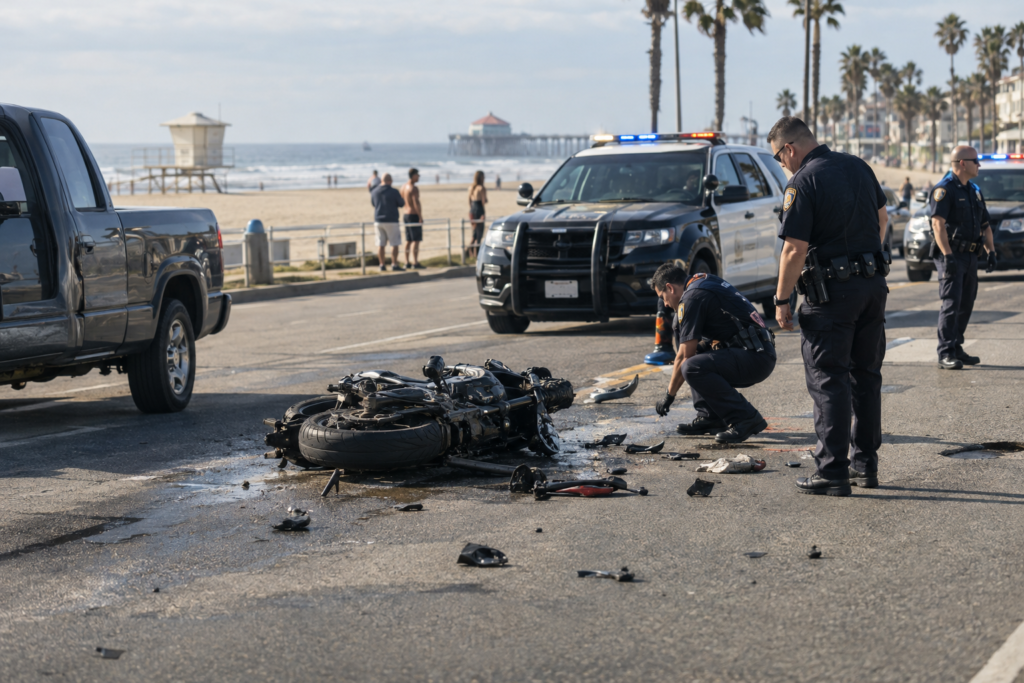
Huntington Beach’s coastal layout funnels heavy traffic along Pacific Coast Highway (State Route 1) past Downtown, the Huntington Beach Pier, and Sunset Beach. Regional crash mapping identifies PCH through Huntington Beach as a hotspot for motorcycle and other serious collisions, and local commentary has repeatedly described this oceanfront route as one of West Orange County’s most dangerous roads for drivers and riders.
When a motorcycle collision happens here, the fact that you are on two wheels instead of four affects everything about your claim: the way fault is argued, the evidence that matters, and how insurers evaluate injuries. Having a clear, local-focused plan helps you protect yourself legally as well as physically.
From Impact to Safety: What to Do at the Crash Scene
Immediately after a motorcycle crash in Huntington Beach, your health and safety come first, followed closely by preserving information you may need for an insurance claim or lawsuit.
Get to Safety and Call 911
If you can move without worsening your injuries, get out of active traffic—this is especially important on fast-moving stretches of PCH or busy arterials feeding the beach. Once you are safe:
- Check yourself and others for injuries.
- Call 911 to request police and emergency medical services.
- Follow the dispatcher’s instructions and stay on the line if asked.
The California Highway Patrol (CHP) explains that 911 should be used for traffic accidents and other emergencies, and callers may be routed either to CHP or the local police agency. Within Huntington Beach city limits, that is typically the Huntington Beach Police Department, headquartered on Main Street near the Civic Center. Their officers and sometimes their Multidisciplinary Accident Investigation Team respond to serious collisions, including major wrecks along PCH.
Exchange Information as Required in California
Once first responders are on the way and you are out of immediate danger, exchange information with the other driver. The California Department of Insurance recommends gathering:
- Names, addresses, and phone numbers for all drivers and passengers
- Driver’s license numbers
- Vehicle license plate numbers
- Insurance company names and policy numbers
- Contact information for any witnesses who stopped
Stay calm and avoid arguing about who was at fault. You can comply with your legal duty to exchange information without admitting blame or speculating about what happened.
Document the Scene Thoroughly
In motorcycle injury claims, fault is frequently contested. Detailed documentation can help counter assumptions that the rider must have been speeding or riding recklessly. Consumer guidance from California’s insurance regulator suggests you should:
- Take wide and close-up photos of vehicle positions and road markings
- Photograph damage to your motorcycle and the other vehicles
- Capture skid marks, debris fields, damaged guardrails, and fluid spills
- Photograph your visible injuries and torn or damaged gear
- Write down or use your phone to record notes about weather, lighting, and traffic
Doing this on scene along PCH, Beach Boulevard, or around the Pier area while details are fresh can be crucial later when an adjuster or defense lawyer tries to downplay what you went through.
Step-by-Step: Protecting a Motorcycle Injury Claim in California
After you leave the crash scene, the focus shifts to medical care, required reporting, and beginning the claims process. The following sequence reflects common best practices drawn from California-oriented guidance for collision claims.
- Get prompt medical evaluation. Even if paramedics clear you, consider being checked out at an urgent care or hospital. Adrenaline can mask pain from soft-tissue injuries, fractures, or concussions, and medical records create an early link between the crash and your symptoms.
- Contact your own insurance company. California insurance materials emphasize notifying your insurer promptly and cooperating with its investigation. Provide basic facts of the crash, but avoid volunteering opinions about fault. You can tell the adjuster that you are still gathering information and receiving medical treatment.
- Be cautious with the at-fault driver’s insurer. You are generally not required to give a recorded statement to the other driver’s insurance company. Riders are often better off speaking with an attorney before engaging in detailed conversations with that carrier.
- Request the official collision report. The investigating agency—often the Huntington Beach Police Department for local streets and parts of PCH—prepares a report that becomes a key document in your claim. Under CHP’s guidance, drivers, passengers, vehicle owners, insurers, and legal representatives can request copies. Having the report lets you check whether it accurately describes lane positions, traffic signals, and witness accounts.
- File the DMV Form SR‑1 when required. California law requires a Report of Traffic Accident Occurring in California (SR‑1) to be submitted to the DMV within 10 days whenever anyone is injured or killed in the crash (even slightly), or when property damage exceeds $1,000. The DMV explains that this obligation applies even if police responded and wrote a report. The form can be filed by you, your insurance agent or broker, or your attorney.
- Preserve your motorcycle and safety gear. Riders are often tempted to repair or replace a damaged bike quickly, especially if it is their main way of getting from neighborhoods like Downtown Huntington Beach or Sunset Beach to work. Yet practitioners stress that impact marks, crushing, and scraping on your motorcycle, helmet, jacket, gloves, and boots can be powerful evidence about how the crash occurred and how violent it was. Whenever possible, do not repair, wash, or throw away these items until they have been photographed and, ideally, reviewed by your lawyer or an expert.
- Organize your claim-related records. From the first few days after the collision, keep all bills, reports, and correspondence together. Well-organized documentation makes it easier to pursue a fair settlement or, if necessary, litigation.
Key Evidence to Keep for a Huntington Beach Motorcycle Claim
Because motorcycle riders are more exposed than occupants of cars or trucks, defense teams sometimes challenge the seriousness of injuries or argue that the rider could have avoided the crash. Thoughtful evidence collection can counter those arguments.
Crash and Injury Documentation
Try to retain or obtain the following materials as your claim moves forward:
- Police collision report from the Huntington Beach Police Department or CHP
- Emergency medical records and follow-up treatment notes
- Imaging reports (X-rays, MRIs, CT scans)
- Photographs of the scene, vehicles, and injuries taken over time
- Written or recorded witness statements, if available
Financial and Life-Impact Records
Practical motorcycle-claim guides often recommend that riders track the real-world effect of the crash on their work and daily activities. Helpful items can include:
- Pay stubs or income records showing missed work
- Receipts for medical co-pays, prescription medications, or medical equipment
- Bills for towing and storage of your motorcycle
- Notes about activities you can no longer enjoy, such as surfing at the Pier or long coastal rides to Newport Beach
- A pain and recovery journal describing sleep issues, mobility limits, and emotional distress
California Comparative Negligence and How It Affects Riders
California uses a pure comparative negligence system for personal injury claims. Court decisions applying this rule explain that an injured person’s compensation is reduced by their percentage of fault, but they can still recover damages even if they were primarily responsible for the crash.
For Huntington Beach motorcycle accidents, that means:
- You are not automatically barred from recovery if you were speeding, lane-splitting incorrectly, or made another mistake.
- If another driver’s negligence—such as failing to yield on Beach Boulevard or making a sudden left turn near Downtown—also contributed, you may still seek compensation.
- When multiple defendants share blame (for example, a driver and a company that maintained a vehicle), the courts use comparative fault principles to allocate responsibility among them for your losses, especially economic damages like medical bills.
Insurers know these rules and may argue that you, as the rider, should bear most of the blame. Strong factual development—photos, gear preservation, and testimony—can be critical to pushing back.

When Dangerous Roads or Government Entities Are Involved
Not every Huntington Beach motorcycle crash is solely about driver error. Oceanfront corridors like PCH can be affected by issues such as defective signals, poor signage, or other dangerous public-property conditions. When a state or local government entity may be responsible, different claim procedures and deadlines can apply.
California’s Government Claims Program explains that auto accident claims involving a state entity are often subject to strict timelines. In many cases, if the claim is not resolved within a short period, a formal government claim must be filed within about six months under statutes that govern public-entity liability before a lawsuit can proceed. Missing these deadlines can severely limit your options.
Because PCH is a state route and local agencies share responsibilities for nearby intersections, it is important to identify promptly whether your crash involved a potentially dangerous public roadway condition so that appropriate notices can be given on time.
Required Reporting vs. Insurance Claims: How They Fit Together
After a collision, riders often feel overwhelmed by multiple agencies and companies wanting information. It can help to distinguish between mandatory reporting and optional, claim-related communication.
| Task | Who Requires It | Typical Deadline | Why It Matters to Your Claim |
|---|---|---|---|
| Call 911 and cooperate with on-scene investigation | CHP or Huntington Beach Police Department | Immediately after the crash | Ensures you receive medical help and that an official collision report is created. |
| Submit DMV Form SR‑1 (if injury or >$1,000 damage) | California DMV | Within 10 days of the collision | Required by law regardless of insurance; helps avoid license and registration issues. |
| Notify your own insurance company | Your insurance policy | As soon as reasonably possible after the crash | Triggers policy benefits such as medical payments or uninsured/underinsured motorist coverage. |
| Present a claim to a government entity (if applicable) | California Government Claims procedures | Often within about six months of the incident | Usually must be done before you can file a lawsuit against a public entity over road conditions. |
Working With Insurance Companies After a Motorcycle Crash
The California Department of Insurance reminds motorists that insurers will evaluate both liability and damages carefully before making settlement offers. For riders, a few points are especially important:
- Cooperate, but be thoughtful. Provide requested documents and basic facts, but avoid speculating, minimizing your pain, or guessing about speed and distances.
- Know your coverages. Review your policy for medical payments coverage and uninsured/underinsured motorist coverage. These can help if the at-fault driver has little or no insurance.
- Beware early low offers. Insurers may make quick offers before the full extent of your injuries or future treatment needs are clear. Once you sign a release, you typically cannot reopen the claim.
- Limit social media. Motorcycle-focused practice materials warn that insurers sometimes review social media accounts to argue that you are less injured than claimed. Avoid posting about the crash or your recovery.
If you feel pressured to give a recorded statement or accept a settlement, it may be a sign that it is time to discuss your situation with an attorney who handles motorcycle cases.
Deadlines for Lawsuits and Why Timing Matters
California generally applies a two-year statute of limitations for most personal injury lawsuits, including those arising from motorcycle crashes. There are often shorter deadlines—commonly around six months—to present administrative claims against government entities before suing over dangerous road conditions or other public-entity negligence, as reflected in state risk-management materials.
Because these timelines can be affected by factors like the rider’s age, the type of defendant, and whether all injuries were immediately known, it is important not to wait until the last minute to get legal advice about how they apply in your specific case.
How an Orange County Lawyer Can Help Huntington Beach Riders
After a serious crash on PCH, near the Huntington Beach Pier, or on busy inland routes connecting to the 405, many riders want someone local who understands both California law and how claims tend to play out in Orange County.
A lawyer who regularly handles motorcycle accident cases can assist by:
- Reviewing the Huntington Beach Police or CHP collision report for accuracy
- Gathering additional evidence, including scene photos and witness statements
- Coordinating with medical providers to document your injuries and future needs
- Handling communications and negotiations with multiple insurance carriers
- Advising on government-claim requirements if a dangerous road or signal may be involved
- Preparing a lawsuit if a fair settlement cannot be reached
Serendib Law Firm represents injured riders throughout Orange County and maintains a strong focus on personal injury work, including motorcycle accidents. The firm also assists clients across the region through its network of offices and local pages such as its Huntington Beach personal injury and Orange personal injury resources. Riders injured in nearby coastal communities may also find guidance in the firm’s Newport Beach personal injury content.
Disclaimer
The information in this article is for general educational purposes only and does not constitute legal advice for any specific case. Reading this page does not create an attorney–client relationship with Serendib Law Firm. Every collision and injury claim is different, and California law changes over time. You should consult a qualified attorney about your particular circumstances before making decisions that could affect your legal rights.
FAQ: Huntington Beach Motorcycle Injury Claims
What should I do first after a motorcycle crash on PCH or near the Huntington Beach Pier?
Prioritize safety and medical care. If you can move without worsening your injuries, get out of traffic and call 911 so police and EMS can respond. Once you are safe and help is on the way, exchange information with the other driver, gather witness contact details, and take photos of the scene, vehicles, and your injuries if you are able. Do not admit fault or argue roadside; those issues can be addressed later through the claims process.
Do I still have a claim if I was partly at fault for the motorcycle accident?
Under California’s pure comparative negligence system, being partly at fault does not automatically bar you from recovering compensation. Instead, any damages you recover may be reduced by your percentage of fault. So, even if you were speeding slightly or made another mistake, you may still pursue a claim if another party’s negligence also contributed to the crash. How fault is allocated often depends on the strength of your evidence and investigation.
Is filing the DMV SR‑1 form necessary if the police came to the scene?
Yes, California’s DMV requires a Report of Traffic Accident Occurring in California (SR‑1) to be filed within 10 days if anyone was injured or killed, no matter how minor the injury, or if property damage appears to be more than $1,000. This requirement applies even when law enforcement prepared a collision report. The SR‑1 can be submitted by you, your insurance representative, or your lawyer.
How long do I have to file a motorcycle injury lawsuit in California?
In many motorcycle injury cases, California’s general statute of limitations for personal injury gives you about two years from the date of the crash to file a lawsuit. However, if a government entity may be responsible—such as in cases involving dangerous road conditions or defective signals—shorter deadlines, often around six months, can apply for presenting a government claim before you can sue. Because exceptions and special rules can change how these limits work, it is wise to talk with a lawyer as soon as practical.
When should I talk to a lawyer about my Huntington Beach motorcycle crash?
It can be helpful to consult a lawyer as soon as your immediate medical needs are addressed, especially before giving detailed or recorded statements to the at-fault driver’s insurer. Early legal help can assist with preserving evidence, meeting the DMV SR‑1 and any government-claim deadlines, and preventing missteps in communications that might weaken your claim. Even if you are unsure whether you want to pursue a lawsuit, a consultation can clarify your options.
Where can I learn more about Huntington Beach and local traffic conditions?
For background on Huntington Beach’s geography, major roads, and local landmarks like Downtown, the Huntington Beach Pier, and Sunset Beach, you can review the city’s overview on Wikipedia. Understanding how Pacific Coast Highway and nearby corridors are laid out can help make sense of why certain stretches see higher crash rates.