Facing age bias in a retail job can feel isolating, especially when years of experience in La Habra seem to count against you. Federal laws like the Age Discrimination in Employment Act and California’s Fair Employment and Housing Act both safeguard workers aged 40 and older from unfair treatment. Understanding your rights is the first step toward protecting your career, and knowing how to document and challenge discriminatory practices is essential for lasting justice.
Table of Contents
- Defining Age Discrimination In Retail Work
- Types And Patterns Of Age-Based Bias
- California Laws Protecting Older Workers
- Employee Rights And How To Take Action
- Reporting Claims And Proving Discrimination
- Avoiding Common Pitfalls And Employer Retaliation
Key Takeaways
| Point | Details |
|---|---|
| Age Discrimination | Age discrimination targeting employees 40 and older is illegal and can manifest in hiring, training, and promotion practices. |
| Legal Protections | Federal and California laws provide strong protections against age-based discrimination in the workplace. |
| Documentation Importance | Maintaining thorough documentation of discriminatory actions and interactions is crucial for supporting legal claims. |
| Retaliation Awareness | Employees should be vigilant about potential retaliation after reporting discrimination and keep records to counteract such actions. |
Defining Age Discrimination in Retail Work
Age discrimination in retail work involves unfair treatment of employees aged 40 and older based solely on their age. Legal protections against workplace age bias prohibit employers from making employment decisions that disadvantage workers in this demographic.
The Age Discrimination in Employment Act (ADEA) establishes critical legal standards protecting retail workers. Under this federal law, employers cannot discriminate against workers 40+ in any employment aspect, including:
- Hiring practices
- Job assignments
- Training opportunities
- Promotion decisions
- Compensation structures
- Termination processes
Retail environments often present unique challenges for workers over 40. Many employers inadvertently or intentionally create workplace cultures that marginalize experienced employees by:
- Preferring younger workers for technology-facing roles
- Assuming older workers are less adaptable
- Creating scheduling practices that disadvantage older employees
- Implementing training programs that exclude experienced workers
Workplace age discrimination can manifest through subtle behaviors or explicit policies that create hostile work environments. When retail employers make decisions predominantly based on age rather than individual performance and capabilities, they violate federal employment regulations.
Age discrimination transforms years of professional experience into a perceived liability rather than an asset.
Legal protections ensure that retail workers cannot be arbitrarily excluded from opportunities based on age. The law recognizes that workers over 40 bring substantial value through expertise, reliability, and institutional knowledge.
Pro tip: Document every instance of potential age-based differential treatment, including emails, performance reviews, and verbal interactions, as these could serve as critical evidence in potential legal proceedings.
Types and Patterns of Age-Based Bias
Age discrimination in retail environments manifests through complex and often subtle mechanisms that systematically disadvantage workers over 40. Systematic review of hiring biases reveals pervasive patterns of exclusion that impact employment opportunities.
Discriminatory practices in retail work can be categorized into several distinct types:
- Direct Discrimination: Explicitly rejecting or excluding candidates based on age
- Indirect Discrimination: Creating policies that disproportionately impact older workers
- Systemic Bias: Institutional practices that subtly marginalize experienced employees
- Technological Exclusion: Limiting access to training or digital skills development
Retail employers often implement age-based bias through nuanced strategies that appear neutral but fundamentally disadvantage older workers. These strategies might include:
- Preferential hiring of younger employees perceived as more technologically adaptable
- Creating job descriptions with coded language targeting younger candidates
- Implementing training programs that inherently exclude workers with longer work histories
- Structuring compensation and advancement opportunities to favor younger employees
Workplace age discrimination transforms experienced professionals into perceived liabilities instead of valuable organizational assets.
Hiring discrimination represents one of the most significant challenges for workers over 40. Studies consistently demonstrate that callback rates and hiring possibilities diminish progressively as candidate age increases, with particularly stark disparities for individuals approaching 50 or 55.

Pro tip: Maintain comprehensive documentation of your professional achievements, technological skills, and adaptability to proactively counter age-based stereotypes during job applications and interviews.
California Laws Protecting Older Workers
California provides robust legal protections for workers aged 40 and older through the Fair Employment and Housing Act (FEHA), which establishes comprehensive safeguards against workplace age discrimination. This critical legislation extends far beyond federal protections, offering workers more comprehensive defense mechanisms.
Key protections under FEHA include:
- Prohibition of age-based discrimination in hiring
- Protection against discriminatory job advertisements
- Restrictions on age-related questioning during recruitment
- Safeguards against harassment based on age
- Mandates for equal employment opportunities
- Protection from retaliatory actions
The law applies to private employers with five or more employees and covers multiple dimensions of workplace interactions. Retail workers in La Habra can leverage these protections against various discriminatory practices, such as:
- Being passed over for promotions due to age
- Receiving different compensation based on age
- Experiencing exclusion from training opportunities
- Facing unreasonable performance expectations
- Encountering hostile work environment tactics
California’s age discrimination laws recognize that professional experience is a valuable asset, not a liability.
Employer obligations under FEHA are comprehensive. Businesses must provide equal opportunities, avoid age-based stereotyping, and create inclusive workplace environments that value workers regardless of age.
Pro tip: Maintain detailed records of workplace interactions, performance evaluations, and potential discriminatory incidents to strengthen any future legal claims.
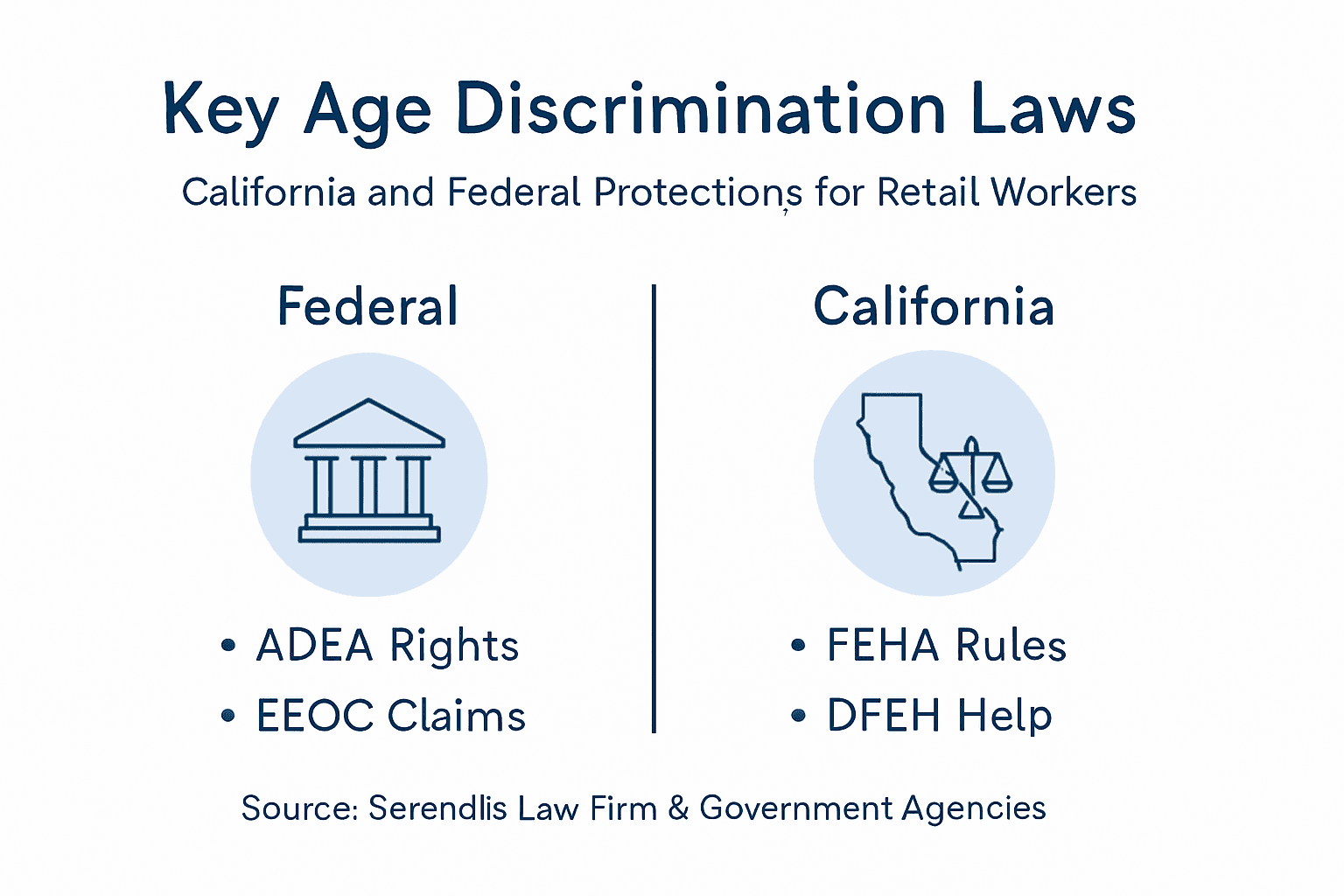
Here’s a side-by-side look at how federal and California state laws protect older retail workers:
| Protection Area | ADEA (Federal) | FEHA (California) |
|---|---|---|
| Age Coverage | Employees 40 and older | Employees 40 and older |
| Employer Size | 20 or more employees | 5 or more employees |
| Recruitment Protections | Limits on age-based hiring | Bans age-related job ads |
| Retaliation Safeguards | Prohibits retaliation | Expands retaliation protections |
| Scope of Coverage | All employment aspects | More comprehensive, including harassment |
| Enforcement Agencies | EEOC | California Civil Rights Dept. |
Employee Rights and How to Take Action
California retail workers facing age discrimination have multiple legal pathways to protect their rights and seek justice. Comprehensive legal protections enable employees to challenge unfair workplace practices effectively.
Steps to address age discrimination include:
- Document all discriminatory incidents in writing
- Collect evidence such as emails, performance reviews, and witness statements
- Report internal violations to human resources
- File formal complaints with appropriate agencies
- Consult with an employment discrimination attorney
- Preserve all communication records
Employees have critical rights when confronting workplace discrimination:
- Right to file complaints without fear of retaliation
- Right to request reasonable accommodations
- Right to equal treatment in hiring and promotions
- Right to seek monetary damages for discrimination
- Right to reinstatement in certain circumstances
- Right to compensation for lost wages and benefits
Workplace discrimination can be challenged through strategic legal action and thorough documentation.
The process of filing a discrimination claim involves multiple potential agencies, including the Equal Employment Opportunity Commission (EEOC) and California’s Department of Fair Employment and Housing. These agencies investigate claims, mediate disputes, and can help workers obtain legal remedies.
Pro tip: Maintain a detailed, chronological journal of all discriminatory incidents, including dates, times, locations, and specific details of each occurrence to strengthen potential legal claims.
Reporting Claims and Proving Discrimination
Proving age discrimination requires strategic documentation and understanding of legal standards. Complaint filing procedures establish critical pathways for workers seeking justice in La Habra retail environments.
Evidence-gathering strategies for discrimination claims include:
- Collecting performance evaluations
- Documenting discriminatory comments
- Saving emails and written communications
- Tracking employment actions affecting older workers
- Recording dates and specific incidents
- Identifying potential witnesses
- Preserving digital and physical documentation
Legal standards for proving discrimination typically require demonstrating:
- Membership in a protected age group (40 and older)
- Qualified job performance
- Adverse employment action
- Evidence suggesting age was a motivating factor
- Pattern of discriminatory behavior
- Differential treatment compared to younger employees
Discrimination claims succeed through meticulous documentation and clear evidence of systemic bias.
Reporting channels for age discrimination include multiple agencies:
- California Civil Rights Department
- Equal Employment Opportunity Commission
- Division of Labor Standards Enforcement
- Internal company human resources departments
Pro tip: Create a confidential, detailed digital and physical file documenting every discriminatory incident, including exact quotes, dates, and potential witnesses to strengthen your potential legal claim.
Avoiding Common Pitfalls and Employer Retaliation
Employees pursuing age discrimination claims must be vigilant about potential employer retaliation. Workplace retaliation protections safeguard workers who assert their legal rights against discriminatory practices.
Common retaliation tactics employers might use include:
- Sudden negative performance evaluations
- Unexpected job reassignments
- Reduction of work hours
- Exclusion from team meetings
- Creating hostile work environments
- Marginalizing employee contributions
- Blocking promotional opportunities
Protective strategies for employees include:
The following table highlights common age discrimination tactics and proactive employee strategies:
| Discrimination Tactic | Typical Impact | Proactive Employee Strategy |
|---|---|---|
| Technology-facing role bias | Limits growth opportunities | Document tech skills; seek training |
| Skewed scheduling practices | Reduces hours or exposure | Record schedule changes; request fairness |
| Biased performance reviews | Threatens job security | Keep detailed records; seek feedback |
| Exclusion from meetings/training | Hinders advancement | Request inclusion; log invitations |
| Harassment or hostile conduct | Creates stressful environment | Maintain journal; report incidents |
- Documenting all interactions
- Communicating concerns in writing
- Maintaining professional composure
- Seeking legal consultation early
- Preserving evidence of discriminatory actions
- Understanding your legal rights
- Reporting incidents through official channels
Retaliation is often more subtle than direct confrontation, requiring careful documentation and strategic response.
Legal protections prohibit employers from taking adverse actions against employees who:
- File discrimination complaints
- Participate in workplace investigations
- Speak with government agencies
- Support other employees’ claims
- Request reasonable accommodations
Pro tip: Create a contemporaneous digital and physical log of all workplace interactions, preserving emails, performance reviews, and witness contact information to build a comprehensive defense against potential retaliation.
Protect Your Rights Against Age Discrimination in La Habra Retail Jobs
Age discrimination in the retail sector can feel isolating and unfair when your experience becomes a barrier instead of an advantage. If you face biased hiring, exclusion from training, or unfair treatment because of your age, know that you are not alone. The challenge of navigating laws like the California Fair Employment and Housing Act while documenting incidents and fighting retaliation takes strength and guidance. You deserve a workplace where your skills and dedication are valued.
At Serendib Law Firm, we are committed to helping retail workers in La Habra stand up to age discrimination. Explore our La Habra Archives | Serendib Law Firm to learn how we have supported others in your community. Don’t wait for the problem to escalate—taking action now can protect your rights and future. Visit our website and connect with our experienced employment law attorneys who provide personalized guidance and free initial consultations.
If wage or compensation issues accompany the discrimination, we also offer expertise in related disputes through our Wage Violations Archives | Serendib Law Firm. Take the first step toward justice and regain control of your career today.
Frequently Asked Questions
What constitutes age discrimination in retail work?
Age discrimination in retail work occurs when employees aged 40 and older face unfair treatment based solely on their age, impacting hiring, training, promotions, and other employment aspects.
What legal protections exist for older workers against age discrimination?
The Age Discrimination in Employment Act (ADEA) provides federal protections for workers aged 40 and older against discrimination in all aspects of employment, including hiring and promotions.
How can retail workers in La Habra take action against age discrimination?
Workers can take action by documenting incidents of discrimination, reporting them to human resources, and filing formal complaints with appropriate agencies like the Equal Employment Opportunity Commission (EEOC) or the California Civil Rights Department.
What should I do if I experience retaliation after reporting age discrimination?
If you face retaliation, document all instances of adverse actions, seek legal advice, and consider filing a complaint with the relevant authorities, as retaliation against those who report discrimination is illegal.