
Audio summary
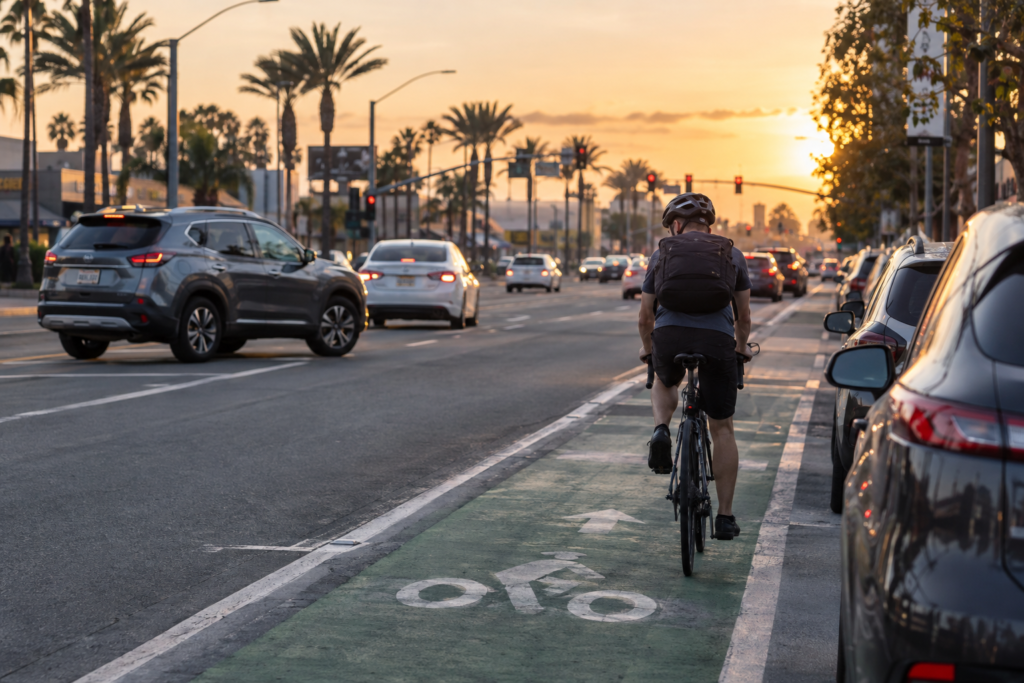
Riding a bike in Anaheim means sharing busy streets with resort traffic, commuters heading to Angel Stadium and the Honda Center, and cars turning into packed parking lots. When a driver suddenly opens a door into your line or cuts across your bike lane for a right turn, the impact can leave you injured and unsure how to prove what really happened. For background on Anaheim, see the Wikipedia article about Anaheim.
Why doorings and right‑hooks are so common in Anaheim
Anaheim’s bicycle network puts riders next to parked cars and frequent turning movements on major streets. City planning documents show many Class II (painted) bike lanes along corridors like Harbor Boulevard, Katella Avenue, and streets connecting to the Santa Ana River Trail, where:
- On‑street parking creates a “door zone” right next to bike lanes.
- Tourist and game‑day traffic generates frequent last‑second turns into hotels, restaurants, and lots near the Convention Center, Angel Stadium, and the ARTIC transit hub.
- Driveways and side streets along arterials like North Street and Manchester Avenue create constant conflict points.
Regional safety reports and crash‑mapping tools identify Orange County, including Anaheim, as an area with elevated serious bicycle crashes, many involving side impacts and turning conflicts. Those are classic patterns for doorings and right‑hook collisions.
What is a bicycle dooring under California law?
A “dooring” happens when someone in a parked or stopped vehicle opens a door into the path of a bicyclist, leaving the rider no time or space to avoid a crash. Under California law, this scenario is not just bad manners—it is usually a clear traffic violation.
California Vehicle Code §22517 prohibits opening a vehicle door on the side available to moving traffic unless it is reasonably safe and does not interfere with traffic, which explicitly includes bicycles. That statute creates a specific duty for drivers and passengers to check for riders before swinging a door open.
In practice, when a cyclist is doored on streets like Harbor Boulevard or Katella, a documented violation of §22517 is strong evidence that the person opening the door failed to use reasonable care.
What is a right‑hook crash in a bike lane?
A “right‑hook” crash occurs when a motorist turns right across a cyclist’s path, often where a bike lane runs along the right side of the road approaching an intersection or driveway. In Anaheim, this frequently happens where drivers:
- Race to beat a cyclist to a right turn into a parking lot near the resort area.
- Cut across the bike lane late on Katella Avenue or Ball Road while heading toward the Santa Ana River Trail connectors.
- Turn right from an arterial with a bike lane into a side street or driveway in neighborhoods like central Anaheim or around Anaheim Hills access routes.
California’s rules on right turns and bike lanes make many of these incidents legally straightforward. The Vehicle Code and California DMV Driver Handbook explain that drivers may enter a bike lane within 200 feet of an intersection to prepare for a right turn, but they must first:
- Check that it is safe before moving into the bike lane.
- Signal the turn.
- Yield to bicyclists already in the lane or going straight.
When a driver skips the merge and simply cuts across the bike lane at the last second, or turns across a cyclist’s path without yielding, that typically violates these duties and supports a finding of negligence.
How negligence works in California bicycle cases
Doorings and right‑hook crashes are usually analyzed under ordinary negligence principles. To establish liability, an injured cyclist generally must show that:
- The driver owed a duty of care (for example, to look before opening a door, or to yield to a rider in the bike lane while turning right).
- The driver breached that duty by acting unreasonably (sudden door opening, unsafe right turn, failure to signal, or failure to merge correctly).
- The breach caused the crash and resulting injuries.
When a driver violates a safety statute—like California Vehicle Code §22517 on door opening or the right‑turn/bike‑lane rules from the DMV handbook—lawyers often argue “negligence per se.” That means the statutory violation itself is used as strong evidence that the driver fell below the standard of care.
This framework allows Anaheim cyclists to anchor their cases in objective rules of the road, rather than debating subjective opinions about who “should have seen” whom on a chaotic corridor near Disneyland or the Convention Center.
Can drivers blame you for riding outside the bike lane or door zone?
After a crash, insurance adjusters sometimes argue that a cyclist was “too far left” or should have stayed in the bike lane. California law does not automatically support those arguments, especially in dooring scenarios.
Vehicle Code §21208 requires cyclists to use a bike lane only when traveling slower than traffic, and it explicitly allows them to leave the bike lane to avoid “debris or other hazardous conditions,” to pass, or to prepare for a turn. Likewise, §21202’s “as close as practicable to the right” rule has similar exceptions.
Parked car door zones are widely recognized as a hazard, and safety materials treat riding outside the door zone as a responsible choice. So if you were riding a bit left of the parked cars on a street like North Street or Manchester Avenue to avoid doors, that can be consistent with the law—not proof you caused your own crash.
Comparative negligence: recovering even if you’re partly at fault
California follows a pure comparative negligence system. Your compensation can be reduced by your percentage of fault, but it is not barred unless you are found 100% responsible.
In dooring and right‑hook claims, this matters because drivers and insurers often argue that:
- You were going too fast for conditions.
- You should have anticipated a car turning into a driveway or hotel entrance.
- You rode too close to parked cars, or swerved left unexpectedly.
Even if a judge or jury concludes that your choices played some role, they can still assign significant fault to a driver who violated §22517 or failed to yield properly before a right turn. Your damages would then be reduced by your percentage of fault.
Key evidence that helps prove driver fault
Because these crashes often unfold in seconds, gathering strong evidence is critical. California negligence law is evidence‑driven, and objective proof can counter common claims like “the cyclist came out of nowhere.” Useful evidence in dooring and right‑hook cases often includes:
Scene and physical evidence
- Photos and video of the crash scene, vehicle position, open door, skid marks, bike lane markings, and surrounding traffic controls.
- Damage patterns on the car door, hinges, and side panels, and on your bike’s frame, wheels, and handlebars.
- Roadway markings showing the bike lane, parking, and any right‑turn only lanes at the intersection or driveway.
Electronic and recorded data
- Helmet‑cam or handlebar video capturing the driver’s movements, signaling, and lane position.
- Bike computer or GPS data showing your speed and path approaching Harbor Boulevard, Katella Avenue, or another Anaheim arterial.
- Nearby business surveillance near resort hotels, restaurants, or strip malls that may show the turn or door opening.
Official records and witnesses
- Police reports from the Anaheim Police Department. Their Traffic Accident Report system can provide diagrams, narratives, cited violations (such as improper turning or opening a door into traffic), and witness information.
- Medical records that consistently document your injuries and how the crash occurred.
- Witness statements from drivers behind the turning vehicle, pedestrians, or nearby workers who saw the moment of impact.

Step‑by‑step: what to do after a dooring or right‑hook crash in Anaheim
The hours and days after a collision are critical for preserving your rights and building your case. When possible, consider the following sequence:
- Call 911 and get medical help. Your health comes first, and emergency documentation ties your injuries to the crash.
- Request a police response and make sure officers know exactly how the door opened or turn occurred so it can be reflected in the collision report.
- Photograph the scene, including the car, door position, bike lane, parked cars, driveways, and any visible injuries.
- Collect driver and witness information, including license, insurance, contact details, and statements or contact info from anyone who saw the crash.
- Preserve your bike, gear, and electronics (helmet, lights, camera, bike computer) without repairing or altering them.
- Request surveillance footage promptly from nearby businesses along Harbor, Katella, or other busy streets before it is overwritten.
- Follow through on all medical care and keep copies of records, bills, and work‑related documentation of missed time or limitations.
- Consult a bicycle accident lawyer familiar with Anaheim’s streets and local crash patterns before talking in detail with the driver’s insurer.
Local factors that can shape an Anaheim bicycle claim
Anaheim’s geography and development pattern mean the details of where your crash occurred can matter as much as how it happened. Practical considerations include:
- Resort and stadium corridors: Areas around Harbor Boulevard, Katella Avenue, the Convention Center, Angel Stadium, and the Honda Center mix heavy tourist traffic with painted bike lanes and driveways. A lawyer can use city bikeway plans and traffic patterns there to explain why a right‑hook or dooring was predictable and preventable.
- Santa Ana River Trail connectors: Riders heading to or from the trail often report feeling exposed on Katella and Ball Road. Evidence of existing bike facilities and ongoing projects aimed at closing bike lane gaps can help frame driver duties in these transition zones.
- Anaheim Hills routes: While Anaheim Hills is known for more dedicated bike lanes and less tourist traffic, right‑hook turns at local intersections and driveways can still be dangerous. The hillier terrain may also affect speed and braking evidence.
Local advocacy groups track serious crashes in Anaheim and nearby cities, underscoring that doorings and turning collisions are not rare flukes but known safety problems. That context can support arguments that careful drivers in Anaheim should anticipate cyclists and follow the rules designed to protect them.
Comparison: key elements in dooring vs. right‑hook claims
Both crash types involve a driver failing to account for a cyclist, but the legal focus and best evidence can differ. Understanding these differences helps your attorney build a targeted case.
| Issue | Dooring Crash | Right‑Hook Crash |
|---|---|---|
| Core legal duty | Check for oncoming traffic (including bikes) before opening a door into the lane. | Merge safely into bike lane within 200 feet, signal, and yield to cyclists going straight. |
| Typical statute cited | California Vehicle Code §22517 (opening a vehicle door into traffic). | Vehicle Code and DMV rules on right turns and bike lanes. |
| Common defense claims | Cyclist rode too close to parked cars; rider was outside the bike lane. | Cyclist was in the driver’s blind spot; rider was speeding or passed on the right. |
| Helpful physical evidence | Door hinge and panel damage, impact marks on the door edge, bike strike pattern. | Scrapes along vehicle side, front‑corner impact damage, skid or tire marks in bike lane. |
| Key reconstruction questions | How far from parked cars was the rider? Was the door opened fully into the lane? | Did the driver enter the bike lane early and yield, or cut across at the last second? |
How an Anaheim bicycle accident lawyer can help
Building a strong dooring or right‑hook case often requires more than just your testimony. Experienced injury lawyers can:
- Obtain and analyze Anaheim Police traffic accident reports, looking for cited violations like improper turns or opening a door into traffic.
- Secure video and electronic data before it disappears, including helmet‑cam footage, bike computer records, and nearby business surveillance.
- Work with crash reconstruction experts to interpret damage patterns, road markings, and speed/path data.
- Apply California statutes and DMV guidance to argue negligence per se where drivers violated clear safety rules.
- Push back against comparative negligence arguments that underestimate the hazards of Anaheim’s door zones and busy turn lanes.
Serendib Law Firm handles bicycle cases as part of its personal injury practice and understands how local conditions in and around Anaheim affect cyclists. To learn more about how serious cases are built and negotiated, you can review the firm’s pages on Bicycle Accidents, related Car Accidents, and the work of Experienced Anaheim Personal Injury Lawyers. Nearby riders in cities like Fullerton and Garden Grove can also look at the firm’s Garden Grove personal injury and other local resources.
Disclaimer
This article is for general informational purposes only and is not legal advice. Reading it does not create an attorney–client relationship with Serendib Law Firm. Bicycle accident cases depend on specific facts, evidence, and deadlines. You should consult a qualified attorney about your particular situation before making legal decisions.
Frequently asked questions about Anaheim bicycle doorings and right‑hooks
Is a driver always at fault for a dooring in California?
California Vehicle Code §22517 makes it illegal to open a vehicle door into traffic—including a bike lane—unless it is reasonably safe and does not interfere with moving traffic. A violation of that rule is strong evidence of fault. However, each case is still evaluated on its own facts, and insurers may argue comparative negligence, so it is important to document how the crash happened and speak with counsel.
What if I was outside the bike lane when a car turned right across me?
California law allows cyclists to leave a bike lane or the right‑hand edge of the road to avoid hazards, pass, or prepare for a turn. If you moved left to avoid debris, a door zone, or another danger, that can be consistent with the law. The key questions will be whether the driver looked for you, signaled, merged safely, and yielded before turning. Evidence from the scene and any video can be critical to clarifying those issues.
Do I need a police report for my bicycle injury claim?
A police report is not legally required to make an injury claim, but it is often very helpful. In Anaheim, collision reports can include diagrams, officer observations, and cited violations such as improper turning or opening a door into traffic. These details can support your account and help strengthen negotiations with an insurer or your case in court.
Can I recover damages if I was not wearing a helmet?
Not wearing a helmet does not automatically bar you from recovering compensation in California. Under comparative negligence principles, a court might consider whether a helmet would have affected specific head injuries, but the primary issue in a dooring or right‑hook crash remains whether the driver acted negligently. A lawyer can help address any helmet‑related arguments raised by the defense or insurer.
How long do I have to bring a claim after a bicycle crash?
California law sets deadlines, called statutes of limitation, that limit how long you have to file a lawsuit after an injury. The exact time limit can vary, especially if a government entity is involved, and missing it can permanently affect your rights. Because these deadlines are strict and fact‑dependent, you should consult with a bicycle accident attorney as soon as you are able to do so.