
A work-related car crash in Costa Mesa is ordinarily covered by California workers’ compensation, regardless of who caused it. The Division of Workers’ Compensation lists a delivery crash as a textbook example of a covered injury, and Labor Code § 3600 makes that liability exist “without regard to negligence” once the injury arises out of and in the course of employment. That means you generally don’t need to prove anyone was at fault to get benefits.
Your first moves matter more than most people realize:
- Get medical care immediately, even if the injury seems minor at the scene.
- Report the crash to your employer as soon as you’re able.
- File the workers’ compensation claim form and request a copy of the completed version for your records.
- Preserve evidence: photos of the vehicle and scene, contact information for witnesses, and any dispatch or delivery instructions you were following.
If the crash happened while you were performing a job duty, or fell under an exception to the “going and coming” rule, your employer may also carry direct tort exposure through respondeat superior or negligent entrustment. Workers’ comp remains the primary path to benefits either way.
Pro Tip: Ask your supervisor, in writing (text or email works), for a copy of the claim form the moment you file it. That paper trail protects you if timelines get disputed later.
Key Takeaways
A work-related car crash in Costa Mesa is generally covered by California workers’ compensation regardless of fault, while non-work crashes fall under standard personal injury and comparative negligence rules.
| Point | Details |
|---|---|
| Coverage comes first | Workers’ comp applies “without regard to negligence” once an injury arises out of and in the course of employment. |
| One-day protections | Employers must promptly issue a claim form and authorize necessary medical care within one working day following injury reporting. |
| Document control facts | Delivery schedules, required vehicles, and employer instructions determine both comp coverage and employer liability. |
| Comparative negligence reduces, not bars, recovery | You can still recover compensation even if partly at fault, minus your percentage of fault. |
| Serendib Law Firm handles both tracks | Bilingual, contingency-based representation covering workers’ comp claims and employer-liability investigation for Costa Mesa employees. |
Table of Contents
- What Causes Most Work-Related Car Accidents in Costa Mesa?
- What Else Causes Car Accidents in Costa Mesa?
- What Legal Protections Exist for Non-Work Car Accident Victims?
- How Do You File a Personal Injury Claim in Costa Mesa?
- What Compensation Can You Recover After a Costa Mesa Crash?
- Why Do Police Reports and Witness Statements Matter So Much?
- How Does Comparative Negligence Affect Your Claim?
- How Serendib Law Firm Reads a Costa Mesa Work-Crash Case
- How Serendib Law Firm Supports Costa Mesa Employees After a Crash
- Where to Verify These Rules and Get Local Help
- Frequently Asked Questions
- Sources
What Causes Most Work-Related Car Accidents in Costa Mesa?
Distracted driving tops the list, and it’s often company-caused, not just a bad habit. Employees juggling GPS directions, dispatch calls, or text updates from a supervisor while driving a required route are prime candidates for a crash that traces back to workplace pressure rather than personal carelessness.
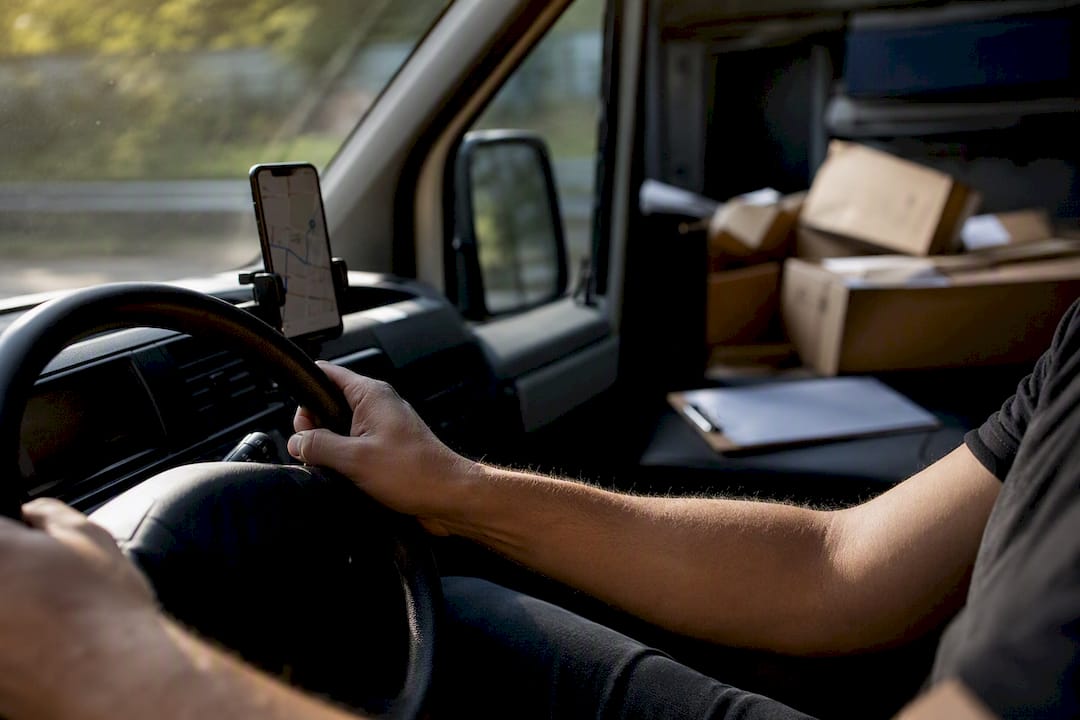
Speeding shows up constantly in delivery and service jobs where schedules are tight. When an employer sets unrealistic delivery windows or docks pay for late arrivals, workers feel pushed to drive faster than conditions allow. That pressure is a workplace-created risk, even though the traffic citation lands on the employee.
Unsafe vehicle maintenance is another recurring factor, particularly for employees who use company-owned or company-assigned vehicles. Bald tires, faulty brakes, or ignored warning lights point to employer negligence in fleet upkeep, which can matter both for a workers’ comp claim’s underlying facts and for any parallel liability theory.

Employer policies themselves sometimes create the hazard. A company that requires employees to answer calls while driving, skips route safety training, or fails to enforce hands-free device rules is effectively building the conditions for a crash. Documenting these patterns, screenshots of scheduling apps, text messages demanding faster turnaround, maintenance logs, gives your claim real substance instead of a vague “I was in an accident at work.”
What Else Causes Car Accidents in Costa Mesa?
Beyond workplace pressure, Costa Mesa’s own traffic patterns create everyday risk. The interchange where State Route 55 meets the 405 sees dense merging traffic during commute hours, and local corridors like Harbor Boulevard and Bristol Street carry heavy retail and restaurant traffic that turns routine lane changes into common collision points.
Driver behavior remains the dominant factor across California generally: distracted driving, impairment, and following too closely account for the bulk of crashes regardless of industry. Costa Mesa’s dense retail districts near South Coast Plaza add pedestrian and cyclist crossings that increase intersection risk, especially during evening rush and weekend shopping hours.
Road conditions play a supporting role. Poor lighting on some side streets, aging pavement in older neighborhoods, and construction zones tied to ongoing development projects all raise the odds of a crash independent of anyone’s driving choices. Weather rarely factors in heavily here, but the occasional heavy rain after a dry stretch makes roads unusually slick and catches drivers off guard.
None of this changes the coverage analysis if you were on the clock. But recognizing these broader causes helps you understand why a crash happened, which matters when your claim moves from “was I hurt at work” to “who else might bear responsibility.”
What Legal Protections Exist for Non-Work Car Accident Victims?
If the crash wasn’t work-related, California operates as a fault-based state, meaning the driver who caused the collision (or their insurer) is financially responsible for your losses. You have the right to file a personal injury claim directly against the at-fault driver, pursue a claim through your own insurance under certain policy provisions, or negotiate a settlement before ever setting foot in a courtroom.
Insurance rights get complicated fast. California requires drivers to carry liability coverage, but minimum limits are often far too low to cover serious injuries, which is why underinsured motorist coverage matters more than most policyholders realize. You also have the right to decline a quick settlement offer from an insurance adjuster, request the claims file, and seek independent legal advice before signing anything that releases the insurer from further liability.
These rights exist separately from any workers’ compensation process. An employee injured in a non-work car accident, say, on a personal errand during off hours, pursues the standard personal injury track rather than a workers’ comp claim. Understanding which track applies to your situation is the first legal question worth answering, since it changes deadlines, evidence requirements, and who you’re ultimately negotiating with.
How Do You File a Personal Injury Claim in Costa Mesa?
Filing starts with documentation, not paperwork. Before any formal claim gets filed, you need a clear record: medical treatment notes, the police report, photos of the scene and vehicle damage, and contact information for any witnesses. Skipping this step is the single most common reason claims stall or get undervalued later.
California applies a statute of limitations to personal injury claims, and the exact deadline depends on the specifics of your case, so it’s worth having an attorney evaluate your timeline early rather than assuming you have unlimited time. Waiting too long to gather evidence, even before any legal deadline, weakens your position because memories fade and physical evidence disappears.
Once documentation is in hand, the process typically moves through a demand letter to the at-fault driver’s insurer, negotiation, and, if no fair settlement emerges, a formal lawsuit. Required documentation usually includes:
- Complete medical records and billing statements tied to the crash
- The official police report and any supplemental reports
- Proof of lost income if the injury affected your ability to work
- Photos or video of the scene, vehicle damage, and visible injuries
A Costa Mesa car accident claim moves faster and settles higher when this documentation is organized from day one rather than assembled after an insurer starts asking hard questions.
What Compensation Can You Recover After a Costa Mesa Crash?
Compensation in a California car accident claim generally falls into three buckets, and understanding each one helps you evaluate whether a settlement offer is actually fair.
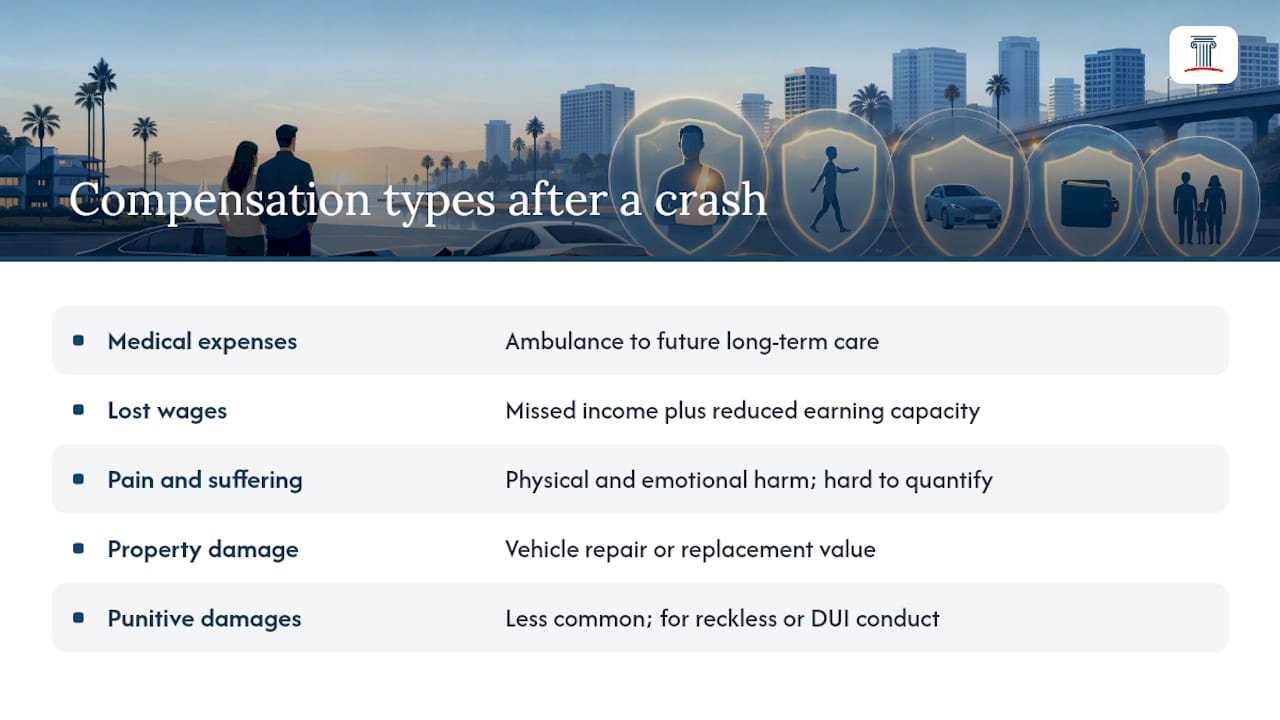
Medical expenses cover everything from the ambulance ride to ongoing physical therapy, and this category often extends to future treatment if your injury requires long-term care. Lost wages account for income missed during recovery, plus diminished earning capacity if the injury limits what kind of work you can do going forward. Pain and suffering compensates for the physical discomfort and emotional toll of the crash itself, a category that’s harder to quantify but no less real for accident victims dealing with chronic pain or lasting anxiety about driving.
Property damage rounds out most claims, covering vehicle repair or replacement value. In cases involving especially reckless conduct, drunk driving or extreme speeding, for example, punitive damages can enter the picture, though these are less common than the categories above.
The size of a settlement depends heavily on injury severity, how well documented your losses are, and whether liability is contested. An employee pursuing a separate personal injury claim tied to a non-work incident should expect insurers to scrutinize medical bills and wage records closely, which is exactly why organized documentation from the outset carries so much weight.
Why Do Police Reports and Witness Statements Matter So Much?
A police report functions as the backbone of most car accident claims because it’s the first neutral account of what happened. Officers note the positions of vehicles, visible damage, statements made at the scene, and sometimes an initial assessment of fault, all details that become far harder to reconstruct weeks later from memory alone.
Witness statements add a layer that even a thorough police report can’t fully replace: independent, third-party perspective. An eyewitness with no stake in the outcome carries real credibility with insurance adjusters and, if it comes to it, a jury. Getting a witness’s name and phone number at the scene, before they leave and become impossible to track down, is one of the cheapest, easiest things you can do to strengthen a future claim.
Following a car accident checklist that prioritizes evidence collection, preserving photos, contact details, and official reports, gives your attorney far more to work with than a claim built on recollection alone. Insurers know the difference between a well-documented claim and a thin one, and they price settlement offers accordingly. A police report that contradicts the other driver’s account, or a witness who corroborates your version of events, can be the deciding factor in whether an insurer pays fairly or drags out negotiations for months.
How Does Comparative Negligence Affect Your Claim?
California follows a pure comparative negligence rule, meaning you can still recover compensation even if you were partly at fault for the crash, your award just gets reduced by your percentage of fault.
This matters enormously in disputed liability cases. Insurance companies routinely try to shift blame onto the injured party specifically because doing so reduces their payout obligation. A claim adjuster might argue you were speeding slightly, changed lanes without signaling, or were distracted, even in situations where the other driver bears the overwhelming majority of fault.
Fighting an inflated fault percentage requires the same evidence discussed above: police reports, witness statements, and photos that establish a clear sequence of events. Because pure comparative negligence allows recovery even at high fault percentages (unlike some states that cut off recovery entirely past 50%), it’s worth pursuing a claim even when liability isn’t perfectly clean. The percentage assigned to you is often negotiable, and a well-documented case gives your attorney real leverage to push that number down.
How Serendib Law Firm Reads a Costa Mesa Work-Crash Case
When we evaluate a work-related crash, the facts that decide coverage almost always come down to control: why you were driving, whether the employer required a vehicle, and what assignment you were on at the time. We ask clients to document delivery schedules, employer texts, and vehicle requirements early, because those details shape both the workers’ comp claim and any employer-liability theory worth pursuing. Our bilingual team supports Spanish-speaking clients through every step, from immediate medical authorization to a free consultation that costs you nothing to start.
How Serendib Law Firm Supports Costa Mesa Employees After a Crash
Filing a workers’ compensation claim while also figuring out whether your employer bears additional liability is not something most employees should navigate alone, especially while recovering from an injury. Serendib Law Firm handles both tracks together: filing and managing your workers’ comp claim, documenting the employer-control facts that determine coverage, and investigating whether theories like vicarious liability, negligent entrustment, or poor vehicle maintenance open the door to additional recovery beyond standard benefits.
Costa Mesa employees get bilingual support in English and Spanish, a free consultation to start, and contingency-fee representation for qualifying cases, meaning you owe nothing upfront while your claim moves forward. Bring a copy of your claim form, medical records, photos from the scene, and any employer communications about your route or assignment to your first meeting. That’s the documentation that turns a routine claim into a fully supported one.
Ready to talk through your situation? Contact Serendib Law Firm for a free consultation and find out exactly where your case stands.
Where to Verify These Rules and Get Local Help
For direct confirmation of these rules, start with the DWC FAQs for employees, which explains covered work injuries, and the DWC injured worker guide, which walks through claim documentation. Labor Code § 3600 and § 3602 establish the coverage rule and exclusive-remedy bar discussed throughout this article.
Coverage almost always turns on the facts you documented at the time, not the facts you remember weeks later.
Costa Mesa employees can also review Serendib Law Firm’s car accident practice page for expanded local guidance.
Frequently Asked Questions
Is a work-related car accident in Costa Mesa automatically covered by workers’ compensation? In most cases, yes. If the crash happened while you were performing a job duty, Labor Code § 3600 makes coverage apply regardless of who caused the crash.
Can I sue my employer instead of filing a workers’ comp claim? Generally no, since § 3602 makes workers’ comp the exclusive remedy against your employer, though exceptions can apply when a third party or separate employer negligence theory is involved.
What if my crash happened during my commute? Commutes are usually excluded under the going-and-coming rule, but exceptions exist when your employer requires a specific vehicle or the trip involved a special work errand, as discussed in Smith v. Workmen’s Comp. App. Bd.
How long do I have to file a claim after a Costa Mesa car accident? Applicable statutes of limitations vary depending on your specific case and whether it involves workers’ comp or a personal injury claim, so it’s worth having an attorney evaluate your timeline early.
Does comparative negligence apply to workers’ compensation claims too? No. Comparative negligence applies to personal injury claims against another driver, not to workers’ comp benefits, which are generally paid without regard to fault.
This article is general information, not a substitute for advice from a qualified lawyer. Consult a qualified legal professional about your own circumstances before acting on anything here.