Disputes over commissions and bonuses can leave sales professionals in Tustin feeling uncertain about their hard-earned compensation. When your pay relies on complex agreements or your employer withholds part of what you are owed, the situation quickly becomes stressful. Clear and detailed contracts are vital for protecting your rights, but many sales employees still face challenges. Get the clarity you need to better understand your legal options and how to safeguard your compensation.
Table of Contents
- Defining Commission And Bonus Disputes
- California Wage Laws Affecting Sales Employees
- How Sales Compensation Agreements Work
- Legal Process For Resolving Disputes
- Employees’ Rights And Employer Obligations
- Common Pitfalls In Sales Compensation
Key Takeaways
| Point | Details |
|---|---|
| Understanding Disputes | Commission and bonus disputes often arise from unclear contractual terms or payment issues. Proper documentation and communication are essential to avoid misunderstandings. |
| California Employer Obligations | Employers in California must provide clear, written agreements outlining commission structures, ensuring transparency and timely payments. Failure to comply can result in legal action by employees. |
| Legal Resolution Pathways | If disputes cannot be resolved internally, sales professionals have multiple options such as mediation, arbitration, or litigation, each with different implications and outcomes. |
| Risks of Poor Structures | Ambiguous commission structures and misleading agreements can lead to disputes, making it crucial for employees to fully understand their compensation terms to protect their rights. |
Defining Commission and Bonus Disputes
Commission and bonus disputes are complex legal challenges that arise when sales professionals encounter compensation disagreements with their employers in Tustin. These conflicts typically emerge when there is a discrepancy between the promised and actual earnings, often stemming from unclear contractual terms or intentional payment withholding.
At their core, commission disputes involve situations where an employer fails to pay promised sales compensation after a sale is completed. These disputes can occur across various sales roles, from real estate to technology and retail sectors. Commissions are typically performance-based payments tied directly to sales achievements, designed to motivate and reward sales professionals for their productivity and success.
Bonus disputes, while similar, often differ in their structure. While commissions are typically calculated as a percentage of a specific sale, bonuses might be based on broader performance metrics such as quarterly or annual team achievements, individual sales targets, or company-wide goals. The key distinction lies in how these additional compensations are structured and calculated. Sales incentive structures can vary widely, making clear documentation and mutual understanding critical to preventing potential conflicts.
Here’s a side-by-side comparison of commissions and bonuses:
| Aspect | Commissions | Bonuses |
|---|---|---|
| Calculation Basis | Percentage of individual sales | Company, team, or individual targets |
| Payment Frequency | Often per sale or monthly | Usually quarterly or annually |
| Key Purpose | Reward direct sales achievements | Motivate broader performance goals |
| Typical Documentation | Detailed sales agreements | Performance bonus plans |
Pro tip: Always maintain a detailed written record of all commission and bonus agreements, including exact calculation methods, payment schedules, and performance metrics to protect your compensation rights.
California Wage Laws Affecting Sales Employees
California has comprehensive legal protections for sales employees, ensuring fair compensation and preventing wage theft in commission-based roles. Commission pay regulations in the state are designed to protect workers from unfair payment practices and provide clear guidelines for how sales compensation must be structured and paid.
Under California law, employers must provide written agreements that clearly outline commission structures, including how commissions are calculated, when they are earned, and the specific conditions for payment. These agreements are legally binding and serve as critical protection for sales professionals. The state requires that commission calculations be transparent, with employees entitled to receive their full earned compensation within a reasonable timeframe after completing the sales transaction.
Additionally, California wage laws mandate that commission payments be considered wages, which means they are subject to the same legal protections as standard hourly or salary compensation. This includes provisions that prevent employers from arbitrarily changing commission structures retroactively or withholding earned commissions without valid justification. Sales employees have the right to pursue legal action if their employers fail to pay commissions as agreed, with potential remedies including recovery of unpaid wages, penalties, and legal costs.
Pro tip: Maintain meticulous documentation of all sales transactions, commission agreements, and communication with your employer to protect your legal rights in potential wage disputes.
How Sales Compensation Agreements Work
Sales compensation agreements are complex legal documents that outline the specific terms of payment for sales professionals in Tustin. Sales commission dispute structures typically include detailed provisions that define exactly how and when sales representatives will be compensated for their work.

These agreements normally contain several critical components that protect both the employer and employee. Key elements include precise definitions of how commissions are calculated, specific performance metrics required to earn full compensation, payment schedules, and conditions for earning different tiers of commission. Some agreements include sliding scale commission rates that increase as sales targets are met, while others might offer flat percentage rates across all sales transactions.
The most comprehensive sales compensation agreements also address potential scenarios like partial sales, team-based achievements, and post-employment commission rights. These provisions are crucial because they establish clear expectations and reduce the likelihood of future disputes. Important details might include how commissions are handled if a sale is canceled, how long an employee must remain with the company to receive delayed commissions, and the process for resolving potential disagreements about earned compensation.
Pro tip: Always request a written copy of your complete sales compensation agreement and carefully review all terms before signing, paying special attention to commission calculation methods and payment conditions.
Legal Process for Resolving Disputes
Sales professionals in Tustin facing commission and bonus disputes have multiple legal pathways to resolve their compensation conflicts. Arbitrations in employment cases represent one primary mechanism for addressing workplace compensation disagreements outside traditional court systems, offering a potentially faster and more cost-effective resolution strategy.
The legal resolution process typically begins with internal communication, where employees document their specific compensation concerns and attempt to resolve issues directly with their employer’s human resources or management team. If internal negotiations fail, sales professionals can pursue more formal legal actions, which might include filing administrative complaints with state labor boards, requesting mediation, or initiating formal arbitration proceedings. These approaches allow employees to seek recovery of unpaid commissions, bonuses, and potentially additional damages related to wage violations.
Each dispute resolution method carries different potential outcomes and procedural requirements. Mediation offers a collaborative approach where a neutral third party helps negotiate a mutually acceptable solution, while arbitration involves a more formal hearing where an arbitrator makes a binding decision. Litigation remains a final option for cases where other resolution methods prove unsuccessful, though it typically involves more significant time and financial investments for all parties involved.
The table below summarizes dispute resolution methods for sales compensation issues:
| Method | Key Feature | Typical Outcome | Recommended When |
|---|---|---|---|
| Mediation | Neutral party facilitates talk | Non-binding agreement | Early-stage disagreements |
| Arbitration | Private hearing, binding result | Decision enforceable | Formal dispute required |
| Litigation | Court trial, legal precedents | Judge/jury verdict | Last resort for resolution |
Pro tip: Collect and preserve all documentation related to your sales agreements, compensation plans, and communication with your employer before initiating any formal dispute resolution process.
Employees’ Rights and Employer Obligations
Sales professionals in Tustin have specific legal protections when it comes to commission and bonus compensation. Sales commission rights are fundamental to ensuring fair treatment and timely payment for earned compensation. Employees are entitled to receive commissions as explicitly defined in their employment agreements, with clear expectations about calculation methods, payment schedules, and performance requirements.
Employers have corresponding obligations that extend beyond simply cutting a paycheck. These include providing transparent commission structures, maintaining accurate records of sales performance, and paying commissions in a timely manner as specified in the original agreement. The law requires employers to honor commission agreements even after an employee’s termination, provided the commissions were legitimately earned during the period of employment. This means sales representatives have the right to pursue unpaid commissions, even if they are no longer working for the company.
California employment law provides robust protections against commission wage theft. Sales employees can seek legal remedies if employers intentionally misclassify earnings, delay payments, or create ambiguous compensation structures designed to minimize commission payouts. These legal protections cover various scenarios, including post-employment commission claims, prorated commissions for partial sales periods, and compensation for sales generated during an employee’s tenure but completed after their departure.
Pro tip: Maintain meticulous documentation of all sales transactions, communication about compensation, and written agreements to strengthen your position in potential commission dispute scenarios.
Common Pitfalls in Sales Compensation
Sales professionals frequently encounter numerous challenges related to compensation structures that can significantly impact their earnings. Common commission dispute scenarios reveal systemic problems that often arise from poorly designed compensation frameworks. These pitfalls typically stem from ambiguous contract language, inconsistent payment practices, and lack of clear performance metrics.
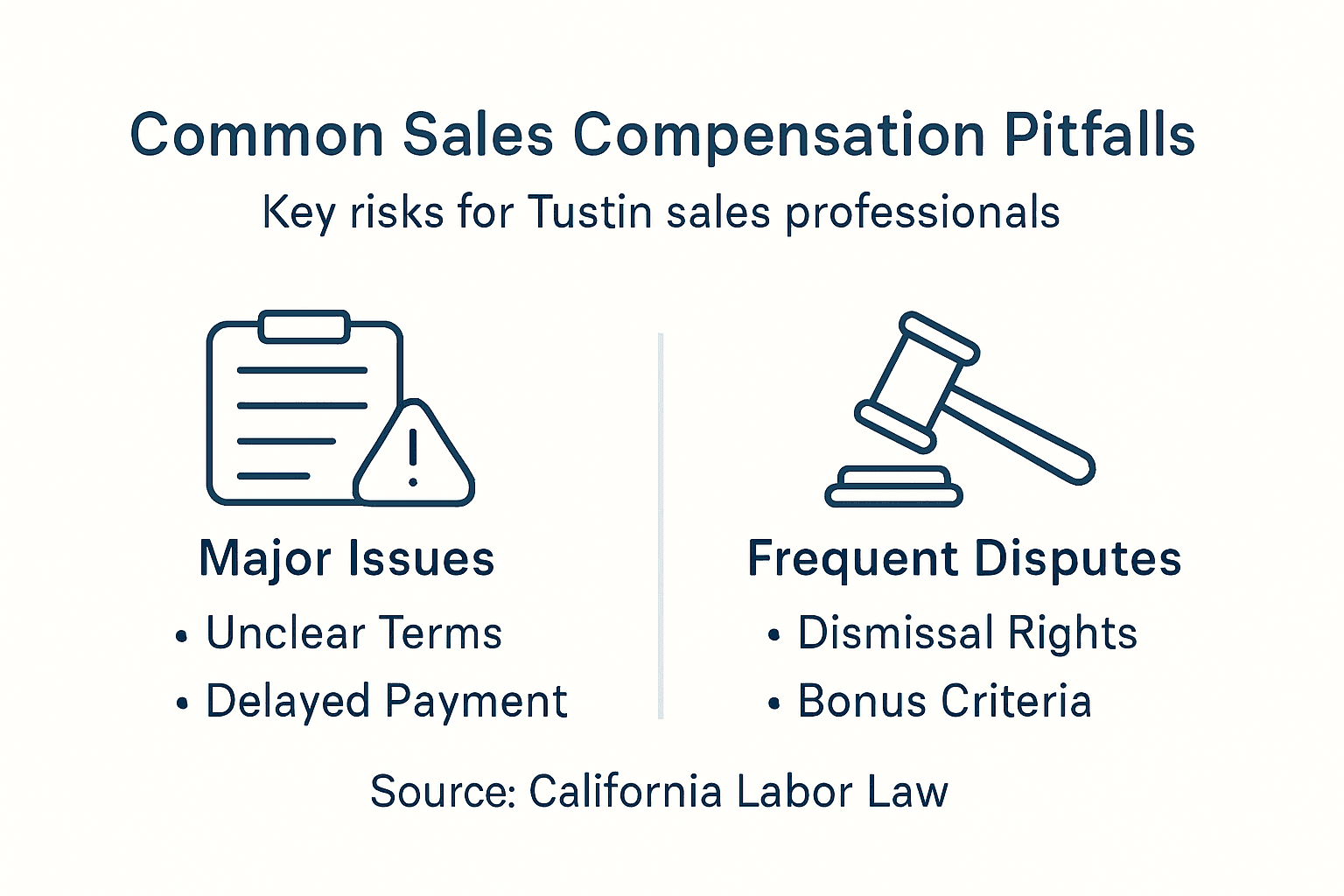
One of the most significant issues involves unclear commission structures that create confusion about how earnings are calculated. Employers might intentionally or inadvertently design compensation plans with complex calculations that make it difficult for sales representatives to understand exactly how their commissions are determined. This complexity can lead to disputes over earned compensation, particularly when performance metrics are subjective or change without proper notice. Problems like retroactive modifications to commission rates, unexplained deductions, or arbitrary performance benchmarks can create substantial tension between sales professionals and their employers.
Additional common pitfalls include challenges related to post-employment commission rights, payment delays, and disputes over sales credited during transition periods. Some employers attempt to avoid paying commissions by implementing aggressive clawback provisions, challenging the validity of sales completed near an employee’s departure, or creating convoluted payment schedules that make tracking earned compensation challenging. Sales professionals must be vigilant about understanding the complete terms of their compensation agreements, including nuanced provisions about how commissions are earned, calculated, and paid.
Pro tip: Request a written, detailed explanation of your complete commission structure and maintain a comprehensive record of all sales transactions to protect yourself against potential compensation disputes.
Protect Your Right to Earn Every Commission and Bonus You Deserve
Commission and bonus disputes can create real uncertainty and frustration for sales professionals in Tustin when promised payments are withheld or calculations are unclear. If you are struggling with unclear commission structures, delayed payments, or disagreements about bonus eligibility, you are not alone. These challenges require experienced legal guidance to ensure your employer honors your compensation agreements in full accordance with California wage laws.
At Serendib Law Firm, we understand the complex nature of sales compensation disputes and are committed to protecting your rights. Explore our Tustin Archives to see how we have helped clients in your community. Learn more about your protections against wage violations and why acting quickly is vital to securing your rightful earnings. Do not wait while your commissions and bonuses are withheld. Take the first step today by contacting us at https://www.serendiblaw.com/ and schedule a free consultation with a trusted advocate who will fight zealously on your behalf.
Frequently Asked Questions
What are commission disputes in sales jobs?
Commission disputes occur when employers fail to pay promised sales compensation after a sale is completed, often due to unclear contractual terms or intentional withholding of payments.
How do bonus disputes differ from commission disputes?
Bonus disputes typically relate to broader performance metrics rather than direct sales achievements, with payments based on team or company goals, while commission payments are directly tied to individual sales.
What are my rights regarding commission payments in California?
In California, employees have the right to receive their earned commissions as defined in their written agreements, and commission payments are considered wages with specific legal protections against withholding or misclassification.
How can I resolve a dispute over unpaid commissions or bonuses?
Disputes can be resolved through internal communication with employers, mediation with third-party assistance, arbitration for binding resolutions, or litigation as a last resort if other methods fail.