

Many student workers at California State University Fullerton assume their campus job offers the same protections as off-campus employment, but that assumption can lead to confusion when disputes arise. Your classification as a student assistant creates a unique employment status with specific limitations on hours, protections, and dispute resolution options. Understanding these distinctions is critical when facing wage violations, discrimination, or retaliation. This guide clarifies your classification, common dispute types, reporting procedures through the Office for Civil Rights and Equity, unionization efforts, and practical steps to protect your rights and resolve conflicts effectively.
Table of Contents
- Understanding Student Worker Classifications At CSUF
- Common Employment Disputes And Rights Challenges For CSUF Student Workers
- Reporting Employment Disputes And Protections At CSUF
- Unionization Efforts And The Evolving Rights Landscape For CSUF Student Workers
- Practical Steps For CSUF Student Workers To Protect Rights And Resolve Disputes
- Need Help With Campus Employment Disputes? Experienced Legal Support Is Here
- Frequently Asked Questions
Key takeaways
| Point | Details |
|---|---|
| Student assistants are at-will employees | CSUF student workers are limited to 20 hours weekly during sessions and exempt from FICA taxes if qualifying. |
| Common disputes include wage and discrimination issues | Wage violations, harassment, and retaliation occur frequently but often go unreported due to power imbalances. |
| CSUF provides formal reporting channels | The Office for Civil Rights and Equity handles discrimination, harassment, and retaliation claims with no time limit. |
| Unionization efforts are expanding | CSUEU is pushing for Unit 15 coverage to secure grievance procedures and leave benefits for student assistants. |
Understanding student worker classifications at CSUF
Your employment status at CSUF falls under specific classifications that determine your rights and limitations. Student workers are classified as Student Assistants under class codes ranging from 1870 to 1881, depending on your role and department. This classification defines you as an at-will employee, meaning the university can terminate your employment without cause, though certain legal protections still apply.
Work hour restrictions are strict and non-negotiable. You can work a maximum of 20 hours per week during academic sessions and up to 40 hours during breaks and holidays. These limits exist to maintain your primary status as a student rather than a full-time employee. Exceeding these hours can jeopardize your employment and potentially affect your CSU student employment eligibility.
Qualifying student workers receive FICA tax exemptions under IRS rules, meaning Social Security and Medicare taxes are not withheld from your paycheck. To qualify, you must be enrolled at least half-time and your employment must relate to your educational program. This exemption significantly affects your take-home pay and distinguishes your employment from traditional jobs.
Understanding your classification impacts how you approach disputes. Key factors include:
- Your at-will status limits wrongful termination claims but does not eliminate protections against illegal discrimination or retaliation
- Hour limitations create potential wage disputes if supervisors pressure you to work off the clock
- FICA exemption status can lead to payroll errors requiring immediate correction
- Classification differences between student assistants and other campus employees affect available grievance procedures
Your classification also determines which policies apply when conflicts arise. Student assistants operate under different rules than faculty, staff, or graduate teaching associates, creating confusion about where to turn for help. Knowing your specific class code and employment terms helps you identify the correct channels for CSUF student worker pay disputes and other conflicts.
Common employment disputes and rights challenges for CSUF student workers
Wage violations represent the most frequent disputes among student workers. Supervisors may ask you to work through breaks, arrive early, or stay late without proper compensation. Some departments pressure students to work off the clock to stay within the 20-hour limit while meeting demanding workloads. These practices violate California labor law regardless of your student status.

Discrimination and harassment occur but often go unreported because student workers fear retaliation or believe their temporary status offers no protection. You might face unequal treatment based on race, gender, disability, or other protected characteristics. Power imbalances between supervisors and student employees create environments where inappropriate behavior goes unchecked. Student assistants bargaining efforts have highlighted systemic issues including lack of sick leave and grievance procedures.
Retaliation disputes arise when you report violations or assert your rights. Your supervisor might reduce your hours, assign undesirable tasks, or terminate your position after you complain about wage issues or discriminatory treatment. California law prohibits retaliation against employees who engage in protected activities, including student workers.
Privacy concerns emerge particularly when your role involves handling sensitive student information. CSULA faced disputes involving student workers and privacy violations, highlighting the need for clear boundaries and training. You have rights regarding how your personal information is used and protected in employment settings.
Common dispute scenarios include:
- Unpaid overtime when work exceeds scheduled hours
- Pressure to falsify timecards to stay under hour limits
- Denial of meal and rest breaks required under California law
- Hostile work environment based on protected characteristics
- Termination after requesting accommodations for disabilities
- Unequal pay compared to peers performing identical work
Pro Tip: Document everything from day one. Keep copies of your work schedule, timecards, pay stubs, and any communications with supervisors. Screenshot text messages and save emails. This documentation becomes critical evidence if you need to file a wage violation claim or report discrimination.
Many student workers confuse their educational role with employment rights, causing delayed or missed claims. You might think complaining will affect your grades or academic standing, but your employment is legally separate from your student status. Understanding this distinction empowers you to assert rights without fear of academic consequences.
Reporting employment disputes and protections at CSUF
The CSUF Office for Civil Rights and Equity serves as your primary resource for discrimination, harassment, and retaliation claims. OCRE handles reports through online forms or in-person meetings, respecting your privacy throughout the investigation. You face no statute of limitations for filing, meaning you can report incidents regardless of when they occurred.
The reporting process follows these steps:
- Submit your complaint through the OCRE online portal or schedule an in-person appointment
- Provide detailed information about the incident, including dates, witnesses, and supporting documentation
- OCRE reviews your complaint and determines whether it falls under CSU Nondiscrimination Policy
- An investigator contacts you to gather additional information and interviews relevant parties
- OCRE issues findings and recommendations, which may include disciplinary action against violators
- You receive notification of the outcome and available supportive measures
Supportive measures protect you during investigations. OCRE can implement no-contact orders preventing your supervisor or alleged harasser from interacting with you. Other accommodations include schedule changes, workspace modifications, or temporary reassignment to different duties. These measures aim to create a safe environment while maintaining your employment.
CSU Nondiscrimination Policy ensures fair and prompt review of all complaints. The policy prohibits discrimination based on race, color, national origin, religion, sex, gender identity, pregnancy, disability, age, medical condition, ancestry, marital status, citizenship, sexual orientation, or veteran status. Understanding these protected categories helps you identify when treatment crosses into illegal discrimination.
Wage disputes require separate administrative processes. While OCRE handles discrimination and harassment, unpaid wages fall under California Division of Labor Standards Enforcement jurisdiction. You may need to file a wage claim with the state or seek legal advice to recover unpaid compensation. Campus HR can sometimes resolve minor payroll errors informally, but systematic wage theft requires formal action.
Pro Tip: Report issues promptly even if you are unsure whether they constitute violations. OCRE can help you understand whether your experience warrants investigation. Early reporting also strengthens your case by demonstrating you took immediate action rather than waiting until after termination or other adverse employment actions.
Protections extend beyond the investigation period. Retaliation for filing complaints violates both CSU policy and California law. If you experience negative treatment after reporting, document it immediately and file a supplemental retaliation complaint. Your workplace harassment legal rights include protection from retaliatory actions.
Unionization efforts and the evolving rights landscape for CSUF student workers
Faculty and academic staff enjoy robust union protections through established collective bargaining units. Unit 4 represents tenure-track faculty while Unit 3 covers academic professionals, providing grievance procedures, job security, and negotiated wage increases. These unions have successfully advocated for improved working conditions and due process protections.
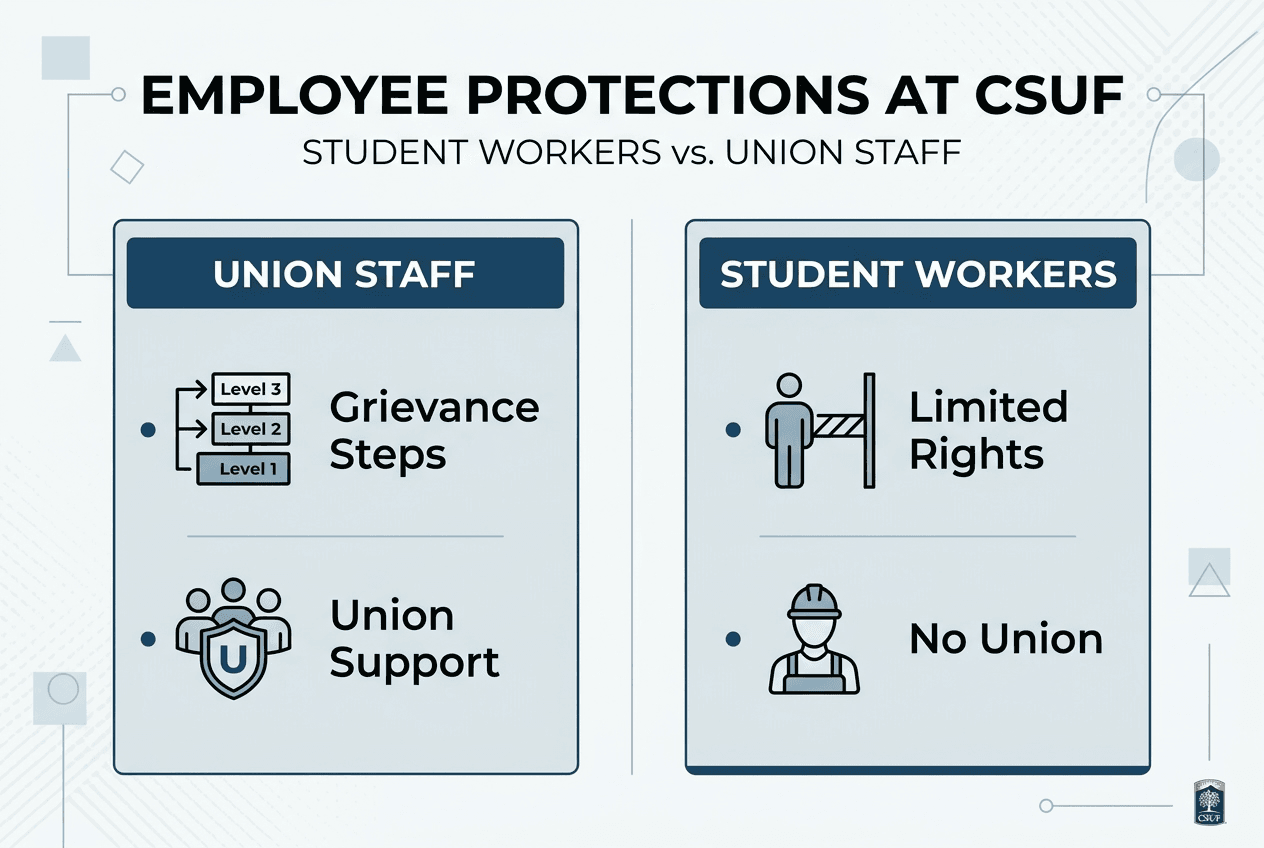
Student workers currently lack comparable union representation. You fall outside traditional bargaining units, leaving you without formal grievance procedures or collective bargaining rights. CSUEU is actively pushing to establish Unit 15 specifically for student assistants, seeking protections including sick leave, bereavement leave, and formal dispute resolution mechanisms.
The university often classifies you primarily as an educational participant rather than an employee, limiting employment protections. This classification strategy allows CSU to avoid extending full labor rights while benefiting from your work. Many student workers view this arrangement as exploitative, particularly when workloads exceed educational value and compensation remains minimal.
Comparing unionized and non-unionized rights reveals significant gaps:
| Protection | Unionized Faculty/Staff | Student Workers |
| — | — |
| Formal grievance procedures | Yes, multi-step process with arbitration | No, limited to informal complaints |
| Just cause termination standard | Yes, requires documented performance issues | No, at-will employment |
| Sick leave and bereavement leave | Yes, negotiated amounts | Limited or none |
| Collective bargaining for wages | Yes, regular negotiations | No, wages set unilaterally |
| Union representation in disputes | Yes, provided at no cost | No, must self-advocate or hire attorney |
Ongoing campaigns for employee protections focus on closing these gaps. Student assistants across CSU campuses are organizing to demand recognition as employees deserving full labor rights. Recent successes include securing grievance procedures and bereavement leave at some campuses, though implementation remains inconsistent.
You can support unionization efforts by attending organizing meetings, signing petitions, and educating fellow student workers about collective bargaining benefits. While current protections remain limited, active participation in union campaigns helps build momentum for systemic change. Understanding the difference between your rights and those of unionized employees clarifies why collective action matters.
The evolving landscape suggests improvements ahead, but change happens slowly. Until formal union recognition occurs, you must navigate disputes using available resources and legal protections. Knowing your wrongful termination rights helps you identify when at-will employment crosses into illegal termination.
Practical steps for CSUF student workers to protect rights and resolve disputes
Documentation forms the foundation of any successful dispute resolution. Keep detailed records of every shift worked, including start and end times, breaks taken, and tasks performed. Save all pay stubs and compare them against your recorded hours to identify discrepancies immediately. Screenshot or print communications with supervisors, particularly those involving schedule changes, work assignments, or complaints.
Report discrimination or harassment promptly to the Office for Civil Rights and Equity. Delays can complicate investigations and weaken your case. Even if you are unsure whether an incident constitutes a violation, filing a report creates an official record and triggers protective measures. OCRE can guide you through the process and explain your options.
Understand your specific classification and limitations. Review your hiring paperwork to confirm your class code, hourly wage, and work restrictions. Verify your FICA exemption status and ensure payroll correctly processes your earnings. Knowing these details helps you identify when policies are violated and strengthens your position in disputes.
Utilize campus resources for informal resolution when appropriate. Some conflicts can be resolved through mediation or conversations with department administrators before escalating to formal complaints. HR staff can correct payroll errors and address minor policy violations without lengthy investigations. Exhaust these options first, but do not let informal processes delay necessary formal action.
Consider consulting employment law attorneys for serious violations. Wage theft claims often require legal expertise to calculate damages and navigate state enforcement procedures. Wrongful termination and discrimination cases benefit from professional evaluation to determine whether you have viable claims. Many attorneys offer free consultations to assess your situation.
Educate yourself about unionization efforts and collective actions. Attend organizing meetings to learn about campaigns for student worker rights. Collective action provides strength in numbers and demonstrates widespread support for improved protections. Even if formal union recognition remains distant, organized advocacy can pressure administration to address systemic issues.
Key protective actions include:
- Never work off the clock, even if supervisors suggest it
- Report injuries or unsafe conditions immediately through proper channels
- Request written confirmation of verbal instructions or policy changes
- Keep personal copies of all employment documents separate from work files
- Know deadlines for filing complaints with external agencies like the Labor Commissioner
- Seek support from workplace discrimination attorneys when facing complex legal issues
Pro Tip: Create a dedicated email folder or cloud storage for work-related documents. Forward important emails to your personal account so you retain access after leaving the position. This practice ensures you have evidence even if university systems become inaccessible.
Take action at the first sign of trouble rather than waiting for situations to escalate. Early intervention often resolves disputes before they become serious legal matters. Your willingness to assert rights also signals to supervisors that you understand employment law and will not tolerate violations.
Need help with campus employment disputes? Experienced legal support is here
Navigating employment disputes as a student worker can feel overwhelming, especially when you are balancing academics and work responsibilities. Serendib Law Firm provides experienced employment law representation for CSUF student workers facing wage violations, discrimination, harassment, and wrongful termination. Our attorneys understand the unique challenges of campus employment and the specific protections available under California law.
We offer free consultations to help you understand your rights and evaluate your options. Whether you need assistance filing a wage claim, reporting discrimination, or challenging retaliation, our team provides clear guidance and zealous advocacy. With convenient offices in Lake Forest, Huntington Beach, and La Habra, we serve student workers throughout Orange County with accessible, personalized legal support.
Frequently asked questions
What hours can CSUF student workers legally work during the academic year?
Student workers may legally work up to 20 hours per week during academic sessions under CSUF policies. During breaks or holidays, this limit increases to 40 hours per week. Exceeding these limits violates employment terms and can jeopardize your position.
How do I report discrimination or harassment as a student worker at CSUF?
You can report online or in person through the CSUF Office for Civil Rights and Equity. There is no time limit to file a report, and privacy is protected throughout the process. OCRE investigates complaints and implements supportive measures to protect you during the investigation. If you need legal assistance, harassment attorneys can guide you through the process.
What can I do if I face unpaid wages or overtime violations at CSUF?
Document your hours and pay records carefully, noting every discrepancy between time worked and compensation received. You can attempt informal resolution through campus HR or file a wage claim with the California Labor Commissioner. Legal consultation helps protect your rights if disputes escalate or the university refuses to pay owed wages. Wage violation remedies include back pay, penalties, and attorney fees.
Are CSUF student workers covered by unions and collective bargaining agreements?
Most CSUF student workers are not currently unionized like faculty and staff. CSUEU is pushing to establish a union unit for student assistants, but protections remain limited. You lack formal grievance procedures and collective bargaining rights available to unionized employees, making individual advocacy and legal consultation more important when disputes arise.