Facing workplace challenges due to a disability can be overwhelming, especially when reasonable accommodations are denied or ignored. For many corporate employees in Lake Forest, California, the difference between success and struggle rests on an employer’s commitment to their legal obligations under the Americans with Disabilities Act and the Fair Employment and Housing Act. Understanding disability accommodation failures puts you in a stronger position to protect your rights and seek meaningful legal remedies when workplace adjustments are not provided.
Table of Contents
- Defining Disability Accommodation Failures
- Types of Disabilities and Accommodations
- Federal and California Law: ADA, FEHA
- Reasonable Accommodation Process and Pitfalls
- Employee Rights and Legal Remedies
- Risks, Liabilities, and Employer Mistakes
Key Takeaways
| Point | Details |
|---|---|
| Understanding Legal Obligations | Employers must engage in a good-faith interactive process with employees requesting accommodations as mandated by the ADA and FEHA. |
| Importance of Documentation | Both employees and employers should meticulously document all accommodation requests and responses, as records can be critical in legal proceedings. |
| Awareness of Accommodation Types | Employers should be familiar with various types of disabilities and corresponding workplace accommodations to foster an inclusive work environment. |
| Risks of Non-Compliance | Failure to comply with disability accommodation laws can lead to significant legal liabilities and damage an organization’s reputation. |
Defining Disability Accommodation Failures
Disability accommodation failures represent complex legal scenarios where employers fail to provide reasonable workplace adjustments for employees with documented disabilities. These failures stem from a fundamental misunderstanding or intentional disregard of legal obligations established under the Americans with Disabilities Act (ADA).
The U.S. Equal Employment Opportunity Commission (EEOC) defines accommodation failures through several critical dimensions. According to their enforcement guidance on reasonable accommodation, these failures typically manifest in several key ways:
- Refusing to engage in an interactive process with the disabled employee
- Rejecting reasonable modification requests without substantive evaluation
- Imposing unreasonable documentation requirements
- Failing to provide accessible workplace environments
- Discriminating against employees requesting disability accommodations
Accommodation failures can occur across multiple workplace interactions. Employers are legally required to recognize disability-related needs and implement appropriate adjustments that enable qualified employees to perform essential job functions. These accommodations might include:
- Modified work schedules
- Specialized equipment or technology
- Physical workspace modifications
- Communication assistance
- Flexible break periods
The Association on Higher Education and Disability emphasizes that accommodation failures frequently arise from systemic misunderstandings about disability protections. Employers often mistakenly believe they have broad discretion in deciding whether to provide accommodations, when in fact, the law mandates a collaborative and good-faith approach.
Disability accommodation is not a privilege—it’s a legally protected right designed to ensure equal employment opportunities for all qualified individuals.
Crucial legal principles underlying accommodation requirements include demonstrating that the requested modification does not create an undue hardship for the employer and that the employee can perform core job functions with reasonable adjustments.
Pro tip: Document every disability accommodation request and employer response meticulously, as these records can become critical evidence in potential legal proceedings.
Types of Disabilities and Accommodations
Workplace disabilities encompass a broad spectrum of physical, mental, and neurological conditions that require tailored accommodations to ensure equal employment opportunities. Understanding these diverse disability types is crucial for both employees and employers in creating inclusive work environments.
The Center for Accessible Education identifies several primary categories of workplace accommodations based on specific disability needs:
-
Presentation Accommodations
- Braille materials
- Closed captioning
- Large print documents
- Screen reader compatibility
-
Response Accommodations
- Assistive computer technologies
- Alternative communication methods
- Personal reading or transcription assistance
-
Timing/Scheduling Accommodations
- Extended time for tasks
- Flexible break schedules
- Modified work hours
-
Setting Accommodations
- Private workspace areas
- Noise-reduced environments
- Ergonomic workstation modifications
According to the U.S. Department of Labor, workplace accommodations can address various disability types including:
- Physical disabilities requiring mobility assistance
- Sensory impairments like hearing or visual disabilities
- Neurological conditions such as epilepsy or multiple sclerosis
- Mental health conditions
- Chronic medical conditions
Effective disability accommodations transform workplace limitations into opportunities for full professional engagement.
Technological innovations have significantly expanded accommodation possibilities. Modern workplace technologies now enable unprecedented levels of accessibility, allowing employees with disabilities to perform complex job functions with greater independence and efficiency.
Pro tip: Always request detailed documentation from medical professionals to support your specific accommodation needs and facilitate a comprehensive workplace adaptation strategy.
Federal and California Law: ADA, FEHA
Employees in Lake Forest benefit from robust legal protections under both federal and state disability discrimination laws. The Americans with Disabilities Act (ADA) and California’s Fair Employment and Housing Act (FEHA) provide comprehensive safeguards to ensure workplace equality and prevent discriminatory practices.
The key differences between federal and state disability laws include:
-
ADA Protections
- Applies to employers with 15 or more employees
- Provides nationwide standard for disability accommodations
- Requires reasonable modifications to job functions
- Covers physical and mental impairments substantially limiting major life activities
-
FEHA Protections
- Applies to employers with 5 or more employees
- Offers broader disability definitions
- Provides more stringent accommodation requirements
- Includes additional protected categories not covered by ADA
Under workplace disability discrimination laws, both ADA and FEHA mandate that employers:
- Engage in good-faith interactive accommodation processes
- Make reasonable workplace modifications
- Prohibit discrimination based on disability status
- Maintain confidentiality of medical information
- Prevent retaliation against employees requesting accommodations
California’s disability laws provide more expansive protections than federal regulations, offering employees enhanced legal safeguards.
Critical legal distinctions exist between ADA and FEHA, with California’s law typically providing more comprehensive employee protections. While the ADA sets a baseline for disability rights, FEHA frequently extends additional protections that benefit employees facing workplace challenges.
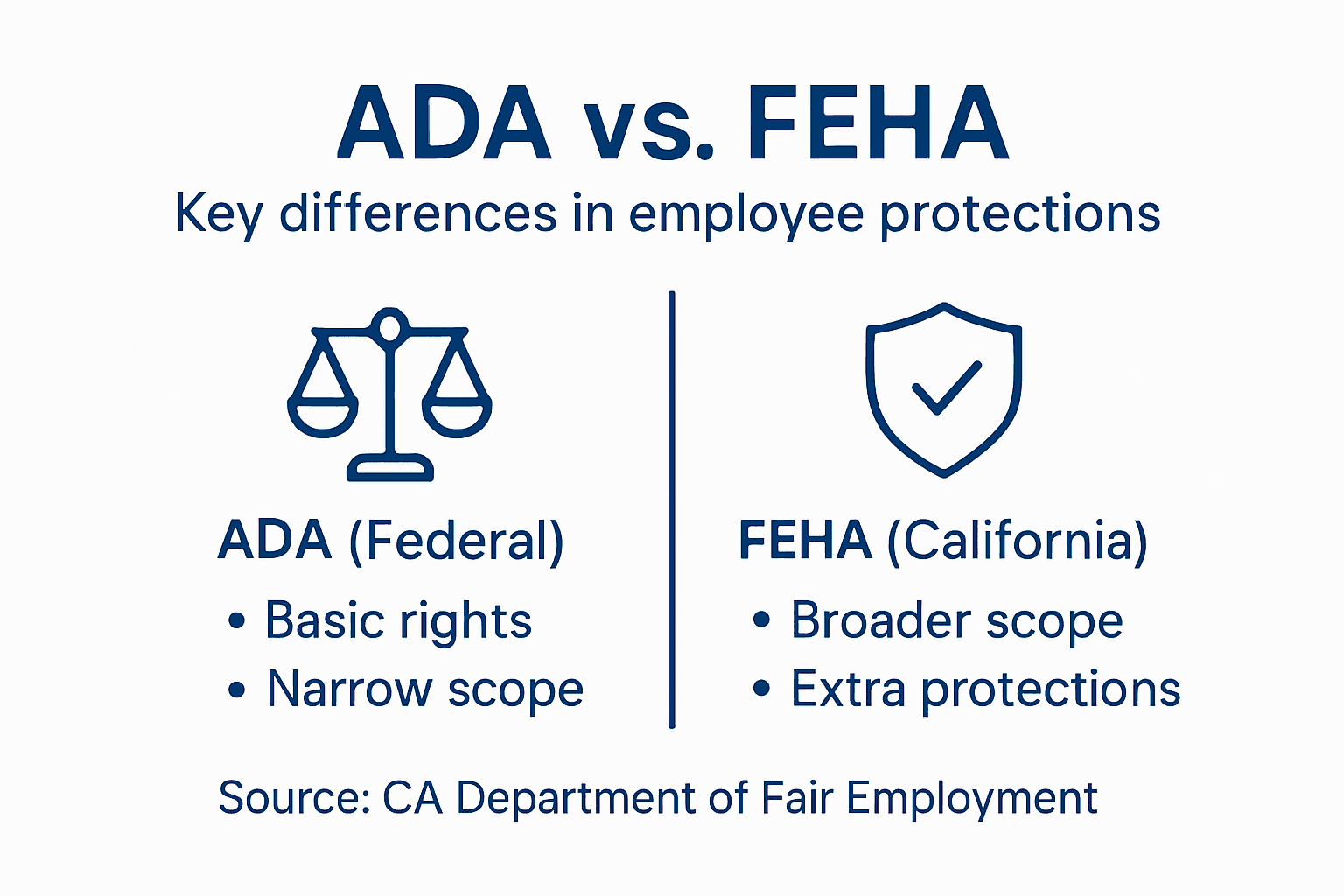
Here’s a side-by-side comparison highlighting key differences between ADA and FEHA disability protections for employees:
| Criteria | ADA (Federal) | FEHA (California) |
|---|---|---|
| Employer Coverage | 15 or more employees | 5 or more employees |
| Disability Definition | More restrictive, federally defined | Broader, includes temporary or less severe conditions |
| Reasonable Accommodation Standard | Reasonable efforts required | More comprehensive, higher standard |
| Protected Categories | Physical and mental impairments limiting major life activities | Includes additional mental/medical conditions not covered by ADA |
| Enforcement Agency | EEOC | California DFEH |
| Retaliation Prohibition | Yes, for requesting accommodations | Yes, with enhanced enforcement in California |
Pro tip: Maintain detailed documentation of all disability-related workplace interactions and accommodation requests to strengthen potential legal claims.
Reasonable Accommodation Process and Pitfalls
The reasonable accommodation process represents a critical legal pathway for employees with disabilities to secure workplace adaptations. Understanding this complex procedure requires navigating multiple strategic steps and potential challenges that can significantly impact an employee’s professional opportunities.
Accommodation request procedures typically involve several interconnected stages:
-
Initiating the Request
- Employee identifies accommodation need
- Communicates specific functional limitations
- Provides relevant medical documentation
- Specifies requested workplace modifications
-
Employer Evaluation Process
- Review employee’s specific job requirements
- Assess proposed accommodation feasibility
- Explore alternative modification options
- Engage in interactive dialogue
Common pitfalls in the accommodation process can derail employees’ rights and workplace inclusivity. These critical errors often include:
- Employers refusing to initiate interactive discussions
- Demanding excessive or intrusive medical documentation
- Rejecting reasonable modifications without substantive justification
- Failing to maintain confidentiality of medical information
- Retaliating against employees requesting accommodations
Successful workplace accommodations require transparent communication, good-faith efforts, and a collaborative approach from both employees and employers.
The legal landscape surrounding reasonable accommodations is complex. Potential litigation risks emerge when employers fail to properly understand or address disability-related workplace needs, highlighting the importance of comprehensive and individualized accommodation strategies.

Pro tip: Document every accommodation request, employer interaction, and proposed modification in writing to create a clear, legally defensible record of your efforts.
Employee Rights and Legal Remedies
Employees facing disability accommodation failures in Lake Forest possess robust legal protections designed to safeguard their workplace rights and secure appropriate workplace modifications. Understanding these rights is crucial for navigating potential discrimination and pursuing meaningful legal recourse.
Legal remedies for employees experiencing accommodation failures typically include:
-
Administrative Complaint Mechanisms
- Filing complaints with California’s Department of Fair Employment and Housing
- Initiating investigations into discriminatory practices
- Seeking mediation and resolution
- Documenting workplace violations
-
Legal Compensation Options
- Monetary damages for lost wages
- Compensation for emotional distress
- Potential reinstatement to previous position
- Coverage of legal representation expenses
The California complaint process provides employees multiple avenues for addressing workplace discrimination, including:
- Formal written complaint submission
- Comprehensive administrative investigation
- Mediation and settlement negotiations
- Potential civil litigation
- Administrative hearing proceedings
Employee rights are not privileges—they are legally protected entitlements designed to ensure fair and equitable workplace treatment.
Strategic legal approaches can help employees effectively challenge accommodation failures. These may involve gathering comprehensive documentation, identifying specific legal violations, and demonstrating how an employer’s actions directly impacted job performance or career opportunities.
Pro tip: Preserve all communication records, performance evaluations, and medical documentation to build a robust legal case demonstrating disability accommodation violations.
Risks, Liabilities, and Employer Mistakes
Workplace disability accommodation failures expose employers to substantial legal and financial risks that can significantly impact their organizational reputation and financial stability. Understanding these potential consequences is crucial for proactive compliance and risk management.
Employers commonly face numerous workplace disability discrimination risks through critical mistakes:
-
Legal Liability Risks
- Substantial monetary damages
- Potential punitive financial penalties
- Mandatory workplace policy modifications
- Mandatory employee training requirements
-
Organizational Reputation Risks
- Negative public perception
- Decreased employee morale
- Potential recruitment challenges
- Reduced workforce diversity
Critical employer mistakes that trigger legal vulnerabilities include:
- Refusing reasonable accommodation requests
- Failing to engage in interactive dialogue
- Discriminatory hiring or termination practices
- Inadequate documentation of accommodation processes
- Retaliating against employees requesting accommodations
Legal compliance is not optional—it’s a fundamental organizational responsibility that protects both employees and employers.
Financial consequences of disability accommodation failures can be profound, potentially involving extensive litigation expenses, settlement costs, and mandated organizational reforms that extend far beyond immediate monetary penalties.
The following table summarizes common employer risks when disability accommodation failures occur:
| Risk Type | Description | Possible Impact |
|---|---|---|
| Legal Liability | Exposure to lawsuits and penalties | Financial damages; mandatory policy changes |
| Reputation | Negative public or employee perception | Loss of trust; difficulties in hiring |
| Operations | Required process and staffing updates | Costly training; process overhauls |
| Compliance | Ongoing monitoring obligations | Regulatory scrutiny; loss of contracts |
Pro tip: Develop comprehensive, written disability accommodation policies and train management consistently to minimize legal exposure and create an inclusive workplace environment.
Protect Your Rights Against Disability Accommodation Failures in Lake Forest
If you are facing challenges with your employer refusing reasonable accommodations or ignoring your disability-related needs, you are not alone. Many employees in Lake Forest encounter obstacles such as lack of interactive dialogue or excessive documentation demands, which can lead to workplace discrimination. Understanding your rights under laws like ADA and FEHA is critical to ensuring you receive the fair treatment and accommodations you deserve.
Our experienced legal team at Serendib Law Firm is dedicated to helping you navigate these complex issues. We provide personalized advocacy focused on disability accommodation compliance and defending your workplace protections. Do not let your employer’s mistakes jeopardize your career or well-being. Explore our Disability Accommodation Archives and learn more about your rights in the Lake Forest Archives. Take action now by contacting us through Serendib Law Firm to schedule your free consultation and secure the workplace fairness you are entitled to.
Frequently Asked Questions
What constitutes a disability accommodation failure?
Disability accommodation failures occur when employers do not provide reasonable adjustments for employees with documented disabilities, which may include refusing to engage in discussions about accommodations or imposing unreasonable documentation requirements.
What are my rights as an employee regarding disability accommodations?
As an employee, you have the right to request reasonable accommodations for your disability, and your employer is required by law to engage in a good-faith interactive process to determine appropriate modifications.
What are some common examples of reasonable accommodations?
Common examples of reasonable accommodations include modified work schedules, specialized equipment, workspace modifications, communication assistance, and flexible break periods.
What should I do if my accommodation request is denied?
If your accommodation request is denied, you should document the interaction, seek clarification on the denial, and consider filing a complaint with state or federal agencies if you believe your rights have been violated.
Recommended
- Disability Accommodation Disputes in Lake Forest Manufacturing – Employee Rights and Solutions | Serendib Law Firm
- Experienced Lake Forest Employment Law Attorneys
- Complete Guide to Disability Accommodation Failures in Garden Grove | Serendib Law Firm
- Disability Accommodations in Tustin Firms: Complete Guide | Serendib Law Firm