Every experienced executive knows the stakes are high when your employment contract defines not just your compensation but the very boundaries of your career in Villa Park, California. As changes in California law and intricate contract terms raise new questions for senior professionals, even the most seasoned leaders can face sudden contract disputes with far-reaching consequences. Understanding the unique complexities of high-level employment contracts provides critical leverage when seeking expert legal guidance to safeguard your executive rights and professional future.
Table of Contents
- High-Level Employment Contracts Defined
- Key Types of Executive Employment Agreements
- 2026 California Laws Impacting Employment Contracts
- Common Contract Dispute Scenarios for Executives
- Legal Rights and Remedies for Executives
- Best Practices to Mitigate Contract Disputes
Key Takeaways
| Point | Details |
|---|---|
| High-Level Employment Contracts | These sophisticated agreements define executive roles with clear expectations and terms, surpassing standard employment paperwork. |
| Importance of Legal Review | Having an experienced employment attorney review contracts is essential to protect professional interests before signing. |
| Impact of California Laws | The 2026 California laws significantly alter standard employment contracts, especially regarding non-compete restrictions, enhancing employee rights. |
| Dispute Mitigation Practices | Executives should implement proactive strategies, such as precise contractual language and regular contract reviews, to prevent disputes. |
High-Level Employment Contracts Defined
High-level employment contracts represent sophisticated legal agreements between top-tier executives and organizations, defining complex professional relationships with precise terms and conditions. These documents go far beyond standard employment paperwork, establishing comprehensive expectations for senior professionals across multiple domains.
Under federal labor standards, employment contracts must outline fundamental elements that protect both employer and employee interests. These critical components typically include:
- Compensation Structure: Total remuneration package including base salary, bonuses, stock options
- Performance Expectations: Clear metrics and objectives for executive role
- Termination Conditions: Detailed provisions for contract dissolution
- Confidentiality Clauses: Protections for proprietary company information
- Non-Compete Agreements: Restrictions on future competitive activities
Historically, employment contracts have evolved from basic service agreements to nuanced legal instruments that balance organizational needs with individual professional rights. Modern contracts recognize the complex interdependencies between employers and high-level executives, establishing mutual obligations that extend beyond traditional workplace relationships.
Key Differentiators: High-level employment contracts distinguish themselves through intricate negotiation processes, personalized terms, and comprehensive risk management provisions that standard employment agreements cannot accommodate.
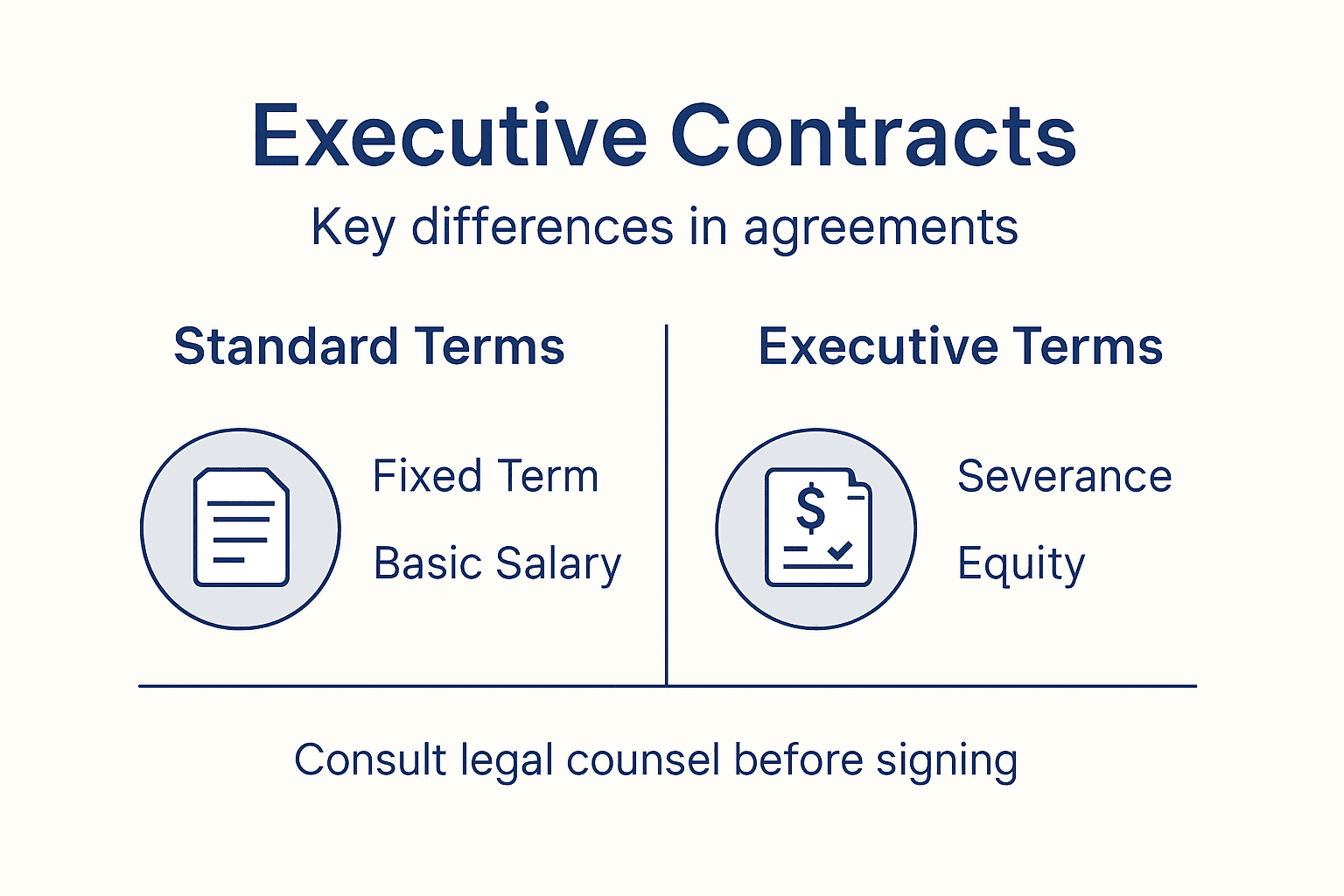
Here is a summary of contract terms distinguishing executive agreements from standard employment contracts:
| Contract Term | Standard Agreement | Executive Agreement |
|---|---|---|
| Negotiation Process | Minimal, standard terms | Highly personalized, complex |
| Compensation Structure | Salary only | Salary, bonuses, equity |
| Risk Management | Basic provisions | Comprehensive risk clauses |
| Customization Level | Generic, one-size-fits-all | Tailored to individual/role |
Pro tip: Always have an experienced employment law attorney review your high-level contract before signing to ensure your professional interests are comprehensively protected.
Key Types of Executive Employment Agreements
Executive employment agreements are sophisticated legal documents that establish comprehensive frameworks for high-level professional relationships. These contracts go beyond standard employment paperwork, addressing complex interactions between senior executives and their organizations through carefully negotiated terms and provisions.
Typical executive agreements include multiple critical components, such as:
- Base Compensation: Detailed salary structures with performance-linked increments
- Bonus Arrangements: Complex incentive packages tied to organizational performance
- Equity Compensation: Stock options, restricted stock units, and long-term incentive plans
- Severance Provisions: Negotiated exit strategies with financial protections
- Non-Compete Clauses: Restrictions on future competitive activities
Recent legal developments have significantly impacted these agreements, particularly regarding non-compete restrictions. Regulatory changes and state-specific legislation now impose more nuanced limitations on traditional non-compete provisions, especially for senior executives who possess critical organizational knowledge.
The complexity of these agreements reflects the strategic importance of top-level executives. Unlike standard employment contracts, executive agreements must balance organizational protection with individual professional autonomy, creating intricate legal instruments that protect both parties’ interests.

Pro tip: Consult an experienced employment law attorney who specializes in executive contracts to ensure comprehensive protection and understanding of every contractual nuance.
2026 California Laws Impacting Employment Contracts
California’s employment landscape is undergoing significant transformations in 2026, introducing comprehensive legal reforms that fundamentally reshape workplace protections and employee rights. These legislative changes represent a sophisticated approach to modernizing labor regulations, with far-reaching implications for both employers and executives across the state.
The most notable developments include landmark changes to non-compete agreements, which dramatically alter traditional employment contract structures. Key legislative modifications include:
- Non-Compete Restrictions: Broad prohibition of restrictive clauses with limited executive exceptions
- Employee Mobility: Enhanced protections supporting professional movement between organizations
- Transparency Requirements: Mandatory employer notifications about workplace rights
- Wage and Classification Standards: Updated minimum wage thresholds for exempt employees
- Immigration Protections: Expanded legal safeguards for workers
Under the Workplace Know Your Rights Act, employers must now provide comprehensive annual notices detailing critical workplace protections. These mandates go beyond traditional employment regulations, requiring extensive employee notifications about rights ranging from labor organizing to workers’ compensation claims.
The legal framework represents a significant shift towards creating more equitable and transparent employment environments. By prioritizing employee mobility and comprehensive rights communication, California is establishing a new standard for workplace legal protections that other states may soon emulate.
Pro tip: Consult an employment law specialist to fully understand how these 2026 legislative changes specifically impact your individual employment contract and professional status.
Common Contract Dispute Scenarios for Executives
Executive employment contracts represent complex legal landscapes fraught with potential conflict zones that require strategic navigation and precise understanding. These high-stakes agreements create intricate frameworks where misunderstandings can quickly escalate into significant professional disputes.
Sophisticated executives frequently encounter contract negotiation challenges involving multiple potential dispute scenarios:
- Performance Interpretation: Disagreements about contractual performance metrics and expectations
- Compensation Conflicts: Disputes over bonus structures, equity compensation, and incentive calculations
- Termination Provisions: Challenges surrounding exit clauses and severance terms
- Confidentiality Breaches: Allegations of proprietary information mishandling
- Breach of Contract: Alleged violations of specific contractual obligations
Government contract disputes demonstrate particularly complex resolution mechanisms. Contract claims processes typically involve structured approaches that prioritize mutual resolution before escalating to formal legal proceedings. These frameworks emphasize negotiation, mediation, and systematic claims certification to minimize protracted litigation.
Understanding these potential conflict zones requires nuanced comprehension of contract language, legal frameworks, and strategic communication. Executives must proactively anticipate potential disputes by carefully drafting comprehensive agreements with clear performance expectations and dispute resolution mechanisms.
Pro tip: Maintain meticulous documentation of all contract-related communications and performance metrics to strengthen your position in potential dispute scenarios.
Legal Rights and Remedies for Executives
Executive employment disputes demand sophisticated legal strategies that protect professional interests while navigating complex workplace dynamics. The landscape of legal remedies offers multiple avenues for executives seeking resolution of contractual conflicts and workplace challenges.
Executives have access to alternative dispute resolution mechanisms that provide nuanced approaches to conflict management:
- Arbitration: Confidential, neutral proceedings outside traditional court systems
- Mediation: Collaborative conflict resolution with mutually negotiated outcomes
- Negotiated Settlements: Direct discussions to resolve contractual disagreements
- Severance Negotiations: Strategic exit strategy discussions
- Legal Claims: Formal proceedings addressing specific contractual violations
Severance agreements represent a critical mechanism for executives facing potential contract termination. Comprehensive severance packages typically encompass complex provisions including salary continuation, benefits preservation, equity considerations, and post-employment restrictions.
Successful legal remedies require strategic preparation, comprehensive documentation, and a nuanced understanding of employment law frameworks. Executives must approach potential disputes with calculated precision, understanding both their contractual obligations and protective legal mechanisms.
The following table compares dispute resolution strategies commonly used by executives and their outcomes:
| Strategy | Approach | Typical Outcome |
|---|---|---|
| Arbitration | Neutral decision-maker | Binding, confidential result |
| Mediation | Collaborative dialogue | Mutually agreed settlement |
| Negotiated Settlement | Direct negotiation | Customized resolution |
| Litigation | Formal court process | Public, often protracted |
Pro tip: Always document every interaction and maintain meticulous records of performance metrics and communications to strengthen your legal position in potential dispute scenarios.
Best Practices to Mitigate Contract Disputes
Mitigating contract disputes requires a proactive and strategic approach that anticipates potential conflicts before they escalate into complex legal challenges. Successful executives understand that prevention is far more efficient than litigation, demanding sophisticated contract management techniques and clear communication strategies.
Executives can implement strategic dispute resolution practices through several key mechanisms:
- Precise Contractual Language: Eliminate ambiguity in contract terms
- Dispute Resolution Clauses: Incorporate mandatory mediation or arbitration provisions
- Performance Metrics: Define clear, measurable expectations
- Documentation Protocols: Maintain comprehensive interaction records
- Periodic Contract Reviews: Regularly assess and update agreements
Effective contract management involves developing comprehensive conflict management systems that prioritize early intervention and collaborative problem-solving. These systems create structured approaches for identifying, addressing, and resolving potential disagreements before they become entrenched legal battles.
Successful mitigation requires a nuanced understanding of both legal frameworks and interpersonal dynamics. Executives must balance assertive protection of their professional interests with a collaborative approach that preserves valuable business relationships.
Pro tip: Develop a systematic approach to contract documentation, creating a comprehensive audit trail that provides clear evidence of performance and communication.
Protect Your Executive Rights in Villa Park with Trusted Legal Experts
Facing complex employment contract disputes as an executive in Villa Park can be overwhelming. Issues like unclear performance metrics, compensation conflicts, or non-compete restrictions threaten your professional security and peace of mind. These challenges demand precise legal guidance that understands the nuances of executive agreements and California’s evolving employment laws.
At Serendib Law Firm, our dedicated team is ready to protect your rights and negotiate terms that defend your interests. Whether dealing with termination provisions or confidentiality clauses, we provide personalized, zealous advocacy tailored for executives. Learn more about how we serve the local community through our Villa Park Archives and explore the full range of employment law services designed to safeguard your professional future.
Do not let contract disputes disrupt your career. Take the first step toward resolution by contacting Serendib Law Firm today. Visit Serendib Law Firm and secure a free consultation to protect your executive employment rights with experienced counsel.
Frequently Asked Questions
What are common contract dispute scenarios for executives?
Executives often face disputes regarding performance interpretation, compensation conflicts, termination provisions, confidentiality breaches, and breaches of contract.
How can executives protect themselves in employment contract negotiations?
Executives can protect themselves by having precise contractual language, incorporating dispute resolution clauses, defining clear performance metrics, maintaining documentation protocols, and conducting periodic contract reviews.
What legal remedies are available for executives involved in contract disputes?
Executives have access to various remedies, including arbitration, mediation, negotiated settlements, severance negotiations, and formal legal claims addressing specific contractual violations.
Why is it important for executives to document interactions related to their employment contracts?
Meticulously documenting interactions and performance metrics strengthens an executive’s position in potential dispute scenarios, ensuring clear evidence and supporting their claims.