Every HR manager and employee advocate in Irvine feels the pressure when new employment laws upend familiar routines. California is making bold moves in 2026, with the Workplace Know Your Rights Act introducing annual workplace rights notices and expanded layoff notification rules that directly affect daily operations. Staying ahead of these changes gives you vital tools to protect workers’ rights, clarify compliance, and strengthen your approach to workplace disputes before challenges escalate.
Table of Contents
- Defining 2026 Employment Law Shifts In Irvine
- Major Legislative Changes Affecting Workplaces
- Pay Transparency, AI Compliance, And New Hiring Rules
- Expanded Employee Rights And Notice Requirements
- Legal Risks, Penalties, And Compliance Priorities
Key Takeaways
| Point | Details |
|---|---|
| Minimum Wage Increase | The minimum wage in California has increased to $16.90, requiring employers to adjust payroll and verify compliance. |
| Workplace Know Your Rights Act | Employers must provide annual notifications detailing workers’ rights, ensuring employees are informed of their protections. |
| Strict Notification for Layoffs | Organizations must adhere to expanded rules on mass layoffs, offering more comprehensive details to employees ahead of time. |
| AI Compliance and Transparency | Employers using AI in hiring must conduct bias audits and disclose information about their decision-making processes to prevent discrimination. |
Defining 2026 Employment Law Shifts in Irvine
California’s employment law landscape is undergoing significant transformation in 2026, and Irvine-based organizations need to understand what’s changing. The state has enacted new transparency and worker protection measures that fundamentally reshape how employers must communicate with their workforce. At the core of these shifts lies the Workplace Know Your Rights Act, which requires employers to provide annual written notice to all employees detailing their fundamental workplace rights. These notifications must cover critical areas including workers’ compensation benefits, immigration-related protections, union organizing rights, and guidance on law enforcement interactions at the workplace. This isn’t a minor administrative requirement. The scope of mandatory disclosures reflects California’s broader commitment to ensuring workers understand their protections from day one.
Beyond individual rights notifications, mass layoff notice rules have expanded significantly in 2026. Organizations planning workforce reductions must comply with stricter notification timelines and more detailed advance warning procedures. If you work in tech, retail, manufacturing, or any sector experiencing restructuring in Irvine, these changes directly impact how your employer must handle any staff reductions. The law now requires employers to provide more comprehensive information about severance, benefits continuation, and employee support resources when announcing layoffs. The enhanced requirements exist because workers need adequate time to prepare for potential job loss, explore other opportunities, and understand their financial protections.
The timing of these shifts matters considerably. Most of these requirements took effect earlier in 2026, meaning employers have already begun implementation. However, many organizations are still in compliance transition phases, and some may not fully understand their obligations. For HR professionals and employee advocates in Irvine, this creates a critical window to ensure your organization meets these standards. If you’re navigating employment disputes related to inadequate rights notices, improper layoff procedures, or retaliation following these new protections, understanding the specific requirements becomes essential for building a strong case.
Pro tip: Request a copy of your employer’s annual workplace rights notice and verify it covers workers’ compensation, immigration protections, union organizing rights, and law enforcement interactions. If your employer hasn’t provided this required notice or it’s incomplete, document the date you requested it and retain all communications, as this information becomes critical if you need to file a complaint regarding inadequate rights disclosure.
Major Legislative Changes Affecting Workplaces
Two significant legislative updates are reshaping how Irvine workplaces operate in 2026. First, the statewide minimum wage has increased to $16.90 per hour, representing a meaningful shift in labor costs and compensation standards across all industries. This increase applies to most employees in California, regardless of company size, and affects everything from part-time retail positions to professional roles. For workers, this translates to higher baseline earnings. For employers, it requires immediate payroll adjustments and compliance verification. But here’s what matters most to you as an employee or advocate: verify that your employer has actually implemented this increase. Many workers aren’t aware the increase occurred, and some employers delay implementation. If you’re earning less than $16.90 per hour in 2026, that’s a red flag worth investigating.
The second major legislative shift centers on the Workplace Know Your Rights Act, which mandates comprehensive annual employee notices covering an extensive range of labor protections. These notices must inform workers about their rights concerning wages, working hours, meal and rest breaks, retaliation protections, paid leave policies, and workers’ compensation coverage. Additionally, employers must now establish clear procedures for emergency contact designation, ensuring employees can identify trusted individuals who’ll receive critical information if something happens at work. These requirements exist because California recognizes that many workers don’t understand their basic protections until a problem arises. By mandating upfront disclosure, the law levels the playing field between employers and workers.

What makes these changes particularly important is the enhanced enforcement framework accompanying them. State agencies have strengthened their mechanisms for investigating complaints and imposing penalties on employers who fail to comply. This means non-compliance now carries real consequences. For workers in Irvine, this creates a stronger foundation for filing complaints if your employer violates these standards. If you haven’t received your annual workplace rights notice or your employer hasn’t implemented the minimum wage increase, document everything. These violations form the basis for legitimate employment law claims.
Pro tip: Maintain records of all wage stubs and compensation documentation from 2026 forward, and keep a copy of any workplace rights notices your employer provides (or a dated record of when you requested one but didn’t receive it). This documentation becomes invaluable if you need to file a wage and hour complaint or prove non-compliance with notification requirements.
Here’s a summary of how major 2026 employment law changes in Irvine affect both employers and employees:
| Legislative Change | Impact on Employers | Impact on Employees |
|---|---|---|
| Minimum Wage Increase | Requires payroll updates, budget review | Raises baseline earnings, prompts wage checks |
| Mass Layoff Notification Expansion | More notice and documentation required | Earlier warning, more severance details |
| Annual Workplace Rights Notice | Must deliver readable, detailed notice | Gains clearer understanding of protections |
| AI Bias Auditing in Hiring | Mandatory bias testing and documentation | Enhanced grounds to challenge unfair rejections |
Pay Transparency, AI Compliance, and New Hiring Rules
Three interconnected trends are reshaping hiring and compensation practices in Irvine during 2026. Pay transparency requirements are expanding, forcing employers to disclose salary ranges upfront in job postings and during recruitment conversations. This shift directly benefits job seekers by eliminating the guessing game around compensation before you invest time in interviews. Irvine-based companies in tech, finance, healthcare, and professional services are all adjusting their hiring processes to comply. For workers, this means you have clearer information earlier in the hiring process to evaluate whether an opportunity aligns with your financial needs and career goals. If an employer refuses to share salary ranges or discourages salary discussions, that’s often a warning sign about their compensation practices.
The second major change involves artificial intelligence and algorithmic decision-making in hiring. Many employers now use AI tools to screen resumes, assess candidate fit, and even predict job performance. The problem? These systems can encode bias from historical hiring data, potentially discriminating against protected groups. That’s why AI compliance now requires bias audits and transparency about how algorithmic systems make employment decisions. Employers must document the purposes of their AI tools, maintain records of vendor agreements, and conduct ongoing bias testing. This means if you believe an AI system rejected your application or promotion unfairly, you now have stronger legal grounds to challenge that decision because employers must prove their systems don’t discriminate.
These compliance obligations create accountability that didn’t exist before. Regulators at both federal and state levels are increasing scrutiny on companies using opaque AI systems for hiring decisions. If you were passed over for a role and suspect discrimination or algorithmic bias played a role, documenting the dates of your applications, the job postings, and any communications about rejection reasons becomes crucial. Ask employers directly what systems they use to evaluate candidates. Request information about how their hiring algorithms work. Many companies are now legally required to disclose this information.
Pro tip: During the interview process, ask employers directly about their use of AI screening tools and whether they conduct bias audits on their hiring systems. Request written confirmation of salary ranges and get all compensation offers in writing before accepting any position. These documented communications protect you if disputes arise later.
Expanded Employee Rights and Notice Requirements
Starting February 1, 2026, California employers face a significant new mandate that fundamentally changes how they communicate with workers. Every employer must provide annual workplace rights notices to all employees, and this isn’t optional or something to ignore. These notices cover seven critical categories that directly impact your job security and work experience. The categories include workers’ compensation benefits, immigration enforcement protections, collective bargaining and union organizing rights, law enforcement workplace interactions, paid leave policies, minimum wage requirements, and retaliation protections. What makes this requirement powerful is that employers must ensure these notices are understandable and delivered through standard communication methods. This means your employer cannot hide behind overly complex legal language or bury the notice in employee handbooks where you’ll never find it.
The timing of these notices matters considerably for your protection. Since the requirement took effect in early 2026, your employer should have already provided this notice. If you haven’t received one, that’s a compliance failure you need to document. Request the notice in writing, and keep records of your request and any responses you receive. These notices serve as your baseline reference for understanding your rights. If your employer later takes action against you for exercising rights described in that notice (like union organizing or reporting wage violations), that retaliation claim becomes much stronger when the employer previously acknowledged those rights.
Beyond the initial notice, employers must maintain ongoing communication about rights changes. California continues adding new protections and modifying existing ones, and workers deserve to know when their rights expand. For Irvine-based employees, this creates a paper trail that protects you. If your employer claims you didn’t know about a specific right, you can reference the required notices they were obligated to provide. The law recognizes that knowledge is power, and by mandating these notices, California is giving workers the information needed to advocate for themselves. If you’re facing a workplace dispute and your employer never provided the required notice, that failure becomes relevant evidence in any complaint you file.
Pro tip: Request your annual workplace rights notice in writing from your HR department and save it in a secure location. If your employer refuses to provide it or claims it wasn’t required, document that refusal in writing. When disputes arise later, having proof that your employer failed to provide mandated notices strengthens your legal position significantly.
Use this quick reference to identify which employment compliance topics to track in Irvine for 2026:
| Compliance Topic | What to Document | Why It Matters |
|---|---|---|
| Wage and Hour Compliance | Pay stubs, work hours, wage rates | Proves legal wage and overtime status |
| Workplace Rights Notices | Written notices, request dates | Demonstrates employer’s disclosure efforts |
| AI in Hiring | Tool details, bias audits, agreements | Evidence for claims of algorithmic bias |
| Layoff Procedures | Warning letters, severance info | Supports cases for improper layoff |
Legal Risks, Penalties, and Compliance Priorities
The convergence of new employment laws in 2026 creates substantial legal exposure for organizations that fail to comply. The stakes are higher than ever because enforcement agencies are paying closer attention to employer conduct. The Equal Employment Opportunity Commission (EEOC), California Department of Fair Employment and Housing (DFEH), and state labor enforcement divisions have all increased their scrutiny of workplace practices. When employers cut corners on compliance, they face significant financial penalties, litigation costs, and reputational damage. For workers, this means regulatory agencies are more likely to take your complaints seriously and investigate thoroughly when violations occur.
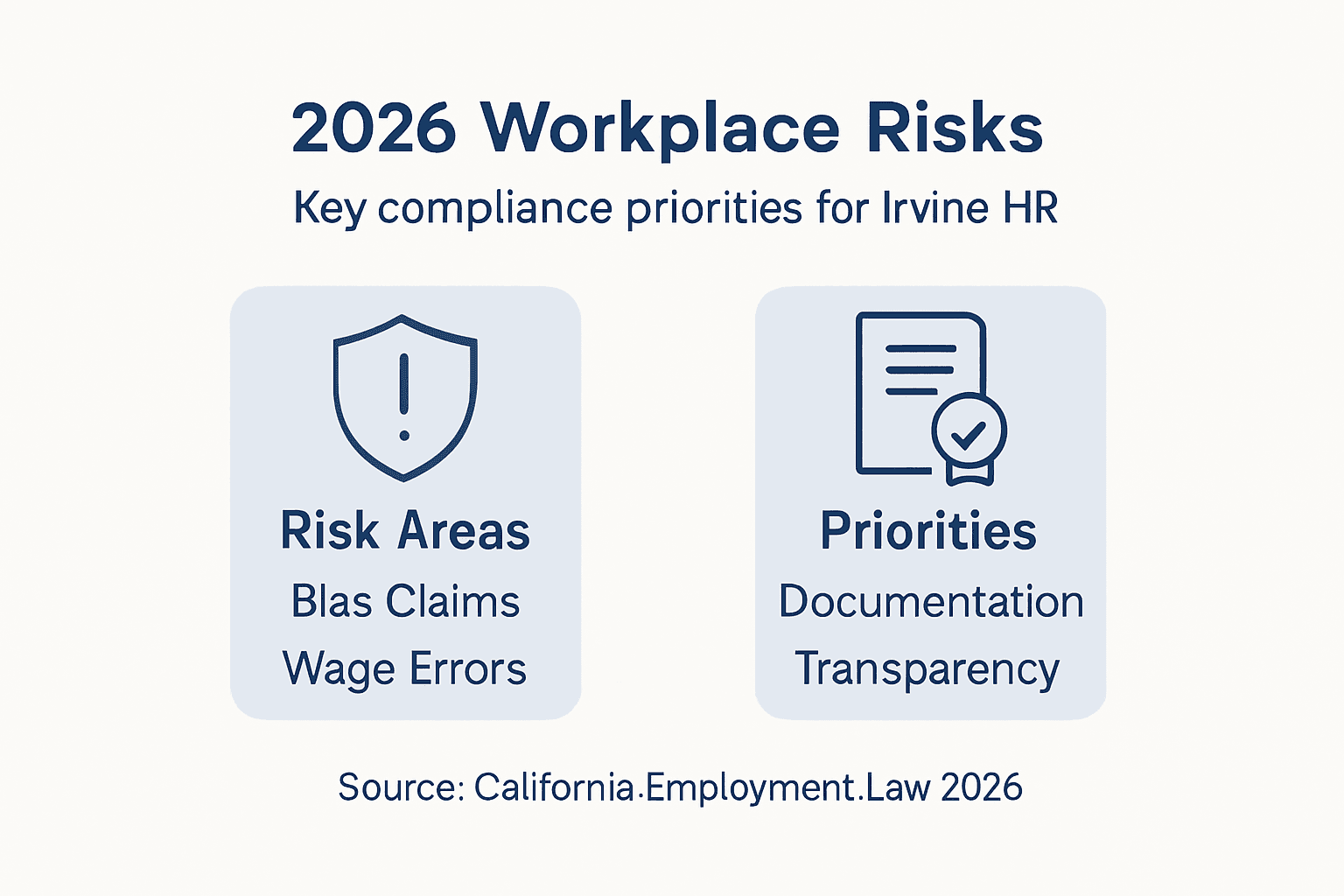
One of the biggest risk areas involves discrimination and bias in employment decisions. Strengthened enforcement from agencies like the EEOC focuses heavily on discrimination, pay transparency, and wage and hour compliance. If an employer uses AI systems to make hiring or promotion decisions without properly auditing those systems for bias, they expose themselves to discrimination claims. Pay equity violations have become a particular focus area. If you discover you’re paid less than colleagues performing similar work, and that disparity correlates with your protected characteristics (gender, race, age, disability), you have grounds for a claim. Documentation becomes critical. Employers must maintain thorough records proving their employment decisions were based on legitimate, non-discriminatory factors.
Wage and hour violations represent another major exposure area. Misclassifying employees as independent contractors, failing to pay overtime, not providing required meal breaks, or underpaying workers now invites rapid regulatory response. The minimum wage increase to $16.90 means many employers had to adjust payroll systems, and some undoubtedly made errors. If you suspect wage violations, calculate your hours carefully and compare your pay to legal requirements. Keep detailed records of your work schedule, tasks performed, and compensation received. These records become evidence if you need to file a wage claim.
The compliance priority for all organizations should be documentation and transparency. Employers need written policies explaining employment decisions, hiring criteria, promotion procedures, and compensation decisions. They need to show they conducted bias audits on any AI systems. They need to prove they provided required notices and maintained accurate records. For workers, understanding these compliance requirements gives you insight into what legitimate complaints look like and how to build your case. If you’re facing potential retaliation or wrongful treatment, remember that violations become easier to prove when employers failed basic compliance obligations.
Pro tip: If you believe you’re experiencing wage and hour violations, discrimination, or retaliation, request copies of your personnel file, performance evaluations, and employment contract in writing. Document all communications with your employer about employment decisions, compensation changes, or disciplinary actions. The more comprehensive your documentation, the stronger your position if you need to file a complaint or pursue legal action.
Navigate 2026 Employment Law Changes with Confidence
Facing evolving employment laws around wage increases, AI hiring compliance, and mandatory workplace rights notices can feel overwhelming. The article highlighted critical challenges like the Workplace Know Your Rights Act and expanded layoff notification rules that impact both employers and employees in Irvine. If you are concerned about wage violations, transparency in hiring, or protecting your rights against retaliation, understanding these complex regulations is key to safeguarding your future.
At Serendib Law Firm, we provide expert guidance tailored to California’s latest employment laws. Whether you need help interpreting the new mandates or require strong representation in workplace disputes, our team is ready to advocate for you. Gain clarity and peace of mind by exploring our California Employment Law Archives | Serendib Law Firm or learn more about addressing specific Wage Violations Archives | Serendib Law Firm concerns. Don’t wait until a violation affects your livelihood. Take action now by visiting Serendib Law Firm to schedule your free consultation and protect your legal rights in this rapidly changing workplace environment.
Frequently Asked Questions
What are the key changes in employment law in Irvine for 2026?
The key changes include the implementation of the Workplace Know Your Rights Act, an increase in the minimum wage to $16.90 per hour, and expanded mass layoff notification requirements. Employers must now provide annual notices detailing employee rights, and compliance is being more strictly enforced by state agencies.
How will the minimum wage increase affect employers in Irvine?
Employers must adjust their payroll systems to comply with the new minimum wage of $16.90 per hour. Failure to implement this increase can lead to legal repercussions. It’s essential for employees to verify that they are being paid the correct amount according to this new wage standard.
What should employees do if they haven’t received their workplace rights notice?
Employees should request a copy of their annual workplace rights notice from their HR department in writing. If the notice is not provided or is incomplete, it’s crucial to document the request and any responses received, as this information may be necessary for filing a complaint.
How can workers protect themselves against workplace violations in 2026?
Workers can protect themselves by maintaining detailed records of their pay stubs, hours worked, and any correspondence regarding their rights. They should also be aware of their protections under the new laws and documentation of any rights violations to strengthen their position in case of disputes.