
TL;DR:
- Many Tustin employees are unaware that California’s reimbursement laws differ for public and private employers, affecting their legal options. Private sector workers can rely on Labor Code 2802 to recover necessary work expenses, while public employees must seek alternative remedies due to legal limitations. Proper documentation, early action, and employer classification verification are crucial to effectively resolving reimbursement disputes.
Not every Tustin employee is protected by the same reimbursement laws, and that single fact catches thousands of California workers off guard every year. You might drive your personal car to a client site, pay for work supplies out of pocket, or cover your own cell phone bill for work calls, only to have your employer refuse repayment. What you do next depends heavily on who your employer actually is. As one critical edge case to keep in mind: Labor Code 2802 does not apply to public employers, meaning your legal strategy must shift based on your employer’s classification. This article walks you through your rights, how to spot the differences that matter, and exactly what steps to take.
Table of Contents
- Understanding expense reimbursement rights in Tustin
- Key differences: Public vs. private employers in reimbursement disputes
- Recognizing and documenting expense reimbursement disputes
- Legal remedies and resolution strategies for Tustin employees
- What most employees overlook (and why it matters in Tustin)
- Connect with expert support for your reimbursement dispute
- Frequently asked questions
Key Takeaways
| Point | Details |
|---|---|
| Check employer status | Your rights depend on whether your employer is public or private in Tustin. |
| Document every dispute | Detailed records and communication are crucial for any reimbursement claim. |
| Know your remedies | Resolution steps and legal protections vary for public versus private employees. |
| Seek legal guidance | Expert advice can help you avoid mistakes and speed up resolution. |
Understanding expense reimbursement rights in Tustin
California has one of the strongest worker protection frameworks in the country, and expense reimbursement is a big piece of that. For most private sector employees in Tustin, the legal foundation is California Labor Code Section 2802. This law requires your employer to reimburse you for all necessary expenditures or losses you incur while performing your job duties. It is not optional. It is not a favor. It is a legal obligation.
Labor Code 2802 is the main California law requiring private employers to reimburse employees for necessary work expenses, but public employers are often treated differently under this statute. That distinction matters a lot in a city like Tustin, which has both a large private sector workforce and a number of public agencies, school districts, and government offices employing local residents.
So what exactly counts as a reimbursable expense? Common examples include:
- Mileage and fuel costs for work-related driving in your personal vehicle
- Home office supplies purchased for remote work
- Cell phone and internet bills when your employer requires work use
- Work-related software subscriptions or app purchases
- Uniforms or equipment your employer mandates but does not provide
- Meals and travel costs incurred during business trips
The standard is “necessary and reasonable.” If your employer required or benefited from the expense, there is a strong argument it qualifies. If your manager at a Tustin-based retail chain like Target asked you to use your personal phone for shift communications, that data and call usage could be reimbursable.
“The law does not require perfection in how you track expenses, but it does require your employer to have a system that accounts for them fairly.” Understanding this principle helps you identify when your employer is falling short.
For Tustin employees in the private sector, you can connect with Tustin employment law help to understand how your specific expenses stack up against the legal standard. Workers in retail environments, including those at major employers, should also review their retail worker rights for context on how reimbursement policies commonly play out at large chains.
Key differences: Public vs. private employers in reimbursement disputes
This is where many Tustin employees make costly assumptions. People tend to think that if a law exists in California, it applies to every employer in the state. That is not how it works with Labor Code 2802.
A California Court of Appeal ruled that Labor Code 2802 does not apply to public employers. That means if you work for the City of Tustin, a county agency, a public school district like Tustin Unified School District, or a state agency operating in the area, you cannot rely on Labor Code 2802 to force reimbursement. You need to look at other rules, collective bargaining agreements, or separate public employment laws.
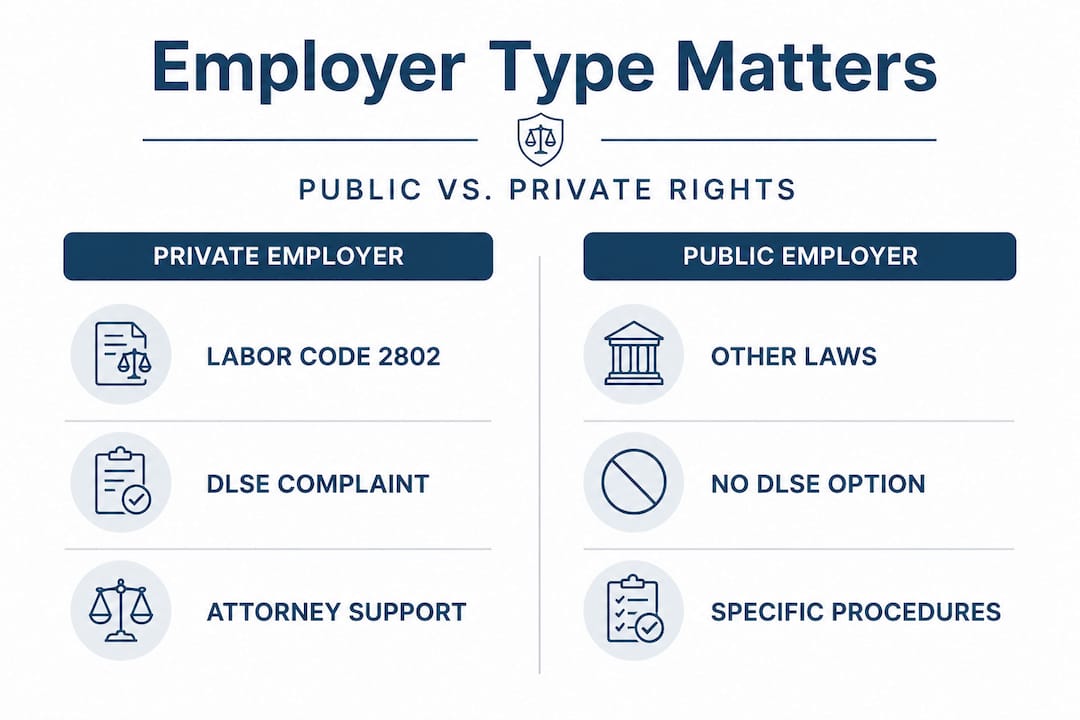
Here is a direct comparison of how your rights differ:
| Factor | Private employer | Public employer |
|---|---|---|
| Labor Code 2802 applies? | Yes | No |
| Can file DLSE wage claim? | Yes | Generally no |
| Must check union contract? | Sometimes | Often required |
| Civil lawsuit option? | Yes, under LC 2802 | Limited; other laws may apply |
| Retaliation protections? | Yes, under LC 2802 | Varies by agency |
The practical impact is significant. If you work for a private Tustin company, say, a tech startup, a law firm, or a local restaurant group, you have a clear statutory right and a clear enforcement path. If you work for a public entity, your situation requires a different strategy from day one.
Pro Tip: Before you file a complaint or even send a strongly worded email to HR, confirm whether your employer is a public or private entity. Look at your pay stub, check if your employer is listed in any city, county, or state database, or ask HR directly. Getting this wrong means choosing the wrong legal strategy and potentially losing time.
For employees who do speak up and face pushback, knowing your retaliation protections is critical. Retaliation for asserting your reimbursement rights is itself illegal under California law for private sector workers. If you need broader context on workplace rights in Tustin, exploring general workplace legal advice gives you a clearer picture of what protections layer on top of each other.
Recognizing and documenting expense reimbursement disputes
A dispute often begins quietly. Your first reimbursement request gets delayed. Then it gets partially denied. Then HR says your expense was “not pre-approved” or “not within policy,” even though your manager verbally told you it was fine. That pattern is a warning sign.
The moment you sense that your employer is not going to repay you fairly, you need to start building a record. Here is how to approach it step by step:
- Write down every expense in detail. Include the date, purpose, amount, and how it connects to your work duties. A mileage log, for example, should show the destination, the business reason, and the miles driven.
- Gather receipts and bank statements. If you submitted a receipt and it was denied, keep a copy. Digital records stored in a personal email or cloud account are especially useful since you will always have access even if you leave the company.
- Document all communications. Save emails, text messages, or any written policies that refer to expense reimbursement. If your manager approved an expense verbally, follow up in writing with a simple email that summarizes the conversation.
- Submit formal written requests. Do not just bring it up at a meeting. Send a written request to your HR department or manager outlining the specific expenses you are owed and the dates you incurred them.
- Track your employer’s responses. Keep a timeline. If HR says they will “look into it” and then goes silent for three weeks, that pattern matters.
It is also critical to confirm employer status before choosing a dispute strategy, because public entity employees cannot rely on Labor Code 2802 and must pursue entirely different channels.
Pro Tip: If you use personal tools, apps, or devices for work, start tracking that usage now, even before a dispute arises. A simple spreadsheet showing monthly work-related cell phone or internet usage builds a compelling paper trail with almost no extra effort.
Be aware that if you assert your rights and your employer starts treating you differently, reducing your hours, passing you over for promotions, or creating a hostile atmosphere, that could be workplace retaliation. California law prohibits this, and documenting the timing of any changes in your treatment is just as important as documenting the expenses themselves.
Legal remedies and resolution strategies for Tustin employees
Once you have built your record, your options open up. The right path depends on whether you work for a private or public employer, but there are clear channels for both.

| Resolution path | Who it applies to | Notes |
|---|---|---|
| California DLSE wage claim | Private employees | Free to file; covers unpaid wages including reimbursements |
| Civil lawsuit under LC 2802 | Private employees | Can recover expenses plus interest and attorney fees |
| Union grievance | Public or unionized private | Requires active union and valid contract language |
| Government agency complaint | Public employees | Depends on the specific agency and applicable rules |
| Internal HR escalation | All employees | Always a smart first step before formal action |
For private sector workers in Tustin, Labor Code 2802 gives you real teeth. You can file a wage claim with California’s Division of Labor Standards Enforcement (DLSE), also known as the Labor Commissioner’s Office. If your employer owes you money for business expenses, you can potentially recover not just the reimbursement amount but also interest and attorney fees in some situations.
“The DLSE process is designed to be accessible to employees who may not have a lawyer, but having legal guidance can significantly improve your outcome.”
For public employees, the situation is more complex. Labor Code 2802 does not provide remedies for public employees, so different rules apply. You may need to rely on your collective bargaining agreement if you are in a union, file a grievance through your agency’s internal process, or explore whether other state or local statutes apply to your situation.
Key protections to know regardless of your employer type:
- Retaliation for asserting reimbursement rights is prohibited for private employees
- Internal complaints should always be followed by a written record
- Statutes of limitations do apply to reimbursement claims, so the timing of your action matters. An attorney can help you evaluate the applicable deadlines for your specific case.
If you believe your dispute connects to broader workplace harassment or targeting based on your protected status, those claims may layer on top of a reimbursement dispute and strengthen your overall legal position. Similarly, if your employer has retaliated against you already, connecting with a retaliation attorney in Orange County can help you evaluate your full set of options.
What most employees overlook (and why it matters in Tustin)
Here is the uncomfortable truth we see again and again: employees waste months pursuing the wrong legal path because they assumed their employer was covered by Labor Code 2802 when it was not. A teacher at a Tustin Unified school or a clerk at a county office spends time gathering documents, drafts a complaint, and then discovers that the main statute does not even apply to their situation.
This is not a fringe problem. Tustin sits in Orange County, which has a significant mix of public agencies, school systems, and private businesses operating side by side. The assumption that “California protects all employees equally” is true in spirit but not always in practice.
The other major oversight is delay. Some employees sit on a reimbursement dispute for months, hoping it resolves itself or wanting to avoid conflict. The longer you wait, the harder it becomes to gather fresh evidence, and the closer you get to applicable legal deadlines that can limit or eliminate your ability to recover.
The contrarian insight here: the dispute that seems hardest to win is often the one that resolves fastest with proper early action. Employers, especially private companies worried about DLSE investigations or civil liability, often pay up quickly once they realize the employee has documentation and legal backing.
Always confirm employer status before committing to a legal strategy, and consult with an attorney early rather than late. Getting Tustin legal guidance at the beginning of a dispute, not after months of back and forth, is almost always the faster and less expensive path.
Connect with expert support for your reimbursement dispute
With the legal nuances now clear, the most important next step is getting personalized guidance for your situation. Reimbursement disputes vary widely based on your employer, the type of expenses involved, and how far along the dispute has already progressed. Our team at Serendib Law works with employees across Orange County, including Tustin, to evaluate reimbursement claims, identify the right legal path, and advocate assertively on your behalf. Whether your employer is a private business or a public agency, we can help you understand your options. Reach out to our Lake Forest employment law attorneys or connect directly with our Tustin employment law experts for a free consultation today.
Frequently asked questions
Does California Labor Code 2802 always apply to Tustin companies?
Labor Code 2802 does not apply to public employers in Tustin, so public entity employees cannot use it to pursue reimbursement claims and must explore other legal avenues.
How do I know if my Tustin employer is public or private?
Check your pay stub for any government agency name, look your employer up in a city, county, or state business database, or ask HR directly. Confirming employer status before taking action prevents you from pursuing the wrong legal remedy.
What should I do first if my reimbursement is denied?
Gather all documentation related to the denied expense, including receipts, emails, and any written policies, and then submit a formal written reimbursement request to HR or your manager so there is a clear paper trail.
Can my employer retaliate if I complain about expense reimbursement?
Retaliation against private employees for asserting their reimbursement rights is illegal under California law, and any adverse action following a complaint should be documented and reviewed by an employment attorney immediately.