
FMLA leave rights in Anaheim, CA entitle qualifying employees to up to 12 weeks of unpaid, job-protected leave per year for serious health conditions, childbirth, family caregiving, or military exigencies, with continued group health insurance throughout. California employees benefit from an additional layer of protection through the California Family Rights Act (CFRA), which often covers workers whose employers are too small to trigger federal FMLA obligations. Understanding both laws is the difference between confidently taking the leave you need and unknowingly forfeiting rights that are already yours.
What are the FMLA leave rights and eligibility requirements in Anaheim, CA?
Federal FMLA eligibility requires three conditions: you must have worked for your employer for at least 12 months, logged at least 1,250 hours worked in the past 12 months, and your employer must have 50 or more employees within 75 miles of your worksite. That 1,250-hour threshold works out to roughly 24 hours per week over a full year. Paid time off and holidays do not count toward this total. Only actual hours worked apply.
For many Anaheim workers, especially those employed at smaller businesses in the service, hospitality, and healthcare sectors, the federal 50-employee threshold is the sticking point. This is where California law steps in decisively. CFRA covers employers with just 5 or more employees, meaning a worker at a 20-person restaurant or a 30-person medical office in Anaheim may still qualify for job-protected leave under state law even if federal FMLA does not apply.

Remote workers present a specific nuance. Your worksite for eligibility purposes is the office to which you report or from which your work is assigned, not your home address. If that office has fewer than 50 employees within 75 miles, you may not meet the federal threshold even if your company employs thousands nationwide. CFRA’s 5-employee rule makes this far less of an obstacle for California employees.
Pro Tip: Before requesting leave, ask your HR department directly how many employees work within 75 miles of your assigned worksite. This single number determines whether federal FMLA, CFRA, or both apply to your situation.
What job protections and health benefits does FMLA guarantee?
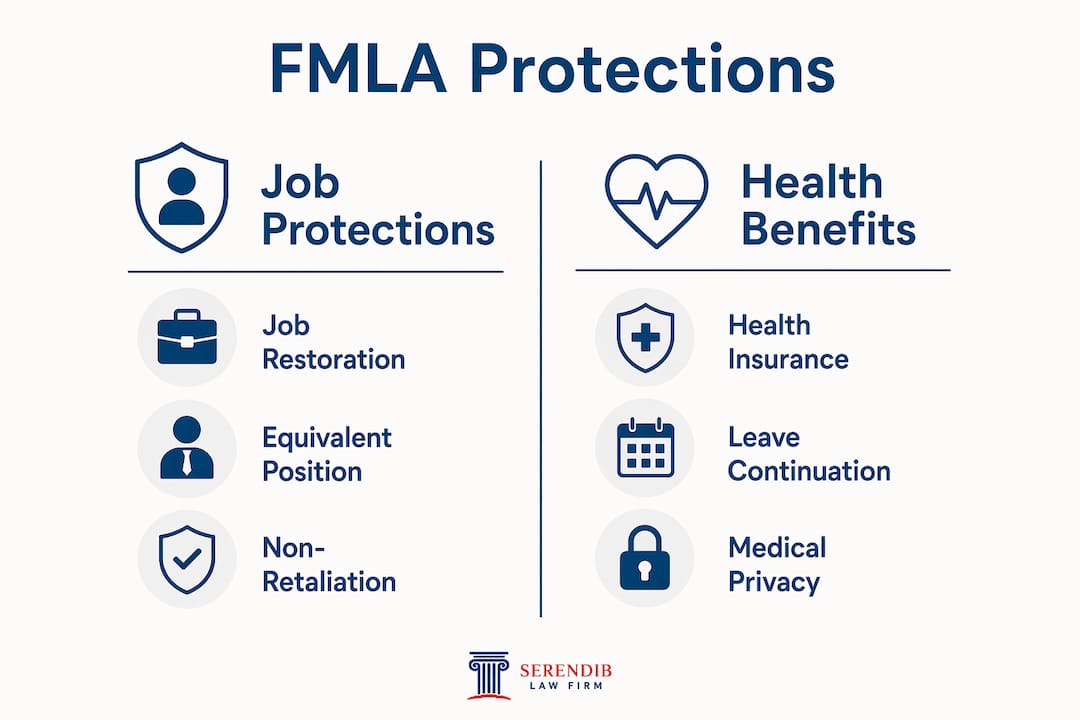
The right to return to work is the backbone of FMLA. After leave, your employer must restore you to your original or an equivalent position with the same pay, benefits, shift schedule, and working conditions. An equivalent position is not a lesser title with a vague promise of similar duties. It must be at the same or a geographically proximate worksite, carry the same compensation structure, and offer no reduction in seniority or benefits.
Employers also must maintain group health insurance during your leave under the exact same terms as if you were actively working. If your employer covers 80% of your premium while you work, that same split applies during your leave. You may be required to continue paying your share of premiums, but your employer cannot drop your coverage simply because you are on leave.
Two important limits exist within these protections:
- The key employee exception: Employers may deny reinstatement to a salaried employee who is among the highest-paid 10% of the workforce if restoration would cause substantial and grievous economic injury to the business. This exception is narrowly applied. Employers must notify you of your key employee status before or at the start of your leave.
- The ADA overlap: Once you return from FMLA leave, any ongoing medical issues may shift from FMLA protections to reasonable accommodation obligations under the Americans with Disabilities Act. These are separate legal frameworks with different standards, and understanding which applies to your situation matters significantly.
| Protection | What it means for you |
|---|---|
| Job restoration | Return to same or equivalent role with equal pay and benefits |
| Health insurance | Employer maintains coverage under same terms during leave |
| Key employee exception | Applies only to top 10% salaried earners; employer must notify you upfront |
| ADA accommodation | Post-leave medical needs may trigger separate reasonable accommodation rights |
Pro Tip: If your employer offers you a different position upon return, compare every detail in writing: title, pay, location, schedule, and benefits. A lateral-sounding move that changes your shift or commute may still violate your reinstatement rights.
How do FMLA, CFRA, and California’s Paid Family Leave work together in Anaheim?
California employees benefit from what legal practitioners call a stacked leave system. Federal FMLA, state CFRA, and California’s Paid Family Leave (PFL) program each serve a distinct function, and California employees uniquely benefit from using them in combination.
Here is how each program works:
- FMLA: Up to 12 weeks of unpaid, job-protected leave for eligible employees at covered employers. No wage replacement.
- CFRA: Mirrors FMLA in most respects but covers employers with 5 or more employees. Provides job protection for bonding leave, caregiving, and serious health conditions.
- PFL: Up to 8 weeks of partial wage replacement through California’s State Disability Insurance program. Pays approximately 60 to 70 percent of your weekly wages. Critically, PFL does not guarantee job protection on its own.
The practical power for Anaheim employees is in combining these programs. When FMLA and CFRA run concurrently, you receive job protection. When you layer PFL on top, you receive partial income during that same period. Many employees at larger Anaheim employers, including those in the healthcare, tourism, and retail sectors, qualify for all three simultaneously.
The gap to watch: if your employer has between 5 and 49 employees, CFRA protects your job but federal FMLA does not apply. PFL still provides wage replacement. Knowing this distinction prevents you from mistakenly believing you have no job protection at a smaller employer.
What employer violations put Anaheim employees at risk during FMLA leave?
Employers face liability not only for outright denying leave but also for interference and retaliation during and after approved leave. These violations are often subtle, which makes them harder to recognize and easier for employers to deny.
Common forms of illegal interference and retaliation include:
- Denying or delaying a leave request without a legitimate legal basis
- Contacting you excessively during leave with work demands or pressure
- Assigning a heavier workload upon your return as a form of punishment
- Demoting you, cutting your hours, or changing your schedule after leave
- Excluding you from meetings, promotions, or projects because you took leave
- Issuing negative performance reviews that reference your leave as a factor
Subtle workplace practices around FMLA leave, including communication tone and workload changes, are now leading sources of employment litigation. An Anaheim employee who returns from maternity leave to find her client accounts reassigned, or a warehouse worker whose shift is changed after a medical leave, may have a valid retaliation claim even if no one said anything explicitly negative about the leave itself.
If you believe your employer has violated your rights, you can review FMLA and CFRA violations and how they are handled in California. You can also file a complaint with the U.S. Department of Labor’s Wage and Hour Division or the California Civil Rights Department. Applicable statutes of limitations govern how long you have to act, and those deadlines should be evaluated on a case-by-case basis with an attorney.
Pro Tip: Start a private log the day your leave begins. Record every work-related contact, every email, and every conversation with HR or management. Courts rely on documentation timelines when evaluating reinstatement and retaliation claims.
How can Anaheim employees apply for FMLA leave and protect their rights?
Applying for FMLA leave is a process with specific steps, and skipping any one of them can create complications. Here is how to do it correctly:
- Give notice as early as possible. For foreseeable leave, provide at least 30 days’ notice. For unexpected situations, notify your employer as soon as practicable, typically the same or next business day.
- Submit a written request. Verbal notice is legally sufficient, but written notice creates a record. Email your HR department and keep a copy.
- Obtain and complete medical certification. Your employer can require a medical certification form completed by your healthcare provider. You generally have 15 calendar days to return it.
- Keep copies of everything. Store copies of your leave request, the certification, any employer responses, and all related correspondence. Treat this paperwork as crucial evidence.
- Clarify your return date. Before you return, confirm whether your employer requires a fitness-for-duty certification. If they do, this must have been communicated to you when your leave was approved.
- Follow up in writing. If your employer fails to respond to your leave request or raises unexpected objections, document your follow-up attempts and the responses you receive.
You can review your broader California employment law rights to understand how FMLA fits within the full spectrum of protections available to you as a worker in Anaheim.
Pro Tip: Never assume your employer has designated your leave as FMLA-protected. Ask for written confirmation that your leave has been approved and designated under FMLA or CFRA. Without that confirmation, disputes about leave status become much harder to resolve.
Key takeaways
FMLA leave rights in Anaheim, CA protect your job, your health insurance, and your income through a combination of federal FMLA, California CFRA, and Paid Family Leave that most employees can use simultaneously.
| Point | Details |
|---|---|
| Federal FMLA eligibility | Requires 12 months employment, 1,250 actual hours worked, and employer with 50+ employees within 75 miles. |
| CFRA expands coverage | California’s CFRA covers employers with 5+ employees, protecting many Anaheim workers federal FMLA excludes. |
| Job restoration rights | Employers must return you to the same or equivalent position with equal pay, benefits, and conditions. |
| Stacked leave programs | FMLA, CFRA, and PFL can run concurrently, combining job protection with partial wage replacement. |
| Documentation is critical | Courts rely on leave paperwork timelines to resolve reinstatement and retaliation disputes. |
What I’ve seen working with Anaheim employees on leave disputes
Working with employees across Orange County, including many in Anaheim, the most consistent pattern I see is this: employees who document everything fare far better than those who trusted verbal assurances. An employer who says “don’t worry, your job is safe” and then restructures your role while you are on leave is not an unusual story. It is a common one.
Anaheim’s workforce is genuinely diverse. You have large hospitality employers like Disneyland Resort and the Anaheim Convention Center, mid-size healthcare networks, and hundreds of small businesses that fall under CFRA but not federal FMLA. The legal protections available to you depend entirely on which category your employer falls into, and many employees do not find out until after a dispute arises.
My practical advice: treat your leave request like a legal filing from day one. Written notice, written confirmation, written follow-up. If your employer contacts you excessively during leave or changes your role upon return, those facts matter in court. If you face medical leave retaliation or a denial of reinstatement, the documentation you kept is often the difference between a strong claim and a difficult one. Do not wait to consult an attorney. Statutes of limitations apply, and early advice costs far less than a missed deadline.
How Serendib law helps Anaheim employees protect their leave rights
If your employer denied your leave request, changed your job after you returned, or made your workplace hostile because you took protected leave, you have legal options. Serendib law’s Anaheim employment law attorneys represent employees facing FMLA and CFRA violations, including wrongful denial of leave, retaliation, and unlawful job changes after reinstatement. The firm handles cases across Orange County with free consultations and contingency-based representation available in qualifying cases. You can also explore the full range of California employment law claims to understand where your situation fits. Contact Serendib law today to get a personalized evaluation of your rights before any filing deadline passes.
FAQ
What qualifies as a serious health condition under FMLA?
A serious health condition includes illnesses, injuries, or impairments requiring inpatient care or continuing treatment by a healthcare provider. Conditions like cancer, severe back injuries, pregnancy complications, and chronic conditions such as diabetes or asthma typically qualify.
Can my employer contact me while I am on FMLA leave?
Occasional contact is permitted, but excessive calls, emails, or work demands during approved leave can constitute illegal interference. If your employer is pressuring you to work or return early, document every contact and consult an employment attorney.
Does FMLA leave have to be taken all at once?
No. FMLA leave can be taken intermittently or on a reduced schedule when medically necessary. For example, you can take one day per week for chemotherapy treatments or a few hours at a time for recurring medical appointments.
What happens if my employer eliminates my position while I am on leave?
If your position was eliminated for legitimate business reasons unrelated to your leave, reinstatement to that exact role is not required. However, your employer must still offer an equivalent position. If the elimination was connected to your leave, that is likely illegal retaliation.
How does California’s CFRA differ from federal FMLA for Anaheim employees?
CFRA covers employers with 5 or more employees, compared to FMLA’s 50-employee threshold, giving far more Anaheim workers access to job-protected leave. CFRA also covers additional family relationships and does not run concurrently with pregnancy disability leave in all circumstances, offering broader protections in specific situations.