
If you work in Fullerton and something has gone seriously wrong at your job, whether it’s a hostile work environment, a manager who crosses the line, or a termination that felt completely unjust, you are not alone and you are not without options. California offers some of the strongest employee protections in the country, but those protections only work if you know how to use them. The process involves specific agencies, procedural steps, and timing considerations that can make or break your claim before you ever set foot in a courtroom.
Table of Contents
- Key takeaways
- California employment laws protecting Fullerton employees
- The administrative process for workplace claims in Fullerton
- Managing deadlines for employment claims
- Your options after receiving a Right-to-Sue notice
- My honest take on what I see employees get wrong
- How Serendib law helps Fullerton employees fight back
- FAQ
Key takeaways
| Point | Details |
|---|---|
| State law covers you broadly | California’s FEHA protects Fullerton employees from discrimination, harassment, and retaliation across many protected categories. |
| Administrative steps come first | Filing with the CRD and obtaining a Right-to-Sue notice is required before you can sue under FEHA. |
| Dual-track filings protect you | Pursuing state CRD and federal EEOC claims simultaneously preserves more legal options. |
| Deadlines are unforgiving | Missing filing windows with the CRD or EEOC can permanently end your ability to pursue a claim. |
| Early legal help makes a difference | Consulting an employment attorney promptly helps you avoid procedural mistakes that cost you your case. |
California employment laws protecting Fullerton employees
The legal framework protecting workers in Fullerton operates on two levels: state law and federal law. Understanding both gives you a clearer picture of what your employer is actually prohibited from doing.
At the state level, the Fair Employment and Housing Act, commonly called FEHA, is the primary law protecting California employees from workplace discrimination, harassment, and retaliation. FEHA applies to employers with five or more employees for discrimination claims and one or more employees for harassment claims. That coverage is broader than most federal laws, which means more Fullerton workers are protected.
FEHA covers a wide range of protected categories, including:
- Race, color, and national origin
- Sex, gender identity, and gender expression
- Sexual orientation
- Religion
- Disability, both physical and mental
- Age (40 and over)
- Pregnancy and related conditions
- Medical condition and genetic information
- Marital status and military or veteran status
At the federal level, laws like Title VII of the Civil Rights Act, the Americans with Disabilities Act (ADA), the Age Discrimination in Employment Act (ADEA), and the Equal Pay Act are enforced by the Equal Employment Opportunity Commission (EEOC). These laws overlap with FEHA in many areas, but the remedies and procedures differ.
Here is a practical example. If you work at a distribution warehouse in Fullerton and your supervisor repeatedly makes demeaning comments about your religion, and HR dismisses your complaint, that conduct likely violates both FEHA and Title VII. You have legal avenues under both state and federal law. The key is knowing which agency to contact and in what order.
Pro Tip: If your employer has fewer than 15 employees, federal law may not apply, but California’s FEHA still covers you in most situations. Do not assume you have no claim just because your workplace is small.
The administrative process for workplace claims in Fullerton
Before you can file a lawsuit under FEHA, you must go through a required administrative process. This step is called administrative exhaustion, and it is not optional. Skipping it means your case gets dismissed regardless of how strong your underlying claim is.

The administrative exhaustion requirement acts as a procedural gatekeeper for FEHA claims. Courts will not hear your case without it.
Here is how the process works, step by step:
- File a complaint with the California Civil Rights Department (CRD). The CRD, formerly known as the Department of Fair Employment and Housing (DFEH), is the state agency that handles FEHA complaints. You can file online, by mail, or by phone.
- Request a Right-to-Sue notice. This document is what gives you permission to file a lawsuit. You have two options here: request it immediately or wait for the CRD to investigate your complaint first.
- Choose your path: immediate notice or investigation. Requesting immediate Right-to-Sue typically results in the notice being issued within 24 hours, but it eliminates any chance of the agency investigating or resolving your complaint on your behalf.
- File your lawsuit within the applicable period. Once you receive the Right-to-Sue notice, you have a limited window to file in Superior Court. FEHA claims must be filed within one year of the Right-to-Sue notice date under Government Code § 12965©(1)©. Missing this window is fatal to your claim.
- Consider a parallel EEOC charge. If federal claims apply, you should also file with the EEOC. Because California is a deferral state, you generally have more time to file a federal charge than employees in states without a parallel state agency.
The table below compares the two Right-to-Sue paths:
| Path | Timeline | Trade-off |
|---|---|---|
| Immediate Right-to-Sue | Notice issued within 24 hours | No agency investigation; you proceed directly to litigation |
| Investigation pathway | Weeks to months for CRD review | Agency may resolve the dispute, but delays your lawsuit timeline |
Most represented employees choose the immediate Right-to-Sue route because it opens the door to Superior Court litigation, where broader remedies are available.
Pro Tip: Even if you are not sure whether your situation rises to the level of a legal claim, filing with the CRD preserves your options. You can always decide not to sue later. You cannot go back and file after a deadline passes.
Managing deadlines for employment claims
Timing is where many Fullerton employees lose claims they should have won. The rules governing when you must file are strict, and the consequences of missing them are permanent.
California and federal law operate on separate clocks. The CRD has its own filing deadlines under FEHA. The EEOC has separate deadlines under federal law. Because California is a deferral state for EEOC charges, employees here generally have up to 300 days to file a charge with the EEOC, compared to 180 days in states without a state civil rights agency. That extra time matters, but it is not unlimited.
The risk of relying on just one agency is real. Here is what can go wrong:
- You file with the CRD but never file an EEOC charge. If your federal claims have a shorter or different deadline, you may lose your Title VII or ADA rights entirely.
- You wait for the CRD investigation to conclude before thinking about your federal charge. By then, the EEOC window may have closed.
- You receive your Right-to-Sue notice and set it aside while you decide what to do. The one-year Superior Court filing period starts running immediately.
Missing EEOC filing deadlines results in dismissal and permanent loss of federal lawsuit rights under Title VII, the ADA, the ADEA, and GINA. There are very few exceptions.
The smarter approach is what employment attorneys call a dual-track strategy. Dual-track filings with both the CRD and EEOC preserve multiple claim opportunities and protect you under both state and federal law simultaneously. This approach requires coordinated deadline tracking, which is another reason early legal consultation pays off.
Practically speaking, the moment you experience conduct you believe is unlawful, start a written record. Document dates, what was said or done, who witnessed it, and how you responded. That documentation becomes the foundation of your claim, and it helps your attorney assess your timelines accurately.
Your options after receiving a Right-to-Sue notice
Getting your Right-to-Sue notice is not the end of the process. It is actually the starting gun. At this point, you have real choices about how to pursue your claim.
Filing a FEHA lawsuit in Superior Court gives you access to the full range of remedies California law provides. That includes back pay, front pay, compensatory damages for emotional distress, punitive damages in egregious cases, and attorney fees if you win. You also get the right to a jury trial, which can be a significant advantage depending on the facts of your case.
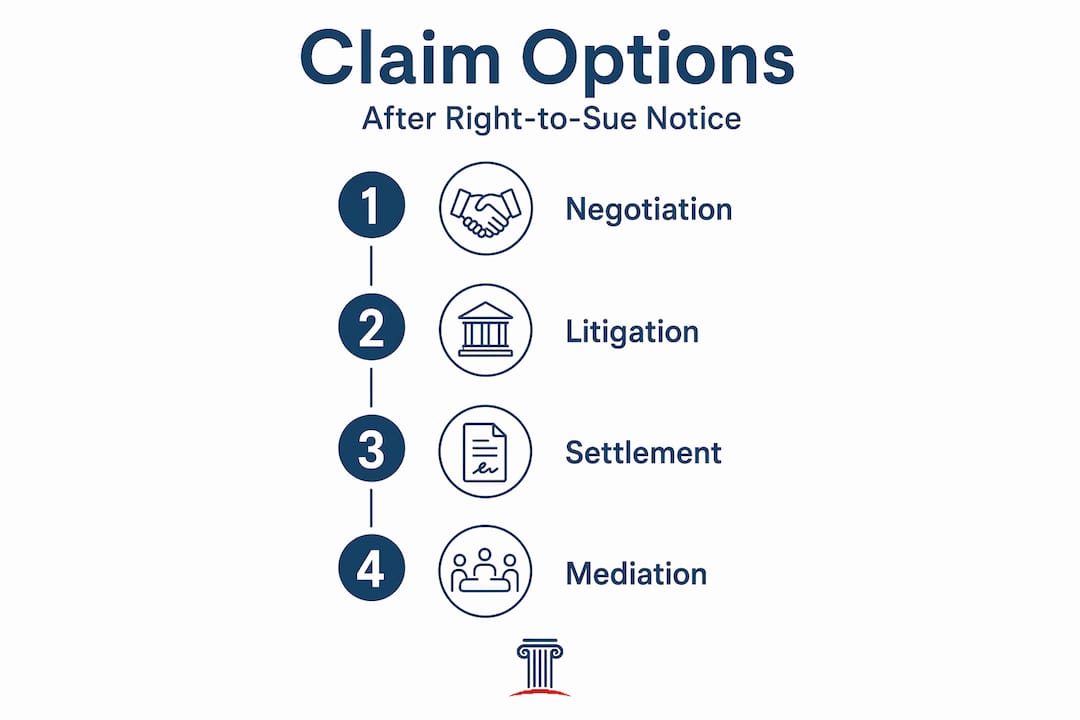
Your options at this stage include:
- Litigation in California Superior Court. This is the most direct path to full compensation. Discovery allows your attorney to obtain emails, HR records, performance reviews, and other documents your employer controls.
- Mediation. A neutral mediator helps both sides reach a voluntary settlement. Mediation is confidential and often faster than litigation. Many employment cases settle at this stage.
- Arbitration. Some employment contracts require arbitration instead of court. If your agreement includes an arbitration clause, your attorney needs to review it carefully before you file anywhere.
- EEOC conciliation or mediation. If the EEOC accepts your charge and finds reasonable cause, it may offer a conciliation process before referring the case for litigation.
The right path depends on your specific facts, your goals, and what your employer is likely to do. An experienced Fullerton employment attorney can assess those factors and help you make a strategic decision rather than a reactive one.
Pro Tip: If you experienced retaliation after reporting harassment or discrimination, that retaliation is a separate legal claim on top of the original conduct. Do not overlook it when speaking with an attorney.
My honest take on what I see employees get wrong
I have worked with employees across Orange County, and the pattern I see most often is this: people wait too long because they are not sure their situation is “bad enough” to be a legal claim. They spend weeks or months hoping things will improve, documenting nothing, consulting no one. By the time they reach an attorney, deadlines are close or already gone.
The second most common mistake is misunderstanding the CRD intake process. Employees often think filing a complaint with HR is the same as filing with a government agency. It is not. Your employer’s HR department works for your employer. The CRD is an independent state agency. These are completely different things with completely different legal consequences.
What I have learned is that the employees who protect their rights most effectively are not necessarily the ones with the most dramatic cases. They are the ones who consulted an attorney early, got their filings done correctly, and understood that the administrative process is not a formality. It is the foundation of everything that follows.
If you are in Fullerton and something feels wrong at work, trust that instinct enough to at least make a phone call. The parallel state and federal paths require coordinated tracking, and that is genuinely hard to do alone. You do not have to figure this out by yourself.
How Serendib law helps Fullerton employees fight back
At Serendib law, we represent employees in Fullerton and across Orange County who are dealing with workplace harassment, discrimination, wrongful termination, and retaliation. We know the CRD and EEOC processes inside and out, and we help clients navigate both tracks without missing critical deadlines.
Our team handles employment law claims across a wide range of situations, from hostile work environments and disability discrimination to retaliation after a protected complaint. We offer free consultations and handle select cases on contingency, meaning you pay nothing unless we recover for you.
If you have received a Right-to-Sue notice, or if you are still in the early stages of deciding what to do, now is the time to speak with our Fullerton employment attorneys. The sooner you get legal guidance, the more options you have. Reach out today and let us help you understand exactly where you stand.
FAQ
What is FEHA and does it apply to Fullerton workers?
FEHA, the Fair Employment and Housing Act, is California’s main state law protecting employees from workplace discrimination and harassment. It applies to most employers in Fullerton and covers more protected categories than federal law.
Do I have to file with the CRD before I can sue my employer?
Yes. Filing with the California Civil Rights Department and obtaining a Right-to-Sue notice is a required step before you can file a FEHA lawsuit. Skipping this step results in dismissal of your claim.
What is the difference between an immediate Right-to-Sue and an investigation?
An immediate Right-to-Sue is typically issued within 24 hours and lets you go straight to court, while the investigation pathway allows the CRD to review your complaint first but takes longer and delays your litigation timeline.
Can I file with both the CRD and the EEOC at the same time?
Yes, and in most cases you should. Filing with both agencies simultaneously preserves your rights under both state and federal law, since each has different deadlines and offers different remedies.
What happens if I miss the filing deadline for my claim?
Missing the applicable deadline with the CRD or EEOC generally results in permanent loss of your right to pursue that claim. There are applicable statutes of limitations that vary by claim type and should be evaluated on a case-by-case basis with an attorney.
Recommended
- California Employment Law Rights List For Workers | Serendib Law Firm
- Campus Employment Disputes At CSUF: Student Worker Rights | Serendib Law Firm
- Wrongful Termination in Fullerton Universities – Protecting Staff Rights | Serendib Law Firm
- How CSUF Student Workers Can Spot And Fight Wage Violations | Serendib Law Firm