
You walked away from another encounter feeling shaken, embarrassed, or dismissed, and now you are wondering if anyone will believe you. That is the brutal reality of workplace harassment: what is clear to you in the moment becomes difficult to prove weeks later when memories fade and the other party denies everything. Knowing how to document harassment at work is not just a procedural step; it is the foundation of your legal protection. For employees in Southern California cities like Anaheim, Irvine, Santa Ana, and Fountain Valley, the right documentation can mean the difference between a strong case and an uphill battle.
Table of Contents
- What you need before you start documenting
- Step-by-step process for documenting each harassment incident
- Collecting and safeguarding supporting evidence beyond your log
- How to report harassment and maintain records during the investigation process
- Common mistakes to avoid and what to expect after documenting harassment
- Why ongoing, real-time documentation changes the legal game in Southern California
- Get expert legal support with harassment claims in Southern California
- Frequently asked questions
What you need before you start documenting
Before you log a single incident, take time to understand what you are actually dealing with. Workplace harassment under California law includes unwelcome conduct based on a protected characteristic such as race, gender, religion, age, disability, or sexual orientation that creates a hostile work environment. It is not limited to physical acts. Comments, messages, gestures, and patterns of exclusion can all qualify.
Read your employer’s written harassment policy carefully. Most companies operating in Southern California are required to have one. Note who the designated complaint officer is, what the reporting procedure looks like, and what retaliation protections the policy promises. Those details will matter later.
Now set up a documentation system that lives entirely outside your workplace. Use a personal device, a personal email account, or a password-protected notebook. Never store records on a work laptop or through a company email account. Your employer can access those systems, and your records could disappear or be used against you.
A California Civil Rights Department guide on harassment prevention outlines the baseline protections employees hold and what employers are required to do. Reviewing this before you begin gives you a clearer sense of the threshold your situation needs to meet.
Every effective harassment incident log entry should capture the following elements:
- Who was involved: the harasser, your role, their role, and any witnesses present
- What happened: specific words, actions, or conduct in factual, unemotional language
- When it occurred: exact date and time
- Where it took place: office, hallway, video call, group chat
- How it affected you: impact on your work performance, emotional state, or physical health
- What you did: your response in the moment
| Documentation element | Why it matters |
|---|---|
| Exact date and time | Establishes a verifiable timeline |
| Specific conduct description | Avoids vague claims that are easy to dispute |
| Witness names and positions | Provides corroboration |
| Your response | Shows you did not consent to or invite the behavior |
| Emotional or professional impact | Supports hostile work environment claims |
| Internal report details | Demonstrates employer had notice |
As tips for documenting workplace harassment make clear, keeping a detailed chronological log with date, time, location, involved persons, responses, and impact is how you establish the kind of pattern that investigators and courts take seriously.
Pro Tip: Our Orange workplace harassment lawyers and Tustin workplace harassment lawyers frequently advise clients to start their log the same day they experience an incident, even if it feels minor. Context built over time is far more persuasive than a single dramatic event recounted from memory.
Step-by-step process for documenting each harassment incident
With your preparation done, here is the detailed process you can follow for every incident you experience.

Step 1: Document immediately. Do not wait until the end of the day. Contemporaneous records are more reliable and reduce the chance of forgotten details. Write your entry as close to the incident as possible, even if it means jotting notes in a personal app during a bathroom break.
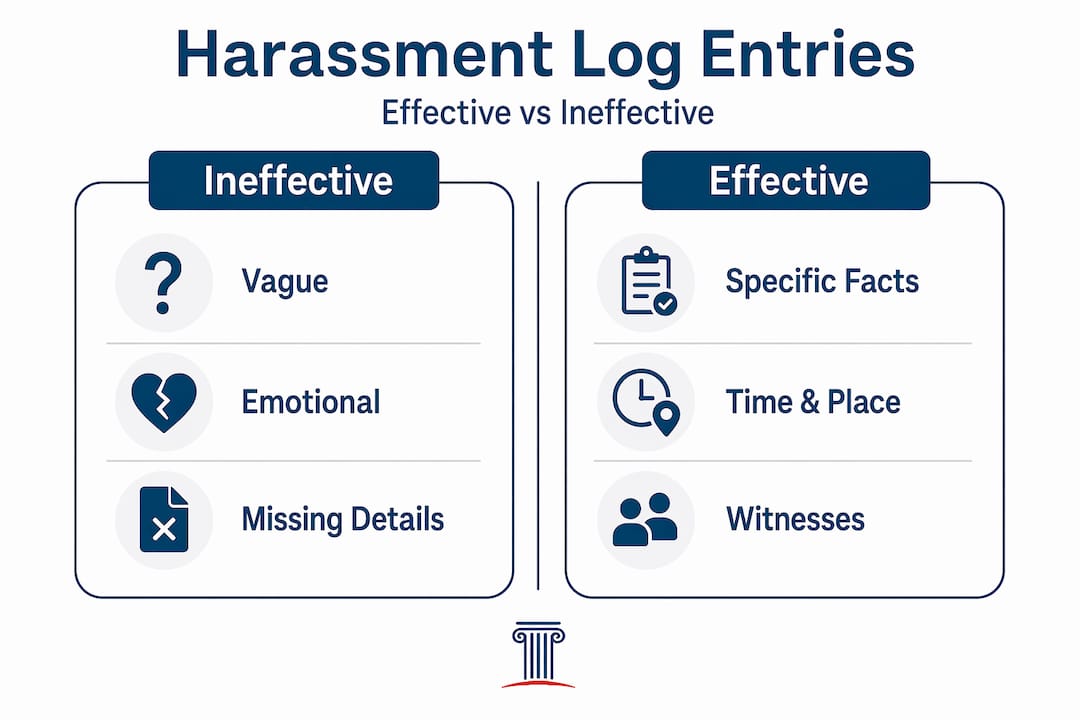
Step 2: Write factually, not emotionally. Instead of writing “my supervisor was cruel and humiliating,” write “on Tuesday, March 4, 2026, at approximately 10:15 a.m. in the break room, my supervisor told me in front of three colleagues that my work was a waste of everyone’s time because of where I come from.” Specific language is far harder to dismiss.
Step 3: Note all witnesses. List the full names and job titles of anyone present, even if they said nothing. Silence from a bystander still places them at the scene.
Step 4: Record your internal report. When you report the incident to HR or a manager, note the date, the name of the person you told, how you reported it (email, in-person, phone), and any response you received. The EEOC recommends identifying who handles harassment issues in your company and reporting accordingly.
Step 5: Track employer action or inaction. Document what your employer did or did not do after each report. This record becomes critical if you later need to show that management failed to respond appropriately.
Here is a quick comparison between effective and ineffective documentation:
| Ineffective entry | Effective entry |
|---|---|
| “He was rude to me again today.” | “On April 9, 2026, at 2:00 p.m., during a team meeting on Zoom, [name] interrupted me three times and said I ‘don’t belong in this role’ in front of the full team.” |
| “She always makes me feel uncomfortable.” | “On April 12, 2026, [name] sent me a direct message containing [specific content], which I have screenshot and saved.” |
| “I reported it but nothing happened.” | “On April 13, 2026, I emailed HR director [name] describing the April 9 incident. I received no response as of April 20, 2026.” |
Learning to document workplace harassment with this level of precision takes practice, but even a few consistent entries can establish a pattern that changes how an investigation unfolds. Our Anaheim workplace harassment lawyers have seen cases turn significantly because a client started logging incidents six weeks before filing a complaint.
Pro Tip: Time-stamp every note using a dated digital file. If you handwrite notes, photograph them with your phone immediately to preserve a digital timestamp.
Collecting and safeguarding supporting evidence beyond your log
Beyond your written log, supporting evidence can significantly strengthen your documentation efforts. Here is how to gather and protect it.
Your written account of events is powerful, but supporting records such as emails, chat logs, and screenshots linked to specific log entries can transform a credible story into an airtight case. Investigators and attorneys look for corroboration across multiple sources.
Here is what to collect and how:
- Emails: Forward harassing emails from your work account to a personal account right away. Keep the original headers intact.
- Text messages and chat logs: Screenshot every relevant message. Include the sender name, timestamp, and full message content. Store screenshots in a dated folder on your personal device.
- Social media or app messages: If harassment occurs through LinkedIn, Instagram, or any third-party platform, screenshot and timestamp those as well.
- Photos or videos: If the harassment involved physical conduct, inappropriate materials, or workplace graffiti, photograph it immediately with your personal phone.
- Voicemails: If you receive harassing voicemails, save them to a personal device rather than deleting them.
Credibility in investigations often depends on corroborating evidence like emails, texts, or comments made shortly after incidents. Even forwarding an email to a trusted friend on the day it happened creates a timestamped record outside your control.
Store all of this on a personal, password-protected device or an encrypted cloud storage service you own. Do not use Google Drive accounts tied to your work email or any storage your employer manages.
Pro Tip: Apps like Google Keep, Evernote, or Day One (personal journal app) allow you to create date-stamped, encrypted entries with photo attachments. Use these to link digital evidence directly to your written log entries. Our Garden Grove workplace harassment lawyers also advise clients to document workplace harassment in multiple formats so that if one record is challenged, others independently confirm the same facts.
How to report harassment and maintain records during the investigation process
After compiling evidence, you need to understand how to report the harassment properly and keep thorough records throughout the employer’s investigation.
Locate your employer’s formal complaint process. Read the harassment policy again. Note whether you must submit a written complaint, whether there is a specific form, and the deadline for internal reporting.
Write a formal complaint summary. Pull directly from your harassment log. Include dates, times, specific conduct, witnesses, and the impact on your work. Keep emotional language out and factual language in.
Submit through a documented channel. Email is preferable because it creates a timestamp and a written trail. If you submit in person, follow up with a written confirmation email summarizing what you said and to whom.
Keep copies of everything. Save your complaint, any HR acknowledgment, and every follow-up communication. Keep records of reports and employer responses to demonstrate the employer’s knowledge and show what actions, if any, were taken.
Continue documenting in real time. Do not stop your harassment log once you report. If the harassment continues or if you experience any retaliation, those new entries are evidence of exactly what the law is designed to address.
The EEOC requires employers to promptly investigate and take steps to stop further harassment and protect employees once they are made aware of the situation. If your employer does not act, that failure is itself a documented fact.
If you are experiencing retaliation after reporting, our retaliation reporting page for Santa Ana employees outlines specific protections available to you under California law. You can also revisit guidance on documenting for legal protection to ensure your records capture retaliation separately from the original harassment incidents.
Pro Tip: If you feel uncomfortable reporting to HR directly because HR works closely with the harasser, escalate to a senior manager or, if needed, go directly to the EEOC or the California Civil Rights Department.
Common mistakes to avoid and what to expect after documenting harassment
Once you know how to report and maintain records, here are common pitfalls to avoid and what you can expect after your documentation is in place.
Mistakes to avoid:
- Writing entries that are vague or driven by emotion rather than fact. “I felt targeted” is not as useful as “on May 1, 2026, [name] excluded me from a client meeting I was supposed to attend, then told a colleague I was too sensitive to handle pressure.”
- Waiting days or weeks to log an incident. Waiting too long to document weakens claims because credibility depends heavily on early, corroborated records.
- Skipping small incidents. What looks like a one-time comment may turn out to be part of a documented pattern of targeting that defines a hostile work environment claim.
- Forgetting to note employer responses. Documentation must include who you told, when, and the employer’s response to establish that the employer had knowledge and either took or failed to take corrective action.
- Storing records on work devices or systems where your employer can access them.
What to expect after documenting and reporting:
Investigations are intended to be confidential, but complete privacy is not guaranteed. Investigators will need to speak with witnesses, review communications, and gather facts. Expect the process to take time, and continue documenting throughout.
If the investigation results in no action or the harassment continues, your documented record becomes the cornerstone of any external complaint or legal claim. California has applicable statutes of limitation for filing harassment complaints, and the specific timeframe that applies to your situation should be evaluated with an attorney. Reaching out to Fountain Valley workplace harassment lawyers early means you are not scrambling to reconstruct a timeline under pressure.
Why ongoing, real-time documentation changes the legal game in Southern California
Here is a perspective that most articles skip: documentation is not just about proving what happened. It is about controlling the narrative before the other side has a chance to build theirs.
When harassment cases go to investigation, whether internally or before the EEOC or California Civil Rights Department, the first question is always: who is more credible? Employers know this. Many companies have HR staff and legal counsel who move quickly once a complaint is filed to gather their own version of events. Real-time documentation helps preserve evidence and demonstrates ongoing patterns that courts and investigators expect to see. It also makes it nearly impossible for an employer to claim the behavior never happened or was not reported.
There is also a behavioral dimension people rarely discuss. When employees begin documenting harassment, their awareness of their own situation sharpens. They start noticing patterns they had normalized. They remember they were not alone in the room for three of the five incidents. They realize the same behavior was directed at another colleague. That sharpened awareness leads to stronger, more detailed records.
Credibility determinations by employers and investigators are heavily influenced by whether evidence is contemporaneous and corroborated socially and electronically. A log entry written the same day as an incident carries far more weight than a recollection offered six months later. And when that log entry is supported by a screenshot, a forwarded email, and a colleague who made a note at the same time, the case becomes difficult to deny.
Finally, do not underestimate the power of asking a trusted colleague to write down what they witnessed and save it themselves. Their contemporaneous account, completely independent of yours, provides corroboration that no employer talking point can easily dismantle. You can learn more about how to document workplace harassment with this kind of strategic depth, and our Orange workplace harassment lawyers are experienced in helping clients build cases that hold up under scrutiny.
Get expert legal support with harassment claims in Southern California
While documentation is crucial, working with skilled employment attorneys in Southern California ensures your rights are fully protected and leveraged. If harassment continues or your employer fails to act, your carefully built record needs a legal professional who knows how to use it. Attorneys serving Lake Forest employees, Huntington Beach employees, and Newport Beach employees understand California employment law and the specific practices of local employers. At Serendib Law Firm, we offer confidential consultations in English and Spanish, review your documentation with you, and help you take the right next step before critical deadlines pass. Reaching out early protects your options and your case.
Frequently asked questions
What should I include in my harassment documentation log?
Include the date, time, location, who was involved, what happened, your response, any reports made, and how it affected you. Every instance should be logged in chronological order to show a clear pattern to investigators and attorneys.
Can I use emails or texts as evidence of workplace harassment?
Yes, emails, chat logs, photos, and screenshots linked to specific incidents strengthen your documentation significantly. Preserve supporting records organized to correspond with your written log entries for maximum credibility.
Who should I report workplace harassment to if I feel uncomfortable?
Report to your designated harassment officer or, if that person makes you uncomfortable, escalate to a manager or HR. The EEOC advises speaking with your manager or another manager in your company if the designated person is not a safe option.
Is there a time limit to file a harassment complaint in California?
Yes, there are applicable statutes of limitation, and CRD filings under FEHA are subject to specific timeframes tied to the date of the alleged unlawful act. Consult an employment attorney to evaluate the exact deadline that applies to your circumstances.
What happens after I report harassment to my employer?
Your employer is legally required to act. Once informed, employers must promptly and thoroughly investigate, stop the harassment, and protect you from retaliation. If they fail to do this, that failure is documented evidence of their inadequate response.