Workplace discrimination tied to language affects thousands of American employees in Garden Grove every year. Experiencing unfair treatment because of an accent or native language can leave workers from diverse backgrounds feeling isolated and powerless. Federal civil rights law recognizes language bias as a specific form of national origin discrimination, giving you the right to push back. Understanding the legal protections and claim options helps you make informed decisions and protect your career.
Table of Contents
- Defining Language Discrimination And National Origin Bias
- Types Of Workplace Language Discrimination
- California Laws Protecting Garden Grove Employees
- Employer Responsibilities And Permissible Language Policies
- Filing A Workplace Claim And Available Remedies
Key Takeaways
| Point | Details |
|---|---|
| Language Discrimination Defined | Language discrimination involves unfair treatment based on linguistic characteristics and often intersects with national origin bias, impacting socioeconomic opportunities for language minorities. |
| Legal Protections in California | California law provides robust protections against language discrimination, prohibiting arbitrary English-only rules and requiring justifications for language policies. |
| Types of Discrimination | Discrimination can be direct (overt actions against employees) or indirect (subtle policies that disadvantage language minorities), requiring careful management from employers. |
| Filing a Claim | Employees can file claims through the California Civil Rights Department or the EEOC, with strict documentation and timely filing essential for a successful resolution. |
Defining Language Discrimination and National Origin Bias
Language discrimination represents a complex and nuanced form of workplace bias that extends beyond simple communication challenges. At its core, this form of discrimination involves treating employees unfairly based on their linguistic characteristics, accent, or native language. Human Rights Watch research reveals that such discrimination frequently intersects with national origin bias, creating significant socioeconomic barriers for language minorities in employment settings.
Under federal civil rights protections, language discrimination is recognized as a specific subset of national origin discrimination. This legal framework acknowledges that language is deeply connected to cultural identity and can serve as a mechanism for excluding or marginalizing workers from specific ethnic or national backgrounds. Academic legal scholarship highlights how accent-based discrimination often functions as a proxy for more overt national origin bias, particularly impacting Asian American and immigrant populations.
Workplace language discrimination can manifest through various problematic practices, such as:
- Implementing English-only workplace rules without legitimate business necessity
- Refusing to hire or promote employees based on accent or language proficiency
- Creating hostile work environments that mock or criticize non-native language skills
- Establishing communication standards that disproportionately disadvantage certain ethnic groups
Pro tip: Document every instance of potential language discrimination carefully, including dates, witnesses, and specific language used, as detailed records can significantly strengthen potential legal claims.
Types of Workplace Language Discrimination
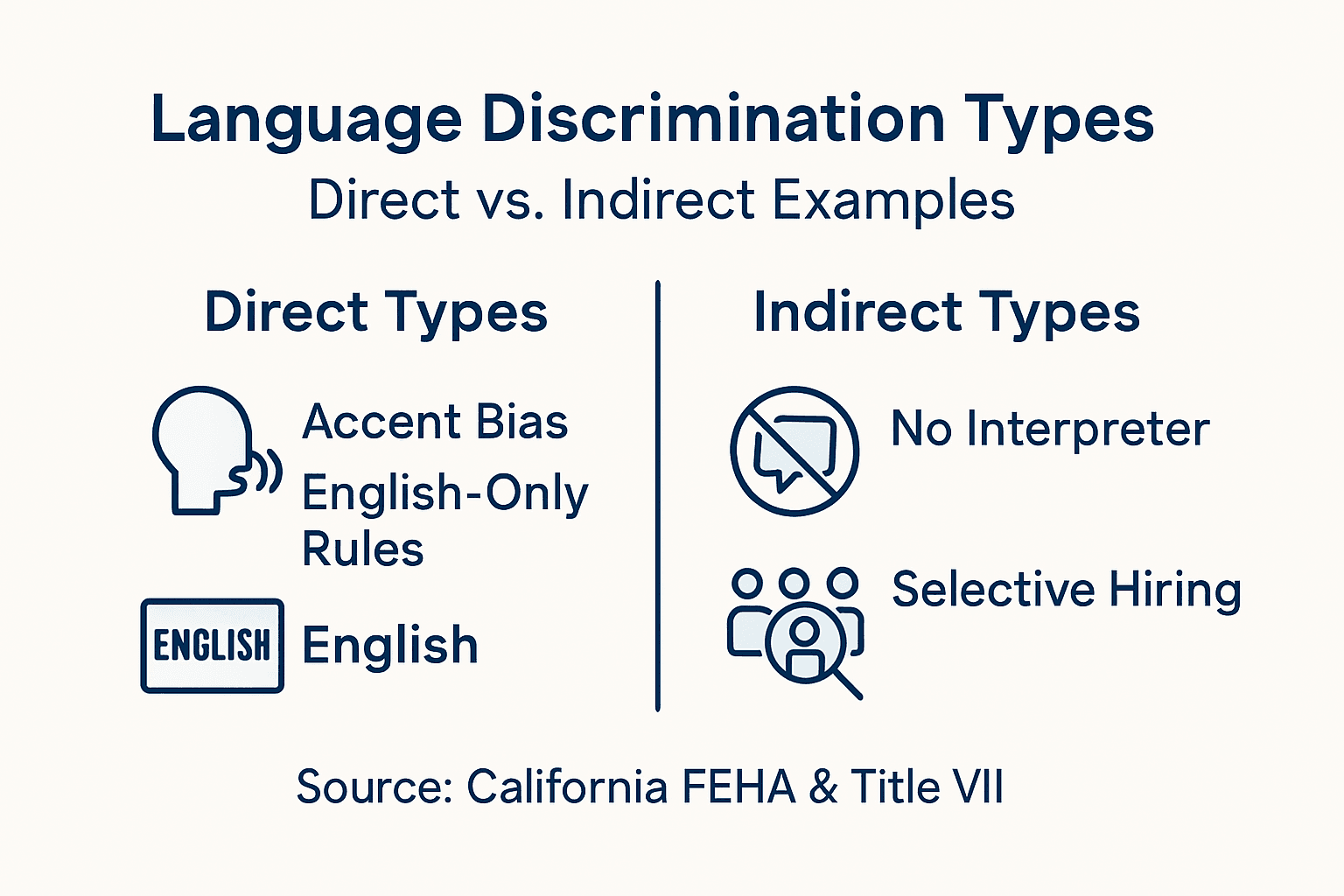
Language discrimination manifests in complex and multifaceted ways within professional environments. Academic research on workplace language diversity reveals two primary categories of discriminatory practices: direct and indirect language discrimination, each presenting unique challenges for employees and employers alike.
Direct language discrimination represents the most explicit form of bias, involving intentional and overt actions that target employees based on their linguistic characteristics. This can include:
- Outright refusal to hire candidates with specific accents
- Explicit statements discouraging use of non-English languages
- Terminating employees solely based on language proficiency
- Making derogatory comments about an employee’s speech patterns
Indirect language discrimination operates more subtly, often through seemingly neutral policies that disproportionately impact language minorities. Linguistic profiling research highlights how such practices can create systemic barriers. These indirect forms might include:
- English-only workplace rules
- Communication standards that inherently disadvantage non-native speakers
- Promotion criteria that unnecessarily emphasize native-like language skills
- Performance evaluation metrics that penalize linguistic differences
Pro tip: Request written documentation of all workplace language policies to help identify potential discriminatory practices and establish a clear record for potential legal challenges.
Here’s a quick comparison of direct versus indirect language discrimination effects:
| Aspect | Direct Language Discrimination | Indirect Language Discrimination |
|---|---|---|
| Employee Experience | Immediate exclusion or hostility | Feeling unfairly disadvantaged |
| Employer Risk | High risk of legal liability | Risk of policy-based complaints |
| Detection Difficulty | Easy to identify and document | Subtle and harder to prove |
| Common Triggers | Accent, language usage | Neutral-seeming workplace policies |
This table helps clarify how each form impacts both employees and employers.
California Laws Protecting Garden Grove Employees
Employees in Garden Grove benefit from robust legal protections against workplace discrimination, particularly regarding language and national origin. California Civil Rights Department regulations provide comprehensive safeguards that extend well beyond federal employment standards, offering significant protections for workers facing language-related bias.

The Fair Employment and Housing Act (FEHA) serves as the primary legal framework protecting employees. This state law applies to all employers with five or more employees and explicitly prohibits discrimination based on national origin, language characteristics, and accent. Critically, the law requires that any language restrictions must meet a strict business necessity standard, meaning employers cannot arbitrarily implement policies that disadvantage employees based on linguistic background.
Specific protections under California law include:
- Prohibition of English-only workplace rules except under narrow, job-related circumstances
- Protection against discrimination based on accent or language proficiency
- Requirements for employers to justify any language-related workplace policies
- Preventing retaliation against employees who challenge discriminatory language practices
Pro tip: Maintain detailed documentation of any language-related workplace interactions, including specific policy communications, potential discriminatory statements, and instances of differential treatment.
Employer Responsibilities and Permissible Language Policies
California law establishes strict guidelines for employers regarding language policies, balancing business needs with employee protections. Employer language regulations mandate that any language restrictions must meet rigorous business necessity standards, ensuring that workplace communication policies do not unfairly target specific national origin groups.
Employers are permitted to implement English-only rules only under very limited circumstances. These exceptional situations include maintaining workplace safety, ensuring effective communication with customers, or addressing specific job-related requirements where language proficiency directly impacts job performance. Any such policies must be:
- Narrowly tailored to specific business needs
- Applied consistently across all employees
- Communicated clearly and in advance
- Justified by legitimate operational requirements
Additionally, employers have critical responsibilities beyond policy creation. California Civil Rights Department guidelines require employers to:
- Provide translations of workplace policies for non-English speaking employees
- Allow language use during personal breaks
- Avoid discriminatory practices related to accent or language proficiency
- Ensure workplace communications do not create a hostile environment
Pro tip: Consult with employment law professionals before implementing any workplace language policies to ensure full compliance with California’s complex legal requirements.
Filing a Workplace Claim and Available Remedies
Employees experiencing language discrimination in Garden Grove have multiple legal pathways to seek justice and compensation. California labor law provides comprehensive complaint procedures that protect workers regardless of immigration status, ensuring accessible mechanisms for addressing workplace language bias.
The complaint filing process involves several critical steps. Employees can initiate claims through two primary agencies: the California Civil Rights Department (CRD) and the Equal Employment Opportunity Commission (EEOC). These agencies investigate discrimination claims and offer multiple potential remedies, including:
- Monetary compensation for lost wages
- Reinstatement to previous position
- Requirement of policy changes
- Potential punitive damages for severe violations
- Compensation for emotional distress
Procedural requirements for filing a workplace discrimination claim include gathering comprehensive documentation such as:
- Detailed written accounts of discriminatory incidents
- Performance reviews and employment records
- Witness statements
- Communication records demonstrating bias
- Evidence of differential treatment based on language or national origin
California labor complaint guidelines emphasize the importance of timely filing, as strict deadlines can significantly impact claim viability. Most discrimination complaints must be filed within one year of the incident, making prompt action crucial for protecting legal rights.
The following table summarizes key legal protections and filing options for language discrimination claims in California:
| Legal Protection Area | California Law (FEHA) | Federal Law (Title VII) |
|---|---|---|
| Covered Employers | 5+ employees | 15+ employees |
| Basis for Complaint | Language, accent, national origin | National origin |
| Filing Agency | California Civil Rights Dept. (CRD) | EEOC |
| Typical Filing Deadline | 1 year | 180-300 days |
This summary offers a quick reference for employees facing workplace language bias.
Pro tip: Preserve all communication records and document every discriminatory incident in real-time, creating a comprehensive and contemporaneous record that can significantly strengthen your potential legal claim.
Protect Your Rights Against Language Discrimination in Garden Grove
If you are facing unfair treatment at work due to your language, accent, or national origin you are not alone and you have legal protections under California law. Language discrimination can feel isolating and unjust but understanding your rights is the first step toward reclaiming fairness. Whether you are dealing with restrictive English-only policies or biased promotion decisions our experienced team at Serendib Law Firm is ready to help you navigate these challenges with clear and personalized legal support.
Do not wait until your rights are violated further. Visit our Garden Grove Archives | Serendib Law Firm to learn how we have successfully helped clients in similar situations. Acting promptly can prevent long-term harm. Contact us today at https://www.serendiblaw.com/ for a free consultation and get trusted advocacy dedicated to protecting you from language and national origin discrimination. For broader information about your protections and options in California visit our California Archives | Serendib Law Firm and stay informed about your workplace rights.
Frequently Asked Questions
What is language discrimination in the workplace?
Language discrimination occurs when employees are treated unfairly based on their linguistic characteristics, accent, or native language, often manifesting as unjust hiring practices, hostile work environments, and biased communication standards.
How can I identify whether I am experiencing language discrimination?
You may be experiencing language discrimination if you notice issues such as being unfairly excluded from hiring or promotion opportunities based on your accent or language skills, or facing ridicule or hostility regarding your language use at work.
What legal protections exist against language discrimination?
Legal protections include the Fair Employment and Housing Act (FEHA), which prohibits discrimination based on language, accent, and national origin, requiring employers to justify language policies with a valid business necessity.
What steps should I take if I want to file a claim for language discrimination?
To file a claim, document instances of discrimination, gather evidence such as emails and witness statements, and file a complaint with agencies like the California Civil Rights Department (CRD) or the Equal Employment Opportunity Commission (EEOC), adhering to the required timelines for filing.