

Amazon and Google eliminated over 380 tech positions in Irvine during 2025 and 2026, leaving many employees uncertain about their legal protections. If you lost your job in these mass layoffs, you might have rights you don’t realize, including claims for inadequate notice, age discrimination, or retaliation. California’s employment laws provide stronger safeguards than federal rules, but most laid-off workers never explore their options. This guide walks you through the legal framework protecting Irvine tech employees, from WARN Act compliance to wrongful termination claims, so you can make informed decisions about your next steps.
Table of Contents
- Overview Of Recent Mass Layoffs Affecting Irvine Tech Employees
- Understanding Your Rights Under The California WARN Act
- Recognizing Wrongful Termination And Discrimination Risks During Layoffs
- Steps Irvine Tech Employees Should Take After A Mass Layoff
- How Serendib Law Can Help Irvine Tech Employees
- FAQ
Key takeaways
| Point | Details |
|---|---|
| WARN Act notice | California requires 60 days advance notice for mass layoffs of 50 or more employees, stricter than federal law. |
| Recent Irvine layoffs | Amazon cut 333 jobs in October 2025 and more in 2026, while Google eliminated 52 positions in 2025. |
| Wrongful termination protections | California law prohibits layoffs motivated by discrimination, retaliation for reporting harassment, or violations of public policy. |
| Documentation matters | Preserve all layoff communications, performance reviews, and personnel files before signing any severance agreement. |
| Severance negotiation | You can often negotiate better terms without automatically waiving valid legal claims against your employer. |
Overview of recent mass layoffs affecting Irvine tech employees
The tech industry’s aggressive cost-cutting wave hit Irvine hard in 2025 and 2026. Amazon conducted mass layoffs affecting 333 Irvine employees in October 2025, followed by additional rounds in 2026 as the company restructured its engineering teams. Meanwhile, Google laid off 52 workers at its Irvine location in 2025 as part of broader efficiency initiatives driven by artificial intelligence automation.
These cuts primarily targeted software engineers, product managers, and technical roles that companies deemed redundant as AI tools took over certain coding and analysis functions. The layoffs weren’t isolated incidents but part of industry-wide workforce reductions affecting thousands of tech professionals across California. Many Irvine employees received minimal warning, and some discovered their termination only when access to company systems suddenly disappeared.
The human impact extends beyond job loss. Tech workers who relocated to Irvine for these positions now face:
- Sudden income disruption with California’s high cost of living
- Health insurance gaps affecting families
- Visa status concerns for H-1B and other work authorization holders
- Career uncertainty in a contracting job market
- Potential age discrimination if older workers were disproportionately selected
Pro Tip: If you were laid off, immediately request a copy of your complete personnel file from HR. California law requires employers to provide this within 30 days of a written request, and these documents become critical evidence if you later discover discrimination or WARN Act violations.
The timing and scale of these layoffs raise important legal questions. When a company eliminates hundreds of positions simultaneously, specific notification requirements and anti-discrimination protections come into play. Understanding whether your employer followed proper procedures can mean the difference between accepting a minimal severance package and recovering significant compensation for legal violations.
Understanding your rights under the California WARN Act
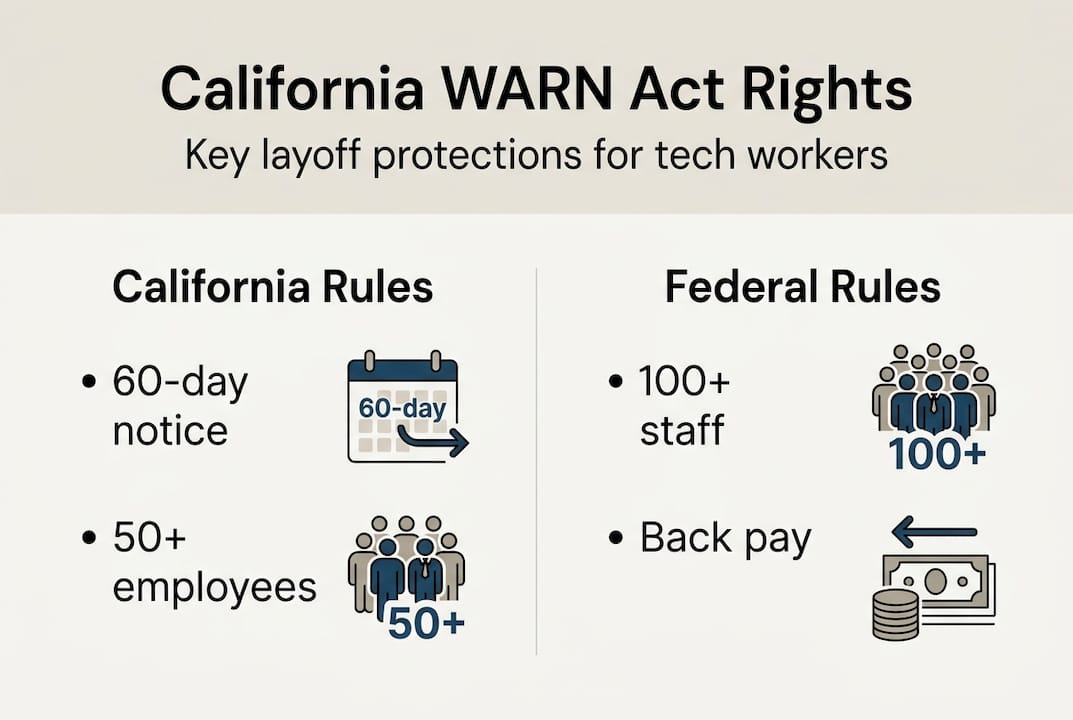
California’s Worker Adjustment and Retraining Notification Act establishes strict employer obligations that exceed federal requirements. The law mandates 60 days advance written notice for mass layoffs, plant closures, or relocations affecting 50 or more employees within a 30-day period. This applies to employers with 75 or more full-time and part-time workers combined.
The federal WARN Act sets a higher threshold of 100 employees for a single site closure or 500 employees for mass layoffs across multiple locations. California’s version protects more workers by covering smaller layoffs and counting part-time employees toward the threshold. For Irvine tech workers, this distinction matters because many companies operate multiple California offices that collectively trigger state WARN obligations even if individual locations fall below federal limits.
| WARN Requirement | California Rule | Federal Rule |
| — | — | |
| Notice period | 60 days | 60 days |
| Mass layoff threshold | 50+ employees in 30 days | 50+ if 33% of workforce |
| Employer size trigger | 75+ total employees | 100+ employees |
| Part-time workers counted | Yes | No |
| Penalties for violation | Back pay, benefits, $500/day civil penalty | Back pay and benefits only |
When employers violate WARN Act requirements, affected employees can recover back pay and the value of benefits they would have received during the notice period that should have been provided. California adds civil penalties up to $500 per day for each violation, payable to the state’s general fund. These penalties create stronger enforcement mechanisms than federal law alone.
Employers must deliver written notice to employees, the Employment Development Department, local workforce investment boards, and the chief elected official of each city where layoffs occur. You can verify whether your employer filed proper WARN notices by checking EDD reports or requesting documentation directly from your company’s HR department.
Pro Tip: WARN Act violations often go unnoticed because employees assume their employer followed the law. If you received less than 60 days notice or no written notice at all, consult an employment attorney immediately. The statute of limitations for WARN claims is limited, so prompt action protects your rights.
Limited exceptions exist for unforeseeable business circumstances or natural disasters, but routine restructuring and cost-cutting rarely qualify. Companies cannot avoid WARN obligations by staging layoffs in waves just under the 50-employee threshold if the cuts were part of a planned reduction. Courts examine the totality of circumstances to prevent employers from gaming the system through artificial timing manipulations.
Recognizing wrongful termination and discrimination risks during layoffs
California operates under at-will employment, meaning employers can generally terminate workers for any legal reason or no reason at all. However, significant exceptions protect against wrongful termination based on discrimination, retaliation, public policy violations, or breach of contract. Mass layoffs don’t provide blanket immunity from these protections.
Anti-discrimination laws prohibit termination decisions based on protected characteristics including age, race, gender, religion, disability, national origin, sexual orientation, or gender identity. The Age Discrimination in Employment Act and California’s Fair Employment and Housing Act specifically protect workers age 40 and older from bias. Tech industry layoffs have faced scrutiny for disproportionately targeting older employees while retaining younger workers in comparable roles.

Retaliation protections shield employees who reported harassment, discrimination, safety violations, or other illegal conduct. If you filed an HR complaint about workplace issues or participated in an investigation shortly before your layoff, the timing creates potential evidence of retaliatory motive. Similarly, whistleblowers who reported legal violations to government agencies receive strong protections under California law.
Key warning signs of potentially wrongful termination include:
- Layoff selection that disproportionately affects workers over 40 while sparing younger employees
- Termination shortly after reporting harassment or discrimination
- Elimination of your position followed by hiring someone younger or of a different protected class
- Inconsistent application of selection criteria across departments
- Sudden negative performance reviews after years of positive evaluations
“When companies conduct mass layoffs, they often use subjective performance ratings or forced ranking systems that can mask discriminatory intent. Statistical analysis of who gets selected versus who stays frequently reveals patterns that wouldn’t be apparent from any single termination.”
Contract breaches provide another wrongful termination avenue. If your employment agreement, offer letter, or employee handbook created enforceable promises about termination procedures, severance, or job security, violation of those terms may constitute breach of contract. Some tech companies provide written commitments that limit at-will employment, though these vary widely by employer.
Public policy violations occur when terminations punish employees for exercising legal rights, such as taking protected family or medical leave, serving on jury duty, or refusing to participate in illegal activities. California courts broadly interpret public policy protections to prevent employers from penalizing workers who stand up for their legal rights.
| Scenario | Likely Lawful | Potentially Wrongful |
|---|---|---|
| Company eliminates entire department due to budget cuts | Yes, if applied uniformly | If selection shows age or other bias |
| Employee laid off after reporting sexual harassment | Unlikely | Strong retaliation claim |
| Termination following negative performance review | Depends on review legitimacy | If review was pretextual or retaliatory |
| Layoff violates written employment contract terms | No | Clear breach of contract |
Pro Tip: Document everything related to your termination, including who else was laid off, their ages and protected characteristics if known, the reasons provided for your selection, and any recent complaints or protected activities you engaged in. This information becomes critical evidence if you later pursue wrongful termination claims or negotiate a better severance package.
Many employees who experienced wrongful termination after reporting HR issues never realized they had legal claims because the company framed the decision as a routine layoff. The mass layoff context doesn’t eliminate wrongful termination protections, it just makes the illegal motive harder to detect without careful analysis of selection patterns and timing.
Steps Irvine tech employees should take after a mass layoff
Protecting your legal rights after a layoff requires immediate, strategic action. Follow these steps to preserve your options and maximize potential recovery:
-
Verify WARN Act compliance by checking whether your employer filed required notices with the Employment Development Department. Review official EDD WARN reports to confirm proper notification. If your layoff involved 50 or more workers and you received less than 60 days written notice, your employer may have violated California law.
-
Request your complete personnel file in writing within 30 days of termination. California law requires employers to provide copies of all documents you signed, performance reviews, disciplinary records, and other employment-related materials. These documents often contain critical evidence of discrimination, retaliation, or contract breaches that you won’t discover until reviewing the full file.
-
Document the layoff selection process by identifying who was terminated versus retained in your department and across the company if possible. Note ages, protected characteristics, recent complaints or protected activities, and performance ratings. Patterns of age discrimination or other bias often emerge only through comparative analysis of multiple terminations.
-
Preserve all communications related to your employment and termination, including emails, text messages, performance reviews, promotion denials, and conversations about the layoff. Save these materials to personal devices or accounts before losing access to company systems. Courts frequently rely on contemporaneous communications as the most reliable evidence of employer intent.
-
Do not sign any severance agreement or release without thorough legal review. Most severance packages require you to waive claims against the employer in exchange for modest payments. Once signed, these releases typically prevent you from pursuing wrongful termination or discrimination claims. An experienced employment attorney can evaluate whether you have viable claims worth more than the offered severance and negotiate better terms.
-
Maintain a detailed timeline of relevant events, including when you reported problems to HR, performance review dates, promotion decisions, medical leaves, and any other protected activities. This chronology helps attorneys identify potential retaliation claims and establishes the sequence of events for legal analysis.
Pro Tip: California law gives you specific timeframes to file different types of claims. WARN Act violations must be addressed within the statute of limitations for wage claims. Discrimination complaints with the Department of Fair Employment and Housing face strict deadlines. Consulting an attorney promptly ensures you don’t forfeit rights by missing critical filing deadlines.
Many tech employees assume they have no recourse because California is an at-will state or because the company called it a layoff rather than a termination. This misconception causes workers to sign away valuable legal claims for minimal severance. Even if you’re unsure whether you have a case, getting a professional evaluation costs nothing and could reveal WARN Act violations or discrimination worth tens of thousands in potential recovery.
Severance negotiation doesn’t always require giving up legal claims. Skilled employment attorneys often negotiate separation agreements that provide better financial terms while preserving your ability to pursue certain claims or limiting the scope of releases. The initial severance offer is rarely the company’s best and final position, especially when legal vulnerabilities exist.
How Serendib Law can help Irvine tech employees
Navigating employment law after a mass layoff requires experienced legal guidance tailored to your specific situation. Serendib Law focuses on employment law and wrongful termination claims throughout Orange County, representing tech workers in Irvine and surrounding communities who face workplace disputes, discrimination, and unlawful terminations. Our attorneys understand the unique challenges affecting California tech employees, from WARN Act compliance issues to age discrimination patterns in industry layoffs.
We help clients enforce their rights under California and federal employment laws, including investigating potential WARN violations, analyzing layoff selections for discriminatory patterns, and negotiating favorable severance terms that don’t require you to abandon valid legal claims. Whether you need representation in Lake Forest, Huntington Beach, Newport Beach, or anywhere in Orange County, our team provides personalized attention to protect your employment rights and pursue maximum recovery. Contact us for a free consultation to discuss your options and take control of your situation.
FAQ
What legal protections do Irvine tech employees have if they suspect age discrimination during layoffs?
California’s Fair Employment and Housing Act and the federal Age Discrimination in Employment Act protect workers age 40 and older from bias in employment decisions, including layoffs. If your employer disproportionately terminated older employees while retaining younger workers in similar roles, you may have grounds for an age discrimination claim. Statistical evidence showing patterns across the layoff, combined with individual circumstances like recent performance reviews or comments about age, can establish illegal discrimination even within a mass reduction.
How can I find out if my employer complied with the WARN Act for my layoff?
Check official WARN notice reports published by California’s Employment Development Department, which maintains public records of employer filings. You can also request written documentation directly from your employer’s human resources department. If your layoff involved 50 or more employees within a 30-day period and you received less than 60 days advance written notice, your employer may have violated WARN requirements. An employment attorney can help you investigate compliance and pursue remedies for violations.
What should I do if I believe my termination was retaliatory or wrongful?
Document all communications, incidents, and timeline details related to your termination and any protected activities like harassment complaints or whistleblowing. Preserve emails, text messages, performance reviews, and notes about relevant conversations before losing access to company systems. Consult an employment attorney promptly to evaluate your case, as strict deadlines apply to different types of claims. Early legal review helps you understand your options and avoid waiving valuable rights through hasty severance agreements.
Can I negotiate my severance agreement after a mass layoff?
Yes, severance agreements are often negotiable, especially when you have potential legal claims or the employer wants to avoid litigation risks. Never sign a severance package without understanding what rights you’re waiving and whether the offered terms reflect the value of potential claims. An experienced attorney can identify WARN Act violations, discrimination, or other legal issues that strengthen your negotiating position. Many employees secure significantly better severance terms or preserve certain legal claims through skilled negotiation before signing releases.
Recommended
- Mass Layoffs and WARN Act: What Irvine Tech Firms Face
- Layoffs and retaliation rights for Blizzard Irvine 2026 | Serendib Law Firm
- WARN Act Violations Impact Irvine Corporate Layoffs | Serendib Law Firm
- Wrongful Termination After PIPs in Irvine Tech – Employee Rights and Legal Actions | Serendib Law Firm