
If a car driver pulled out in front of you on Beach Boulevard or Valley View Street and you are now dealing with medical bills, a damaged bike and missed paychecks, you are likely asking what your claim is worth. Compensation after a motorcycle accident in Buena Park, California, is built from your proven losses, reduced by any share of fault assigned to you, and paid by an insurer or a liable party only when the evidence supports it. Below, we explain how that works, what you can claim, what weakens a claim, and what to do in the first days.
TL;DR
- Compensation is built from economic losses (medical care, lost income, repairs) and non-economic losses (pain, suffering, emotional distress), not from a fixed formula or an “average” number.
- California uses comparative fault: if you are partly to blame, your recovery is reduced by your percentage of fault, not eliminated.
- Lane splitting is addressed in the Vehicle Code, and insurers sometimes use it to shift blame to riders, so documenting how the crash happened matters.
- Medical records, photographs, witness names and a prompt, consistent treatment history are the backbone of a strong claim.
- Filing deadlines in California are strict and can be shorter when a government entity is involved, so speak with a Buena Park injury attorney early.
Table of Contents
- How compensation is calculated after a Buena Park motorcycle crash
- What damages a rider can recover
- How California’s comparative-fault rule affects your claim
- Lane splitting, helmets and rider bias
- Common ways motorcycle crashes happen in Buena Park
- What to do after the crash
- Deadlines you cannot miss
- Our perspective on motorcycle claims
- Getting help from a Buena Park injury team
- Frequently asked questions
- Sources
How compensation is calculated after a Buena Park motorcycle crash
There is no calculator that produces a trustworthy number from a few inputs. Articles that quote a California “average settlement” mix minor and catastrophic cases, and the average tells you very little about your own crash. What determines value is the combination of three things: what the crash cost you, who is legally responsible, and what coverage or assets stand behind that responsible party.
In practice, we build a claim in this order:
- Document the full cost of the injury. This means every bill and record to date, plus a medical opinion on what future care you will need.
- Establish fault. We look at the police report, scene evidence, vehicle damage, video, and witness accounts to show how the collision occurred.
- Apply the fault rule. If any part of the blame is placed on you, the total is reduced accordingly (more on this below).
- Identify every source of recovery. That can include the at-fault driver’s liability insurance, your own uninsured or underinsured motorist coverage, and in some cases other parties, such as a vehicle owner or an entity responsible for a dangerous road condition.
The last step is where many riders lose money without knowing it. A motorcycle injury can be severe enough that one driver’s policy does not cover the full loss. Looking beyond the first insurance policy is part of what a careful attorney does from the start.
What damages a rider can recover
California personal injury law separates losses into categories. Which ones apply depends on your injuries and your circumstances.
Economic damages
These are the losses that come with receipts and records:
- Emergency care, hospital stays, surgery, imaging and medication
- Ongoing treatment such as orthopedic follow-up, injections and rehabilitation
- Physical therapy, both completed and recommended in the future
- Lost wages and reduced earning capacity if you cannot return to your old work or hours
- Motorcycle repair or replacement, and damaged gear such as your helmet, jacket and boots
- Out-of-pocket costs such as prescriptions, mobility aids and transportation to appointments
Non-economic damages
These compensate for what the injury has done to your life, which no invoice captures:
- Physical pain and ongoing discomfort
- Emotional distress, including anxiety, sleep problems and fear of riding or driving after a traumatic crash
- Loss of enjoyment of life, for example a rider who can no longer take weekend rides or play with their children
- Scarring or disfigurement, which is common after road rash and surgical repair
Stress and anxiety are legitimate parts of a claim, but they must be real and supported. Insurers discount vague statements. A record of counseling, a physician’s notes about sleep disruption or panic when near traffic, and your own detailed account all give these damages weight. There is no standard multiplier that California law guarantees, so we would rather build the evidence than promise a figure.
Does physical therapy raise the value of a claim?
Physical therapy does not “increase” a settlement as a tactic. It does two honest things. First, its cost is itself an economic loss. Second, consistent treatment records show an insurer, and a jury if it comes to that, how serious the injury is and how hard you worked to recover. The opposite is also true: gaps in treatment, missed appointments or stopping therapy early give an adjuster an argument that you were not hurt as badly as you claim. Follow your doctor’s plan because it is good medicine, and the documentation will follow.
Wrongful death
When a motorcycle crash takes a life, certain family members may bring a claim for funeral and burial costs, lost financial support and loss of companionship. These claims have their own rules about who may file, and we handle them with particular care. If you are in that situation, our Buena Park team will meet you where you are, in English or Spanish.
How California’s comparative-fault rule affects your claim
Motorcyclists often hear that if they were speeding, weaving or not wearing proper gear, they get nothing. That is not how California works. In its landmark decision in American Motorcycle Assn. v. Superior Court, the California Supreme Court adopted a system of comparative fault: a person’s damages are reduced in proportion to their own negligence, rather than being barred because they were partly at fault.
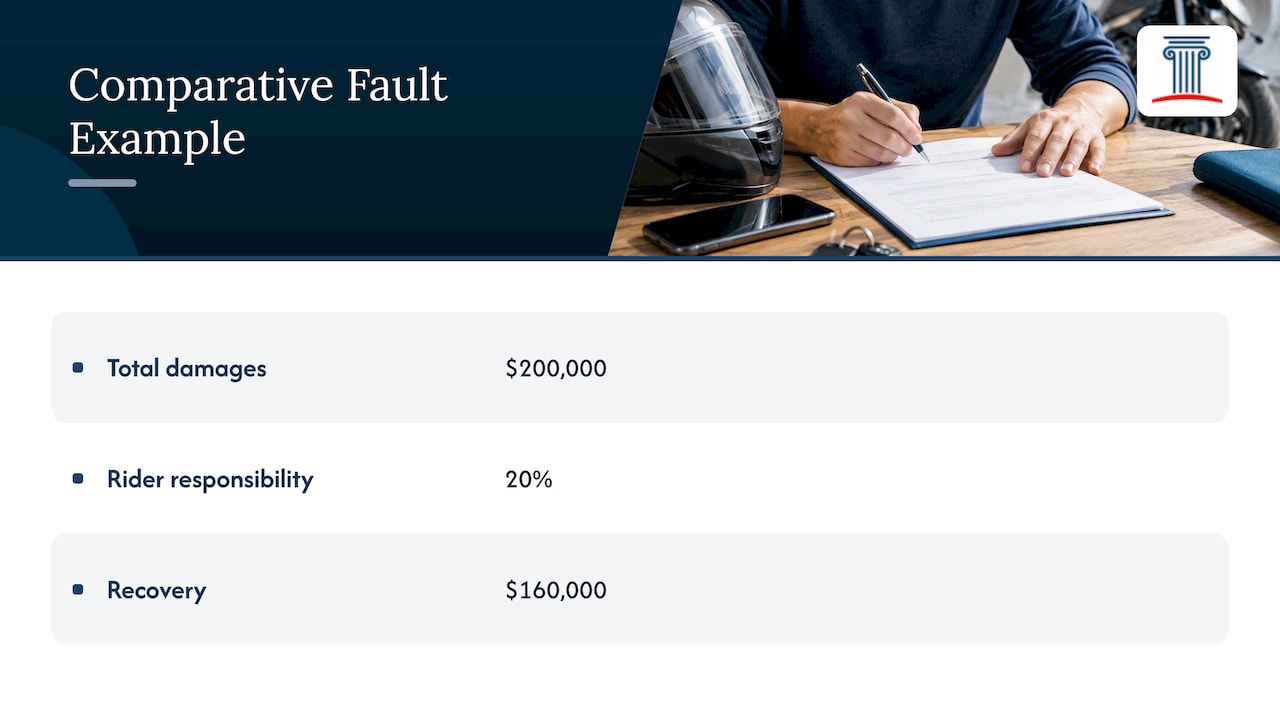
A simple illustration, using made-up numbers for explanation only: suppose a jury finds your total damages are $200,000 and decides you were 20 percent responsible because you were traveling somewhat faster than traffic. Your recovery would be reduced by 20 percent. That is why insurers work so hard to move even a small percentage of blame onto the rider. Every point of fault they assign comes straight out of your compensation.
This is also why you should be careful about what you say after a crash. A casual “I didn’t see him until the last second” or “I’m fine” at the scene can resurface in a recorded statement. You can be honest and polite with police and medics while declining to give a detailed statement to the other driver’s insurance company until you have received advice.
Lane splitting, helmets and rider bias
Motorcyclists in Orange County know the daily reality of crowded freeways like the 91 and the 5 near Buena Park. Lane splitting is a common point of dispute after a collision, so it is worth understanding what the law says.
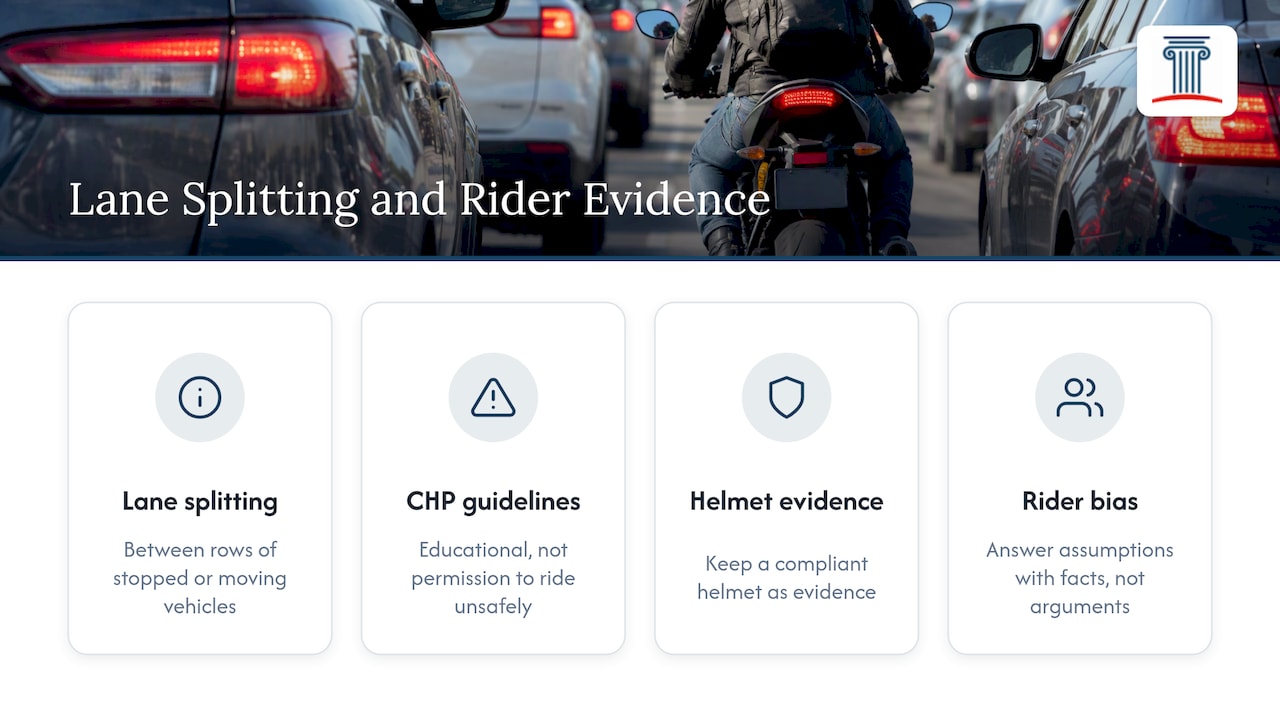
California Vehicle Code section 21658.1 defines lane splitting as driving a two-wheeled motorcycle between rows of stopped or moving vehicles in the same lane, and it allows the California Highway Patrol to develop educational safety guidelines for the practice. Those guidelines are educational, not a license to ride unsafely, and an insurer may point to them to argue you were riding too fast for conditions. Whether lane splitting played any role in your crash, and whether it was done reasonably, is a factual question we examine closely with the report, the vehicle positions and any footage.
Helmet use is another issue insurers raise. If you were wearing a compliant helmet, document it and keep the helmet, because it is evidence. If there is a question about gear, the issue is generally whether it contributed to a specific injury, not whether it makes you a bad rider.
Both topics feed into a broader problem: many adjusters and some jurors carry assumptions about motorcyclists. A solid claim answers those assumptions with facts, not arguments.
Common ways motorcycle crashes happen in Buena Park
Buena Park is a busy crossroads, with heavy retail and tourist traffic, wide arterial streets and freeway access close by. Certain situations produce a large share of rider injuries anywhere in Orange County, and they are the ones we see in claims:
- Left-turn collisions. A driver turns across your path at an intersection and claims they did not see you.
- Unsafe lane changes. A car drifts into your lane, often in a blind spot.
- Rear-end crashes in stop-and-go traffic.
- Dooring or sudden stops in parking lots and commercial driveways.
- Road hazards, such as potholes, gravel, oil or poorly maintained pavement, where a public agency or property owner may share responsibility.
- Impaired or distracted driving.
Each of these changes who is responsible and which insurance applies. A road-defect claim against a city or other public agency, for instance, is handled differently from a claim against a private driver, and the notice deadlines can be much shorter. That is a reason to get advice early rather than wait for the insurer’s first offer.
What to do after the crash
Your health comes first, and your claim benefits from the same steps.
- Call 911 and get medical care, even if you feel you can walk it off. Adrenaline hides injuries, and head, neck and back injuries often show up later. A prompt medical record also links your injuries to the crash.
- Report the crash to the police and ask how to obtain the report.
- Photograph everything. The scene, vehicle positions, skid marks, traffic signals, your injuries, your bike and your gear.
- Collect names and contact details for the other driver, their insurer and any witnesses. Witnesses matter most in cases where the driver says you caused the crash.
- Keep your helmet and damaged gear. Do not repair or sell the bike until it has been documented.
- Follow your treatment plan and keep a simple journal of pain, sleep, missed work and activities you can no longer do.
- Limit what you say to insurers. Report the crash as required by your policy, but avoid recorded statements and early settlement offers until you understand the full extent of your injuries.
- Speak with a Buena Park personal injury attorney before signing anything.
Deadlines you cannot miss
California sets strict time limits on injury claims. For most personal injury lawsuits, the general rule is a two-year window from the date of the injury, but exceptions exist, and the clock can be much shorter when the claim involves a city, county or other government entity, which typically requires a formal written claim first. Because the exact period depends on who is responsible and the facts of your case, treat any deadline you read online, including this one, as a reason to call an attorney soon, not as a date to plan around. Waiting also costs you evidence: video is overwritten, witnesses move and memories fade.
Our perspective on motorcycle claims
We represent injured people in Orange County, and what we see in motorcycle cases is consistent. Riders are rarely paid fairly by the first offer, and the offer usually arrives before anyone knows the full medical picture. A fractured wrist that looks like a six-week problem can become months of therapy and a permanent loss of grip, and a settlement signed too early closes the door on all of it.
We also see how much the story of the crash is shaped in the first days. Insurers move quickly to frame the rider as reckless. Our approach is to move just as quickly to gather the facts, protect the evidence and present your injuries as they truly are. We do not ask whether a claim can be made stronger; we figure out how.
Most of all, we want you to feel understood. A serious crash upends your work, your family and your sense of safety. Our attorneys and staff speak English and Spanish, so you can explain what happened in the language you are most comfortable with, and we explain your rights in return, plainly and without pressure.
— Maya Serkova
Getting help from a Buena Park injury team
If you were injured on a motorcycle in Buena Park, we offer a free consultation to review what happened, explain your options and tell you honestly whether we can help. In select personal injury matters we work on a contingency basis, which means our fee depends on the outcome of your case, and we will explain how that applies to your situation at the start. Learn more about our personal injury practice, see how our Buena Park personal injury lawyers approach local cases, or contact us to schedule a conversation about your claim.
If your accident involved someone else on the road, we also help with pedestrian accidents in Buena Park and bicycle accidents in Buena Park.
Frequently asked questions
How much is my Buena Park motorcycle accident claim worth?
There is no reliable figure without knowing your injuries, your treatment, your lost income and how fault is assigned. Published “average settlements” blend very different cases and can mislead you. An attorney can evaluate your records and give you a realistic range once your medical picture is clearer.
Can I still recover compensation if I was partly at fault?
Yes. Under California’s comparative-fault rule, your damages are reduced by your percentage of responsibility instead of being denied altogether. That is why it matters to dispute any unfair fault assignment from the insurer.
Can stress and anxiety be included in my claim?
Emotional distress is a recognized part of non-economic damages when it results from the crash. It carries the most weight when supported by medical or counseling records and a clear description of how it affects your daily life.
Will physical therapy increase my settlement?
Therapy costs are recoverable economic damages, and consistent attendance documents the seriousness of your injury and your effort to recover. It is not a way to inflate a claim, and gaps in treatment can hurt it, so follow your doctor’s recommendations.
How long do I have to file?
Most California injury lawsuits must be filed within a limited period measured in years, and claims involving government entities can have much shorter notice requirements. Because the exact deadline depends on your facts, contact an attorney as soon as you can after the crash.