Getting passed over for a promotion or being assigned tough shifts because of your accent or background can feel isolating, especially when you know your skills match the job. Manufacturing employees in Garden Grove deserve fair treatment, and facing national origin discrimination brings real stress and uncertainty about job security. Understanding your rights under both federal and California law helps you recognize unfair practices and shows you the steps to protect yourself and your future at work.
Table of Contents
- Defining National Origin Discrimination In Manufacturing
- Types And Examples Of Discriminatory Practices
- California And Federal Legal Protections Explained
- Employer Obligations And Permissible Policies
- Procedure For Filing Claims And Remedies Available
Key Takeaways
| Point | Details |
|---|---|
| Understanding Discrimination | National origin discrimination is illegal under federal law for employers with 15 or more employees, affecting all aspects of employment from hiring to daily treatment. |
| Types of Discriminatory Practices | Discrimination can be direct, such as denial of promotion based on accent, or indirect, such as policies that appear neutral but disadvantage certain national origins. |
| Legal Protections in California | California law offers broader protections against national origin discrimination than federal law, applying to employers with as few as 5 employees. |
| Steps for Filing Claims | Workers should act quickly to file claims as there are strict deadlines, and pursuing both federal and state remedies can offer stronger legal standing. |
Defining National Origin Discrimination in Manufacturing
National origin discrimination happens when an employer treats you unfavorably because of where you’re from, your ethnicity, your accent, or your association with a particular country or culture. In Garden Grove’s manufacturing sector, this kind of discrimination can show up in ways that might seem subtle at first, but have serious consequences for your job security and career.
Under federal law, national origin discrimination is illegal for any employer with 15 or more employees. That protection covers everything from hiring and firing decisions to promotions, pay, training opportunities, and how you’re treated day to day on the floor. The legal frameworks protecting you include Title VII of the Civil Rights Act, which makes it crystal clear that employers cannot base employment decisions on your national origin. What this means in practical terms is that your employer cannot favor one nationality or ethnic group over another, cannot make decisions based on where you were born, and cannot treat you differently because of an accent or language background.
In manufacturing environments specifically, national origin discrimination often appears in several distinct ways. An employer might pass you over for a promotion that you’re qualified for and give it instead to someone from a different background. They might assign you the least desirable shifts or tasks based on your national origin. They might exclude you from training programs or advancement opportunities that would normally be available to similarly situated employees. Harassment also counts as discrimination, whether it’s derogatory comments about your country of origin, mocking your accent, or creating a hostile work environment based on ethnicity. Even seemingly small actions like requiring only certain employees to show extra documentation or speak only English on the job can constitute illegal discrimination if applied unequally.
What makes this different from simple rudeness is that discriminatory treatment must be systematic or stem from a discriminatory motive. An isolated comment that offends you probably won’t rise to the legal standard, but a pattern of unfavorable treatment absolutely will. The key question courts and investigators ask is this: Would you have been treated the same way if you had a different national origin? If the answer is no, then discrimination likely occurred.
Pro tip: Document everything by keeping detailed records of any unfavorable treatment, dates, names of witnesses, and what happened. Email yourself summaries if needed, and note whether similarly situated employees from different backgrounds were treated more favorably in the same situations.
Types and Examples of Discriminatory Practices
National origin discrimination in manufacturing environments takes many forms, and understanding the specific ways it shows up can help you recognize when it’s happening to you. Discrimination can be blatant and obvious, or it can be subtle enough that you might question whether what you experienced was really unfair treatment. Discriminatory practices range from direct exclusion in hiring and promotions to indirect policies that seem neutral on the surface but end up disadvantaging workers from certain backgrounds. The reality is that both types are illegal, and both can seriously damage your career prospects and workplace experience.
Direct discrimination shows up when an employer makes an explicit decision based on your national origin. An employer might refuse to hire you because of your accent, even though you speak English fluently enough to do the job. They might pass you over for a promotion and give it to someone less qualified but from a preferred background. They could assign you to the graveyard shift or the dirtiest jobs while giving better assignments to workers from other origins. Pay discrimination also falls into this category, where workers with the same position and performance receive different compensation based on national origin. Harassment based on accent, cultural customs, or country of origin is another form of direct discrimination that creates a hostile work environment. One documented case involved African employees who faced constant mocking of their accents and unjustified scrutiny of their work, making it nearly impossible to perform their jobs without stress and humiliation.

Indirect discrimination is trickier because the policy itself might seem neutral, but it affects certain groups unfairly. For example, an employer might require all employees to speak only English, even in situations where it is not necessary for the job. This policy appears neutral until you realize it disadvantages workers whose first language is not English and can unfairly limit their opportunities for advancement or even their ability to work comfortably with colleagues. Another example is requiring specific certifications or educational credentials that are harder for immigrants to obtain, even when these qualifications are not truly necessary for job performance. Retaliation against workers who complain about discrimination is also illegal and represents another serious form of discriminatory practice. This might look like being demoted, receiving poor performance reviews, having hours cut, or being moved to an undesirable position after you file a complaint.
The key to recognizing these practices is understanding that discrimination does not need to be intentional to be illegal. Systemic bias that affects groups of people, unconscious prejudice, or policies that create unequal outcomes all count. Your employer cannot hide behind claims that they did not mean to discriminate. What matters is the result: did the action limit your opportunities or create a worse work experience because of your national origin?
Here’s a quick comparison of direct vs. indirect national origin discrimination in manufacturing workplaces:
| Discrimination Type | Typical Examples | How It Manifests | Legal Standard |
|---|---|---|---|
| Direct | Passing over for promotion based on accent | Unequal shift assignments given openly | Intent is clear and explicitly based on origin |
| Indirect | Unjustified English-only policy | Neutral policies with unequal outcomes | Impact matters, intent may be hidden |
Pro tip: Keep a detailed log with dates, times, and descriptions of each incident, including who witnessed it and what was said or done. This creates a timeline that becomes invaluable if you need to file a complaint or pursue legal action.
California and Federal Legal Protections Explained
You have protections at two levels: federal law and California state law. This dual protection system is actually good news for you because California often goes further than federal requirements, giving you stronger rights. Federal laws enforced by the EEOC cover most employers with 15 or more employees and prohibit discrimination based on national origin in hiring, firing, promotions, compensation, and all other employment terms. Title VII of the Civil Rights Act is the main federal statute that shields you from this kind of discrimination. However, California has decided that federal protections are not enough, so the state added its own layer of safeguards.
California’s Fair Employment and Housing Act, or FEHA, is your strongest weapon against national origin discrimination. The FEHA covers employers with even fewer than 15 employees, meaning you have protection even if you work at a smaller manufacturing facility. More importantly, FEHA provides broader remedies than federal law, which means you can potentially recover more money if you win your case. The FEHA also imposes affirmative obligations on your employer, requiring them to prevent discrimination and harassment actively, not just avoid discriminating. Additionally, California employment law requires employers to make good faith efforts to accommodate employees where necessary, going beyond what federal law demands. This means your employer cannot simply claim they did not intentionally discriminate; they must show they took steps to prevent it and to address complaints when raised.
The practical difference between federal and state law matters significantly in Garden Grove. If you file a claim under federal law through the EEOC, you are limited in the damages you can recover and the time it takes to resolve your case can stretch out. If you file under FEHA, you have broader options, longer timeframes to pursue your claim, and potentially larger financial recoveries. You can actually pursue both simultaneously, which gives you flexibility in how you approach your case. The FEHA also protects you from retaliation if you report discrimination or participate in an investigation, and these protections are often stronger than federal retaliation protections.
One critical thing to understand is that you do not have to choose one or the other. Your case can be pursued under both federal and state law, giving you the strongest possible legal position. An experienced employment attorney can evaluate your specific situation and determine the best strategy for your particular circumstances. The key takeaway is this: California recognizes that national origin discrimination is serious, and the state has built a comprehensive system to protect you that goes beyond federal minimums.
The following table summarizes the differences between federal and California state law protections for national origin discrimination:
| Aspect | Federal Law (Title VII) | California State Law (FEHA) |
|---|---|---|
| Employer size coverage | 15+ employees required | Applies to 5+ employees |
| Types of damages | Capped compensatory/punitive | Broader and potentially higher |
| Claim time limits | Shorter deadlines | Longer deadlines available |
| Employer obligations | Prohibit discrimination | Must actively prevent and address |
| Retaliation protections | Prohibited, limited remedies | Stronger, broader remedies |
Pro tip: Contact an employment law attorney as soon as possible after experiencing discrimination, since there are applicable statute of limitations that should be evaluated on a case by case basis, and preserving evidence becomes harder the longer you wait.
Employer Obligations and Permissible Policies
Your employer has clear legal obligations when it comes to national origin discrimination, and understanding what these are helps you identify when they are being violated. The law does not simply tell employers to avoid being overtly discriminatory. Instead, employers must actively maintain neutral policies that do not disproportionately harm workers from certain national origins unless there is a genuine business reason for the policy. This means your employer cannot hide behind seemingly neutral rules if those rules actually target or disadvantage people from your country of origin or ethnic background. Employers must also provide equal access to training, benefits, and promotion opportunities, and they cannot make hiring or firing decisions based on national origin or stereotypes associated with your background.
Language policies are a perfect example of where employers often cross the line. Your employer can require employees to speak English on the job, but only if this requirement is truly necessary for the business to operate. For instance, if you work in a role where you interact with customers, English fluency might be justified. However, language requirements must be justified by business necessity, which means your employer cannot simply decide that all employees must speak English at all times in all situations, including during breaks or when working independently. If your employer enforces an English-only policy just because they prefer it or because of their own biases, that is discrimination. Many manufacturing facilities in Garden Grove have gotten this wrong by imposing English-only rules in the break room or during informal workplace conversations, which courts have found to be discriminatory because they serve no legitimate business purpose.
Beyond policies, employers have obligations regarding harassment and retaliation. Your employer must actively work to prevent harassment based on national origin, which means they should have clear procedures in place, train supervisors and managers, and respond promptly when complaints are made. When you report discrimination or harassment, your employer cannot retaliate against you by cutting your hours, demoting you, giving you poor performance reviews, or isolating you at work. Employers are responsible for preventing harassment and addressing complaints effectively, which means they cannot just say they have a policy and then do nothing when you come forward. If you report discrimination and your employer does anything negative to you afterward, that retaliation is itself illegal and actionable.
The bottom line is this: your employer cannot use neutral sounding policies as a cover for discrimination. Every policy and decision must be genuinely job related and applied consistently. If you are being treated differently because of your national origin, that is a violation of your employer’s legal obligations, regardless of what neutral language they use to justify it.
Pro tip: Request a copy of your employer’s workplace policies in writing and document how these policies are actually applied in practice, noting if workers from different national origins are treated differently under the same policy.
Procedure for Filing Claims and Remedies Available
If you have experienced national origin discrimination, you have a legal process available to hold your employer accountable and seek compensation. The first critical step is understanding the timeline. You need to act relatively quickly because there are applicable statute of limitations that vary depending on whether you file under federal or state law, and these should be evaluated on a case by case basis. Once you miss the deadline, you lose your right to pursue the claim entirely, so time is genuinely important here.
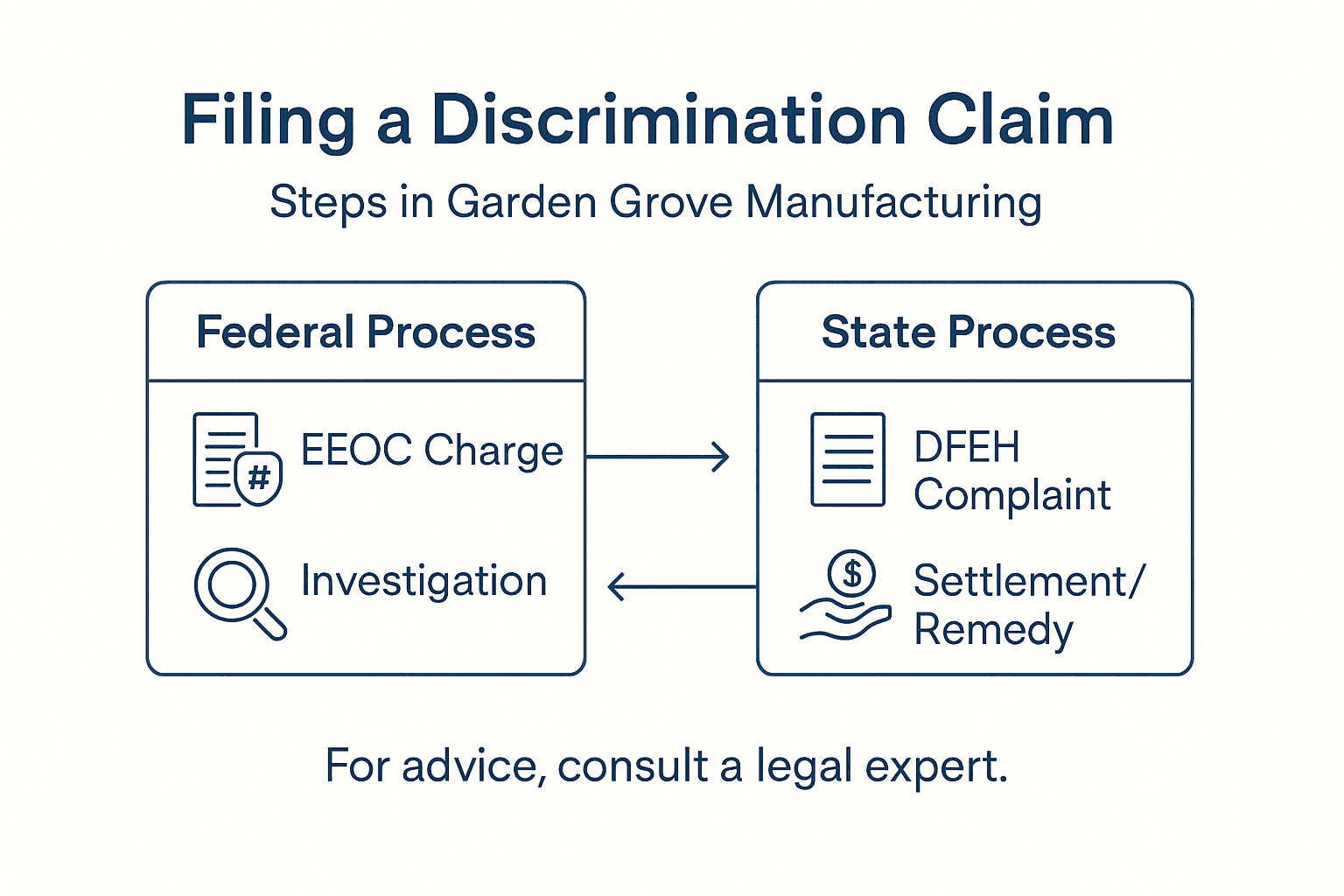
The federal process typically begins with the EEOC. You must file a charge with the EEOC as your first formal step in the federal system. The EEOC then investigates your charge, gathering evidence from you, your employer, and any witnesses. The agency attempts to resolve the matter through mediation or settlement, which can be faster and less adversarial than litigation. If settlement fails, the EEOC can file a lawsuit on your behalf or issue you a right to sue letter, which allows you to pursue the case in court with an attorney. Alternatively, you can pursue your claim directly through California state channels using the state’s fair employment agency, which operates under FEHA, or you can go directly to court in some circumstances. Many Garden Grove manufacturing workers file under both federal and state systems simultaneously because California often provides stronger protections and larger potential recoveries.
What You Can Recover
The remedies available to you if you win your case are substantial. You can seek reinstatement to your job if you were fired, or placement in a position you should have been promoted to. Back pay covers all the wages you lost due to the discrimination, including benefits. Compensatory damages cover your pain and suffering, emotional distress, and harm to your reputation. Many cases also include punitive damages, which punish the employer for intentional discrimination. Beyond money, you can obtain injunctive relief, which means a court order forcing your employer to change specific policies or practices to prevent future discrimination. If discrimination is systematic within the company, courts can mandate company-wide policy changes, training programs, and monitoring.
The amount of money you can recover depends on the severity of the discrimination, how long it lasted, and how it impacted you financially and emotionally. Some manufacturing workers in Garden Grove have recovered six figures when discrimination led to job loss or permanent career damage. Your damages are not limited to the amount the EEOC might initially suggest. Working with an employment attorney allows you to pursue the full range of available remedies and fight for the maximum compensation you deserve. The key point is this: you are not limited to getting your job back. You can recover real money that compensates you for what the discrimination cost you.
Pro tip: Gather all documentation immediately: performance reviews, emails, text messages, pay stubs, and witness contact information, as evidence collected early is typically stronger and more credible than evidence gathered months later.
Stand Strong Against National Origin Discrimination in Garden Grove Manufacturing
Facing unfair treatment at work because of your national origin can create deep stress and uncertainty about your future. If you are dealing with denied promotions, biased language policies, or hostile work environments in Garden Grove’s manufacturing sector you need experienced legal help that understands both federal and California protections like FEHA. Our team at Serendib Law Firm is dedicated to fighting for your rights and ensuring you receive the justice and compensation you deserve.
Don’t let discrimination limit your career or peace of mind. Learn how we have helped others in our community by visiting our Garden Grove Archives and explore more about your legal options in Orange County. Act now to protect your rights and secure your future. Contact us at Serendib Law Firm for a free consultation and take the first step toward holding your employer accountable.
Frequently Asked Questions
What is national origin discrimination in the manufacturing industry?
National origin discrimination occurs when an employer treats an employee unfairly based on their ethnicity, accent, country of origin, or cultural association. In manufacturing, this can affect hiring, promotions, job assignments, and treatment in the workplace.
How can I identify if I am a victim of national origin discrimination?
You may be experiencing national origin discrimination if you are passed over for promotions despite being qualified, assigned undesirable shifts based on your background, or subjected to derogatory comments about your national origin. Keeping detailed records of any unfair treatment is crucial for identification.
What legal protections are available against national origin discrimination?
Both federal law and California state law provide protections against national origin discrimination. Federal protections apply to employers with 15 or more employees, while California’s Fair Employment and Housing Act provides broader protections, covering employers with 5 or more employees and requiring them to actively prevent discrimination.
What steps should I take if I experience national origin discrimination?
If you encounter national origin discrimination, document all incidents in detail, including dates, witnesses, and comments made. Then, consider filing a complaint with your employer and, if necessary, with the EEOC or California’s fair employment agency, ensuring you adhere to any timelines for filing claims.