Facing a non-compete agreement can feel daunting for Cypress Technology employees who want to pursue new opportunities in Southern California. With recent California laws now banning most non-compete clauses and offering robust protections for workers, understanding your rights has never been more important. This guide explains how these legal changes affect tech professionals, highlighting key steps to guard your career and challenge restrictive agreements effectively.
Table of Contents
- Defining Non-Compete Agreements In Technology
- California Law On Non-Competes In 2026
- Types Of Restrictive Covenants For Cypress Employees
- Rights And Risks In Non-Compete Disputes
- Trade Secret Protection Without Non-Competes
- Resolving Non-Compete Disputes Legally
Key Takeaways
| Point | Details |
|---|---|
| Non-Compete Agreements (NCAs) in Technology | NCAs are contracts that restrict employees from joining competitors, designed to protect sensitive business information and trade secrets. |
| California Law Changes in 2026 | California will ban most non-compete agreements, enhancing employee mobility and legal protections against restrictive clauses. |
| Restrictive Covenants Types | Common types include non-compete, non-solicitation, and confidentiality agreements, which need careful legal review for enforceability. |
| Navigating Non-Compete Disputes | Employees should document interactions and consult legal specialists to address dispute resolutions effectively and understand their rights. |
Defining Non-Compete Agreements in Technology
Non-compete agreements (NCAs) represent legally binding contracts that restrict technology employees from working for competing organizations or launching rival businesses for a specified duration after leaving their current employer. These agreements are strategically designed to protect a company’s sensitive business interests, intellectual property, and confidential information.
In the technology sector, non-compete agreements typically emerge as critical tools for safeguarding trade secrets and preventing knowledge transfer between competing organizations. Government research indicates that NCAs are extensively used across technology job categories, particularly for roles involving access to proprietary information and innovative technological developments.
The key components of a non-compete agreement in technology often include:
- Geographic restrictions defining prohibited employment regions
- Time-based limitations on working for competitors
- Specific definitions of competitive businesses or activities
- Scope of restricted professional activities
- Financial penalties for contract violations
Technology companies frequently implement these agreements to mitigate risks associated with intellectual property leakage and protect significant investments in research and development. Federal Trade Commission studies demonstrate that while NCAs aim to protect business interests, they can simultaneously reduce innovation by limiting knowledge spillovers and constraining inventor mobility.
Pro tip: Always carefully review and understand the full implications of a non-compete agreement before signing, and consider consulting an employment law professional to interpret its specific restrictions and potential long-term career impacts.
California Law on Non-Competes in 2026
In 2026, California has solidified its position as a national leader in protecting employee mobility through comprehensive legislation that fundamentally restricts non-compete agreements. California’s new legal framework represents a stringent approach to preventing employers from constraining workers’ professional opportunities through restrictive contractual clauses.
The state’s legislative approach is characterized by several key provisions that dramatically reshape how non-compete agreements can be constructed and enforced:
- Complete prohibition of most non-compete clauses
- Retroactive invalidation of existing non-compete agreements
- Expanded legal protections for employees
- Significant financial penalties for non-compliant employers
- Private right of action for employees facing non-compete restrictions
Statutory Landscape for non-compete agreements in California now explicitly bans restrictive employment contracts with extremely narrow exceptions. The laws apply not just to contracts signed within California, but potentially extend to agreements originating in other states when they impact California-based employees or businesses.
Employers attempting to enforce non-compete agreements now face substantial legal risks. The legislation creates robust mechanisms for employees to challenge these restrictions, including potential monetary damages and injunctive relief. Technology companies, particularly in innovation hubs like Silicon Valley, must dramatically redesign their employment contract strategies to comply with these progressive legal standards.

Pro tip: Consult an employment law specialist immediately if you have an existing non-compete agreement, as the 2026 California laws may render your current contract unenforceable.
Here’s a comparison of how non-compete agreement laws differ between California in 2026 and other major technology states:
| Legal Aspect | California (2026) | Texas & Massachusetts | New York |
|---|---|---|---|
| Non-compete enforceability | Nearly all banned | Generally allowed, with restrictions | Allowed with reasonableness |
| Employee protections | Strong, broad legal remedies | Moderate, case-by-case | Varies by court decision |
| Scope of impact | Applies retroactively | Forward only, existing contracts valid | Current contracts usually valid |
| Employer penalties | Significant financial risk | Minimal unless proven unlawful | Fines possible if overbroad |
Types of Restrictive Covenants for Cypress Employees
Restrictive covenants represent legal mechanisms that technology employers like Cypress Tech use to protect their business interests and confidential information. Legal frameworks increasingly scrutinize these agreements to balance employer protection with employee mobility and professional freedom.
The primary types of restrictive covenants encountered by Cypress employees typically include:
- Non-Compete Clauses: Preventing employees from working with direct competitors
- Non-Solicitation Agreements: Restricting contact with former clients or colleagues
- Confidentiality Agreements: Protecting trade secrets and proprietary information
- No-Hire Provisions: Preventing recruitment of current or former employees
- Intellectual Property Assignment Agreements: Transferring work-related innovations to the employer
Modern legal developments highlight evolving approaches to workforce mobility that challenge traditional restrictive covenant structures. Technology sectors like Cypress are experiencing significant shifts, with courts and legislatures increasingly prioritizing employee rights while still recognizing legitimate business protection needs.
Enforceability of these covenants depends on multiple factors, including reasonableness of scope, duration, and geographic limitations. Technology employees must carefully evaluate the specific terms of any restrictive covenant, understanding that overly broad restrictions may be deemed unenforceable by courts.
Pro tip: Consult an employment law specialist to thoroughly review any restrictive covenant before signing, ensuring your professional future remains uncompromised.
Below is a summary of restrictive covenants and their typical legal review criteria in the technology sector:
| Covenant Type | Common Legal Review Factors | Impact on Employees |
|---|---|---|
| Non-compete Clause | Duration, scope, geography | Limits future job options |
| Non-solicitation Agreement | Definition of clients, length | Restricts contacting clients |
| Confidentiality Agreement | Detail of protected info | Improves data security |
| No-Hire Provision | Scope of eligible employees | Affects team-building efforts |
| IP Assignment Agreement | Breadth of IP definition | Assigns ownership of patents |
Rights and Risks in Non-Compete Disputes
Non-compete disputes present complex legal challenges that fundamentally impact employee mobility and employer protection strategies. Federal regulatory insights highlight significant worker risks associated with these restrictive agreements, revealing the nuanced balance between corporate interests and individual professional freedoms.
The key rights and risks for employees in non-compete disputes include:
-
Employee Rights:
- Right to challenge overly broad restrictions
- Protection against unfair employment constraints
- Ability to seek legal remedy for contract overreach
- Freedom to pursue professional opportunities
-
Potential Employee Risks:
- Limited job mobility
- Potential wage suppression
- Legal uncertainty and litigation costs
- Career trajectory disruption
Legal Landscape of non-compete disputes continues to evolve, with ongoing congressional analysis demonstrating the complex interplay between employer protections and worker rights. Technology employees must navigate these intricate legal frameworks carefully, understanding that each jurisdiction may interpret non-compete agreements differently.
Employers face substantial risks when attempting to enforce non-compete agreements, including potential legal challenges, reputational damage, and significant financial penalties. Technology workers like those at Cypress Tech must proactively understand their contractual obligations while preserving their professional autonomy.
Pro tip: Document every interaction and communication related to your non-compete agreement, as detailed records can become critical evidence if a dispute emerges.
Trade Secret Protection Without Non-Competes
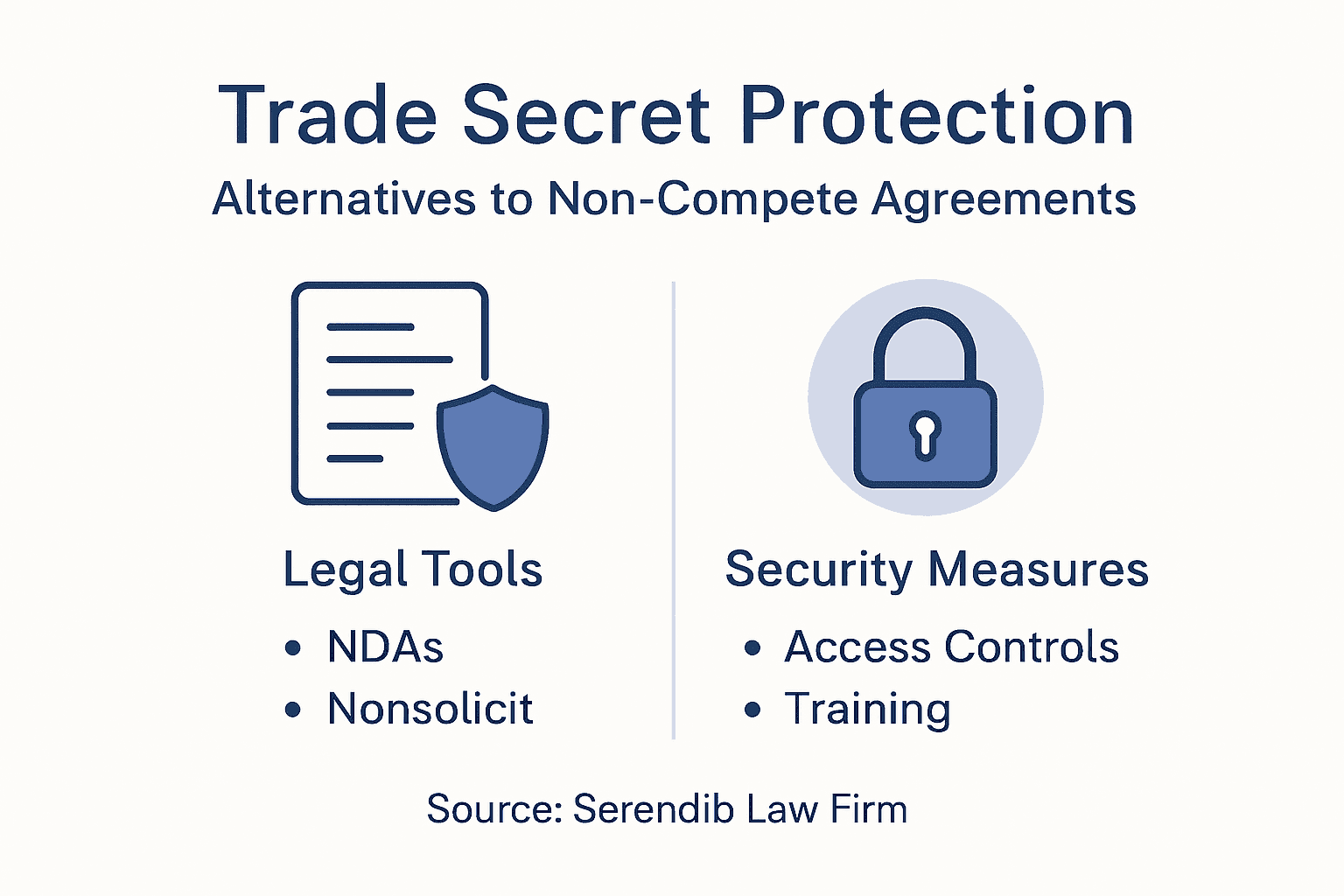
Technology companies like Cypress Tech have multiple legal strategies to protect sensitive information without relying on restrictive non-compete agreements. Uniform Trade Secrets Act provides comprehensive protection for businesses seeking to safeguard their intellectual property while maintaining employee mobility.
Alternative methods for trade secret protection include:
-
Confidentiality Agreements:
- Restrict disclosure of proprietary information
- Legally binding without limiting employment options
- Specifically define protected information
- Provide clear consequences for violations
-
Contractual Protective Mechanisms:
- Non-solicitation clauses
- Intellectual property assignment agreements
- Limited-scope information protection strategies
- Targeted legal remedies for specific breaches
Legal Frameworks continue to evolve, with alternative approaches emerging that balance business protection with employee professional freedom. These strategies allow companies to secure competitive advantages without imposing overly restrictive employment constraints.
Technology employees and employers must carefully craft agreements that protect legitimate business interests while respecting individual career mobility. Precise legal language and targeted protective clauses can achieve comprehensive security without the broad limitations of traditional non-compete agreements.
Pro tip: Consult an employment law specialist to design nuanced protection strategies that secure your business interests without unnecessarily restricting employee opportunities.
Resolving Non-Compete Disputes Legally
Resolving non-compete disputes requires a strategic approach that balances legal protections with professional mobility. Federal regulatory changes have dramatically transformed the landscape of employment contract enforcement, creating new pathways for dispute resolution.
Key strategies for legally addressing non-compete disputes include:
-
Negotiation Approaches:
- Direct communication with current/former employer
- Mediation with neutral third-party facilitator
- Comprehensive review of agreement terms
- Identifying potential overreach in restrictions
-
Legal Challenge Mechanisms:
- Challenging agreement’s geographical scope
- Contesting unreasonable duration of restrictions
- Proving economic hardship from restrictions
- Demonstrating lack of legitimate business interest
Legal Landscape continues to evolve, with ongoing court injunctions and litigation creating complex precedents for non-compete dispute resolution. Technology employees must navigate these intricate legal frameworks carefully, understanding that each jurisdiction may interpret agreements differently.
Employees facing non-compete disputes should document every interaction, gather comprehensive evidence, and consult specialized employment law attorneys who understand the nuanced legal terrain. Strategic preparation and understanding of recent regulatory changes can significantly impact the outcome of non-compete disputes.
Pro tip: Preserve all documentation related to your employment and non-compete agreement, as these records can become critical evidence in potential legal proceedings.
Protect Your Rights in Cypress Tech Non-Compete Disputes
Navigating non-compete agreement disputes can feel overwhelming, especially when these contracts limit your ability to advance your career or protect your professional freedom. The challenges discussed in this article highlight critical issues such as restrictive covenants, employee rights to challenge overbroad clauses, and evolving California laws that now strongly favor employee mobility. If you work in technology or for companies like Cypress Tech, understanding these legal complexities is essential to safeguard your career and avoid costly mistakes.
At Serendib Law Firm, we specialize in employment law cases focused on non-compete and restrictive covenant disputes. Our team offers personalized advocacy designed to protect your rights and negotiate or challenge unfair contracts. Explore our detailed insights and resources in the Cypress Archives and broader CA Employment Law Archives to stay informed. Don’t wait until a dispute disrupts your career. Visit Serendib Law Firm to schedule your free consultation and take decisive action to protect your professional future today.
Frequently Asked Questions
What is a non-compete agreement?
Non-compete agreements are legally binding contracts that restrict employees from working for competing organizations or starting rival businesses for a specified time after leaving their employer. They are commonly used in the technology sector to protect sensitive business interests and intellectual property.
What should I do if I have a non-compete dispute with Cypress Tech?
If you are facing a non-compete dispute, it’s essential to document every interaction related to the agreement. Consider consulting an employment law specialist to understand your rights and options for challenging the restrictions outlined in your contract.
How do California’s 2026 laws affect non-compete agreements?
California’s 2026 laws largely ban non-compete agreements, with significant protections for employees, including the ability to challenge existing contracts. Employers who attempt to enforce non-compete clauses face substantial legal risks and penalties.
What alternative methods can companies use to protect trade secrets instead of non-compete agreements?
Companies can use confidentiality agreements, non-solicitation clauses, and intellectual property assignment agreements to protect sensitive information without restricting employee mobility. These alternatives provide legal protection while allowing employees more flexibility in their career options.
Recommended
- Non-Compete and Trade Secret Disputes in Cypress Tech | Serendib Law Firm
- Experienced Cypress Employment Law Attorneys
- Wrongful Termination After PIPs in Irvine Tech – Employee Rights and Legal Actions | Serendib Law Firm
- Age Discrimination in Irvine Tech Layoffs: Broadcom and Google | Serendib Law Firm