Workplace tensions can quickly surface when an employee’s sincerely held religious beliefs run up against company policies or scheduling demands. For human resources managers and diversity officers in Westminster, understanding religious accommodation conflicts is vital to respecting employee rights while keeping operations running smoothly. This guide examines the types of accommodations local employees request, outlines the legal requirements under Title VII and California FEHA, and shares expert strategies for managing these sensitive issues with confidence.
Table of Contents
- Defining Religious Accommodation Conflicts
- Types of Accommodation Requests In Westminster
- Legal Protections Under Feha And Title Vii
- Hr Strategies For Diverse Workforces
- Employer Duties And Common Pitfalls
- Managing Risks And Legal Exposure
Key Takeaways
| Point | Details |
|---|---|
| Understanding Religious Accommodation | Employers are required to provide reasonable accommodations for employees’ sincerely held religious beliefs unless it causes undue hardship. |
| Legal Frameworks | Title VII of the Civil Rights Act and the California Fair Employment and Housing Act set the foundation for protecting religious practices in the workplace. |
| Proactive HR Strategies | Developing comprehensive policies and training for managers helps ensure fair evaluation of religious accommodation requests. |
| Risk Management | Establishing transparent protocols and documentation can mitigate legal exposure and demonstrate a commitment to inclusivity in the workplace. |
Defining Religious Accommodation Conflicts
Religious accommodation conflicts emerge when an employee’s sincerely held religious beliefs create tension with workplace requirements or policies. These complex interactions occur when workers need adjustments to standard work practices to observe their faith. Religious accommodation laws mandate that employers provide reasonable modifications unless such changes would impose significant operational challenges.
Under Title VII of the Civil Rights Act, employers must engage in an interactive process with employees to explore potential accommodations. This might involve adjusting work schedules, modifying dress codes, or providing spaces for prayer and religious observance. Common scenarios include requests for time off during religious holidays, wearing religious attire, or scheduling around sabbath observances. Employers cannot discriminate based on religious practices and must demonstrate genuine efforts to find mutually acceptable solutions.
Workplace religious accommodation conflicts typically manifest in several key areas. These include scheduling conflicts, dress code exceptions, grooming standards, and providing alternative work assignments that do not conflict with religious beliefs. The legal standard requires employers to show that an accommodation would create undue hardship – meaning more than minimal additional cost or operational disruption. Religious discrimination protections ensure that workers cannot be penalized or marginalized for practicing their faith.
Pro tip: Create a standardized religious accommodation request form and training protocol to help managers consistently and fairly evaluate employee religious practice modification requests.
Types of Accommodation Requests in Westminster
Religious accommodation requests in Westminster workplaces reflect the diverse faith practices of employees seeking reasonable adjustments to standard work expectations. Religious accommodation guidelines outline several key categories of potential modifications that employers must thoughtfully consider while maintaining operational effectiveness.
The most frequent accommodation requests typically involve scheduling flexibility, religious attire exceptions, and designated prayer spaces. Employees might seek shift adjustments to observe religious holidays, permission to wear traditional religious garments like hijabs, yarmulkes, or turbans, or request time and private areas for daily prayer or meditation. Other common requests include allowing beard or hairstyle variations connected to religious practices, shift substitutions during significant religious observances, and potential reassignments that minimize conflicts with religious beliefs.

Workplace religious accommodation requests are evaluated through a nuanced, individualized process that balances employee rights with business operational needs. Workplace religious accommodations require employers to demonstrate genuine effort in finding practical solutions without causing undue hardship. This might involve creative problem-solving such as shift trading, flexible break schedules, or identifying alternative work assignments that respect an employee’s sincerely held religious practices while maintaining workplace productivity.
Pro tip: Develop a comprehensive religious accommodation policy that provides clear guidelines, standardized request forms, and training for managers to ensure consistent, fair, and legally compliant evaluation of religious practice modification requests.
Legal Protections Under FEHA and Title VII
Workplace religious discrimination protections are comprehensively established through two primary legal frameworks: Title VII of the Civil Rights Act and the California Fair Employment and Housing Act (FEHA). Religious discrimination laws provide robust safeguards ensuring employees cannot be penalized or disadvantaged because of their religious beliefs, practices, or observances.
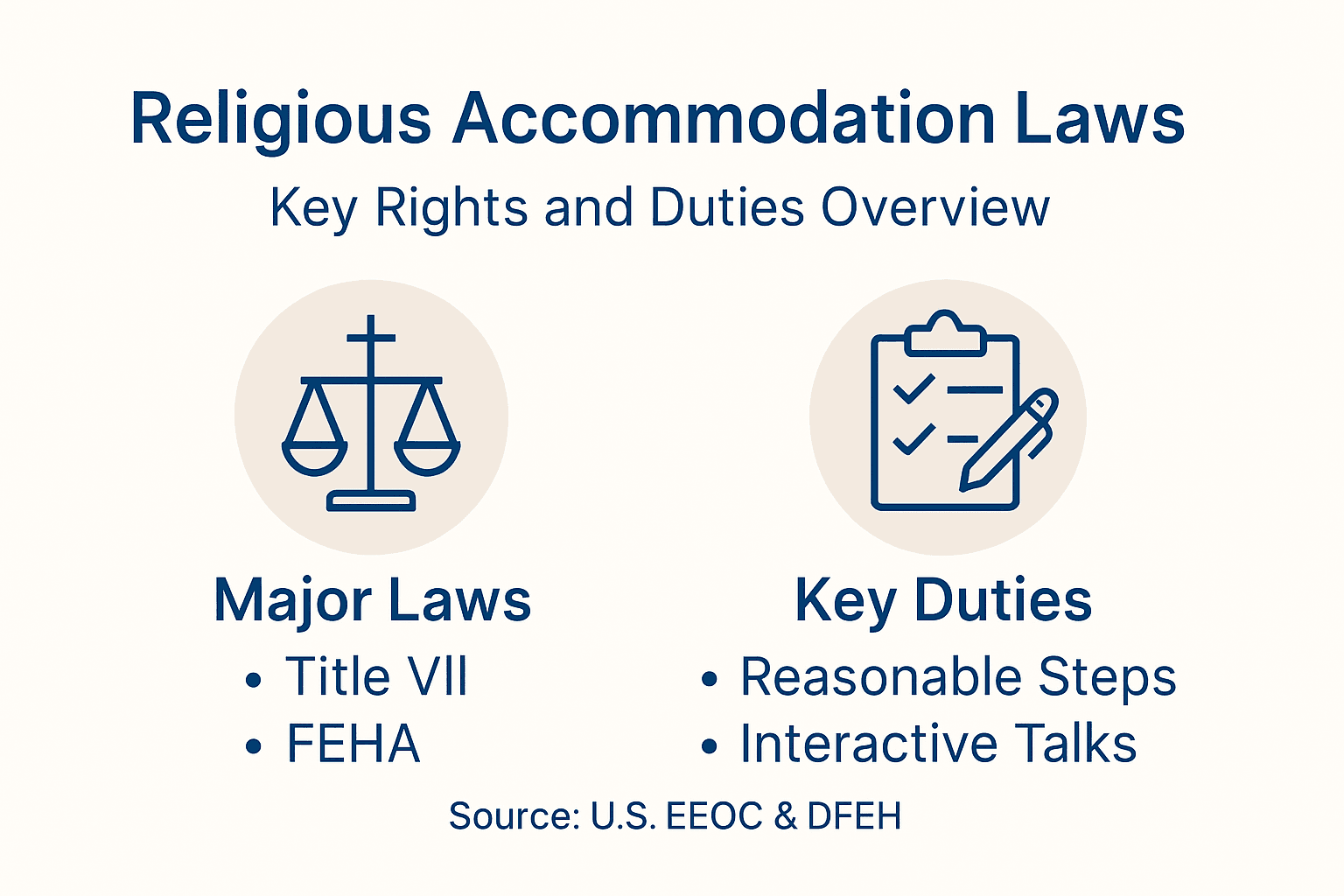
Both Title VII and FEHA mandate that employers provide reasonable accommodations for employees’ sincerely held religious practices, with critical provisions protecting against workplace discrimination. These laws broadly define religion, encompassing traditional faiths, nontraditional belief systems, and moral or ethical convictions. Employers are prohibited from making adverse employment decisions based on religious identity, including hiring, firing, promotion, compensation, or job assignments. The legal standards require employers to demonstrate that an accommodation would create undue hardship – a substantial increased cost or operational burden – before denying a religious accommodation request.
Workplace religious accommodations extend significant protections for employees, covering diverse scenarios such as religious attire, grooming practices, scheduling modifications, and prayer spaces. The laws require employers to engage in an interactive process, exploring potential accommodations that balance employee rights with business operational needs. This means Westminster employers must approach religious accommodation requests with genuine consideration, creativity, and a commitment to finding mutually acceptable solutions that respect both individual faith practices and workplace requirements.
Here’s a summary comparing the core legal frameworks governing religious accommodation in the workplace:
| Legal Framework | Coverage Area | Accommodation Standard | Key Employer Obligation |
|---|---|---|---|
| Title VII (Federal) | All U.S. employers | Reasonable unless undue hardship | Engage in interactive dialogue |
| FEHA (California) | California employers | Reasonable unless significant difficulty or expense | Broader definition of religion, more employee-friendly standard |
Pro tip: Document every religious accommodation request and decision-making process meticulously, ensuring transparent communication and creating a clear record of good-faith efforts to reasonably accommodate employee religious practices.
HR Strategies for Diverse Workforces
Managing religious diversity in the workplace requires a strategic, proactive approach that balances legal compliance with organizational culture. Religious accommodation strategies emphasize creating an inclusive environment that respects individual faith practices while maintaining workplace productivity and harmony.
Effective HR approaches involve developing comprehensive policies that provide clear guidance for handling religious accommodation requests. This includes establishing transparent procedures for employees to submit requests, training managers to recognize and respond to religious diversity sensitively, and creating a workplace culture that values religious differences. Key strategies include implementing flexible scheduling options, modifying dress codes to accommodate religious attire, providing designated spaces for prayer or meditation, and ensuring that accommodation decisions are made through an interactive, collaborative process.
Workplace religious accommodation practices require HR professionals to approach each request individually, maintaining strict confidentiality and demonstrating genuine commitment to employee inclusion. This means conducting thorough, case-by-case evaluations that consider both employee needs and business operational requirements. Successful implementation involves ongoing education, open communication, and a willingness to explore creative solutions that respect religious beliefs while maintaining workplace efficiency. HR teams must also stay informed about legal requirements, ensuring that accommodation processes comply with Title VII and FEHA regulations.
Pro tip: Develop a standardized religious accommodation request form that guides employees through the process transparently, while providing HR with a consistent framework for evaluating and documenting accommodation requests.
Employer Duties and Common Pitfalls
Religious accommodation protocols require employers to proactively navigate complex workplace religious diversity challenges while maintaining legal compliance. Employers have critical responsibilities in addressing religious accommodation requests, which extend far beyond simple policy compliance and demand nuanced, thoughtful approaches to employee interactions.
Key employer duties include establishing a transparent, responsive framework for handling religious accommodation requests. This requires prompt communication, engaging in meaningful interactive dialogues, and carefully evaluating each request’s potential impact on workplace operations. Employers must avoid discriminatory practices by understanding that religious beliefs encompass a broad spectrum of faith traditions and personal convictions. They are legally obligated to provide reasonable modifications to work practices unless such accommodations would create demonstrable undue hardship for the organization.
Workplace religious discrimination risks emerge when employers fail to understand key legal requirements. Common pitfalls include making accommodation decisions based on stereotypes, imposing excessive documentation requirements, retaliating against employees who request accommodations, and neglecting to train management about religious rights. Successful navigation requires comprehensive training, consistent policy implementation, and a commitment to creating an inclusive workplace environment that respects diverse religious practices.
Pro tip: Develop a comprehensive religious accommodation training module for managers that includes scenario-based learning and clear guidelines for evaluating and responding to employee religious practice modification requests.
Managing Risks and Legal Exposure
Religious accommodation legal standards have significantly evolved, requiring Westminster employers to implement sophisticated risk management strategies that go beyond basic compliance. The Supreme Court’s 2023 Groff v. DeJoy decision fundamentally transformed the legal landscape, establishing a more rigorous standard for evaluating religious accommodation requests and potential workplace hardships.
Effective legal risk management demands a proactive, comprehensive approach to religious accommodation protocols. Employers must meticulously document interactive processes, maintain transparent communication channels, and develop robust policies that demonstrate good faith efforts to understand and accommodate employees’ religious practices. This includes creating detailed training programs, establishing clear request submission procedures, and implementing consistent evaluation frameworks that minimize potential discriminatory practices. The legal threshold now requires employers to prove that an accommodation would cause substantial increased costs or operational disruptions before denying a request.
Religious accommodation risk mitigation strategies must encompass more than defensive legal positioning. Organizations should foster an inclusive workplace culture that proactively respects religious diversity, thereby reducing the likelihood of potential litigation. This involves developing comprehensive management training, creating accessible communication protocols, and maintaining flexibility in addressing employee religious practice needs. Potential legal exposure can be significantly reduced by demonstrating consistent, fair, and empathetic approaches to religious accommodation requests.
To help HR teams strategize effectively, here’s a quick-reference table of risk mitigation best practices:
| Practice | Purpose | Practical Example |
|---|---|---|
| Policy Documentation | Ensures consistency | Written accommodation procedures |
| Manager Training | Reduces discrimination risk | Scenario-based learning modules |
| Thorough Recordkeeping | Legal protection/audit trail | Log each request and interaction |
| Open Communication Channels | Early issue detection | Anonymous feedback or suggestion boxes |
Pro tip: Develop a comprehensive risk management documentation system that tracks all religious accommodation requests, interactions, and decisions, creating a clear audit trail to demonstrate consistent and fair evaluation processes.
Navigate Religious Accommodation Conflicts with Trusted Legal Support
Religious accommodation conflicts in Westminster workplaces present complex challenges that require careful legal guidance. If you face difficulties with scheduling flexibility, dress code exceptions, or discrimination related to sincerely held religious beliefs, understanding your rights is essential. Key concepts such as “undue hardship” and the interactive process to find reasonable accommodations demand expert interpretation to protect your workplace rights.
At Serendib Law Firm, we specialize in navigating these sensitive issues to help employees and employers alike. Our team provides personalized advocacy rooted in deep knowledge of California laws including FEHA and Title VII. Explore our Religious Discrimination Archives and Westminster Archives for insights tailored to your situation. Don’t wait until conflicts escalate. Contact us today at Serendib Law Firm for a free consultation and take the first step toward a respectful and legally compliant workplace.
Frequently Asked Questions
What are religious accommodation conflicts in the workplace?
Religious accommodation conflicts occur when an employee’s sincerely held religious beliefs clash with workplace requirements or policies, requiring adjustments to standard work practices.
What types of religious accommodation requests are commonly made?
Common requests include scheduling flexibility for religious holidays, exceptions for religious attire, and designated spaces for prayer or meditation.
How do employers evaluate religious accommodation requests?
Employers must engage in an interactive process that involves discussion with the employee to explore potential accommodations while balancing operational needs and avoiding undue hardship.
What legal protections exist for religious accommodation requests?
Legal protections include Title VII of the Civil Rights Act and the California Fair Employment and Housing Act (FEHA), which mandate reasonable accommodations unless they create undue hardship for the employer.
Recommended
- Religious Accommodation Disputes in Garden Grove Workplaces | Serendib Law Firm
- Religious Dress Code Issues for Tustin Retail Workers
- Religious Discrimination in Garden Grove Food Service | Serendib Law Firm
- Religious Leave Discrimination in Villa Park Workplaces | Serendib Law Firm
- What Is Employment Law? Complete UK Guide | Ali Legal