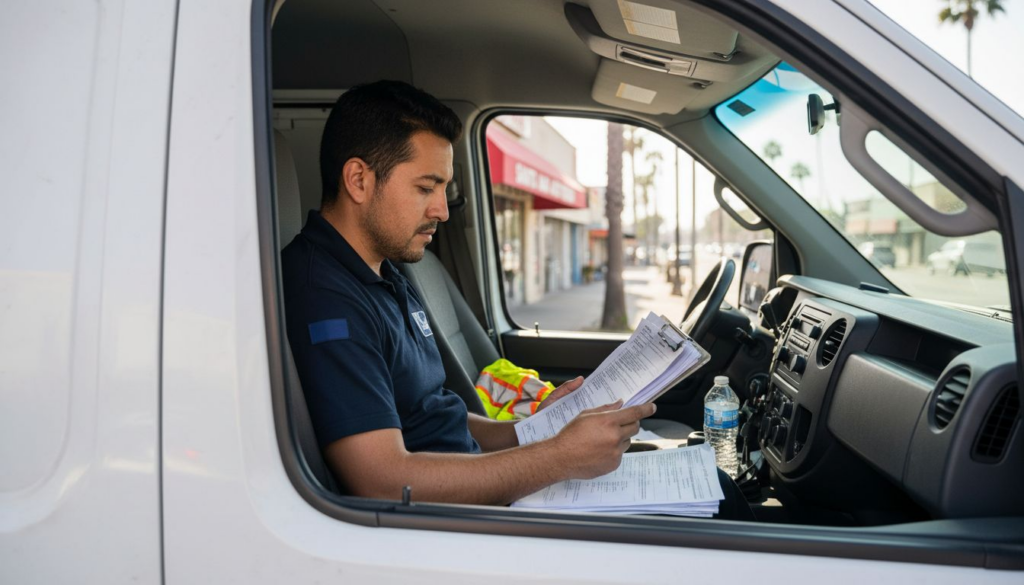
Most American delivery drivers in Santa Ana have faced the confusion and frustration of worker classification laws. With more than 1 in 3 gig workers nationwide experiencing misclassification, the stakes are high for anyone behind the wheel. Understanding how California’s strict AB 5 legislation affects your rights and obligations can mean the difference between missing critical benefits or securing fair compensation. This article breaks down what every American delivery driver in Santa Ana must know about worker status, protections, and legal risks.
Table of Contents
- Defining Misclassification and AB 5 Criteria
- Classifying Delivery Drivers Vs. Gig Workers
- Legal Standards: ABC Test and Exemptions
- Rights, Protections, and Employer Obligations
- Penalties, Risks, and Compliance Best Practices
Key Takeaways
| Point | Details |
|---|---|
| Misclassification Risks | Misclassified workers lose essential protections, making awareness of classification critical for delivery drivers. |
| AB 5 Criteria | Delivery companies must meet the ABC test criteria to classify workers as independent contractors, focusing on control, business scope, and trade independence. |
| Employer Obligations | Employers bear the burden of proof in classification; failure to comply can lead to significant legal and financial penalties. |
| Proactive Compliance | Regular audits and comprehensive documentation are crucial for delivery companies to avoid misclassification and remain compliant with California regulations. |
Defining Misclassification and AB 5 Criteria
For Santa Ana delivery drivers, understanding worker classification is critical. Misclassification occurs when businesses incorrectly label employees as independent contractors, which can strip workers of essential protections and benefits. The California Assembly Bill 5 (AB 5) provides a comprehensive framework for determining proper worker status through the stringent ABC test requirements.
Under AB 5, delivery companies must prove three specific criteria to classify a worker as an independent contractor. The first requirement (A) mandates that the worker operates free from direct control or supervision by the hiring entity. This means the delivery driver must have substantial autonomy in performing their work, without micromanagement of daily tasks. The second criterion (B) requires that the work performed falls outside the typical business operations of the hiring company. For delivery services, this becomes challenging, as transportation and delivery are core functions. The final condition © demands that the worker be independently established in their trade, typically demonstrated through business registration, marketing efforts, or offering services to multiple companies.
The implications of misclassification are significant for Santa Ana delivery drivers. Workers incorrectly labeled as independent contractors may lose access to crucial benefits like minimum wage protections, overtime compensation, workers compensation, unemployment insurance, and healthcare coverage. Moreover, misclassified workers bear higher tax burdens, as they must cover both employer and employee portions of payroll taxes. Companies that misclassify workers can face substantial legal penalties, including back wages, tax assessments, and potential civil litigation.

Here’s a comparison of employee and independent contractor classifications for delivery drivers:
| Key Aspect | Employee Status | Independent Contractor |
|---|---|---|
| Wage Protections | Guaranteed minimum wage | No minimum wage guarantee |
| Overtime Eligibility | Entitled to overtime pay | Not eligible for overtime |
| Tax Responsibility | Employer pays half of payroll taxes | Worker pays full payroll taxes |
| Access to Benefits | Full benefits, including healthcare | Only benefits required by law, limited coverage |
| Control Over Work | Supervised by employer | Full autonomy over work execution |
Pro Tip – Worker Protection Strategy: Carefully document all work arrangements, maintain detailed records of your work independence, and consider consulting an employment law professional if you suspect misclassification in your delivery driver role.
Classifying Delivery Drivers vs. Gig Workers
The legal landscape for delivery drivers and gig workers in California has become increasingly complex, particularly with the introduction of AB 5 and subsequent modifications through Proposition 22. Unlike traditional employees, gig workers operate in a unique regulatory environment that distinguishes their employment status from standard workers. Proposition 22 created a special classification that allows app-based delivery and rideshare drivers to maintain independent contractor status with certain protections.
Under the nuanced framework of California law, delivery drivers face distinct criteria for classification. App-based companies must meet specific requirements to maintain independent contractor designations. These conditions include allowing drivers complete freedom in their work schedule, permitting them to reject specific service requests, and ensuring they can work for multiple platforms simultaneously. Companies must also provide certain benefits, such as healthcare subsidies and minimum earnings guarantees, which partially compensate for the lack of traditional employment protections.
The legal distinctions between delivery drivers and traditional gig workers remain subtle but significant. While rideshare and delivery app workers enjoy some unique protections under Proposition 22, they still lack comprehensive benefits afforded to full-time employees. The California Supreme Court’s recent ruling has solidified this hybrid classification, creating a middle ground that recognizes the evolving nature of modern work arrangements. This approach acknowledges the flexibility desired by many workers while attempting to provide some basic economic safeguards.
Pro Tip – Worker Classification Strategy: Carefully document your work arrangements, track your independent business activities, and maintain records of your autonomy to strengthen your position as an independent contractor if challenged by regulatory authorities.
Legal Standards: ABC Test and Exemptions
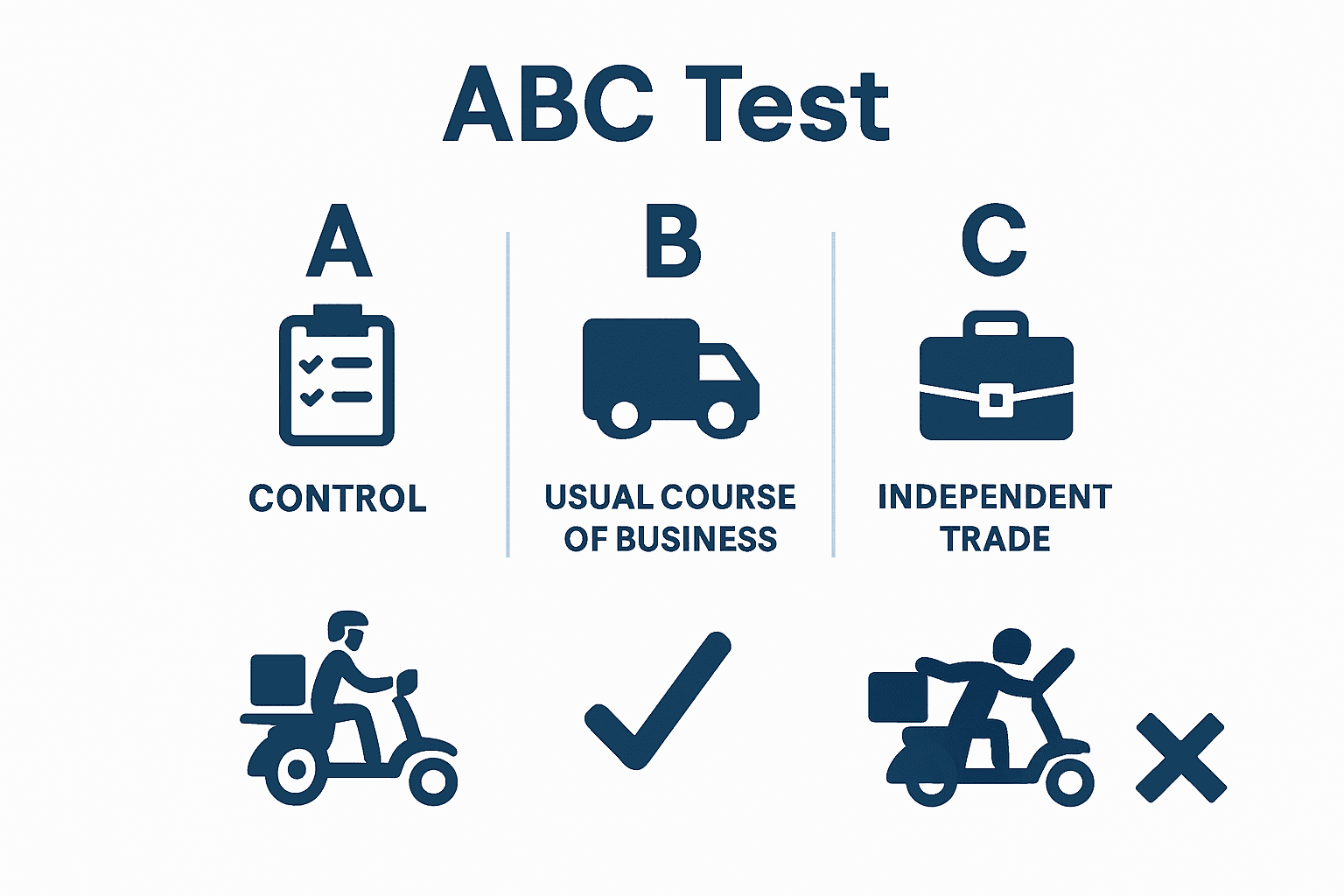
The ABC test represents a pivotal framework in California’s worker classification landscape, establishing strict criteria for determining employment status. California’s legislative approach to worker classification creates a presumption that workers are employees unless employers can definitively prove three comprehensive conditions. The burden of proof falls entirely on employers to demonstrate that workers genuinely qualify as independent contractors.
Under the ABC test, employers must satisfy three critical requirements simultaneously. Condition (A) mandates that workers operate completely free from the company’s control and direction. Condition (B) requires that the performed work falls outside the hiring entity’s primary business operations. Condition © demands proof that the worker is independently established in their trade, typically demonstrated through business registration, marketing efforts, or providing services to multiple clients. These stringent requirements effectively narrow the path for classifying workers as independent contractors, particularly in industries like delivery services and app-based platforms.
The table below summarizes the main ABC test criteria and practical examples for delivery drivers:
| ABC Test Criterion | Explanation | Delivery Driver Example |
|---|---|---|
| A: Control | Worker is free from company control | Sets own routes and schedule |
| B: Business Scope | Work outside core business | Delivers for multiple unrelated companies |
| C: Independent Trade | Independently established business | Has business license and markets services |
California’s approach includes nuanced exemptions that recognize the complexity of modern work arrangements. Certain professional categories, including doctors, lawyers, real estate agents, and some freelance writers, receive special consideration under the law. These exemptions acknowledge that some professionals inherently operate with greater autonomy and have more established independent business structures. The legislative framework continues to evolve, reflecting the ongoing challenges of categorizing workers in an increasingly dynamic economic landscape.
Pro Tip – Exemption Navigation Strategy: Carefully review your specific professional classification, maintain comprehensive documentation of your independent business activities, and consult with an employment law specialist to understand your precise legal standing under California’s worker classification regulations.
Rights, Protections, and Employer Obligations
Delivery drivers in Santa Ana face a complex landscape of worker rights and employer responsibilities under California law. Misclassification can systematically strip workers of critical legal protections, creating significant financial and professional vulnerabilities. Employee classification determines access to fundamental workplace safeguards, including minimum wage guarantees, overtime compensation, unemployment insurance, and protection from discriminatory practices.
Employers bear substantial legal obligations in worker classification. They must accurately determine worker status, providing full employee benefits when appropriate or maintaining clear independent contractor agreements that meet all legal standards. Failure to properly classify workers can result in severe financial penalties, including back wage payments, tax assessments, and potential civil litigation. Delivery companies must meticulously document worker relationships, demonstrating either genuine independent contractor status or providing comprehensive employee protections and benefits.
The legal framework surrounding worker rights extends beyond basic wage considerations. Employees receive comprehensive protections including workplace safety regulations, anti-discrimination safeguards, workers compensation coverage, and the right to collective bargaining. Independent contractors, while maintaining greater work flexibility, sacrifice many of these critical protections. This nuanced distinction underscores the importance of accurate worker classification and understanding the potential long-term implications of employment status for both workers and employers in the delivery and transportation industries.
Pro Tip – Documentation Defense: Maintain comprehensive records of your work arrangements, communication with employers, and independent business activities to protect yourself against potential misclassification disputes.
Penalties, Risks, and Compliance Best Practices
Delivery companies face substantial financial risks when improperly classifying workers, with penalties ranging from $5,000 to $25,000 per violation. Misclassification represents a complex legal minefield that extends far beyond simple monetary fines. Employers can be held liable for unpaid wages, overtime compensation, payroll taxes, and potential civil litigation, creating a potentially devastating financial and legal exposure for businesses operating in Santa Ana and throughout California.
The compliance landscape demands meticulous attention to detail. Delivery companies must develop robust classification protocols that carefully examine worker relationships, documentation, and operational practices. This involves conducting comprehensive assessments of worker autonomy, control mechanisms, and the nature of work performed. Companies should maintain detailed records demonstrating the independent contractor status, including contracts, payment structures, and evidence of workers’ ability to work for multiple platforms. Repeat violations can escalate penalties, potentially triggering more severe legal consequences and regulatory scrutiny.
Effective compliance requires a proactive approach that goes beyond mere documentation. Businesses must develop comprehensive training programs for management, implement clear written policies, and create transparent communication channels with workers. Regular internal audits, legal consultations, and systematic review of worker classifications can help mitigate risks. Understanding the nuanced requirements of AB 5 is crucial, as misinterpretation can lead to unintentional violations that carry significant financial and legal repercussions.
Pro Tip – Compliance Shield Strategy: Conduct regular internal audits of worker classification practices, maintain comprehensive documentation, and consult with employment law specialists to ensure ongoing compliance with California’s evolving worker classification regulations.
Protect Your Rights as a Santa Ana Delivery Driver Facing AB 5 Misclassification Risks
If you are a delivery driver in Santa Ana concerned about misclassification under AB 5, you are not alone. Misclassifying workers as independent contractors instead of employees can lead to lost wages, denied benefits, and unfair tax burdens. Understanding the complex ABC test criteria and the evolving legal landscape is essential to safeguard your rights and financial security. Many delivery drivers experience confusion and frustration as companies impose unfair work conditions that strip away vital benefits like overtime pay and worker protections.
At Serendib Law Firm, we specialize in helping delivery drivers and gig workers navigate these challenges. Our team offers personalized and zealous advocacy in employment law matters, including worker misclassification disputes. Explore our Misclassification Archives to learn more about your rights. Don’t wait until you face serious financial losses—connect with trusted advocates who understand California’s labor laws and can fight for the protections you deserve. Visit Serendib Law Firm now for a free consultation and take the first step toward reclaiming your rightful status and benefits.
Frequently Asked Questions
What is misclassification for delivery drivers?
Misclassification occurs when a business incorrectly labels an employee as an independent contractor, which can deny workers essential protections and benefits.
What are the three criteria under the ABC test for independent contractors?
The ABC test requires that the worker operates free from direct control (A), the work performed falls outside the hiring company’s typical business operations (B), and the worker is independently established in their trade ©.
What legal protections do delivery drivers lose if misclassified as independent contractors?
Misclassified delivery drivers may lose access to minimum wage protections, overtime pay, workers’ compensation, unemployment insurance, and healthcare coverage.
How can delivery drivers protect themselves from being misclassified?
Delivery drivers can maintain detailed records of their work independence, document all work arrangements, and consult with an employment law professional if they suspect misclassification.