
Audio summary
Slip and fall accidents can turn an ordinary trip to The District at Tustin Legacy, The Tustin Marketplace, or your apartment parking lot into months of medical visits and missed work. When a dangerous condition on someone else’s property causes your injuries, California premises liability law may give you a right to pursue compensation—if you can prove the property owner or occupier was negligent.
How California Law Views Slip and Fall Accidents
In California, a slip and fall is a type of premises liability claim. The focus is on whether the person or business responsible for the property used reasonable care to keep it safe.
Under Civil Code section 1714 and the Judicial Council of California Civil Jury Instructions for premises liability (CACI 1000 series), an injured person generally must show:
- The defendant owned, leased, occupied, or controlled the property.
- The defendant was negligent in the use or maintenance of the property.
- The plaintiff was harmed.
- The defendant’s negligence was a substantial factor in causing that harm.
The core questions mirror ordinary negligence: duty, breach, causation, and damages. In premises cases, this centers on whether the owner or occupier failed to act as a reasonably careful person would in inspecting, maintaining, or warning about the property’s condition, and whether that failure caused your injuries. Slip and fall is simply one kind of premises claim under this ordinary-care standard.
What Counts as a Dangerous Condition in Tustin
Premises liability cases turn on whether there was a dangerous condition that created an unreasonable risk of harm and whether the owner or occupier used ordinary care to discover and address it. In busy Tustin locations—like big-box stores at The Tustin Marketplace, crowded restaurant walkways at The District, or common areas in apartment complexes—hazards can appear and change quickly.
Examples of dangerous conditions that often lead to slip and fall accidents include:
Liquid spills in grocery aisles or food courts
Uneven flooring, loose tiles, or raised transitions
Worn, torn, or bunched-up carpeting
Poor lighting in stairwells or parking structures
Loose handrails or broken steps
Grease, sand, or debris tracked into entrances
Cracked sidewalks or potholes in parking lots
California jury instructions on unsafe conditions (such as CACI No. 1003) emphasize that landowners and occupiers must maintain property in a reasonably safe condition and use ordinary care to discover and repair dangerous conditions or to warn visitors. They are not insurers of everyone’s safety—some hazards arise so suddenly that even a careful owner has no reasonable chance to fix or warn before someone gets hurt.
Actual vs. Constructive Notice: Did the Property Owner Know?
In most California slip and fall cases, a central issue is whether the property owner or manager had notice of the dangerous condition in time to correct it or warn. Courts look for either actual notice or constructive notice.
Actual notice means someone responsible for the property actually knew about the hazard because, for example, an employee saw the spill or broken step, a customer reported the hazard, or the owner’s own work created the condition.
Constructive notice is more subtle. In Ortega v. Kmart Corp., the California Supreme Court explained that constructive notice can be inferred when the hazard existed long enough that a reasonably careful owner would have discovered and fixed it, or where reasonable inspection procedures were not in place or not followed.
In practice, this often comes down to questions like how long liquid or debris was on the floor before the fall, when the area was last inspected, whether there were written sweep or inspection schedules and if they were followed, and whether there were prior complaints or incidents involving the same condition.
In a crowded Tustin grocery store or a movie theater near Jamboree Road, a spill left on the floor for 30–40 minutes with no inspection may be treated very differently than a drink dropped seconds earlier. The plaintiff bears the burden of showing that the owner had actual or constructive notice; no inference of negligence arises merely because a fall occurred.
Inspection and Cleanup Policies in Busy Tustin Properties
California law measures property owners against a “reasonably careful” standard. For high-traffic areas—like common walkways in Tustin apartment complexes, stairways and parking lots, or the main corridors at The District—reasonable care usually includes inspection and cleanup systems tailored to how the property is used.
Evidence that often shows whether inspection and maintenance systems were reasonable includes:
Written sweep logs documenting when aisles, entries, and restrooms were checked
Cleaning schedules specifying inspection and mopping intervals
Maintenance policies for spills, loose mats, cracked pavement, or tripping hazards
Employee training materials describing safety and reporting responsibilities
In Ortega, the Court noted that a lack of reasonable inspections before an accident can support an inference that a dangerous condition existed long enough to have been discovered. By contrast, detailed inspection records showing frequent, consistent checks may help a defendant argue that it used ordinary care.
In a Tustin apartment complex, reasonable care might include periodic inspections of stairways, lighting, and walkways, especially after storms. In retail settings, it might mean documented walkthroughs of aisles and restrooms at set intervals, followed by prompt cleanup or warning when hazards are discovered.
Key Evidence That Can Help Prove Negligence
Much of the critical evidence in a slip and fall case is in the property owner’s possession. California practitioners emphasize early preservation and collection of:
Surveillance video showing the fall, the condition of the floor, or how long a hazard existed
Photographs and measurements of liquid, debris, uneven surfaces, or lighting conditions
Incident reports prepared by store managers, maintenance, or security staff
Sweeping and inspection logs for the area where the fall happened
Maintenance and repair records, including prior complaints or work orders
Employee schedules and training materials showing who was responsible for inspections
In public-property cases, public works or facilities inspection and repair records
Because surveillance systems at shopping centers and apartments often overwrite video quickly, lawyers commonly send written preservation demands soon after being retained, asking owners or managers not to erase relevant video or discard logs and incident reports. While missing or incomplete records do not automatically prove negligence, courts and juries may consider such gaps when evaluating notice and credibility.
Public Property Falls and the Government Claims Act
Some Tustin-area slip and fall accidents occur on public sidewalks, in parks, or in and around government buildings. When a public entity owns or controls the property, California’s Government Claims Act and Government Code section 835 add specific rules.
To hold a public entity liable for a dangerous condition of public property, a plaintiff generally must show that the public property was in a dangerous condition, that the condition created a reasonably foreseeable risk of the kind of injury suffered, that it was a substantial factor in causing harm, and that a public employee created the condition or the entity had actual or constructive notice in time to protect against it.
There are also strict deadlines for presenting claims to public entities—often about six months for bodily injury claims—before any lawsuit can be filed. These claim-presentation deadlines are separate from, and earlier than, the general statute of limitations for personal injury. Anyone injured on public property in or near Tustin should speak with a lawyer quickly to avoid forfeiting their rights.
Comparing Private vs. Public Property Slip and Fall Claims
Slip and fall claims operate differently depending on whether an incident occurred at a private apartment complex, a commercial center, or on public property. The comparison below highlights key differences that affect investigation and timing in Tustin cases.
| Issue | Private / Commercial Property (e.g., Tustin Marketplace) | Public Property (e.g., city sidewalk) |
|---|---|---|
| Governing law | Premises liability (Civil Code §1714; CACI 1000 series) | Government Claims Act; Government Code §835 |
| Core elements | Ownership/control, negligence in use or maintenance, harm, causation | Dangerous condition, foreseeability, causation, and employee creation or notice |
| Notice | Actual or constructive notice in time to repair or warn | Actual or constructive notice to the entity, unless it created the condition |
| Pre-suit requirements | No special pre-suit claim, subject to general limitation periods | Written government claim usually due in about six months for bodily injury |
| Typical evidence | Store or landlord incident reports, video, sweep logs, maintenance records | Public works inspection and repair records, prior complaint history |

Step-by-Step Actions After a Slip and Fall in Tustin
What you do in the hours and days following a fall can strongly influence the strength of any claim. In a place like Tustin, where businesses and public entities control much of the key information, being organized from the start helps.
- Get medical attention right away. Call 911 for serious injuries. Even if you can walk away from a fall at The District or your apartment complex, see a doctor promptly so injuries are documented and hidden problems are ruled out.
- Report the incident. In a store, restaurant, or office, ask for a manager and request that an incident report be completed. Give accurate facts but avoid guessing about fault. On apparent public property, note any signs indicating which agency maintains the area.
- Document the scene. If safe, take photos or video of the hazard, surrounding area, lighting, warning signs (or lack of them), and your visible injuries.
- Collect witness information. Obtain names and contact details for anyone who saw your fall or the hazard beforehand.
- Preserve physical evidence. Keep the shoes and clothing you wore unchanged; they may later help show how slippery a surface was or whether a substance stuck to your soles.
- Be cautious with insurers. After accidents at shopping centers or apartments, insurance adjusters may contact you quickly. Consider speaking with counsel before giving recorded statements or signing broad releases.
- Consult a Tustin-area slip and fall attorney promptly. Local counsel can identify the correct owner, tenant, manager, or public entity; send preservation letters for video and logs; and advise you on applicable deadlines.
How Comparative Fault and Defenses May Affect Your Case
California follows pure comparative negligence. In premises cases, a jury may assign a percentage of fault to each party and reduce your recovery by any share of fault attributed to you. Defendants often argue that plaintiffs failed to watch where they were going, wore unsafe footwear, or ignored warning signs.
Common defenses in slip and fall cases include arguments that the owner lacked actual or constructive notice and had reasonable inspection systems; that the condition arose only moments before the fall; that the hazard was open and obvious such that an ordinary person would have seen and avoided it; or that the plaintiff was distracted, disregarded warnings, or otherwise contributed to the accident.
California appellate decisions emphasize that the mere fact you slipped and fell does not itself prove negligence. Detailed evidence about inspections, complaints, and the specific condition at the time of the fall is therefore crucial in Tustin slip and fall cases.
Why Local Context Matters for Tustin Slip and Fall Claims
Tustin’s mix of shopping centers, big-box and grocery stores, multifamily complexes, and office parks creates many settings where premises liability principles apply. Cases frequently focus on how long a spill, debris, or uneven surface existed; whether reasonable inspection and cleaning systems were in place and followed; and whether prior complaints or incidents put owners or managers on notice.
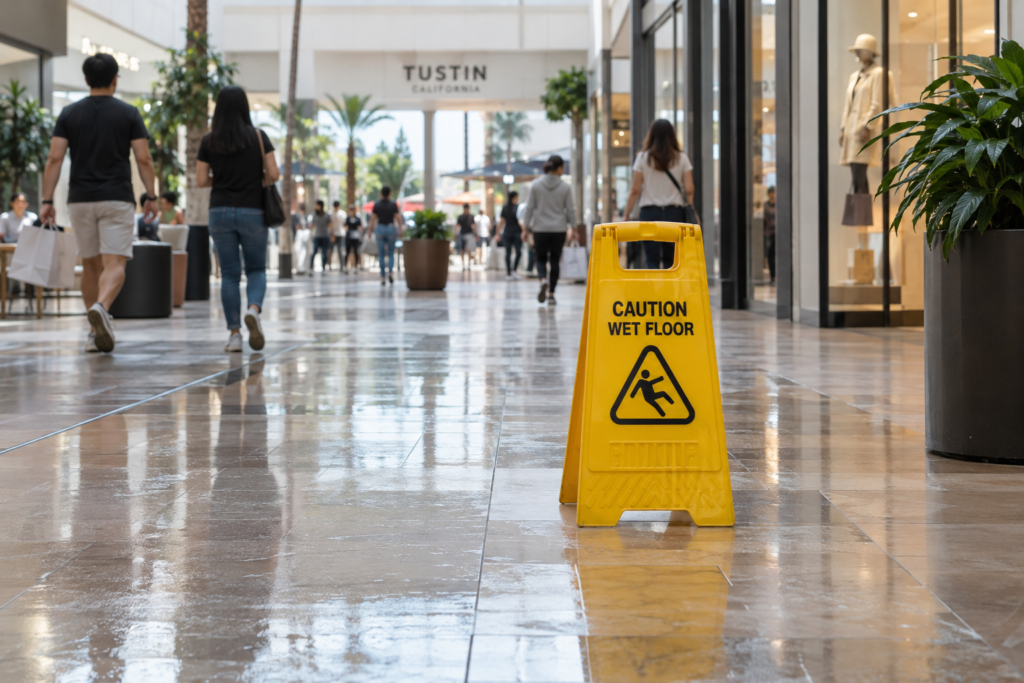
A fall on a wet grocery store floor at The Tustin Marketplace may hinge on store sweep policies and video showing when the spill occurred. A fall on worn stairs at a Tustin apartment complex may center on the landlord’s inspection routines and earlier tenant complaints. A fall on a cracked sidewalk by a government building may trigger Government Claims Act procedures and questions about public-works inspections.
Residents and visitors often move between Tustin and nearby cities like Orange and Santa Ana for shopping, work, and entertainment, so correctly identifying which owner, management company, or public agency controlled the accident location is important. Serendib Law Firm, based in nearby Orange, handles personal injury matters including slip and fall cases, as described on its Slip and Fall Accidents page, its Experienced Tustin Personal Injury Lawyers page, and its Experienced Orange Personal Injury Lawyers and Experienced Santa Ana Personal Injury Lawyers pages.
How a Lawyer Helps Build a Strong Premises Liability Case
Slip and fall claims in Tustin often involve overlapping responsibilities. A store tenant may lease space from a shopping center owner; a property management company may handle daily operations; a janitorial contractor may be responsible for sweeping and mopping; and, on public property, multiple agencies can share control.
An attorney familiar with California premises liability and local property patterns can help by determining who owned, leased, occupied, or controlled the property at the time of your fall; sending preservation letters to protect surveillance video, sweep logs, and incident reports; requesting incident reports, inspection logs, maintenance and repair records, and prior complaint histories; interviewing or deposing employees and witnesses about inspection and cleanup practices; working with experts on flooring, lighting, human factors, or safety standards when appropriate; evaluating medical records and lost income documentation; and navigating government-claim procedures when public property may be involved.
Because the plaintiff must prove negligence, assembling the right combination of factual, documentary, and expert evidence is essential. Counsel can also address comparative fault arguments and explain how California’s pure comparative negligence rules might affect any potential recovery.
Learning More About Slip and Fall Law
For a broad overview of slip and fall concepts and how they fit within premises liability, you can review the general Slip and fall article on Wikipedia. For guidance tailored to California law and local conditions in Tustin, however, speaking with an attorney who regularly handles these cases is usually more useful than relying solely on general online resources.
Disclaimer
Disclaimer: This article provides general information about slip and fall accidents and premises liability principles in California, including how they may arise in Tustin. It is not legal advice for any specific situation and does not create an attorney–client relationship with Serendib Law Firm or any other lawyer. Laws, procedures, and jury instructions can change, and how they apply depends on particular facts. If you have been injured in a slip and fall or have questions about your rights, you should consult a qualified attorney licensed in California to obtain advice regarding your individual circumstances.
FAQ: Slip and Fall Accidents in Tustin CA
Do I have a case if I fell but did not see what made me slip?
Not seeing the exact cause of your fall does not automatically end your claim, but you will still need evidence of a dangerous condition and negligence. California practice materials highlight surveillance video, photographs taken shortly after the accident, witness statements, and inspection records as ways to identify what likely caused the fall. If you were hurt at a Tustin shopping center or apartment complex, an attorney may be able to obtain store, landlord, or management records that clarify what condition was present and how long it existed.
How long do I have to bring a slip and fall claim in California?
General personal injury claims in California are typically subject to statutes of limitation measured in years, but exact time limits depend on the circumstances and on who the defendant is. Claims against public entities often require a formal written government claim within about six months of the injury before you can sue. Missing an applicable deadline can bar your claim, so after a slip and fall in Tustin it is important to speak with a lawyer promptly to identify and meet the correct timelines.
What if I was partly at fault for my own fall?
Under California’s pure comparative negligence system, you may still recover damages even if you were partly at fault, but any award can be reduced by your percentage of responsibility. Defendants may argue that you were distracted, ignored warning signs, or wore unsafe footwear. A premises liability attorney can analyze the facts, address comparative negligence arguments, and work to ensure that fault is allocated fairly among all responsible parties.
Do I need a lawyer for a minor slip and fall injury?
For minor injuries that resolve quickly without significant medical bills or missed work, some people choose to handle their own insurance discussions. However, injuries that seem minor immediately after a fall in Tustin can sometimes worsen over time. An attorney can help you understand potential long-term effects, evaluate whether a property owner failed to use ordinary care, and communicate with insurers so that any settlement reflects the full scope of your damages.
What if there were warning signs near where I fell?
Warning signs, cones, or taped-off areas are relevant to whether a property owner used reasonable care, but they do not automatically defeat a claim. Courts look at whether the warnings were placed where people would reasonably notice them, whether they clearly addressed the specific hazard, and whether the underlying condition still created an unreasonable risk. For example, a small sign partially hidden near a busy Tustin store entrance or an unlit stairwell warning may not provide adequate notice under the circumstances. Photographs, video, and witness statements help assess whether the warnings were sufficient.
Can I bring a claim if I fell at a friend’s apartment complex in Tustin?
Yes. Many premises liability claims involve accidents at apartments or condominiums where a landlord or property management company is responsible for common areas such as stairways, walkways, and parking lots. Your friend typically is not the defendant; instead, the focus is on the entities that control and maintain those shared spaces. A Tustin-area attorney can help identify the responsible owner or manager and evaluate whether their inspection and repair practices met California’s ordinary-care standard.