

If you slipped and fell on someone else’s property in Tustin, you can likely recover compensation for medical bills, lost wages, and pain and suffering, but two deadlines control everything. Private property claims must generally be filed within two years, while injuries on government-owned property require an administrative claim within six months. Preserve photos, medical records, and witness contacts today, and talk to a qualified law firm for a free consultation before evidence disappears or a deadline quietly closes your case.
TL;DR:
- Claims on private property must be filed within two years, while government property injuries require a six-month administrative claim.
- Evidence preservation, including photos, witness contacts, and medical records, is critical within the first 48 hours after a fall.
- Fault is calculated on a pure comparative negligence basis, meaning your recovery decreases with your assigned fault percentage but is never completely barred.
- Settlement ranges vary based on injury severity, liability clarity, and insurance coverage, with liens and subrogation often reducing the final payout by 20-40 percent or more.
- Choosing a local, experienced premises liability attorney with bilingual capabilities and contingency-fee arrangements improves your chances of maximizing compensation.
Table of Contents
- Slip and Fall Accidents Tustin CA Injury Compensation: What You Can Recover
- What Are the Elements of a Premises Liability Claim?
- How Does Fault Percentage Affect Your Payout?
- How Long Do You Have to File a Slip and Fall Claim?
- What Should You Do Immediately After a Fall in Tustin?
- Author and Law Firm Proof Points for Tustin Clients
- How Do You Start a Slip and Fall Lawsuit in Tustin?
- What California and Tustin-Specific Rules Apply to Your Case?
- How Should You Choose a Slip and Fall Attorney in Tustin?
- How Long Does a Tustin Slip and Fall Case Take to Resolve?
- Are There Other Sources of Compensation Beyond the Property Owner’s Insurance?
- What Medical Documentation Supports a Slip and Fall Claim?
- An Editorial Take on What Tustin Slip and Fall Victims Get Wrong
- Contact Serendib Law Firm for Your Free Consultation
- Sources
- FAQ
Slip and Fall Accidents Tustin CA Injury Compensation: What You Can Recover
California law splits slip and fall compensation into two main buckets: economic and non-economic damages. Economic damages cover the bills you can point to on paper: emergency room visits, physical therapy, prescription costs, and wages lost while you recover. Non-economic damages compensate for pain, emotional distress, and the toll an injury takes on your daily life, things that don’t come with a receipt but are just as real.
Punitive damages show up rarely in premises liability cases and only when a property owner’s conduct was especially reckless, not merely careless.
Settlement ranges vary enormously because three factors drive the number: how severe the injury is, how clearly liability can be proven, and how much insurance coverage the property carries. A torn ligament settles differently than a fractured hip, and a case with a strong paper trail settles differently than one built on a shaky memory of what the floor looked like.
What actually reduces your check: Even a strong settlement rarely arrives intact. Attorney fees under a contingency arrangement, outstanding medical liens, and health insurer subrogation claims all take a bite before you see a dollar. In more serious cases, liens and subrogation can consume 20 to 40 percent or more of the gross recovery, which is why negotiating those liens down is often as valuable as negotiating the settlement itself.
Common deductions include:
- Attorney’s contingency fee, typically a percentage of the total recovery
- Medical liens from hospitals or treating providers
- Health insurer subrogation claims seeking reimbursement
- Case costs such as expert witness fees or records requests
What Are the Elements of a Premises Liability Claim?
Winning a slip and fall case in California means proving four specific elements, not just showing that you got hurt. CACI No. 1000 lays out the standard the courts actually use:
- Ownership or control. The defendant owned, leased, occupied, or otherwise controlled the property where you fell.
- Negligent use or maintenance. The property owner was careless in maintaining, managing, or repairing the premises.
- Notice. The owner knew, or reasonably should have known, about the hazard in time to fix it or warn you.
- Causation and harm. The hazardous condition was a substantial factor in causing your injury.
Notice is where most cases are won or lost. Actual notice means an employee saw the spill and walked past it. Constructive notice means the hazard sat there long enough that a reasonable inspection routine should have caught it. Maintenance logs, inspection schedules, and store surveillance footage often prove constructive notice even when no employee admits to seeing the spill firsthand. A cracked sidewalk tile photographed with visible wear at the edges tells a different story than a puddle that appeared thirty seconds before you walked through it, and evidence has to speak to that timeline.
How Does Fault Percentage Affect Your Payout?
California follows pure comparative negligence, meaning your compensation gets reduced by whatever percentage of fault a jury or insurer assigns to you, but you are never completely barred from recovering, even if you were mostly at fault.
Here’s how the math actually plays out. If you’re awarded $100,000 in damages but found 25 percent at fault for not noticing a clearly marked wet floor sign, your recovery drops to $75,000 before attorney fees and liens come out. Push that fault percentage to 60 percent, and the same $100,000 case nets you only $40,000.
Insurance adjusters know this math cold, and they use it aggressively. Assigning even a modest fault percentage to you shrinks their payout without ever going to trial.
That’s precisely why having counsel who can dispute an inflated fault percentage matters. Adjusters routinely open negotiations by suggesting you were distracted, wearing the wrong shoes, or ignoring an obvious hazard. Some of that may be fair. A lot of it is a negotiating tactic designed to shave dollars off your claim before you’ve even seen a doctor’s full report.
How Long Do You Have to File a Slip and Fall Claim?
Miss these deadlines, and your claim can be gone no matter how strong the evidence is.
- Private property claims: California Code of Civil Procedure §335.1 gives you two years from the date of injury to file a personal injury lawsuit.
- Government property claims: If you fell on a sidewalk, park, or building owned by a city, county, or state entity, Government Code §911.2 requires an administrative claim within six months, a fraction of the standard window.
- Narrow exceptions exist, such as delayed discovery of an injury or claims involving a minor, but these are fact-specific matters and risky to rely on without legal guidance.
A fall outside a Tustin city building runs on an entirely different clock than a fall at a private shopping center, and confusing the two has ended more than one otherwise valid claim.
What Should You Do Immediately After a Fall in Tustin?
The steps you take in the first 48 hours often determine whether your claim is strong or vulnerable. Prioritize in this order:
- Get medical attention right away, even if the injury feels minor. Documentation created the same day carries more weight than a delayed diagnosis.
- Photograph everything: the hazard itself, the surrounding area, lighting conditions, and any warning signs (or their absence).
- Collect witness names and phone numbers on the spot. People are far harder to track down a week later.
- Request the property’s official incident report and keep a copy for your own records.
- Preserve your clothing and shoes, including damaged footwear, without washing or repairing them.
- Send a written request for surveillance footage as soon as possible. Consumer legal guidance widely recommends acting fast on video preservation, since many businesses overwrite footage within days to weeks.
- Decline recorded statements to any insurance adjuster until you’ve spoken with an attorney.
- Save every receipt tied to the injury, from prescription co-pays to rideshare fares to medical appointments.
Pro Tip: Send your surveillance footage request in writing, by email or certified letter, and keep a copy. A verbal request to a store manager is easy to forget and impossible to prove later if the footage happens to disappear.
Author and Law Firm Proof Points for Tustin Clients
This guide is written by Maya Serkova, drawing on Tustin-area premises liability case patterns and California’s statutory framework for personal injury claims. Serendib Law Firm backs that guidance with practical, client-facing commitments:
- Bilingual representation in English and Spanish, so language is never a barrier to understanding your rights.
- Contingency-fee arrangements for personal injury cases, meaning you pay nothing upfront and fees come only from a successful recovery.
- Free initial consultations to evaluate your case before you commit to anything.
- Dedicated local practice pages covering Tustin personal injury representation and slip and fall claims specifically.
Beyond consultations, typical law firm work on a case includes preserving evidence before it disappears, negotiating medical liens down so more of a settlement reaches you, and filing government claims within the tight six-month window that catches many injured people off guard.
How Do You Start a Slip and Fall Lawsuit in Tustin?
Filing a claim starts well before you ever see a courtroom. Most cases begin with a demand letter sent to the property owner’s insurance carrier, laying out the facts of the fall, the injuries sustained, and the compensation sought. This triggers a negotiation period where the insurer investigates, often disputing liability or the extent of your injuries.
If negotiations stall or the insurer’s offer doesn’t reflect the actual harm done, the next step is filing a formal complaint in Orange County Superior Court, which has jurisdiction over civil claims arising in Tustin. The complaint must identify the defendant, describe the hazardous condition, and specify the damages sought.
Necessary documents typically include your medical records and bills, photographs of the hazard, the property’s incident report if one exists, witness statements, proof of lost income, and any correspondence with the property owner or their insurer. If the fall happened on government property, remember that the administrative claim under Government Code §911.2 must be filed and either denied or allowed to lapse before a lawsuit can proceed. Skipping that administrative step, even by accident, can get a case dismissed regardless of how strong the underlying facts are.
Once a complaint is filed, the defendant has a limited window to respond, after which the case moves into discovery, where both sides exchange evidence and take depositions. Many cases settle during this phase once the strength of the evidence becomes clear to both sides.
What California and Tustin-Specific Rules Apply to Your Case?
California’s premises liability framework applies statewide, but a few local realities shape how these cases actually unfold in Tustin. The city sits within Orange County, meaning civil lawsuits arising from falls here are filed in Orange County Superior Court, not a separate municipal system.
Property owners in Tustin, whether commercial retailers along El Camino Real, apartment complexes, or public sidewalks maintained by the city, are held to the same duty-of-care standard under California’s premises liability statutes and CACI No. 1000. That said, falls involving city-maintained sidewalks or public buildings trigger the shortened six-month government claims deadline, while a fall inside a private business follows the standard two-year window.
Tustin’s municipal code also imposes maintenance obligations on adjacent property owners for sidewalk upkeep in many cases, which can shift liability toward a private owner even when the sidewalk sits on public right-of-way. This distinction surprises a lot of injured residents who assume any sidewalk fall automatically means a government claim.
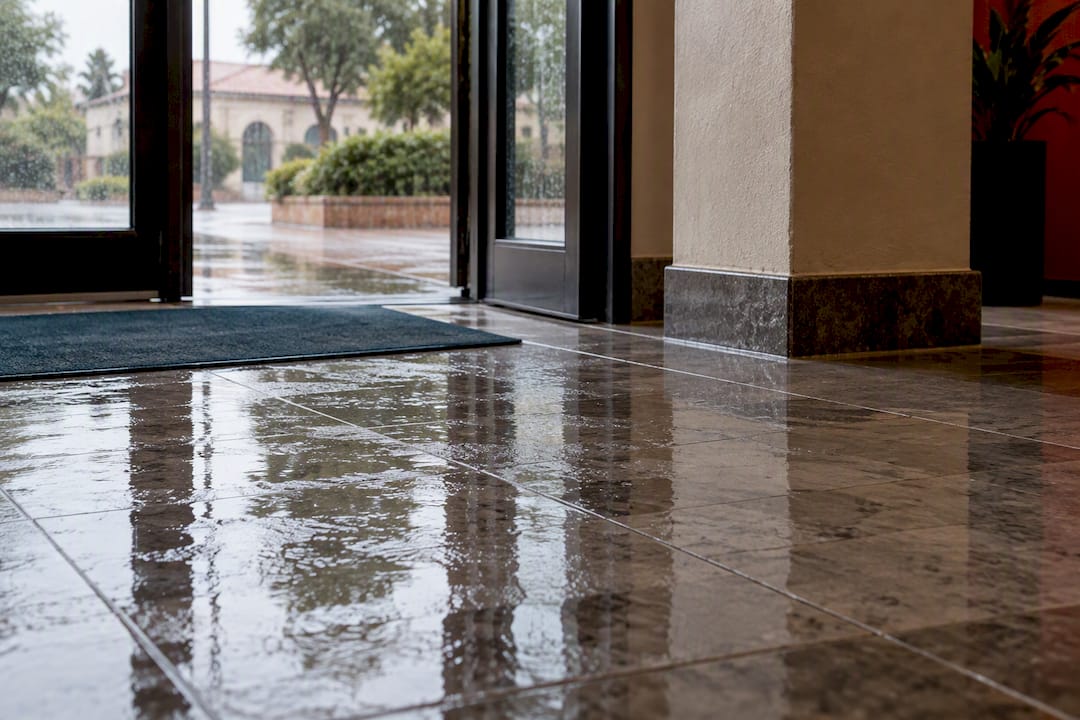
Weather and seasonal maintenance also matter locally. Tustin’s dry season creates its own hazards, dust and debris accumulation in parking structures and retail entryways, while occasional winter rain turns tile and polished concrete floors into serious slip risks with little to no signage in older commercial buildings. Documenting the specific condition and location matters just as much as documenting the injury itself.
How Should You Choose a Slip and Fall Attorney in Tustin?
Not every personal injury attorney handles premises liability cases with the same depth of experience, and the difference shows up in negotiated outcomes. Start by asking whether the firm has handled slip and fall cases specifically in Orange County courts, since local procedural familiarity and relationships with local claims adjusters can speed up negotiations.
Confirm the fee structure upfront. A contingency-fee arrangement, where you pay nothing unless the attorney recovers compensation, removes the financial barrier that keeps many injured people from pursuing valid claims in the first place.
Ask direct questions during your initial consultation: How many premises liability cases has the firm handled? Who will actually manage your file day to day? What is the realistic timeline given your specific injury and the strength of the evidence? A firm that gives vague, evasive answers to these questions is one to be cautious about.
Bilingual capability matters more than many people expect. If English isn’t your first language, or a family member handling communication on your behalf is more comfortable in Spanish, working with a firm offering genuine bilingual intake, not just a translated pamphlet, changes how well you understand what’s happening with your own case.
Finally, look for a firm with a visible local presence, not one that treats Tustin as an afterthought inside a larger regional territory. Local case experience means the attorney already understands which Orange County property owners and insurers tend to fight claims versus settle reasonably.
How Long Does a Tustin Slip and Fall Case Take to Resolve?
Timelines vary widely, but most cases follow a recognizable pattern. The first phase, medical treatment and evidence gathering, typically runs a few weeks to several months, depending on how long it takes your injury to reach what’s called maximum medical improvement, the point where your treating doctors can accurately project long-term impact.
Once treatment stabilizes, your attorney sends a demand letter to the insurer, opening a negotiation period that commonly lasts one to three months. Many cases resolve here without ever reaching a courtroom, particularly when liability is clear and injuries are well documented.
If the insurer’s offer doesn’t reflect the actual damages, filing a lawsuit in Orange County Superior Court starts a longer process. Discovery, the phase where both sides exchange records and take depositions, often takes six months to a year. Many cases still settle during or shortly after discovery once both sides have a clearer picture of how a jury might view the evidence.
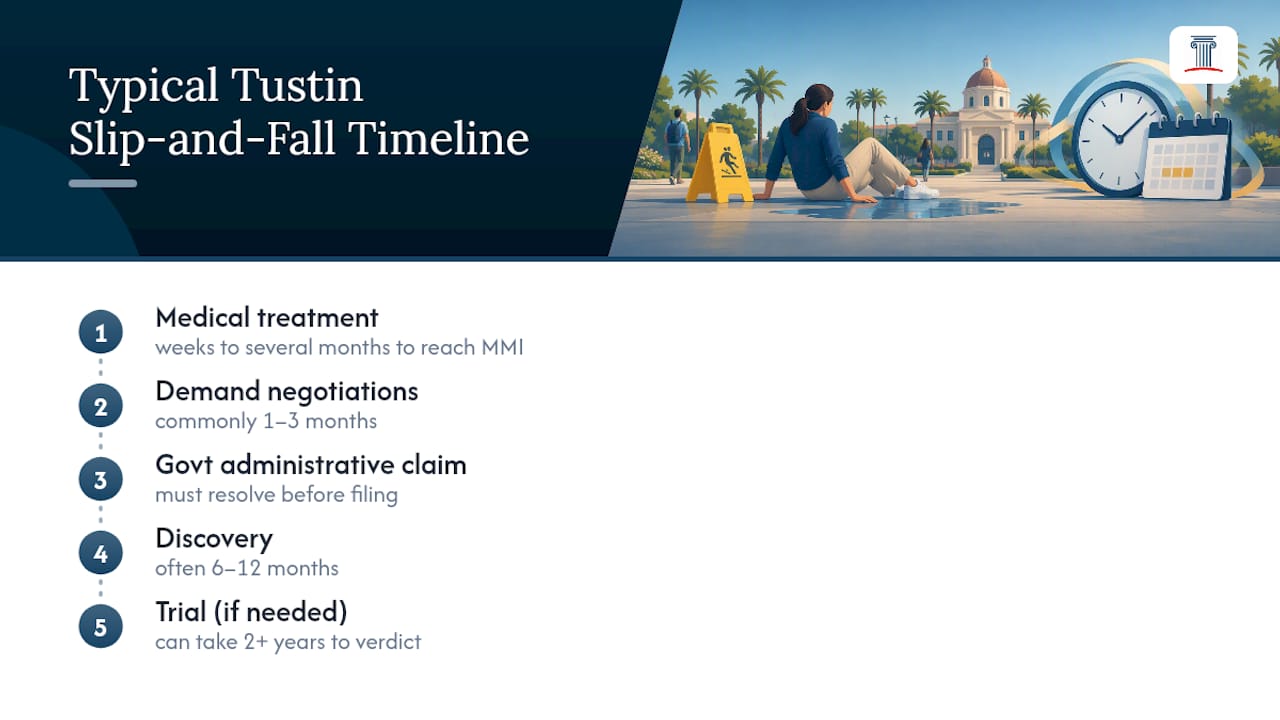
Cases that proceed to trial can take considerably longer, sometimes two years or more from filing to verdict, factoring in court scheduling backlogs common throughout Orange County. Government-property claims add time on the front end, since the administrative claim under Government Code §911.2 must be resolved or lapse before a lawsuit can even be filed. Patience during this process pays off. Rushed settlements taken to avoid a longer timeline routinely undervalue the true cost of an injury, particularly when future medical needs haven’t fully surfaced yet.
Are There Other Sources of Compensation Beyond the Property Owner’s Insurance?
The property owner’s liability insurance is usually the primary source of recovery, but it isn’t always the only one. If a third party contributed to the hazard, a contracted cleaning company that failed to mop up a spill properly, a maintenance contractor who left equipment in a walkway, or a product manufacturer whose defective flooring material caused the fall, that party’s own insurance may also owe compensation.
Multi-tenant properties add another layer. A fall in a shopping center’s common area might implicate the property management company, the individual tenant business, or both, depending on who controlled the specific area where the hazard existed.
For falls on government property, beyond the standard claims process, some injured residents may qualify for additional public assistance programs covering medical costs during a prolonged recovery, though these programs vary and rarely cover the full scope of pain and suffering damages.
Your own health insurance often pays medical bills upfront, but expect a subrogation claim seeking reimbursement once your case settles. Underinsured or uninsured motorist coverage isn’t typically relevant to a standard slip and fall, but it’s worth mentioning if a fall happened in connection with a vehicle incident, such as slipping while exiting a car in a poorly maintained parking structure. Identifying every potential source of recovery early, rather than assuming the property owner’s policy is the only pot of money available, often makes the difference in fully covering long-term medical needs.
What Medical Documentation Supports a Slip and Fall Claim?
Medical records are the backbone of any injury claim, and the quality of that documentation directly shapes settlement value. An emergency room visit or urgent care evaluation immediately after the fall creates the first, and often most persuasive, record linking your injury to the incident itself.
Follow-up care matters just as much. Orthopedic evaluations for fractures or joint injuries, neurological assessments for head trauma, and physical therapy records showing the trajectory of your recovery all build a documented timeline insurers can’t easily dismiss. Imaging studies, X-rays, MRIs, and CT scans provide objective evidence that’s difficult for an adjuster to argue against.
For soft-tissue injuries that don’t show up clearly on imaging, consistent treatment notes from your physician become critical. Gaps in treatment, even short ones caused by scheduling difficulty or cost concerns, give insurers an opening to argue the injury wasn’t serious or wasn’t caused by the fall at all.
Keep a personal record too: a simple daily log noting pain levels, missed work, and activities you can no longer do normally adds credibility to non-economic damages that medical charts alone can’t fully capture. If your case eventually requires an independent medical examination, arranged by the insurer or ordered by the court, having a thorough, consistent treatment history beforehand strengthens your position significantly against a defense-oriented evaluation.
An Editorial Take on What Tustin Slip and Fall Victims Get Wrong
The biggest mistake I see in how this topic gets discussed isn’t ignorance of the law. It’s timing. Most people treat the deadline conversation as something to worry about eventually, when in reality the six-month government claims window has usually already started ticking before the injured person even knows which entity owns the property they fell on.
Conventional advice tends to front load the legal theory, duty, breach, causation, and treats evidence collection as a footnote. That ordering is backwards. Evidence has a shelf life; legal arguments don’t. Surveillance footage gets overwritten, witnesses move on, and a torn shoe gets thrown out during laundry day, but the four elements of premises liability will still be sitting in CACI No. 1000 whenever you’re ready to build your case around them.
My honest read: prioritize preservation over analysis in the first week. You don’t need to know your exact fault percentage or settlement range on day one. You need photos, names, and a doctor’s note with a timestamp. The legal strategy can be built later, with an attorney, using evidence that no longer exists if you wait.
— Maya Serkova
Contact Serendib Law Firm for Your Free Consultation
Some law firms represent injured Tustin residents on a contingency-fee basis, meaning there’s no fee unless compensation is recovered, and often offer free initial consultations. Intake may be available in both English and Spanish to ensure language is not a barrier to understanding options.
When you reach out, bring what you have: medical records or bills from your treatment, photos of the hazard and the scene, any incident report the property provided, and contact information for witnesses. If you don’t have all of it yet, that’s fine. The first conversation is about understanding what happened and what deadlines apply to your specific situation, not about having a perfect file.
From there, we handle evidence preservation, lien negotiation, and filing requirements, including the tight six-month window for government property claims, so nothing slips past you while you focus on recovering. Reach out through our contact page by phone or the online form to schedule your free consultation today.
Sources
For readers who want to see the primary sources behind the deadlines and legal elements covered above, California Code of Civil Procedure §335.1 sets the two-year filing deadline, Government Code §911.2 governs the six-month government claims process, and CACI No. 1000 outlines the elements courts require to prove premises liability.
This article is general information, not a substitute for advice from a qualified lawyer. Consult a qualified legal professional about your own circumstances before acting on anything here.
FAQ
What is the average payout for a slip and fall in California?
There’s no single average because settlements depend heavily on injury severity, how clearly liability can be proven, and available insurance limits. A minor soft-tissue injury with disputed liability settles very differently than a fracture backed by strong evidence of constructive notice, so any number quoted without those details should be treated skeptically.
How much can someone sue for in a slip and fall case?
You can pursue both economic damages (medical bills, lost wages) and non-economic damages (pain and suffering) with no fixed cap in most California premises liability cases. The final amount a jury or insurer agrees to depends on the strength of your evidence and, under California’s pure comparative negligence rule, any percentage of fault assigned to you.
Can you get compensation for a slip and fall injury?
Yes, if you can show the property owner controlled the premises, was negligent in maintaining it, had notice of the hazard, and that the hazard caused your injury, the four elements outlined in CACI No. 1000. Serendib Law Firm offers a free consultation to evaluate whether your specific facts support a claim.
How much of a $25,000 settlement will I actually keep?
It depends on your attorney’s contingency fee percentage, any outstanding medical liens, and health insurer subrogation claims, all of which come out before you receive your share. In cases with significant medical treatment, liens and subrogation alone can take a meaningful bite out of the gross amount, which is why negotiating those deductions down is a core part of what your attorney should be doing on your behalf.
How long do I have to file a slip and fall claim in Tustin?
For falls on private property, California law gives you two years from the date of injury to file a lawsuit. If the fall happened on property owned by the city, county, or state, you have only six months to file an administrative claim before you can even proceed to a lawsuit.