
Audio summary
Delivery drivers keep Villa Park running—dropping packages and food to quiet cul-de-sacs, larger residential lots, and the busy Villa Park Town Center. When a hidden pothole, broken curb, or poorly lit loading area causes a serious injury, California premises liability law can give you a path to pursue compensation. For background on Villa Park, see the Wikipedia article about Villa Park.
Why delivery driver parking lot injuries matter in Villa Park
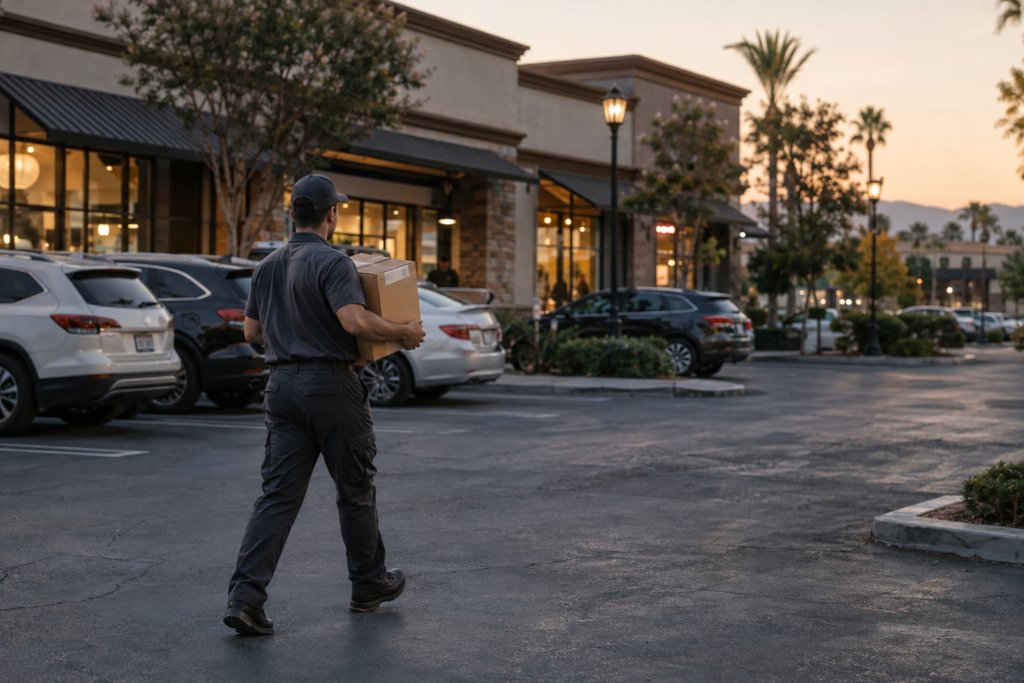
Villa Park is a small, mostly residential “hidden jewel” in north-central Orange County. With almost all housing made up of single-family homes on larger lots and only one primary shopping hub at the Villa Park Town Center, many Amazon, USPS, UPS, FedEx, Instacart, and app-based gig deliveries happen in:
- Long residential driveways and sloped walkways
- Shared private roads and cul-de-sacs near the city’s four neighborhood schools
- Parking lots and loading lanes around the Town Center’s shops, City Hall, and library
Even in a city with a reputation for being one of Orange County’s safest communities, hazards like uneven pavement, oil slicks, or confusing traffic flows can put delivery workers on foot at real risk.
Serendib Law Firm’s office on South Anita Drive in nearby Orange serves Villa Park residents and workers who are injured while doing their jobs on these properties.
California premises liability basics for delivery drivers
In California, premises liability is a type of negligence claim. According to the Judicial Council of California Civil Jury Instructions, to hold a property owner or occupier responsible, an injured person generally must show:
- The defendant owned, leased, occupied, or controlled the property
- The defendant was negligent in using or maintaining the property
- The plaintiff was harmed
- The defendant’s negligence was a substantial factor in causing that harm
These elements apply whether you are a customer, employee, or delivery driver entering the property to do your job. The law focuses on whether the person or business responsible for the premises used ordinary care to keep it reasonably safe.
Who may be responsible for a parking lot or driveway injury?
In practice, understanding who might be liable often turns on who had control over the place where you were hurt, not just who holds the title to the property.
Control is more important than ownership
California courts have explained that premises liability is grounded in possession and control. A person or entity that owns, leases, occupies, or otherwise controls a property can owe a duty of care, even if they are not the recorded owner. By contrast, there is usually no duty for areas they do not own or control, such as part of an adjacent public street or another parcel’s lot.
For Villa Park delivery drivers, potentially responsible parties might include:
- A homeowner who controls a driveway or front walk
- A business that controls its portion of the Town Center parking area and loading zone
- A property management company that maintains a private road, shared driveway, or small HOA lot
Sometimes more than one party shares control—for example, a commercial tenant plus the property owner or management company. An attorney will typically investigate how control and maintenance responsibilities are allocated.
Common hazards for Villa Park delivery drivers
Because Villa Park covers only about two square miles and has almost no large apartment or condo complexes, the hazards delivery drivers encounter here tend to fall into a few recurring patterns.
Residential driveways and walkways
- Broken or uneven concrete at curb cuts or stepped pathways leading up to front doors
- Loose gravel or landscaping debris scattered across driveways or entry paths
- Poor lighting near side gates or back doors where packages are sometimes left after dark
- Cluttered paths from trash bins, garden tools, or children’s toys
Villa Park Town Center and small commercial lots
- Oil or water accumulation in sloped drive lanes or near loading areas
- Broken wheel stops or curbs hidden by parked vehicles
- Unmarked loading zones that force drivers to cross active traffic or unload in unsafe locations
- Inadequate lighting around the rear or side of buildings used for after-hours deliveries
School-adjacent streets and quiet cul-de-sacs
- Narrow roads with parked cars that limit visibility and safe walking routes
- Active crosswalks where drivers must carry packages while watching for children and vehicles
- Confusing signage about parking or loading, increasing the chance of walking in vehicle paths
Whether any of these conditions create legal liability depends on proof of control, notice, and causation under California law.
Property owners’ duty to keep parking areas reasonably safe
Under California law, landowners and those who control property must use ordinary care to keep their premises in a reasonably safe condition. This duty covers parking lots, walkways, and access routes that delivery drivers rely on.
Reasonable care typically includes efforts such as:
- Inspecting parking lots, driveways, and walkways at reasonable intervals
- Repairing dangerous conditions like potholes, broken pavement, or unstable wheel stops
- Cleaning or addressing spills, oil slicks, or debris that create slip or trip risks
- Providing adequate lighting or warning signs where hazards cannot be fixed right away
This duty usually extends to people lawfully on the property, including commercial delivery drivers making business-related deliveries to homes, HOAs, and local businesses.
Actual vs. constructive notice of dangerous conditions
To impose liability for an injury caused by a defective condition, California courts generally require proof that the owner or occupier either:
- Actually knew about the condition (actual notice), or
- Should have discovered it through reasonable inspections (constructive notice)
Examples in Villa Park parking areas and driveways might include:
- A long-standing pothole at the entrance to a shared private road
- Repeated oil buildup in the same loading lane at the Town Center
- Outdoor lights that have been burned out for weeks in a frequently used side lot
- Broken concrete on a front walkway that a homeowner regularly uses
Evidence that a hazard existed for a significant period, generated complaints, or was obvious during routine use may help show constructive notice.
Parking lot design, third-party drivers, and delivery injuries
Operators of dedicated parking facilities in California owe a duty to use ordinary care in managing the lot. Negligent design or maintenance can create foreseeable risks, such as:
- Unsafe pedestrian routes from a loading area to a store entrance
- No separation between delivery foot traffic and vehicle lanes
- Angles or obstructions that make it hard for drivers to see pedestrians
At the same time, courts have declined to impose a duty where a parking lot owner had no control over the area where the injury occurred, or where an injury was caused by an unforeseeable, independent act of a third-party driver that was not tied to the lot’s design or operation.
In delivery cases, that means an analysis usually focuses on both:
- How the lot or driveway was laid out and maintained, and
- Whether the way it was managed made the risk of the particular kind of accident foreseeable
Residential homes, HOAs, and recreational-use limits
Villa Park’s housing stock is overwhelmingly single-family homes on larger lots, with some private roads and shared driveways. For these and any HOA-controlled common areas, the general duty to maintain safe walkways and parking areas still applies, but liability remains fact-specific and hinges on control and foreseeability.
California’s recreational use statute generally limits landowners’ duties to people using property for recreational purposes, subject to exceptions. However, this limitation typically does not apply to delivery drivers, because they are on-site for business reasons, not recreation.
Workers’ compensation, civil claims, and time limits
When a delivery driver is injured on the job in Villa Park, there may be more than one possible legal route, depending on the working relationship and who controlled the property.
Workers’ compensation vs. premises liability
- Employees of delivery companies may have a workers’ compensation claim against their employer for job-related injuries.
- They may also have a separate premises liability claim against a negligent property owner or manager who is not their employer.
- Independent contractors and gig drivers typically pursue civil claims rather than workers’ compensation, though platform agreements can affect where and how disputes are resolved.
California statute of limitations
California generally imposes a two-year statute of limitations for personal injury and premises liability claims. Missing this deadline can seriously affect your ability to pursue compensation, so it is important to get timely legal guidance after an incident.

Step-by-step: What to do after a delivery-related parking lot injury
In the moments and days after a fall or other injury in a Villa Park driveway or parking lot, your health comes first. Subject to medical needs, the following steps often help protect your rights:
- Get medical care immediately. Even if you think you can “walk it off,” prompt evaluation helps your health and creates a clear record of your injuries.
- Photograph the scene. Capture the exact spot where you fell or were hurt, including close-ups of defects, lighting conditions, and wider shots showing the layout of the area.
- Note the property type and who is present. Write down whether it’s a private home, business, or HOA. If an owner, manager, or employee speaks with you, get their name and contact information.
- Look for cameras or witnesses. Make note of any security cameras around the Villa Park Town Center or nearby homes, and gather names and contact information for anyone who saw what happened.
- Report the incident in writing. Provide a concise written report to your employer or platform and, if appropriate, to the property owner or manager, saving copies of all communications.
- Preserve evidence. Keep your shoes, delivery bag, and clothing from the incident, along with any app screenshots or route information that show when and where you were injured.
- Consult a premises liability attorney. Speak with a lawyer familiar with Orange County and Villa Park premises cases—such as the team at Serendib Law Firm—to review your options before dealing with insurers on your own.
Comparing key issues in Villa Park delivery driver injury claims
Every case turns on its specific facts, but certain patterns come up regularly for delivery drivers injured in Villa Park’s residential areas and at the Town Center. The table below highlights a few common scenarios and the kinds of questions an attorney may explore.
| Scenario | Key Questions About Control & Notice | Examples of Helpful Evidence |
|---|---|---|
| Trip on uneven residential driveway or walkway | Did the homeowner control and regularly use the area? Did the defect exist long enough that they should have known about it? | Photos of cracks or height differences, statements from residents or neighbors, prior repair estimates, or text messages about the condition |
| Slip on oil in commercial parking lot at Villa Park Town Center | Who maintains the lot—the business tenant or a property manager? How often are inspections done? Have there been similar issues in the same area? | Incident reports, maintenance logs, surveillance footage, and testimony from other drivers or customers about recurring oil or puddles |
| Fall in poorly lit side or rear loading area | Who is responsible for lighting and safety in that section? Were lights known to be out or inadequate? | Nighttime photos or videos showing the lighting, work orders for light repairs, emails or complaints about poor visibility |
| Impact with vehicle while walking across shared driveway or lot | Did the property’s layout or signage make such conflicts foreseeable? Who controlled traffic patterns and markings? | Diagrams or photos of the layout, signage, speed bumps, prior incident records, and witness statements regarding traffic flow |
How comparative fault can affect your claim
California uses a pure comparative negligence system. Fault can be apportioned between:
- The injured delivery driver
- The property owner or occupier
- Other potentially responsible parties, such as third-party drivers
In parking lot and driveway cases, property owners and insurers may argue that the driver:
- Parked in a no-parking or red zone despite safer options
- Ignored cones, taped-off areas, or other warnings
- Was distracted by a phone or handheld scanner
- Chose a more dangerous route instead of a reasonably safe alternative
None of these arguments automatically defeat a premises claim, but they can reduce any recovery if a judge, jury, or arbitrator finds that your conduct contributed to the incident. An attorney can help gather evidence and present the facts in context.
How Serendib Law Firm supports Villa Park injury victims
From our office in nearby Orange, Serendib Law Firm helps Villa Park residents and workers pursue premises liability claims after parking lot and driveway injuries. We understand the unique mix of quiet residential streets, school traffic, and the single Town Center that shapes how deliveries actually happen here.
Depending on the facts, our work on a delivery driver premises case may include:
- Investigating who owned, leased, occupied, or controlled the specific area where you were hurt
- Documenting the hazard and how long it existed
- Identifying all potentially responsible parties, including property owners, tenants, and management companies
- Coordinating with your medical providers to understand your injuries and limitations
- Negotiating with insurers and, when appropriate, preparing a lawsuit within California’s deadlines
If your injuries extend beyond premises liability—for example, if a negligent driver also played a role—our broader personal injury experience may also be relevant. You can learn more about our approach on our Experienced Villa Park Personal Injury Lawyers page and our general Premises Liability overview.
Gathering documentation for a potential claim
Strong documentation often makes the difference in establishing what happened and who was responsible. In addition to the immediate steps listed earlier, consider organizing:
- Scene evidence
- Photos and videos from multiple angles and times of day
- Notes on weather, lighting, and traffic conditions
- Injury and treatment records
- Emergency room or urgent care records
- Follow-up visits, physical therapy notes, and prescribed restrictions
- Work and income records
- Delivery logs or app history showing your route and schedule
- Pay statements and records of missed work or reduced hours
- Communications
- Emails or messages with property owners, HOAs, or businesses
- Reports made to your employer, dispatch, or platform support
A lawyer can use this information to analyze control, notice, and causation, and to determine whether multiple entities should be included in any claim.
Local perspective: Villa Park, Orange, and regional routes
Many delivery routes that serve Villa Park also pass through the City of Orange and nearby corridors like SR‑55 and SR‑91. Drivers may load at warehouses or stores in Orange, then wind through Villa Park’s quiet neighborhoods, school zones, and the Town Center. Because of this overlap, it is helpful to work with a firm that understands both Villa Park’s residential character and the broader Orange County environment.
Serendib Law Firm regularly serves clients from Villa Park and surrounding cities. If your injury occurred in another nearby community, our Experienced Orange Personal Injury Lawyers and Experienced Garden Grove Personal Injury Lawyers pages provide additional information about our broader service area.
Frequently asked questions about Villa Park delivery driver parking lot injuries
Does it matter that Villa Park is mostly residential instead of commercial?
From a legal standpoint, premises liability principles apply to both residential and commercial properties. What changes is how hazards arise and who controls the area. In Villa Park, many injuries involve residential driveways, walkways, and shared private roads rather than sprawling shopping center lots. The key questions remain whether the person or entity controlling the property used reasonable care to keep it safe, and whether they knew or should have known about the dangerous condition.
Can I have a claim if I was classified as an independent contractor?
Yes, your classification as an employee or independent contractor primarily affects your access to workers’ compensation, not your right to bring a civil premises liability claim. If you were on a property in Villa Park for business purposes and a dangerous condition caused your injury, you may have a claim against the property owner or occupier regardless of your classification. However, contract terms with your platform may affect how and where disputes are resolved, so it is important to have those agreements reviewed.
What if I was partly at fault, like checking my phone for the next stop?
California’s pure comparative negligence system allows fault to be divided among everyone involved. If you were distracted or chose a less safe route, a court or insurer might argue that your share of fault should reduce your recovery, but it does not necessarily bar your claim. An attorney can evaluate how your actions and the property condition interacted and work to present a balanced picture of what really happened.
Is there a different rule for injuries on public streets or sidewalks?
Premises liability focuses on property that a particular person or entity owns, leases, occupies, or controls. In many situations, private owners and businesses are not responsible for hazards in areas they do not control, such as portions of adjacent public streets. Sidewalk responsibility can be more complex and may depend on local rules and specific facts about control and maintenance. It is important to map out exactly where your injury occurred and who had authority over that area.
How soon should I talk to a lawyer after a Villa Park parking lot injury?
Because California generally has a two-year statute of limitations for personal injury and premises liability claims, and important evidence like surveillance footage or witness contact information can be lost quickly, it is wise to speak with a lawyer as soon as you have addressed your immediate medical needs. Early advice can help you avoid mistakes in dealing with insurers and ensure that key evidence about the property condition and your route is preserved.
Disclaimer: This article provides general information about California premises liability and delivery driver parking lot injuries in Villa Park. It is not legal advice for any specific situation and does not create an attorney–client relationship. Laws and their application can change, and the outcome of any matter depends on its unique facts. For guidance about your circumstances, consult a qualified attorney licensed in your jurisdiction.