Imagine filing a workers’ compensation claim after an injury on an oil rig in Huntington Beach, only to face sudden termination or hostile treatment days later. This scenario is not uncommon for contractors in the local energy sector who exercise their legal rights. Retaliation issues in Huntington Beach affect workers beyond their physical injuries, threatening their livelihoods and careers. Understanding your legal protections and knowing how to respond effectively can make the difference between justice and continued mistreatment.
Table of Contents
- Introduction To Workers’ Compensation Retaliation In Huntington Beach Oil And Energy Sector
- Legal Framework Protecting Contractors From Retaliation In California
- Common Manifestations Of Retaliation In Oil And Energy Contractors
- Proving Retaliation: Evidence And Legal Standards
- Filing Complaints, Legal Remedies, And Employer Penalties
- Common Misconceptions And Legal Realities For Contractors
- Practical Steps For Contractors Facing Retaliation In Huntington Beach
- Protect Your Rights With Experienced Huntington Beach Employment Law Attorneys
- Frequently Asked Questions
Key Takeaways
| Point | Details |
|---|---|
| Retaliation Forms | Employers may terminate, demote, cut pay, or create hostile conditions after workers’ comp claims. |
| Legal Protections | California Labor Code §132a and federal laws shield contractors from retaliation for filing claims. |
| Evidence Requirements | Timing between claim filing and adverse actions, written communications, and witness statements prove retaliation. |
| Filing Process | Contractors must file complaints with California Labor Commissioner’s Retaliation Complaint Investigation Unit. |
| Available Remedies | Successful claims can result in reinstatement, back pay, compensatory damages, and employer penalties. |
Introduction to Workers’ Compensation Retaliation in Huntington Beach Oil and Energy Sector
Huntington Beach hosts a significant oil and energy workforce, with contractors performing high risk tasks on drilling platforms, refineries, and extraction sites. These workers face daily hazards that can lead to serious injuries requiring workers’ compensation claims. When contractors exercise their right to file claims, some employers respond with illegal retaliation rather than supporting injured workers.
Workers’ compensation retaliation occurs when employers take adverse actions against employees or contractors specifically because they filed injury claims or exercised related rights. Employers commonly retaliate against workers’ compensation claimants by terminating employment, demoting, reducing pay, or creating hostile work environments shortly after claims are filed. This unlawful conduct aims to punish workers for claiming benefits and deter others from doing the same.
Common retaliation methods contractors encounter include:
- Immediate termination without legitimate business justification
- Demotion to lower paying or less desirable positions
- Significant pay reductions unrelated to performance
- Hostile work environments with increased criticism and scrutiny
- Denial of light duty assignments despite medical restrictions
- Exclusion from projects and opportunities for advancement
Recognizing these tactics as illegal retaliation in Huntington Beach workplaces empowers contractors to defend their rights. The 12 common retaliation tactics employers use share a clear pattern: adverse employment actions occurring suspiciously close to workers’ compensation claim filings. Understanding this connection is the first step toward legal protection.
Legal Framework Protecting Contractors from Retaliation in California
California law provides robust protections for workers who file workers’ compensation claims. Labor Code §132a explicitly prohibits employers from discriminating against or discharging employees because they filed claims or testified in workers’ compensation proceedings. This statute applies broadly to protect contractors alongside traditional employees in many circumstances.
The California Labor Commissioner’s Retaliation Complaint Investigation Unit investigates workplace retaliation complaints including wrongful termination, pay reduction, and disciplinary actions. This state agency provides contractors with a direct avenue to file complaints and obtain investigations without hiring private attorneys initially. The Labor Commissioner can order remedies including reinstatement and back pay when retaliation is proven.
Federal protections complement California law. Federal and state laws protect workers from retaliation not only for filing workers’ compensation claims but also for asserting related rights such as taking medical leave or reporting workplace injuries. The Family and Medical Leave Act and Americans with Disabilities Act add layers of protection when contractors need medical leave or workplace accommodations following injuries.
Key legal protections include:
- Prohibition against termination for filing workers’ compensation claims
- Protection from demotion or pay reduction linked to injury claims
- Right to reasonable workplace accommodations during recovery
- Protection from hostile treatment or harassment after filing claims
Pro Tip: Courts increasingly recognize that independent contractors deserve retaliation protections similar to traditional employees, especially when employers exercise significant control over work conditions. Document your working relationship details to strengthen your legal standing.
Understanding these protections through the California retaliation complaint process and federal retaliation protections helps contractors recognize when their rights are violated and take appropriate action.
Common Manifestations of Retaliation in Oil and Energy Contractors
Retaliation in Huntington Beach’s oil and energy sector takes both obvious and subtle forms. Outright termination within days or weeks of filing a workers’ compensation claim represents the most blatant retaliation. Employers may claim performance issues or business necessity, but suspicious timing reveals the true motive.

Subtle employer retaliation tactics in workers’ compensation cases include increased supervision, denial of light duty work, and hostile treatment beyond outright termination. These covert methods allow employers to create intolerable working conditions that force injured contractors to quit, achieving the same result as termination while appearing less obviously illegal.
Contractors should watch for these retaliation patterns:
- Termination occurring within 30 days of filing a workers’ compensation claim
- Sudden negative performance reviews after years of satisfactory evaluations
- Assignment to dangerous tasks beyond medical restrictions
- Exclusion from safety meetings or training opportunities
- Verbal abuse or intimidation from supervisors following claim filing
- Reduction in available work hours without legitimate business reasons
Timing matters significantly. Employers commonly retaliate against workers’ compensation claimants by terminating employment, demoting, reducing pay, or creating hostile work environments shortly after claims are filed. When adverse actions occur within weeks of claim filing, this temporal proximity strongly suggests retaliation.
Understanding subtle retaliation tactics prepares contractors to identify violations early. The sooner you recognize retaliation, the better you can preserve evidence and protect your legal rights. Even seemingly minor changes in treatment can constitute illegal retaliation if linked to your workers’ compensation claim.
Proving Retaliation: Evidence and Legal Standards
Successfully proving retaliation requires demonstrating a clear connection between your workers’ compensation claim and subsequent adverse employment actions. Proving retaliation requires demonstrating a close timing link between the workers’ compensation claim filing and adverse employer actions such as termination or demotion. Courts examine whether the proximity between these events suggests causation.
The strongest evidence establishes this temporal relationship convincingly. The strongest evidence for retaliation cases includes written documentation such as emails, performance reviews, pay stubs, and witness statements corroborating employer retaliation actions linked to workers’ compensation claims. Physical evidence carries more weight than verbal testimony alone.
Critical evidence types include:
- Written communications mentioning your injury or workers’ compensation claim
- Performance evaluations dated before and after claim filing
- Pay stubs showing wage reductions following your claim
- Medical records documenting work restrictions employers ignored
- Witness statements from coworkers observing retaliation
- Employment contracts or agreements showing changed terms
| Evidence Type | Strength | Why It Matters |
|---|---|---|
| Termination within 30 days of claim | Very High | Strong temporal proximity suggests causation |
| Written employer statements about claim | Very High | Direct admission of retaliatory motive |
| Sudden negative reviews after claim | High | Shows changed treatment pattern |
| Witness testimony of hostility | Medium | Corroborates hostile environment |
| General poor treatment | Low | Difficult to link directly to claim |
Pro Tip: Start documenting everything the moment you file a workers’ compensation claim. Keep copies of all employment related documents at home, not just at work, where employers might restrict access.
Understanding retaliation evidence requirements helps contractors build compelling cases. For guidance on related employment law violations, explore wrongful termination claims guidance addressing overlapping legal theories.
Legal standards vary slightly between administrative complaints and civil lawsuits. Generally, you must show that your protected activity (filing a workers’ compensation claim) was a substantial motivating factor in the employer’s adverse action. Employers may try to prove they would have taken the same action regardless, but strong temporal evidence undermines this defense.
Filing Complaints, Legal Remedies, and Employer Penalties
Taking action against retaliation begins with filing a formal complaint. The California Labor Commissioner’s Retaliation Complaint Investigation Unit investigates workplace retaliation complaints including wrongful termination, pay reduction, and disciplinary actions. This state agency provides a streamlined process for contractors without requiring upfront legal fees.
Follow these steps to file a retaliation complaint:
- Gather all documentation of your workers’ compensation claim filing date
- Compile evidence of adverse employment actions with specific dates
- Complete the retaliation complaint form available through the Labor Commissioner
- Submit your complaint within the statute of limitations period
- Cooperate with investigators by providing additional evidence as requested
- Attend scheduled hearings or interviews related to your complaint
- Consider consulting employment law attorneys for complex cases
Successful retaliation claims can result in substantial remedies. Contractors may obtain reinstatement to their previous positions with the same pay and benefits. Back pay covers lost wages from the retaliation date through resolution. Compensatory damages address emotional distress and other harm caused by illegal retaliation.
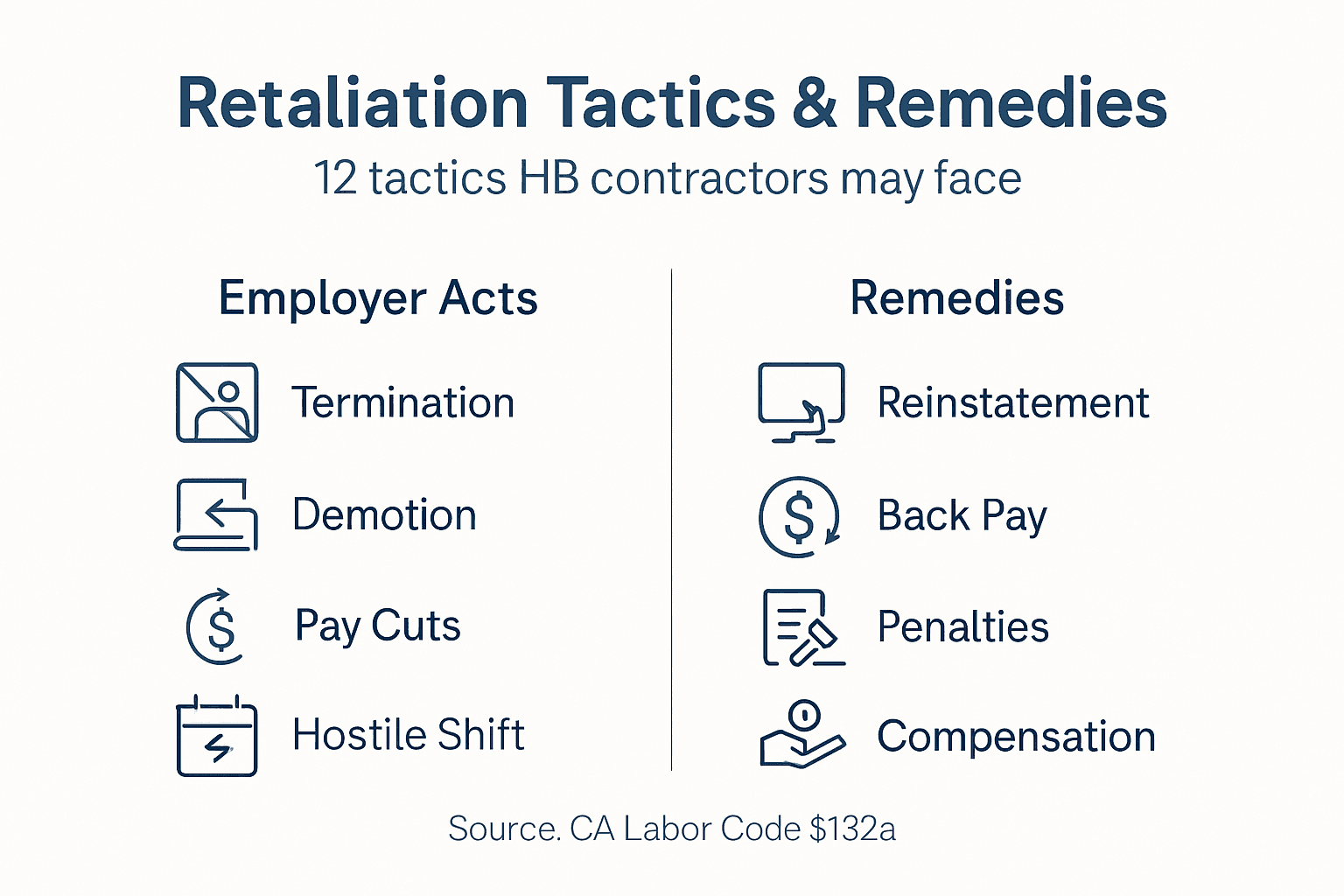
Employers found guilty of retaliation in California can face penalties including reinstatement orders, back pay, compensatory damages, and fines. These penalties serve both to make workers whole and deter future violations. In egregious cases, punitive damages may apply to punish particularly malicious conduct.
Real penalties employers have faced include tens of thousands in fines plus mandatory corrective action plans. The Labor Commissioner may require employers to post notices about workers’ rights and provide anti retaliation training. Repeat violators face escalating penalties and increased scrutiny.
Understanding the filing retaliation complaints process and potential employer penalties for retaliation empowers contractors to pursue justice confidently. Acting promptly preserves your rights and strengthens your case.
Common Misconceptions and Legal Realities for Contractors
Many contractors hold mistaken beliefs about retaliation protections that prevent them from asserting their rights. One widespread myth suggests independent contractors lack the same protections as traditional employees. California courts increasingly recognize that workers classified as independent contractors deserve retaliation protections when employers exercise substantial control over their work.
Another misconception limits retaliation to outright termination. In reality, retaliation encompasses any adverse employment action including demotions, pay cuts, hostile treatment, or unfavorable schedule changes. Courts evaluate the totality of circumstances, not just whether you lost your job completely.
Key misconceptions to avoid:
- Believing only traditional employees have retaliation protection rights
- Thinking retaliation requires termination rather than other adverse actions
- Assuming you must prove employer intent beyond reasonable doubt
- Believing verbal retaliation is legal while written retaliation is not
- Thinking small employers are exempt from retaliation laws
Contractors often underestimate the strength of circumstantial evidence. Direct admission of retaliatory motive is rare. Instead, timing, shifting explanations for adverse actions, and patterns of treatment provide powerful circumstantial proof. Courts recognize that employers rarely announce illegal motives explicitly.
Manage your expectations about outcomes realistically. While many retaliation claims succeed, results vary based on evidence quality and specific circumstances. Settlement often occurs before final judgment, providing faster resolution but potentially lower compensation than trial verdicts. Understanding these realities helps contractors make informed decisions about pursuing claims.
Practical Steps for Contractors Facing Retaliation in Huntington Beach
Recognizing retaliation early maximizes your legal options and evidence preservation opportunities. Trust your instincts when treatment suddenly changes following a workers’ compensation claim. Immediate documentation creates contemporaneous records that carry significant evidentiary weight.
Take these practical steps when facing potential retaliation:
- Document every adverse action with specific dates, times, and witnesses present
- Save all employment related emails, texts, and written communications
- Request written explanations for any negative employment decisions
- Keep detailed notes of verbal conversations about your injury or claim
- Gather copies of performance reviews and employment contracts immediately
- Consult experienced Huntington Beach employment attorneys before the situation escalates
- File complaints with the Labor Commissioner within required deadlines
- Continue performing your job duties professionally despite mistreatment
Documentation strategies matter significantly. Write detailed notes immediately after incidents while memories remain fresh. Include objective facts rather than subjective interpretations. Describe who said what, when actions occurred, and how situations made you feel professionally.
Pro Tip: Avoid discussing your retaliation concerns on company email or devices. Use personal communication channels when contacting attorneys or gathering evidence. Employers may monitor company systems and use your communications against you.
Seeking legal counsel promptly protects your rights before critical deadlines pass. Legal counsel in Huntington Beach can evaluate your situation, advise on evidence gathering, and represent you in complaints or lawsuits. Many employment attorneys offer free consultations to assess case viability.
For related resources on employment law violations, explore wrongful termination resources and connect with workplace retaliation lawyers who understand local oil and energy industry dynamics.
Timely action matters because statutes of limitations restrict how long you can wait to file complaints. Missing deadlines may permanently bar your claims regardless of merit. Early consultation ensures you meet all procedural requirements while evidence remains available.
Protect Your Rights with Experienced Huntington Beach Employment Law Attorneys
Facing workers’ compensation retaliation can feel overwhelming, but you don’t have to navigate this challenge alone. Serendib Law Firm’s experienced Huntington Beach employment attorneys understand the unique pressures contractors face in the local oil and energy sector. Our team provides personalized legal strategies tailored to your specific circumstances, fighting to protect your livelihood and hold employers accountable.
Whether you need guidance on wrongful termination legal help or comprehensive workers’ compensation legal services, our attorneys bring proven experience to your case. We offer free consultations to evaluate your situation and explain your legal options clearly. Contact us today to take the first step toward justice.
Frequently Asked Questions
What are common signs of retaliation after filing workers’ comp claims?
Watch for sudden termination, demotions, pay cuts, or hostile treatment occurring within weeks of filing your claim. Increased supervision, denial of light duty work, and exclusion from projects also signal potential retaliation.
Do independent contractors have the same retaliation protections as employees?
California courts increasingly extend retaliation protections to independent contractors, especially when employers exercise significant control over work conditions. Your specific working relationship details determine the extent of protection available.
What evidence is most critical to prove retaliation?
The timing between your workers’ compensation claim filing and adverse employment actions provides crucial evidence. Written communications, performance evaluations, pay records, and witness statements strengthen your case significantly.
How quickly must I file a retaliation complaint?
Statutes of limitations vary depending on your specific legal claims, but generally range from six months to three years. Filing promptly preserves evidence and ensures you meet all deadlines, so consult an attorney immediately after experiencing retaliation.
What remedies can I expect if my retaliation claim is successful?
Successful claims may result in reinstatement to your previous position, back pay for lost wages, compensatory damages for emotional distress, and potential punitive damages. Employers may face substantial fines and corrective action requirements.
Recommended
- Retaliation Claims After Construction Safety Reports | Serendib Law Firm
- Employer Retaliation for Workers’ Compensation Claims: Complete Guide | Serendib Law Firm
- Safety Complaints and Retaliation in Huntington Beach | Serendib Law Firm
- Wrongful Termination After Workers’ Comp Claims: Huntington Beach Impact | Serendib Law Firm
- 7 Key Red Flags for IRS Audits Every Business Owner Should Know