
If you suspect workplace retaliation in Anaheim, stop sending emotional or accusatory messages right now and start a dated incident log today. California’s Civil Rights Department (CRD) handles retaliation claims under the Fair Employment and Housing Act (FEHA), while the U.S. Department of Labor’s Wage and Hour Division covers wage-related retaliation. Serendib Law Firm represents employees across Orange County, including Anaheim, and offers a free consultation to assess your situation before you take any formal step.
Before you do anything else, run through this checklist:
- Secure your documents. Save emails, texts, paystubs, and performance reviews to a personal device or cloud folder you control, not a company system.
- Note witnesses and dates. Write down the names of anyone who saw or heard the adverse action, along with exact dates and locations.
- Do not delete company communications. Even messages that seem minor can establish a pattern later.
- Preserve copies of performance reviews. A sudden negative review after a protected complaint is one of the most common retaliation signals.
- Do not resign impulsively. Quitting before consulting an attorney can complicate your legal options significantly.
- Do not post accusations on social media. Public statements can be used against you and may undermine your credibility.
- Do not sign a separation agreement without legal review. These agreements often include waivers of your right to sue.
Pro Tip: Under SB 497, effective January 1, 2024, California law creates a rebuttable presumption of retaliation if your employer takes an adverse action within 90 days of a protected activity. That timing window matters enormously, so document the exact date of every relevant event from day one.
For an immediate case assessment, contact Serendib Law Firm for a free consultation.
Table of Contents
- What does workplace retaliation mean under California law?
- How do you recognize retaliation in your day-to-day work?
- What counts as a protected activity under California law?
- How should you document and preserve evidence right now?
- How hard is it to prove retaliation, and what evidence actually works?
- What are your options in Anaheim: internal complaint, agency filing, or attorney?
- What remedies can Anaheim employees realistically expect?
- When should you contact an employment attorney, and what should you bring?
- Key Takeaways
- What most employees get wrong about retaliation cases
- Serendib Law Firm is ready to help Anaheim employees right now
- Government and authoritative resources for filing or learning more
What does workplace retaliation mean under California law?
Retaliation is an employer’s punishing action taken against an employee because that employee engaged in a legally protected activity. Under California’s FEHA and related Labor Code provisions, proving retaliation requires establishing three distinct legal elements.
The three-element checklist:
- Protected activity. You engaged in conduct the law shields from punishment. Example: You reported sexual harassment to your HR department at a Disneyland Resort hotel in Anaheim.
- Adverse employment action. Your employer took a materially negative action against you. Example: Two weeks after your complaint, you were demoted from shift supervisor to line staff.
- Causal link. A substantial motivating reason for the adverse action was your protected activity. Example: Your manager told a coworker “things changed after she went to HR,” and your performance record was clean before the complaint.
All three elements must be present. A bad day at work, a missed promotion with a documented business reason, or a layoff tied to a company-wide reduction in force may not meet this standard even if the timing feels suspicious to you.
The CRD, which enforces FEHA for employers generally with five or more employees, applies this framework when it screens incoming complaints. SB 497 adds an important timing layer: if the adverse action occurs within 90 days of your protected activity, California law presumes retaliation occurred, shifting the burden to your employer to offer a non-retaliatory explanation. Serendib Law Firm evaluates all three elements during an initial consultation, which is why contacting an attorney early gives you a clearer picture of where your case stands.

How do you recognize retaliation in your day-to-day work?
Retaliation rarely arrives as a single dramatic event. More often, it accumulates through a series of smaller actions that, taken together, paint a clear picture of employer hostility toward a protected complaint.
Common forms of retaliation and what they look like in practice:
- Termination. Fired within weeks of reporting wage theft to the California Labor Commissioner. The timing alone can be significant evidence.
- Demotion. Moved from a management role to an individual contributor position after requesting a disability accommodation.
- Pay cut. Hourly rate reduced or commission structure changed after you complained about unequal pay.
- Schedule changes. Shifted to undesirable overnight hours after filing a harassment complaint, making the job effectively untenable.
- Exclusion from meetings. Removed from client strategy sessions you previously led, immediately after participating in a discrimination investigation.
- Negative performance reviews. Suddenly receiving a “needs improvement” rating after years of “exceeds expectations,” with no documented performance issues in between.
- Transfer. Reassigned to a distant location or a less desirable department after reporting a safety violation.
- Constructive discharge. Conditions made so intolerable — through isolation, harassment, or impossible workloads — that a reasonable person would feel forced to resign.
- Changes in duties. Stripped of key responsibilities, such as being suddenly removed from client accounts after reporting workplace harassment.
Not every negative employment action is unlawful retaliation. Context matters. If your employer can show a legitimate, non-retaliatory reason that predates your protected activity, the legal analysis becomes more complex. What you are looking for is a pattern: a clean record before the complaint, a sudden shift in treatment after it.
What counts as a protected activity under California law?
Not every workplace complaint qualifies as a protected activity. California law protects specific conduct, and understanding the line between protected and unprotected behavior is critical before you take any formal step.
Core protected activities:
- Reporting discrimination or harassment to your employer, to the CRD, or to the EEOC. Protected: Telling your HR manager at a large Anaheim manufacturing company that your supervisor is making racially offensive comments. Not protected: Privately thinking your supervisor is biased but never telling anyone.
- Complaining about wage violations to the California Labor Commissioner or the U.S. Department of Labor. Protected: Calling the Labor Commissioner’s office to report that your employer is not paying overtime. Not protected: Complaining to a friend outside work with no employer awareness.
- Requesting disability or religious accommodations. Asking your employer to modify your schedule for a medical condition or a religious observance is protected the moment you make the request.
- Participating in an investigation. Serving as a witness in a coworker’s harassment complaint, even if you did not file the complaint yourself, is fully protected.
- Refusing to follow illegal instructions. Telling your manager you will not falsify time records or dispose of hazardous materials illegally is protected conduct under Labor Code provisions enforced by the California Division of Labor Standards Enforcement (DLSE).
One nuance worth knowing: informal complaints to coworkers can be protected if they put the employer on notice of a potential violation. A private, unexpressed belief that stays entirely in your own head does not qualify. The employer must have known or reasonably should have known about your protected conduct for the causal link to hold. For a full picture of your employee rights in California, reviewing the applicable statutes with an attorney is the most reliable approach.
How should you document and preserve evidence right now?
Documentation is where retaliation cases are won or lost. CRD guidance specifically recommends building a contemporaneous paper trail because company records can be altered or become inaccessible after a complaint is filed.
Documentation checklist:
- Emails and text messages related to the adverse action or the protected complaint
- Calendar entries showing meeting invitations you were excluded from or schedule changes
- Paystubs before and after any pay cut or hour reduction
- Screenshots of messaging apps (with visible timestamps)
- Personnel files and performance reviews, especially any sudden negative evaluations
- Witness names, job titles, and contact information
- Voicemail timestamps and any recorded messages (check California’s two-party consent rules before recording)
Incident log template — copy these fields for every entry:
| Field | What to record |
|---|---|
| Date and time | Exact date, day of week, and time of the incident |
| Location | Office, floor, remote call, or specific address |
| People present | Full names and job titles of everyone involved |
| Exact words or actions | Quote directly where possible; paraphrase otherwise |
| Attachments | List any emails, texts, or documents tied to this entry |
| Why it matters | One sentence connecting this event to your protected activity |
Store everything on a personal email account or a private cloud folder you access only from your personal device. Do not use company-issued laptops, phones, or email accounts to preserve evidence if you have any concern about employer monitoring.
Pro Tip: Write your incident log entry within 24–48 hours of each event. Contemporaneous entries carry far more credibility with investigators than notes written weeks later. When saving emails, export them as PDFs to preserve full message headers; screenshots alone can be challenged on authenticity if metadata is missing.
How hard is it to prove retaliation, and what evidence actually works?
Causation is the hardest element to establish, but it is rarely proven with a single smoking-gun document. Agencies and courts accept both direct and circumstantial evidence, and circumstantial patterns are often the most persuasive.
Evidence that strengthens your causation argument:
- Close temporal proximity. Being fired 10 days after filing a wage complaint is far more compelling than an adverse action that occurs eight months later with no intervening incidents.
- Comparative treatment. A coworker in a similar role who did not file a complaint and received a raise while you were demoted is powerful circumstantial evidence.
- Sudden shift in performance reviews. Three years of “meets expectations” followed by a “performance improvement plan” issued the week after your HR complaint.
- Inconsistent employer explanations. If your employer gives one reason for the adverse action to you, a different reason to HR, and a third reason in a written response to the CRD, that inconsistency signals pretext.
- Witness statements. Coworkers who heard a manager make comments connecting your complaint to the adverse action can corroborate your account.
- Contemporaneous documentation. Your dated incident log, written within 48 hours of each event, establishes a credible timeline.
Contrast: strong vs. weak evidence
A termination 10 days after a harassment complaint, with no prior written warnings in your file, is a strong fact pattern. A termination six months after a complaint, where the employer has documented three prior performance warnings predating the complaint, is a much harder case. SB 497’s 90-day rebuttable presumption is specifically designed to help employees in the first scenario: once you show the adverse action fell within that window, your employer must produce a credible non-retaliatory explanation, which investigators will then test for pretext.
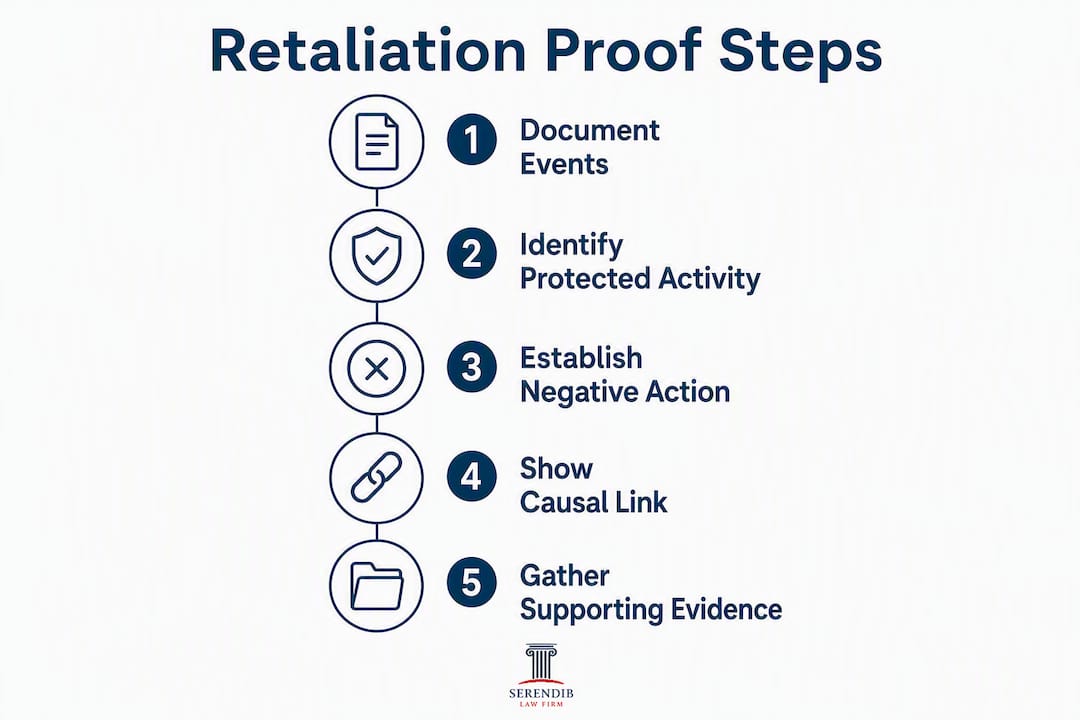
Legal practitioners consistently emphasize that a cluster of negative actions occurring soon after a protected activity is more persuasive than any single incident. Build your documentation around the pattern, not just the most dramatic event.
What are your options in Anaheim: internal complaint, agency filing, or attorney?
Most Anaheim employees face three realistic paths after documenting retaliation. Each has distinct advantages and trade-offs, and the right choice depends on your specific facts.
The three paths at a glance:
- Internal complaint (HR or management). You raise the issue formally within your company using its grievance or anti-retaliation policy.
- State agency filing (CRD). You file a complaint with the California Civil Rights Department, which can investigate, mediate, and issue a right-to-sue notice.
- Federal agency filing (EEOC or DOL). You file with the U.S. Equal Employment Opportunity Commission for discrimination-based retaliation, or with the U.S. Department of Labor’s Wage and Hour Division for wage-related retaliation.
Internal complaint: pros and cons
The main advantage is speed and the possibility of a workplace fix without formal proceedings. HR may investigate and resolve the issue, reinstate lost pay, or discipline the retaliating supervisor. The significant risk is that HR works for your employer, not for you. Internal complaints also create a formal record that your employer controls, and the process offers no independent enforcement mechanism if the company ignores your complaint.

Agency filing: pros and cons
Filing with the CRD gives you access to a neutral investigator, potential mediation, and ultimately a right-to-sue if the agency does not pursue the case itself. The CRD offers free resolution services and mediation before litigation, and entering mediation with a clear documentation packet and a defined desired outcome (reinstatement, back pay, or policy changes) significantly improves your position. The trade-off is that agency processes take time and the outcome is not guaranteed.
Decision checklist — choose your path based on:
- Severity of the harm (job loss or significant income loss weighs toward agency or legal action)
- Strength of your documentation (a strong paper trail supports agency filing)
- Desire for confidentiality (internal complaints are less public but less protected)
- Interest in monetary remedies vs. a workplace fix
- Whether a separation agreement has already been offered (consult an attorney immediately)
- Whether the adverse action falls within the 90-day SB 497 window
For Anaheim workplace retaliation claims, consulting an employment attorney before choosing a path often prevents costly mistakes, particularly if your employer has already offered you a package.
What remedies can Anaheim employees realistically expect?
California law provides a meaningful range of remedies for proven retaliation, though outcomes vary significantly depending on the facts, the applicable statute, and how the case resolves.
Common remedies available in retaliation cases:
- Reinstatement. Return to your former position or a comparable one.
- Back pay. Compensation for wages lost from the date of the adverse action to the date of resolution.
- Front pay. Compensation for future lost earnings when reinstatement is not practical.
- Compensatory damages. Damages for emotional distress and other non-economic harm caused by the retaliation.
- Civil penalties. Employers may be liable for civil penalties of up to $10,000 per employee per violation for unlawful retaliation under certain Labor Code provisions.
- Injunctive relief. A court or agency order requiring the employer to change policies or stop specific conduct.
- Attorneys’ fees and costs. In many California retaliation cases, a prevailing employee can recover legal fees from the employer.
Remedies can be awarded through agency orders, negotiated settlements, or court judgments. The CRD’s employment remedies include back pay, reinstatement, promotion, and damages for emotional distress, among others. Punitive damages may be available in cases involving particularly egregious employer conduct.
A candid note: no attorney can guarantee a specific outcome. The value of your case depends on the strength of your evidence, the applicable statutes, and the employer’s conduct. Consulting counsel early gives you the clearest picture of what remedies are realistically available in your specific situation.
When should you contact an employment attorney, and what should you bring?
The right moment to call an employment attorney is before you take any formal step, not after. Three situations make early consultation especially critical: you have been offered a separation agreement, your job is actively at risk, or you have already lost income because of suspected retaliation.
If a separation agreement lands on your desk, attorneys typically request a preservation and pending-litigation hold letter to prevent evidence destruction and to buy time for a proper evaluation before you sign anything. Signing without review can permanently waive your right to pursue a retaliation claim.
What to bring to your first attorney meeting:
- Your dated incident log, covering every relevant event in chronological order
- All communications: emails, texts, voicemails, and any written warnings or performance improvement plans
- Paystubs from before and after any pay change
- Performance reviews, especially any sudden negative evaluations
- Records of any internal HR complaint you filed and the company’s response
- Witness names and contact information
- A copy of any company policies on anti-retaliation, grievance procedures, or separation agreements
At Serendib Law Firm, the initial consultation typically covers evidence preservation, claim evaluation under FEHA and applicable Labor Code sections, and a strategic recommendation on whether an internal complaint, agency filing, or direct legal action best serves your interests. The firm represents employees only, which means every recommendation is made with your outcome in mind.
Key Takeaways
Workplace retaliation in Anaheim is provable when you document early, understand the three legal elements, and choose the right path before taking formal action.
| Point | Details |
|---|---|
| Start your incident log now | Record every adverse event within 24–48 hours, with dates, names, and exact words, stored on a personal device. |
| Know the 90-day window | SB 497 creates a rebuttable presumption of retaliation when adverse action follows a protected activity within 90 days. |
| Choose your path carefully | Internal complaints, CRD filings, EEOC, and DOL each serve different retaliation types; agency intake may be required to preserve certain remedies. |
| Remedies can include civil penalties | California law allows civil penalties of up to $10,000 per employee per violation under certain Labor Code provisions, in addition to back pay and reinstatement. |
| Serendib Law Firm | Represents Anaheim employees only and offers a free consultation to evaluate your retaliation claim before you sign anything or file. |
What most employees get wrong about retaliation cases
The single most common mistake I see from employees who come to us after a retaliation incident is waiting too long to document. By the time they call, critical emails have been deleted, witnesses have left the company, and the employer has constructed a paper trail of “performance issues” that predates the complaint. The law can work in your favor, especially with SB 497’s 90-day presumption, but only if your own documentation is contemporaneous and credible.
The second mistake is over-sharing. Employees post about their situation on social media, vent in group chats with coworkers, or send emotionally charged emails to HR that undermine their legal position. I understand the impulse. Being retaliated against at work is genuinely distressing. But every written statement you make becomes potential evidence, and a single intemperate message can give an employer a pretext argument they would not otherwise have.
The third mistake is treating an internal HR complaint as a substitute for legal advice. HR’s role is to protect the company, not you. Filing an internal complaint can be a necessary step, and it creates a record, but it should be done strategically, with counsel, not as a first instinct. At Serendib Law Firm, we represent employees only, and we offer bilingual services in English and Spanish to make sure every Anaheim client fully understands their rights and options before taking any step that cannot be undone.
Serendib Law Firm is ready to help Anaheim employees right now
If you have lost income, been demoted, or been pushed out of your job after raising a complaint, you do not have to figure out the next step alone. Serendib Law Firm represents employees exclusively across Orange County, including Anaheim, and offers a free initial consultation to assess your retaliation claim, review your documentation, and advise you on the strongest path forward before you sign anything or file anywhere.
Our Anaheim employment law attorneys handle retaliation matters under FEHA, the Labor Code, and federal statutes, and we provide bilingual services in English and Spanish. After your initial contact, we move quickly: evidence preservation, a litigation hold letter if a separation agreement is involved, and a clear intake review of your facts.
Reach us by phone, through our online contact form, or by scheduling an in-office consultation. Contact Serendib Law Firm today to speak with an attorney who is on your side.
Government and authoritative resources for filing or learning more
These agencies handle different types of retaliation claims. Knowing which one applies to your situation before you file saves time and protects your rights.
California Civil Rights Department (CRD) handles retaliation claims under FEHA for employers with five or more employees. CRD can investigate, offer mediation, and issue a right-to-sue notice if it does not pursue the case itself. This is the primary agency for discrimination-based and harassment-based retaliation in California.
U.S. Equal Employment Opportunity Commission (EEOC) handles federal retaliation claims under Title VII, the ADA, and related statutes. Filing with the EEOC is required before pursuing a federal lawsuit, and the EEOC and CRD coordinate on overlapping claims.
U.S. Department of Labor, Wage and Hour Division handles retaliation tied to wage and hour complaints, including claims under the Fair Labor Standards Act. If your protected activity was a wage complaint, this is the federal agency to contact.
California Department of Industrial Relations (Labor Commissioner / DLSE) enforces Labor Code anti-retaliation provisions, including protections for employees who file wage claims or report Labor Code violations. The DLSE administers civil penalty provisions, including the up-to-$10,000 penalty available under certain sections.
Each agency operates under its own procedures and timelines. Applicable statutes of limitations vary by claim type and should be evaluated on a case-by-case basis with an attorney. Filing with the wrong agency, or missing a deadline, can permanently affect your ability to pursue certain remedies. Consult an employment attorney to confirm the right filing strategy for your specific situation before you submit anything.
This article provides general legal information about workplace retaliation under California law and is not legal advice. For guidance specific to your situation, consult a qualified employment attorney.