

Workplace retaliation is defined as any adverse action an employer takes against an employee for engaging in a legally protected activity, such as reporting discrimination, filing a safety complaint, or participating in a workplace investigation. For employees in Fountain Valley, CA, this practice is prohibited under some of the strongest employee protection laws in the country, including California’s Fair Employment and Housing Act (FEHA) and Labor Code Section 1102.5. Recognizing retaliation, documenting it correctly, and understanding your legal options are the three steps that determine whether you can enforce your rights effectively.
What actions constitute workplace retaliation in Fountain Valley, CA?
Retaliation covers far more than getting fired. Any materially adverse change that would discourage a reasonable employee from reporting misconduct qualifies as retaliation under California law. That definition is intentionally broad, and it protects workers from a wide range of employer behaviors.
Common retaliatory actions include:
- Termination or constructive dismissal (making conditions so unbearable you feel forced to quit)
- Demotion or reduction in job responsibilities
- Pay cuts or denial of a promised raise or promotion
- Negative performance reviews that appear suddenly after a complaint
- Reduction in hours or schedule changes that harm your income
- Hostile treatment, isolation, or exclusion from team meetings
- Increased scrutiny, micromanagement, or unwarranted disciplinary write-ups
Subtle retaliation is the form most employees miss. A supervisor who stops including you in project emails after you filed an HR complaint is retaliating. A manager who suddenly assigns you to the least desirable shifts after you reported a safety violation is retaliating. These patterns matter because courts and agencies look at the full picture, not just a single incident.
The connection between the protected activity and the adverse action is what makes a behavior retaliatory. Normal workplace changes, such as a company-wide restructuring or a documented performance issue that predates your complaint, do not automatically qualify. The key question is whether your protected activity was a contributing factor in the employer’s decision.

Pro Tip: Keep a private log of every adverse change you notice after making a complaint. Record the date, what happened, who was involved, and any witnesses. This contemporaneous record is far more credible than memory alone.
How does California law protect Fountain Valley employees from workplace retaliation?
California provides employees with layered legal protections that go well beyond federal law. Two statutes form the core of those protections for Fountain Valley workers.
Labor Code Section 1102.5 is California’s primary whistleblower protection law. It prohibits employers from retaliating against employees who report suspected violations of law to a government agency, to a supervisor, or even internally within the company. Critically, employees only need a reasonable, good-faith belief that a violation occurred to be protected. You do not need to prove the underlying violation was real.
FEHA (the Fair Employment and Housing Act) prohibits retaliation against employees who oppose discrimination based on race, gender, age, disability, religion, national origin, or other protected characteristics. FEHA covers adverse actions including termination, demotion, bad performance reviews, and hostile treatment directed at employees who file complaints or participate in investigations.
The table below summarizes the key protections available to Fountain Valley employees:
| Law | Protected Activity | Covered Adverse Actions | Enforcing Agency |
|---|---|---|---|
| Labor Code 1102.5 | Reporting suspected legal violations | Termination, demotion, harassment | California Labor Commissioner |
| FEHA | Opposing discrimination, participating in investigations | Termination, demotion, hostile treatment | California Civil Rights Department |
| Labor Code 132a | Filing a workers’ compensation claim | Termination, discrimination | California Workers’ Compensation Appeals Board |
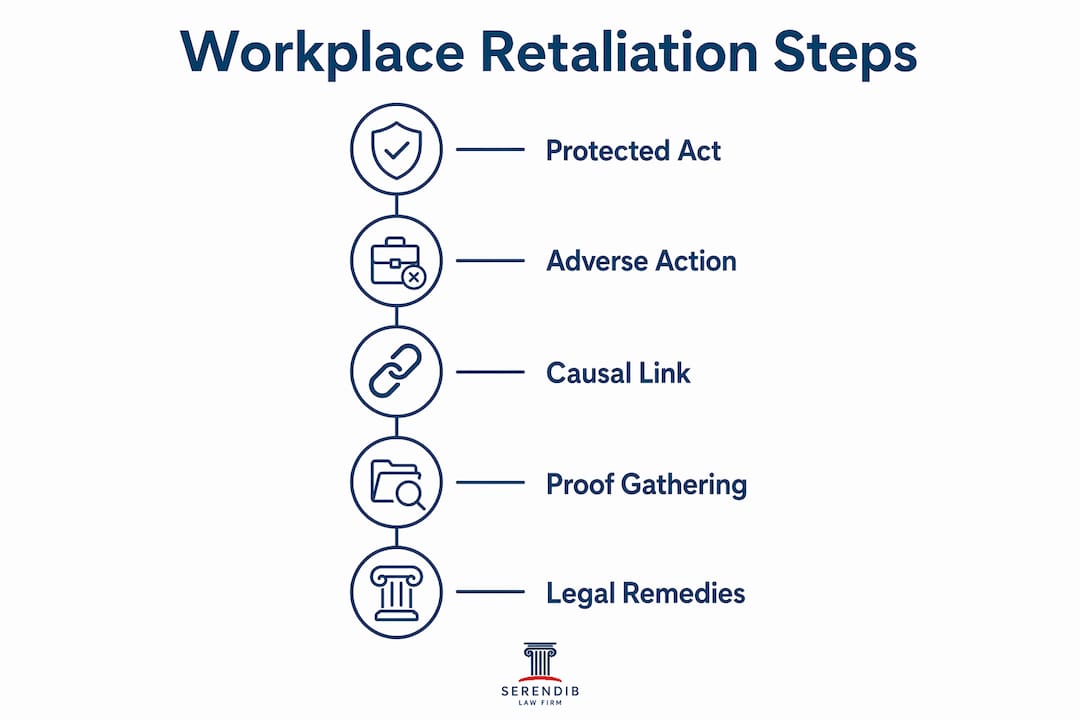
To prove retaliation, you generally need to show three things: you engaged in a protected activity, your employer took an adverse action, and there is a causal link between the two. Timing between the protected activity and the adverse action is strong circumstantial evidence. A gap of a few days or weeks is far more persuasive than a gap of many months. California uses a “contributing factor” standard, meaning you do not need to prove retaliation was the only reason for the adverse action. You only need to show it was one factor.
Remedies available to employees who prove retaliation include reinstatement to their former position, back pay for lost wages, compensation for emotional distress, and in some cases, punitive damages. These remedies make pursuing a claim financially worthwhile, even when the process feels daunting.
What practical steps should Fountain Valley employees take if they suspect retaliation?
Acting quickly and carefully after you suspect retaliation protects your legal rights and strengthens any future claim. Follow these steps in order.
Start documenting immediately. Detailed logs of events, dates, and witnesses prove patterns of behavior rather than isolated incidents. Write down what happened, when it happened, who was present, and what was said. Do this the same day the incident occurs.
Preserve all relevant communications. Save emails, text messages, performance reviews, and any written warnings. Store this evidence outside your employer’s network in personal cloud storage or printed physical copies. If you are terminated, you may lose access to company systems immediately.
Compare your pre-complaint and post-complaint treatment. Comparing pre-complaint positive reviews with sudden negative changes reveals inconsistencies that indicate retaliation. Print or save copies of older performance reviews that show your standing before you made a complaint.
Report internally in writing. Internal reporting to HR creates a formal record and can sometimes resolve retaliation without litigation. If you have already made a verbal complaint, follow it up with a written summary sent by email so there is a timestamp and a paper trail.
Consult an employment attorney before taking further action. An attorney can assess the strength of your claim, advise you on what not to say or do, and help you avoid mistakes that could weaken your case. Many Fountain Valley employees wait too long, and that delay can affect their options.
Recognize patterns, not just single events. Retaliation often builds gradually. A single negative review may not be enough. A pattern of negative reviews, reduced hours, and exclusion from meetings following a complaint is a much stronger case.
Pro Tip: Never use your work computer, work phone, or company email to store retaliation evidence or communicate with an attorney. Use personal devices only. Your employer may monitor company equipment and could access those communications.
For detailed guidance on building your evidence file, Serendib Law Firm’s resource on documenting workplace harassment walks through the process step by step.
What are the remedies and legal recourse options for retaliation victims in Fountain Valley?
Fountain Valley employees have several paths to enforce their rights after experiencing retaliation. The right path depends on the facts of your case, your goals, and how quickly you act.
Mediation is a fast, confidential option that many employees overlook. Mediation typically resolves retaliation disputes in weeks rather than months or years. Statements made during mediation are confidential and cannot be used in court if the process fails. This makes it a low-risk first step for employees who want a resolution without a lengthy legal battle.
Administrative complaints can be filed with the California Civil Rights Department (formerly the DFEH) for FEHA violations, or with the California Labor Commissioner for Labor Code violations. Filing an administrative complaint is often a required step before you can file a civil lawsuit, and it creates an official record of your claim.
Civil litigation gives you the right to sue your employer in court. A successful civil lawsuit can result in reinstatement, back pay, damages for emotional distress, and attorney’s fees. The process takes longer than mediation or administrative complaints, but it can produce larger recoveries in serious cases.
Contingency fee representation removes the financial barrier for most employees. Most California employment attorneys charge 25%–40% of the settlement with free initial consultations. You pay nothing unless you win, which means access to legal representation does not depend on your current financial situation.
“The statute of limitations on retaliation claims is not the same for every law or every situation. An employment attorney can evaluate the specific deadlines that apply to your case. Waiting too long can permanently bar your claim, regardless of how strong it is.”
Employees in Fountain Valley should also know that California law prohibits employers from retaliating against employees for exercising their rights under workers’ compensation law. If you were injured at work and your employer took adverse action after you filed a claim, that is a separate and distinct form of retaliation with its own legal protections. You can review your full California employment law rights to understand which protections apply to your specific situation.
Key takeaways
California’s layered retaliation protections under FEHA and Labor Code 1102.5 give Fountain Valley employees strong legal tools, but documentation and timely action determine whether those tools actually work.
| Point | Details |
|---|---|
| Retaliation is broadly defined | Any adverse action that discourages a reasonable employee from reporting misconduct qualifies. |
| California law offers layered protection | FEHA, Labor Code 1102.5, and Labor Code 132a each cover different protected activities and adverse actions. |
| Documentation is the foundation | Contemporaneous logs, saved communications, and preserved performance reviews build a provable case. |
| Store evidence outside company systems | Personal cloud storage or printed copies prevent evidence loss if you are terminated or locked out. |
| Legal help is accessible | Most California employment attorneys work on contingency, so you pay nothing unless you recover. |
What I’ve learned watching retaliation cases play out in Orange County
Retaliation cases are rarely clean. The employees who come to me with the strongest cases are not always the ones who suffered the most. They are the ones who documented the most. I have seen employees with clear, compelling stories lose leverage because they had no written record, no saved emails, and no timeline. The employer’s attorney walks in with a stack of performance reviews, and suddenly the narrative shifts.
The subtlety of retaliation is what makes it so difficult. Employers rarely send an email saying “we are demoting you because you filed a complaint.” What they do is gradually make your work life worse, assign you to less visible projects, skip you for promotions, and wait for you to quit or make a mistake. That pattern is exactly what California law is designed to catch, but only if you have the evidence to show it.
My strongest advice to any Fountain Valley employee who suspects retaliation is this: do not wait to see if things get better. Start documenting the day you notice a change. Talk to an attorney before you resign, before you sign any severance agreement, and before you assume the situation is too small to matter. Early legal advice costs you nothing under a contingency arrangement, and it can change the entire outcome of your case. You have real rights under California law. Use them.
Serendib Law Firm’s support for Fountain Valley employees facing retaliation
Serendib Law Firm is an Orange County employment law firm that represents employees in Fountain Valley and throughout California who have experienced workplace retaliation, discrimination, and wrongful termination. The firm offers free initial consultations and handles retaliation cases on a contingency fee basis, meaning you pay no attorney’s fees unless you recover. The team is bilingual in English and Spanish, making legal support accessible to a broader community. If you believe your employer has retaliated against you for asserting your rights, speaking with a California employment lawyer at Serendib Law Firm is a practical first step. You can also learn more about working with Fountain Valley retaliation lawyers who understand the specific legal landscape in your area.
FAQ
What is workplace retaliation under California law?
Workplace retaliation is any adverse employment action an employer takes because an employee engaged in a protected activity, such as reporting discrimination or filing a safety complaint. California law defines adverse action broadly to include termination, demotion, pay cuts, and hostile treatment.
What protected activities does California law cover?
California law protects employees who report suspected legal violations, oppose workplace discrimination, participate in investigations, and file workers’ compensation claims. Labor Code 1102.5 and FEHA together cover a wide range of protected activities.
How do I prove my employer retaliated against me?
You need to show that you engaged in a protected activity, your employer took an adverse action, and there is a causal link between the two. Close timing between your complaint and the adverse action is strong circumstantial evidence of retaliation.
Should I report retaliation to HR before contacting an attorney?
Reporting to HR in writing creates a formal record and can sometimes resolve the issue without litigation. Consulting an employment attorney at the same time helps you avoid mistakes and understand your rights before the situation escalates.
Is there a deadline to file a retaliation claim in California?
Yes, retaliation claims are subject to statutes of limitations that vary depending on which law applies and the specific facts of your case. An employment attorney should evaluate your deadlines as early as possible to protect your right to file.